The Feminist Gap

There was something poignant (and grotesque) about the ‘scolding’ that Madeleine Albright and Gloria Steinem gave younger American women this week.  The subject was Hillary and the support that female voters—as women—supposedly owe her.  The tone was dire yet dismissive.  Madeleine Albright, revered for her achievements as a diplomat, essentially threatened wayward women with punishment, warning that if they didn’t ‘help’ Hillary they would go to hell.  Gloria Steinem, now a shocking 81, relied on sexual stereotyping to explain why some young women have chosen to vote for Bernie.  These women, she claimed, care only about ‘where the boys are’—lemming-like, they have gravitated to Sanders because ‘the boys are with Bernie.’  In other words, young women in Sanders’ camp suffer from an out-of-control sex drive!  Both Albright and Steinem asserted in different ways that young women had forgotten their rightful duty, which, in the eyes of older feminists, is to practice sex solidarity.  This tenet, so central to first-generation feminism, is outmoded and deeply unpalatable.

The desperate awkwardness of these protests points up a problem that Hillary is having.  How does her sex, how does the women’s movement, figure in her campaign?  Hillary never was much of a bra-burner; she never wasted much time railing against society’s constraints or male tyranny.  Instead, she crossed over early, believing that doors were open and assuming that full equality and freedom were hers.  She carved out a remarkable path, relying more on her own grit and talents than on the dictates of feminist ideology.

In some profound sense, Hillary is not free to tell her story, which is that of a woman who has been more in the public eye for more of her life than any other woman in American history.  Contrary to Steinem’s assumption about the fate of women, Hillary has not ‘lost power’ as she’s aged.  Instead, Clinton is one of the most well-known and powerful women on the face of the globe.

As Clinton has grown more unusual, more distinguished, and more famous, her capacity to pass as a representative woman has inevitably waned.  The fact is one to reckon with in the remaining campaign.

Why Hillary Should Declare, “I’m Worth It”

Who can stand the sexist attacks on Hillary’s speaking fees?

The questions aim to make voters aware that, while not in office, Hillary accepted huge fees for speaking to audiences that included big banks.  Like many effective campaign tactics, however, questioning the legitimacy of her fees also serves other, less-than-creditable ends.  The questions implicitly cast aspersions on Hillary Clinton’s essential worth, on her value as a veteran stateswoman, and on the integrity of the speaking engagements themselves.  The issue is a classic ‘dog-whistle’ tuned to the frequency of the envious and chauvinistic.

The underlying assumption?  Something must be wrong because Hillary couldn’t possibly be worth that kind of money.  Thank god Hillary is running for office!  She’s giving us an opportunity to express our resentment toward women who defy social norms and out-perform men.  How dare she make that kind of money in one day?

What’s clear from Secretary Clinton’s responses is that she doesn’t feel guilty.  She doesn’t feel implicated in the banks’ decision to pay up to hear what’s in her heart and brain.  Thank goodness she isn’t apologizing for the very legitimate demand within the business community to learn from one of the nation’s most experienced leaders.

But Hillary, for the sake of all women struggling against their own glass ceilings, you must go a step further.  You must assert that your experience and perspective on American politics are unique, and that, in the eyes of the market, you deserve your fees.

You might lose the anti-capitalist vote, but you’d win the gratitude of millions of American women who are tired of being treated as though they can’t possibly be worth as much as a man.

Campaign Notes (The GOP)

The GOP-Heap after Iowa 2016, © Susan Barsy
In the wake of the Iowa caucuses, GOP candidates are dropping like flies. In a more insensitive time, they would be likened to the ten little Indians, who dwindled, through various mishaps, to the point of annihilation.

In truth, it’s fair to wonder whether at this point, with nine GOP presidential candidates remaining, they are not already annihilated.  Is any of them a nationally electable candidate?  Would the nation really elevate a Bible-thumping Ted Cruz to the presidency?  Would it tolerate having as its symbolic representative someone as indelicate and bellicose as Donald Trump? As priggish as Marco Rubio?  One senses it is already over for the Republicans—that, despite all the hubbub and incessant media attention, the party is in the throes of something ugly, something momentous, even life-threatening.

The ‘establishment’ of the Republican Party appears weak indeed.  It is being weakened cannibalistically, as hostile forces (the ‘anti-establishment’) eat away at it from inside.  Ted Cruz’s campaign manager, Rick Tyler, described the situation brilliantly in a post-Iowa interview with the Newshour‘s Gwen Ifill.  Usually, he said, ‘the establishment has one well-funded candidate, and the conservative [wing] has a lot with no money.  This time, we’re the well-funded candidate, and the establishment, there’s a lot of them, and they don’t have the money.’

The situation points up the party’s growing incapacity to influence who will become its nominee.  The national party structure is more or less irrelevant to the primary process, where individual choice and extraneous forces (ranging from mega-donors to cable networks) increasingly shape the candidate field.  The pruning of candidates is being accomplished by entities like Fox and CNN rather than by the Republican National Committee.

The fallout from Iowa, where the three top candidates garnered 75% of the vote and nine ‘trailing’ candidates split the remainder, shows the prescience of former candidate Scott Walker’s warning to his rivals back in September, when weak early poll numbers based on his debate performances prompted him to drop out.  Others should follow his lead, Walker argued, so that the party could coalesce quickly around an alternative to Trump.  Three candidates–Paul, Santorum, and Huckabee–finally quit the race this week.  By now, however, the opportunity to create an impression of unity is gone.

Be careful what you wish for.  The Republican party’s disarray and fragmentation is accelerating under the impact of  Citizens United, the ironically titled Supreme Court decision widely regarded as conferring an advantage on Republicans and the wealthy cliques selectively backing them.  Now it appears that, with outside money flowing into the campaign process unimpeded, the power of the Party to govern itself and its nominating process has been fatally weakened.  As Mr Tyler notes, candidates like Cruz, whom the establishment hates, now have the money and staying power.  There’s little to keep such creatures from claiming the party’s mantle–whether the GOP likes it or not.

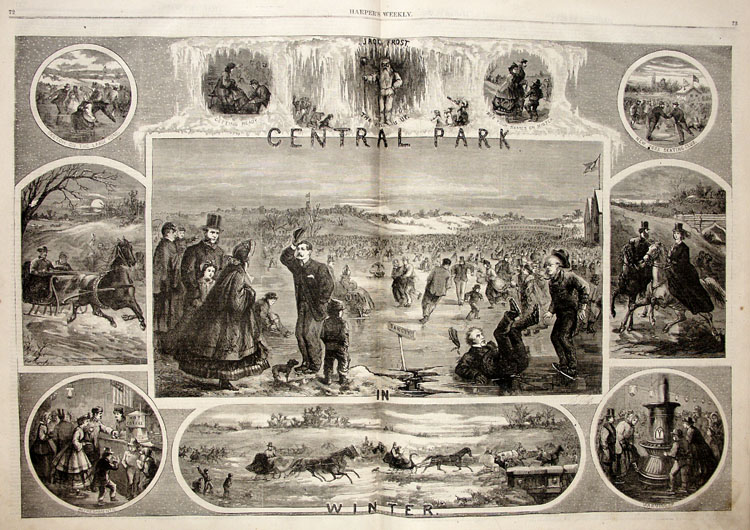
Thomas Nast’s ‘Central Park in Winter’

Two scenes, showing skating and sleighing in Central Park. The top panel includes drawings of James Gordon Bennett Sr and Horace Greeley
For the January 30, 1864, issue of Harper’s Weekly, Thomas Nast drew a many-paneled illustration of Central Park in winter.  Like many of his works, this one featured a large central drawing, surrounded by smaller vignettes in round and elliptical frames.  The main drawing shows New Yorkers ice-skating on Central Park’s Pond.  (The Park was then only a few years old.)  Below that is a rather wild sleighing scene, in which genteel New Yorkers ride through a desolate terrain, as urchins throw snowballs or rocks at them.

The opening of Central Park coincided with ice-skating’s growing popularity, which took hold in earnest in the 1850s.  The Park was most heavily visited in winter, when its pond became crowded with thousands of skaters, whose activities Nast captures here in wonderful detail.  (Note the woman in the skating chair.)

Perhaps inevitably, Nast’s wonderland contains some politics, too.  Two months earlier, President Lincoln had been reelected as an inconclusive Civil War dragged on, inflicting terrible casualties.  New York, being a commercial center, had always viewed the war with ambivalence.  The conflict was contrary to the city’s interests, disrupting a lucrative trade with the South on which New York’s economy relied.  While many New Yorkers were ardent Unionists and Republicans, the city also had a large Democratic constituency, including a politically active immigrant population, which resented the war, the federal government, and the fuss about slaves.  Many, wishing a return to peace, had lately voted for Lincoln’s challenger, Democrat George McClellan.

Anger over the federal government’s war policies had boiled into violence the previous July.  New York became the scene of bloody draft riots, in which rioters lynched at least 11 blacks and 120 people were killed in street fighting between protesters and the police.  Poor whites were inflamed against a draft bill that Congress had recently passed: while ostensibly requiring all fit men to serve in the Union military, it contained a loophole that wealthier Northerners would use to evade the draft: arranging for a replacement by paying a bounty.

In the foreground of his skating scene, Nast (who ardently supported Lincoln and the war) highlights several figures, including a military man at the far left wearing a kepi—a reminder of high-minded Northerners voluntarily leading the Union effort as officers.  At right are two prominent New York newspaper editors, James Gordon Bennett Sr and Horace Greeley, who have run into trouble on proverbially thin ice.  Greeley is teetering, while Bennett has fallen, both near a hole signifying treachery.  Bennett had been an outspoken critic of Lincoln and proponent of McClellan, whereas Greeley, while fitfully supportive of the war, had recently embarrassed the Lincoln administration by engaging in bogus ‘peace negotiations’ with some Confederate representatives who turned out to be fakes.

Both editors, though overwhelmingly influential, earned Nast’s scorn because they were feckless peace-mongers.  To have ended the Civil War through a settlement at that juncture would have rendered the suffering of the soldiers in vain.

Their presence heightens the allegorical meaning of the left side of the tableau, where three figures guard the safety of the family and society.  Besides the Union officer, who holds a small boy in his arms, Nast’s own editor Fletcher Harper (with mutton-chop whiskers) stands over a young girl protectively, while a third man (unidentified, but probably a prominent editor, too) deferentially greets a woman standing at the edge of the ice.  Nast depicts these figures as both benevolent and patriotic.  Harper gave Nast a venue for his pro-Union and radically egalitarian views.

So what at first glance passes for an innocuous pleasure scene is a comment on specific editors, and a paean to the value of virtuous editors in a conflict-ridden time.

Image from this source.

The State of the Union? The President Was Too Hyped to Care

President Obama after the State of the Union (January 2016 screenshot), © Susan Barsy
I was disappointed in President Obama’s final State of the Union address.  Though I am generally appreciative of the president, in this instance he did a real disservice to the nation, wasting a key opportunity to acknowledge the true condition of the land, the economy, and the citizens.

How refreshing it would be to hear a factual State of the Union address, where the essential aspects of our collective existence were candidly enumerated, realistically described.  Though thoroughly out of fashion, an address so styled would reassure Americans that the president sincerely cared about their pain and discontents, that the guy at the top identified with what they were experiencing.  Offering such recognition consistently and in a heartfelt way is only right, given that the prospects of many Americans are shrinking.  Particularly imperiled is the prospect that Americans will enjoy personal autonomy and independence: that they will stay free of debt, realize their potential, and, as they mature and grey, have enough to sustain themselves and their families.

Instead of frankly acknowledging the trade-offs that the government constantly makes for the sake of global supremacy and national pride, the President exhorted citizens to ’embrace change’ and take comfort in the fact that ‘The United States of America is the most powerful nation on Earth, period,’ and that ‘We spend more on our military than the next eight nations combined.’  Reasserting the vision that catapulted him to office in the first place (remember Change You Can Believe In?), President Obama urged Americas to have faith in the beneficent nature of change itself.   Even as he paid lip service to some of the nation’s glaring problems, his tone remained unduly up-beat and celebratory.  In the end, his platitudinous tone made me sad and uneasy.

Contrast his speech with Pope Francis’s somber eloquence when he similarly addressed a joint meeting of Congress last fall.  While the pope, too, paid homage to American dreams, his speech stood out for its moral discernment and honesty—the precision with which he outlined the great problems facing America and the world. His observations were at once compassionate and unflinching.  Perhaps it’s unfair to compare a pope and a president, but, in such a case, the president’s take on the nation comes off as almost callous, as willfully out of sync with the people he leads.