Master the CPS Pension Crisis in 5 Easy Steps

Playing Teacher (Prang Co. lithograph), Courtesy Library of Congress.

Should we sympathize with the Chicago Teachers Union (CTU)?  On Friday, the teachers walked off the job and took to the streets, ostensibly on a crusade, not principally for their own benefit, but for the sake of increasing education funding more generally.  Union boss Karen Lewis, looking jaunty, proclaimed, ‘We’re dying a death of a 1,000 cuts,’ implying that teachers were among Governor Bruce Rauner’s victims, and that all would be well if only the union could squeeze more money out of the state and its taxpayers.

Yet, if a report of the Illinois Policy Institute is correct, the financial woes of the Chicago school system and its teachers are largely internal and have been brought on by themselves.  The Chicago Teachers Union has been complicit in the ruin of the pension system established to provide retirement security, allowing money to be diverted from the fund while accepting overly generous increases in working teachers’ salaries.  Meanwhile, the Chicago Public Schools (CPS) leadership has so mismanaged its finances that a pension system that was fully funded in 1999 now represents a $9.5 billion liability, despite the fact that, over the same period, public funding for CPS has increased at 150% of the rate of inflation, when calculated on a per-student basis.

The IPI’s report, published in late 2015, analyzes the funding of teachers’ pay and pensions over several decades.  It explains the arrangements that have created the pension crisis while debunking some leading claims about where the solution lies.

1. Pension pick-ups:  In 1981, when Ruth Love was CPS superintendent, the district and teachers agreed that the district would pay the part of the teachers’ pension contributions.  Instead of pension contributions coming out of teachers’ pay, a part of their share would come out of the schools’ general operating funds.  These pension “pick-ups,” which continue today, amount to a loss of operating revenue of $1.266 billion over the last decade.  Meanwhile, the pick-up has not been counted as part of the CPS’s mandated contribution to the pension fund.

2. Pension holidays: On two occasions, in 1995 and again in 2010, the General Assembly allowed the CPS to forego paying in to the teachers’ pension fund as mandated.  The first of these ‘pension holidays’ lasted from 1995 to 2006.  During this period, the school system diverted all the money that should have gone for pensions (amounting to $1.5 billion) into its general operating funds.  During the second pension holiday, from 2011 to 2013, the CPS diverted another $1.3 billion from the pension fund.

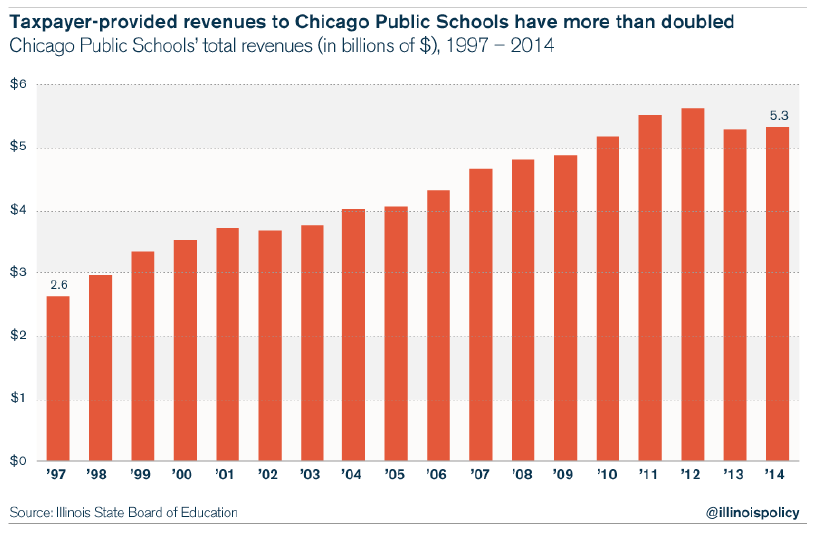
3. Colossally bad management: While the public is constantly being told that the schools’ problems stem from under-funding, the IPI claims that ‘Tax-payer provided revenues for the Chicago Public Schools have more than doubled‘ between 1997 and 2014, rising from $2.6 to $5.3 billion annually.  Meanwhile, the size of the student population has dropped by about 7 percent, from a high of roughly 383,000 students in 2003 to 355,634 students in 2014.  In 2014, the CPS received revenue of $15,011 for each child enrolled.

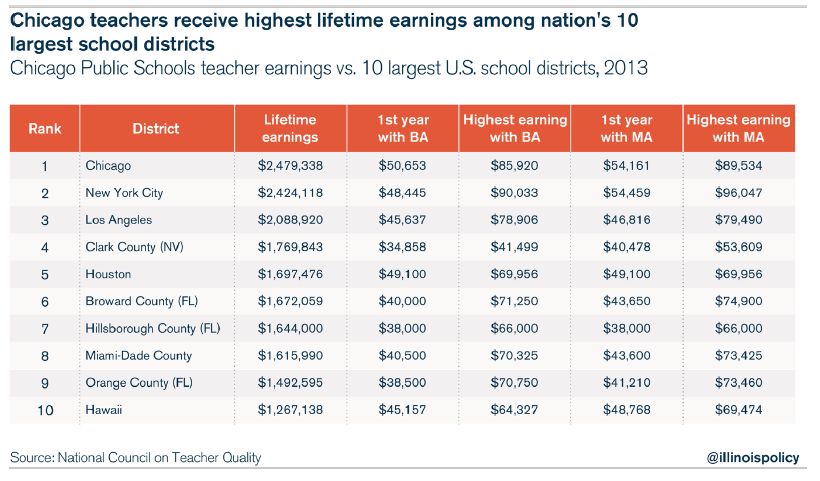
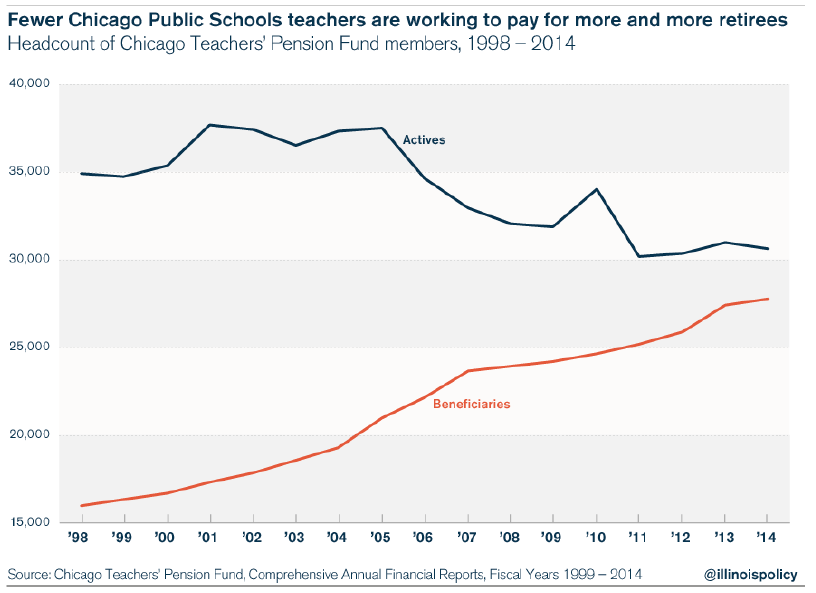
4. Unwise salary increases: The lifetime compensation of CPS teachers is the highest in the nation, relative to other major urban school systems.  A beginning teacher with a BA earns $51,092 a year.  Salaries increase rapidly during the first decade of service, so that teachers with 10-14 years of service earn an average pay of over $84,000 per year.  The salary structure increases the pension benefits of teachers earlier in their careers, enhancing the payout to younger ‘retirees.’  In 2014, over 72% of teachers in the Chicago schools had less than 14 years’ seniority.  The pension fund’s pool of beneficiaries is increasing, while the number of teachers paying into it is declining, another factor pushing it toward insolvency.

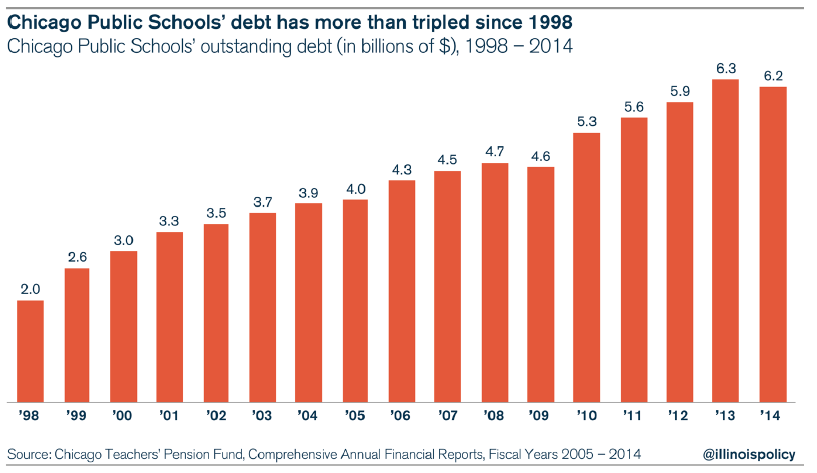
5. Reckless borrowing: It’s hard to escape concluding that the Chicago schools have been terribly mismanaged. Between 1998 and 2014, despite enjoying many years of pension ‘holidays,’ the CPS sank ever more deeply into the red, borrowing instead of confronting its true fiscal constraints.  CPS indebtedness totaled $6.2 billion in 2014.  Its bond offerings have been floated at ever higher rates of interest, even as its bond rating tanks.  Today, nearly eight percent of the CPS budget goes right to debt payments.  Another 68 percent goes to compensation costs, leaving just 24 percent for all the other expenses of running the schools.

Image: “Playing Teacher”
(1890 Prang Company lithograph)
from this source.

The Teachers’ Example

Winslow Homer, The Noon Recess (Courtesy Library of Congress)

Today, children enrolled in the Chicago Public Schools are learning to do without their teachers.  The teachers are not in the schools today because they, as union members, decided to teach us all a lesson by not showing up to do their jobs.  Instead of teaching, they chose today, April Fools Day, to stage what they ironically refer to as a Day of Action.  Yes, this day, when they do not show up to do their jobs.

No doubt the teachers have legitimate grievances, but so do taxpayers.  The teachers want the school district and the state government to bend heaven and earth to give them an agreeable contract.  The school district is teetering on bankruptcy.  Teachers’ unfunded pensions are an underlying cause.  The teachers deserve pensions and rightly fault the politicians for failing to invest in and protect the pension funds, as obligated.  But the funds that should be there simply aren’t.

Taxation is increasing to help cover ballooning pension obligations.   Meanwhile, the school budget is being cut.  Education in the present is being sacrificed to preserve the benefits of retired and retiring teachers.  The teachers’ union doesn’t speak to this issue.  Yet, to all appearances, Peter is being robbed in order to pay Paul.  The teachers are going to squeeze Peter and everyone around him, hoping that enough money can miraculously be conjured to go around.

The Day of Action is a farce, because it does not solve the problem.  It doesn’t bring antagonistic parties any closer to agreeing on what to do about a desperate lack of money.  Instead it diminishes the public’s sympathy and respect for teachers and the difficult work they do.  How not to behave: this is all Chicago teachers have taught on this April Fools.

The Neapolitan Crèche

The Neopolitan Creche at the Art Institute
There is something particularly wonderful about gazing on the Nativity as presented in the Art Institute’s Neapolitan Crèche.  Housed in a small, darkened gallery on the museum’s second floor, the crèche is displayed in a way that heightens its inherent magic and mystery.  The effect owes something to the dramatic glass case that contains the nativity scene and the splendid cornice above it: their beaming draws viewers near to inspect the fantastic spectacle framed within their proscenium.  Before this gigantic dollhouse of a crèche, adults stand and stare as if they were kids.

Detail showing the variety of mortal and heavenly beings the creche displays.
The urge to represent Jesus’s birth in a ‘living way,’ whether through tableaux vivants, Christmas pageants, or three-dimensional crèches has spanned more than a millennium.  While two-dimensional depictions of the nativity date from within several centuries of Jesus’s death, the history of the crèche is associated with the work of Saint Francis of Assisi.  Legend has it that, around 1223, he originated the custom of re-enacting the story of Jesus’s birth using human actors along with live oxen and ass.  This tradition of pageantry grew and became intertwined with the custom of creating of lasting sculptural representations of the Holy Family’s arrival in Bethlehem and the unlikely birth of Jesus in a stable, an event whose significance was apprehended, according to Gospel, only by angels, shepherds, and three wise men.

By the 18th century, when most of the Art Institute’s crèche was made, the artists of Naples had pushed the art form of crèche-making to unprecedented heights.  Patrons commissioned the artists to make crèches for palaces and cathedrals, encouraging the growth of a genre that became ever more elaborate and expansive.  The Art Institute’s crèche includes some 250 figures—an amazing array of mortal and heavenly beings, all shaped, painted, and outfitted in lifelike detail.

Detail, Neapolitan creche (early 18th century)Significantly, the crèche integrates the transformative moment of Jesus’s birth with the ongoing drama of human society.  Naples was cosmopolitan, and the crèche includes people of many sorts and nationalities.  As a host of angels and cherubs flutters down out of a hand-painted sky, and as Mary and Joseph beam on their newborn son, the surrounding human family parties on.  The crèche’s conflation of past and present, its melding of spiritual joy with the worldly, is very much in keeping with the transcendent possibilities told of in Christmas’s original, earthy story.

The crèche is a relatively new acquisition of the Art Institute.
It can be seen in Gallery 209 through January 8, 2017.
Click here for more information.

A Day in the Life of the Finance Committee: Estate of McDonald, case no. 14C2041

ON APRIL 13, 2015, five days after Chicago mayor Rahm Emanuel narrowly won re-election, his corporation counsel, Steve Patton, appeared before the finance committee of the City Council.  He was there to urge aldermen to authorize a $5 million payment that the City had negotiated with Laquan McDonald‘s family.  (A transcript of the committee meeting is below.)

While Mr Patton made the aldermen uneasily aware that a video from the scene would establish that Laquan McDonald’s killing had been wrong and unnecessary, he plied them at the same time with positive arguments about the pay-out, a ‘common sense’ measure that would save the city trouble and money.  Already the family had been talked down from $16 million to just 5; settling with them would keep the video under wraps and silence inconvenient truths that the plaintiffs’ lawyers were murmuring.

Questions from the finance committee were not very searching but betray some disapproval and disgust.  Alderman Laurino’s questions about why Tasers were unavailable at the scene prompted Alderman Burke to comment, “It would appear had the Taser been available in this case, the taxpayers wouldn’t be shelling out $5 million.”  Alderman Burke, once a city cop, recalled that, in his day, officers were taught to shoot only three rounds (instead of the 16 that Officer Jason Van Dyke pumped into McDonald).  Alderman Ervin’s questions explored whether the officer who killed McDonald (identified to them only as ‘Officer A’) would be bear any responsibility, given that his misconduct was about to be cleaned up by the city.

The finance committee (which included ‘good’ aldermen like Scott Waguespack) then approved Patton’s proposal, which swiftly advanced to the Council, where it passed unopposed.  Alderman Burke, as the committee’s chair, introduced the $5-million payout merely as ‘Estate of McDonald, the case 14C2041.‘  This cryptic cue was understood by all, for the Council, with Mayor Emanuel present and wielding the gavel, approved the measure in 36 seconds, without a single question about what it might mean.

As a consequence, the rights and wrongs of McDonald’s shooting were never discussed in a judicial setting, sparing the city from accusations of wrong-doing.

The finance-committee transcript establishes that members of the Emanuel administration and City Council knew in April that McDonald’s killing was likely unjustified.  They knew that ‘Officer A’s’ actions were uncalled-for and way out of line.  In light of that uncomfortable reality, however, aldermen went along with the mayor fairly readily, agreeing to pay off the victim’s family rather than to speak out against City Hall or the police’s actions or to demand any change.

(Thanks to Natasha Korecki for making this transcript available on Scribd.)

Scandal Envelops Chicago

Screen shot of Officer Jason Van Dyke raising his weapon to shoot Laquan McDonald on a Chicago street.

The October 2014 video of Chicago police officer Jason Van Dyke fatally shooting Laquan McDonald became available only after a court battle and was first made public on November 25, 2015.

Everyone is more comfortable talking about ‘the video’ than about the killing of Laquan McDonald.  But the video is important only as ‘the thing left behind’—a messy artifact revealing that, for more than a year, Chicago’s police force and political establishment have all been complicit in covering up a dirty killing.

With this artifact as key, events of the past year have taken on a whole new meaning, one filling all Chicago with disgust and outrage.  This clue to ‘what really happened’ gives the public a yardstick, empirical and moral, for measuring all the related actions that our officials took subsequently.  The callousness, cowardice, and banality of their actions are enveloping the city in shame.

In a town used to corruption, this scandal is different, implicating the mayor, the police, the City Council, the state’s attorney, a complacent media, even, arguably, the victim’s family.

No one of the parties responsible for declaring Laquan McDonald’s death an unjustifiable mistake and demanding that his killer be appropriately punished rose to the occasion.  For various reasons, everyone involved shirked this basic responsibility, efficiently burying the facts of the case in such a way that a gross miscarriage of justice was, in the end, nobody’s fault,’ as Dickens would say.

Now the guilty parties are rushing to save themselves, stab others in the back, and shift the burden of responsibility.  The mayor fired the police chief the other day.  The feds will step up their investigating.  But will the guilty be punished?  Will Chicago ever change?  As all Chicago wakes to the reality of its government’s systemic corruption, we’re about to find out whether any entity has the wherewithal to hold the police union, the mayor, or the City Council responsible for actions that amounted to an obstruction of justice.

Image: Screen shot from dashcom video,
which can be viewed in its entirety here.