Girl with a Kodak on a Winter’s Day

A girl holding a Kodak camera and standing in a snowy Washington DC smiles for an unknown photographer.

George Eastman (1854-1932) had been on a tear.  He had dreamed up a series of innovations that, when realized, transformed photography and its role in society, so much so that we may credit him with inventing this photograph and the two-Kodak family who arranged themselves around a slushy curb to take it in Washington DC.  Thanks to Eastman, private life gained a new means of preserving its own history, an advance that marked the birth of modernity, in a visual sense at least.

Before the ‘Kodak revolution,’ a family’s ability to record its own existence, its own specific reality, was limited indeed.  It helped if one were literate or could draw or paint, for art was the only direct means of capturing the look of one’s child’s face or the cut and color of the clothes one’s beloved wore.  Photographers were professionals who wrangled obdurate equipment and understood the complex alchemy of developing the imagery.  Either such a one, or a professional artist, could capture the look of a freak snowstorm as it was melting.  Without photography of an accessible kind, one’s only hope of chronicling the weather or family life was to write a lot of letters or keep a careful diary.

Eastman’s genius was mechanical and conceptual, too.  He invented a new camera and new film processes, while also envisioning a whole new social role for photography, which he realized by assuming all the burden of developing the photographs that Kodak customers made.  “You press the button—we do the rest.”  With that notion, Eastman transformed the relationship between the would-be photographer and the medium.  He gave the world the snapshot, empowering amateurs to practice photography.

Eastman’s Kodak camera hit the streets in 1888.  It was lightweight, small, and easy to work.  Instead of sensitive or messy plates, his affordable camera was the first to employ roll film (another of his inventions).  Once the pictures were taken, customers sent the film back to the company for developing.  The very earliest Kodak prints were round, like the one above.

The new technology brought an immediacy to photography that, before, it seldom achieved.  It eliminated the middleman, allowing a relationship-driven photography.   The girl in this picture epitomizes the change, as she stands stock still, grinning, hugging a new Kodak camera close to her body.  The wind lifts her coat hem.  Her style and the swing of her mother’s skirt are just as they were in that earlier century.  In the street, her father, Uriah Hunt Painter, presses a button, capturing his willowy wife and daughter as they half-stop and smile, a two-Kodak family on a winter’s day.

Image from this source.

Columbia Has Her Eye On You

A modern Columbia reminds American women to vote

A very modern-looking Columbia, dressed in a becoming flapper style, adorns the cover of Leslie’s Illustrated Newspaper on October 2, 1920.  Her message?  “Don’t Forget!  Columbia has her eye on You and expects You to vote for the Good of the Nation”  (Columbia being the traditional female personification of the United States).

Her message had special meaning, given that women had gained the right to vote just months earlier, when the Nineteenth Amendment to the Constitution was finally ratified on August 26.  Women were about to cast ballots in a presidential election for the very first time, the fruit of an epic political struggle that American women began way back in 1848.

Over the decades, myriad arguments had been advanced both for and against women’s suffrage.  Some opponents to suffrage argued that political participation would degrade the female sex; others worried it would quickly lead to a government by females.  And of course it was argued that woman suffrage was contrary to the vision of the Founders, as laid out in the Constitution.  Americans of the Progressive era understood that the female vote would inevitably alter the dynamics of American politics–they just didn’t know how.

Suffragists responded partly by arguing that women would have a civilizing effect on political life, an attitude that Leslie’s get-out-the-vote appeal was eager to prove.  As it turned out, newly enfranchised women voted in far smaller numbers than did men.  Not until 1980 would the size of the female vote exceed that of males.  Even today, it’s unclear how the female vote as such will influence the outcome of the current campaign.

Don’t forget!
  Cast your vote for the good of the nation this Super Tuesday.

Image: Drawing by [William] Haskell Coffin
from this source.

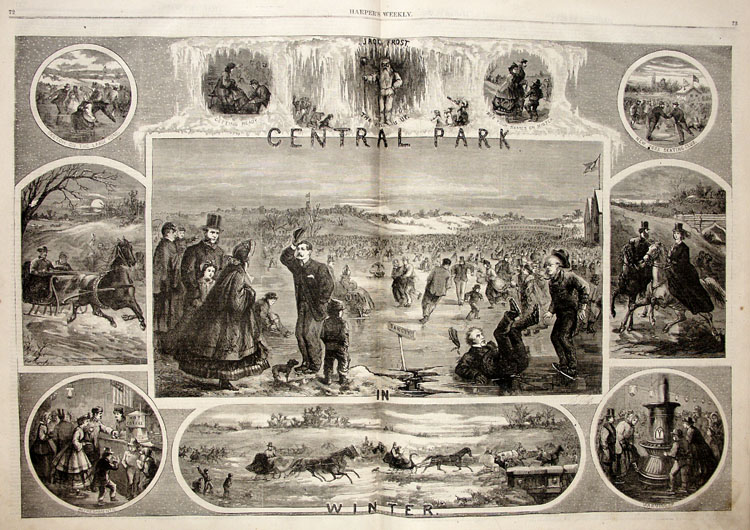
Thomas Nast’s ‘Central Park in Winter’

Two scenes, showing skating and sleighing in Central Park. The top panel includes drawings of James Gordon Bennett Sr and Horace Greeley
For the January 30, 1864, issue of Harper’s Weekly, Thomas Nast drew a many-paneled illustration of Central Park in winter.  Like many of his works, this one featured a large central drawing, surrounded by smaller vignettes in round and elliptical frames.  The main drawing shows New Yorkers ice-skating on Central Park’s Pond.  (The Park was then only a few years old.)  Below that is a rather wild sleighing scene, in which genteel New Yorkers ride through a desolate terrain, as urchins throw snowballs or rocks at them.

The opening of Central Park coincided with ice-skating’s growing popularity, which took hold in earnest in the 1850s.  The Park was most heavily visited in winter, when its pond became crowded with thousands of skaters, whose activities Nast captures here in wonderful detail.  (Note the woman in the skating chair.)

Perhaps inevitably, Nast’s wonderland contains some politics, too.  Two months earlier, President Lincoln had been reelected as an inconclusive Civil War dragged on, inflicting terrible casualties.  New York, being a commercial center, had always viewed the war with ambivalence.  The conflict was contrary to the city’s interests, disrupting a lucrative trade with the South on which New York’s economy relied.  While many New Yorkers were ardent Unionists and Republicans, the city also had a large Democratic constituency, including a politically active immigrant population, which resented the war, the federal government, and the fuss about slaves.  Many, wishing a return to peace, had lately voted for Lincoln’s challenger, Democrat George McClellan.

Anger over the federal government’s war policies had boiled into violence the previous July.  New York became the scene of bloody draft riots, in which rioters lynched at least 11 blacks and 120 people were killed in street fighting between protesters and the police.  Poor whites were inflamed against a draft bill that Congress had recently passed: while ostensibly requiring all fit men to serve in the Union military, it contained a loophole that wealthier Northerners would use to evade the draft: arranging for a replacement by paying a bounty.

In the foreground of his skating scene, Nast (who ardently supported Lincoln and the war) highlights several figures, including a military man at the far left wearing a kepi—a reminder of high-minded Northerners voluntarily leading the Union effort as officers.  At right are two prominent New York newspaper editors, James Gordon Bennett Sr and Horace Greeley, who have run into trouble on proverbially thin ice.  Greeley is teetering, while Bennett has fallen, both near a hole signifying treachery.  Bennett had been an outspoken critic of Lincoln and proponent of McClellan, whereas Greeley, while fitfully supportive of the war, had recently embarrassed the Lincoln administration by engaging in bogus ‘peace negotiations’ with some Confederate representatives who turned out to be fakes.

Both editors, though overwhelmingly influential, earned Nast’s scorn because they were feckless peace-mongers.  To have ended the Civil War through a settlement at that juncture would have rendered the suffering of the soldiers in vain.

Their presence heightens the allegorical meaning of the left side of the tableau, where three figures guard the safety of the family and society.  Besides the Union officer, who holds a small boy in his arms, Nast’s own editor Fletcher Harper (with mutton-chop whiskers) stands over a young girl protectively, while a third man (unidentified, but probably a prominent editor, too) deferentially greets a woman standing at the edge of the ice.  Nast depicts these figures as both benevolent and patriotic.  Harper gave Nast a venue for his pro-Union and radically egalitarian views.

So what at first glance passes for an innocuous pleasure scene is a comment on specific editors, and a paean to the value of virtuous editors in a conflict-ridden time.

Image from this source.

Ready or Not

Puck Christmas 1899 (Courtesy Library of Congress)
The new American girl glides into a new century on the 1899 cover of Puck magazine.  She holds onto her hat, her skirts flapping and duster billowing out behind her, a measure of her velocity.  She smiles in a frank and carefree way, as Puck pushes her from behind.

Frank Nankiwell‘s marvelous drawing captures the freedom and athleticism that the American girl of this era was enjoying.  Though her clothes look constraining to a modern eye, in relation to fashions that had come before, her garb was practical, masculine, and revealingly form-fitting.

In the Gay 1890s, as horizons for women broadened, their increasing physicality prompted dramatic changes in the clothing they favored.  Women began wearing shirtwaists and belts borrowed from men’s fashions.  Their bell-like skirts hugged their hips and thighs, before flaring out dramatically above the knee.  The length was short enough to reveal ankles and leave feet more free.  So dressed, the American woman moved faster and more freely, increasingly visible on skates, on bicycles, and in automobiles.

Image from this source.

Maidens Speed-Skate, 1809

Women racing on ice skates in 1809.
‘At a women’s skating race in Leeuwarden [the Netherlands] in 1809, the crowd watched sixty-four unmarried women vie for a gold cap-brooch. The winner was Houkje Gerrits Bouma. For greater ease, many had thrown off their cloaks. Baur painted the finalists with bare arms, a jettisoned cloak on the ice. It left little to men’s imagination and caused an outcry; therefore it was the last women’s race for many years.’


Image: Nicolaas Baur (Dutch, 1767-1820)
‘Women’s Skating Competition on the Stadsgracht in Leeuwarden, 21 January 1809’
Rijks Museum via Wikimedia Commons

This is the ninth in an occasional series of posts on ice-skating.
Click here to go to the first post.