A Glimpse of Another Christmas

Washington DC market scene by E. B. Thompson (Courtesy DC Library via the Commons on Flickr)

E.B. Thompson was a successful photographer active in Washington DC in the early decades of the 20th century.  Thompson, who was probably born around the time of the Civil War, gained prominence around the same time as Theodore Roosevelt; indeed, the Rough Rider may have been Thompson’s chief patron.  Readers may recall reading this post about Thompson’s 1899 photograph of the coffins of American war dead awaiting burial at Arlington Cemetery.

Besides documenting the political scene, Thompson created and preserved many other pictures—photographs and stereographsof everyday life in the District and other subjects of local and personal appeal.  Among them was this picture of a turn-of-the-century open-air market, taken around Christmastime, as you can see.

Evidence internal to the photograph (such as the clothing and shutter speed) suggests it was taken no earlier than 1905.  Prints of the original image were then colorized for sale.  The color does a lot to draw us back into that earlier time.

Image: from this source.

A President Ventures Abroad

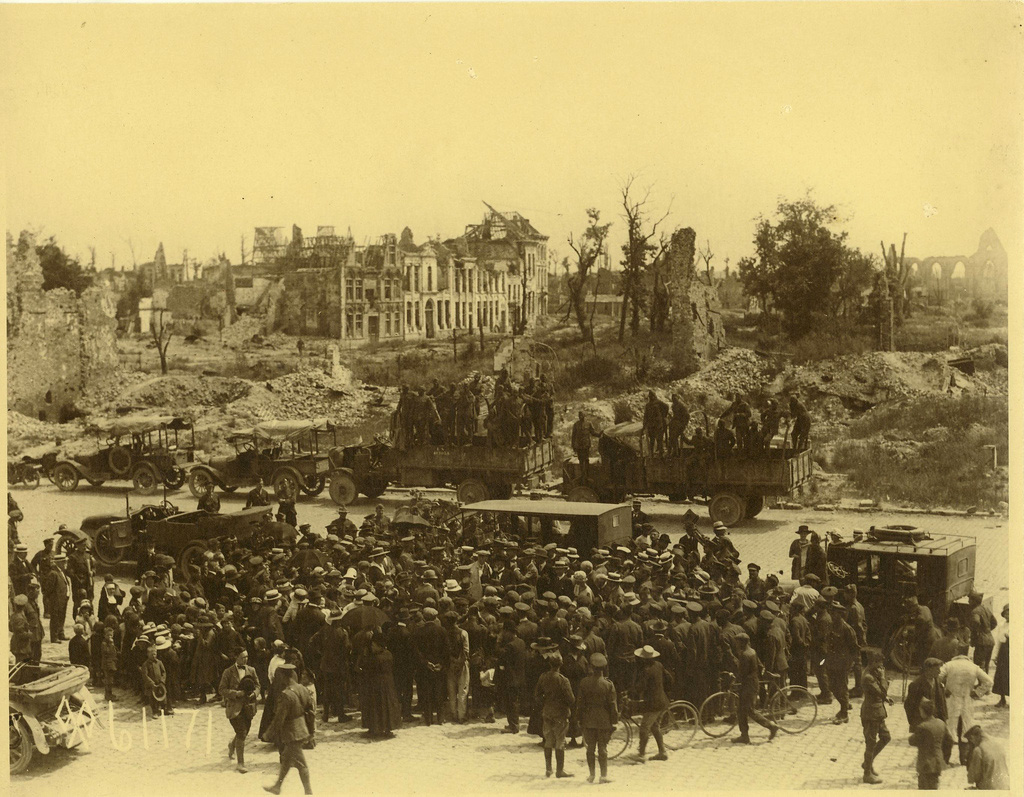
President Wilson and the King and Queen of Belgium at Ypres, 1919 (Courtesy: Woodrow Wilson Presidential Library via the Commons on Flickr)

Given the international status of the United States today, the home-bound nature of the presidency during the first century-plus of the nation’s existence is hard to imagine.  The first president to venture beyond the western hemisphere was Woodrow Wilson, who in 1919 traveled to Europe at the conclusion of the First World War to participate in the negotiations that produced the Treaty of Versailles.

During his trip, Wilson and his entourage visited Belgium, touring Ypres and other areas that had been devastated by the fighting.  An anonymous photographer attached to the US Signal Corps documented the president’s tour of the war-torn landscape.  The resulting deep-focus sepia prints preserve the occasion on which Wilson first saw something of late war in which he and the rest of the nation had been engaged.

Image: from this source.
Click image to enlarge.

Woodrow Wilson Casts His Ballot

Woodrow Wilson Casts His Ballot, 1912 (Courtesy Princeton University Library via Flickr Commons)

I’d been looking for an excuse to write about Woodrow Wilson when Monday’s presidential debate, with its exchange over “horses and bayonets” and the WWI navy, came along especially to encourage me.

An interesting cache of photographs put online by the Woodrow Wilson Library includes this one of Wilson casting his ballot in the presidential election of 1912.  Wilson, then governor of New Jersey and the Democratic candidate for president, won the election in a landslide.

The photograph, with its mesh ballot receptacle, handwritten records, and air of social intimacy, casts doubt on some time-honored political verities.  How free and fair were the elections conducted with this “technology”?  Did our elective process, so often derided as “broken,” really work better in an earlier day?

In 1912, most black Americans were barred or discouraged from voting.  Community norms and party interests inflected how election rules were applied.  Until the ‘Australian’ ballot was universally adopted, casting a vote was a social act, not granted any privacy.  And party loyalty was the grease that kept the machinery running: for much of the nineteenth century, “voting” typically meant nothing more than delivering to the poll a ballot that your party had already completed for you.

Wilson’s ascent coincided with a move toward a more participatory democracy.  In 1912, US senators were still elected, not by the populace, but by the state legislatures.  A Constitutional amendment changing that would be ratified the next year.  The nominating conventions of 1912 were historic, because they were the first to include delegates chosen, not by party operatives, but by popular votes cast in the nation’s first presidential primaries.

*     *     *

A scholar-statesman not unlike Barack Obama, Wilson, a noted professor of political science and former president of Princeton University, spent just two years as New Jersey’s chief executive before catapulting to the presidency.

His path to the White House was more than a little unlikely.  The 1912 election pitted him against three other candidates: the Socialist Eugene Debs, incumbent President William Taft, and former president Theodore Roosevelt, the latter two representing the Conservative and Progressive wings of the Republican Party, respectively.  Only deep divisions within the Republican Party enabled Wilson, the first Southerner to be elected to the White House since Zachary Taylor, to succeed.  Wilson had been a dark horse in the fight for his party’s nomination, triumphing over the favorite, James Beauchamp Clark, a popular House Speaker, in the eleventh hour.

Wilson’s agenda was progressive and sophisticated, but the fractious political environment prevented him from realizing many of his cherished visions, dealing him some notable humiliations instead.  In 1913, John McCutcheon drew this cartoon drubbing Wilson’s first-year performance, yet in the succeeding years Wilson presided over many liberal reforms (e.g. women’s suffrage) and fiscal innovations (e.g. the income tax) that shape our political landscape today.  While Wilson’s approach to the Great War was adroit, he suffered a rebuke heard round the world when a Republican-controlled Senate jettisoned US participation in the new League of Nations and refused to ratify the Treaty of Versailles.  (Unbelievably, Wilson was the first US president to make an official trip abroad when he traveled to Europe to negotiate the Treaty in 1919.)

Image: Wilson voting in New Jersey, from this source.

Stephen Colbert on the recent attacks against the 17th Amendment here.

Ferris: His Wonderland

The First Ferris Wheel, Chicago, 1893; photograph by Starks W. Lewis (Courtesy Brooklyn Museum via the Commons on Flickr)

Around this time of year in 1893, millions of people were flocking to Chicago to see the great world’s fair the city was hosting.  Formally known as the World’s Columbian Exposition, the fair belatedly commemorated the 400th anniversary of Columbus’s “discovery” of the New World.

In a bid for national and international celebrity, Chicagoans (whose young city had burned to the ground 22 years earlier) went all out in constructing the fair’s great White City: acres and acres of magnificent pavilions, illuminated at night by millions of dazzling electrical lights, and all organized around a network of waterways.

To make it even more special, the organizing committee hired a young engineer named George Washington Gale Ferris, Jr., to dream up something similar to the amazing tower that George Eiffel had designed for the world’s fair in Paris in 1889.  Similar to that tower, but better.  Yet at first the organizers of Chicago’s fair were doubtful about the idea that Ferris came up with.

Ferris, 34 years old (and destined to die of typhoid fever just three years later), had already gained an impressive reputation as an engineer and bridge-builder, a reputation that sprang from his understanding of steel.  The design that he proposed to the fair’s organizers was for a gargantuan wheel, that, if built, would tower above everything and lift passengers effortlessly, treating them to aerial views from astonishing heights.

Starks W. Lewis, an amateur photographer who managed to get his camera (it would have been pretty bulky) set up on the wheel, captured the wonder of it all.  From his vantage, the intricate workmanship of the wheel itself, as well as size and design of the passenger cars, each of which was designed to hold 60 people, is clearly revealed.

Despite organizers’ fears, Ferris’s daring contraption worked perfectly.  Rising to a height of 264 feet and measuring 825 feet around, the Wheel weighed more than 2.6 million pounds.  It was powered by two 1,000-horsepower steam engines and operated reliably, unimpaired by lightning and gale-force winds.  According to Judith Adams-Volpe, writing about Ferris in the American National Biography, the wheel became the Fair’s leading attraction, the first instance of “technology being harnessed purely as a pleasure machine.”

View of the Fair from the Ferris Wheel, 1893 photograph by Starks Lewis (Courtesy of the Brooklyn Museum via Flickr Commons)

What steel gave society was the capacity to rise above the earth and gain an entirely new perspective on itself.  The people who visited the Fair from all over the US could see their world as they had never seen it, from a perspective previously offered only by mountains or the occasional steeple.  In the wondrous aerial vision Ferris gave the world came a hint of the built marvels that were still to come.

Images: Photographs of and from the first Ferris Wheel
by Starks W. Lewis, 1893, courtesy of the Brooklyn Museum, from this source.

Lorimer

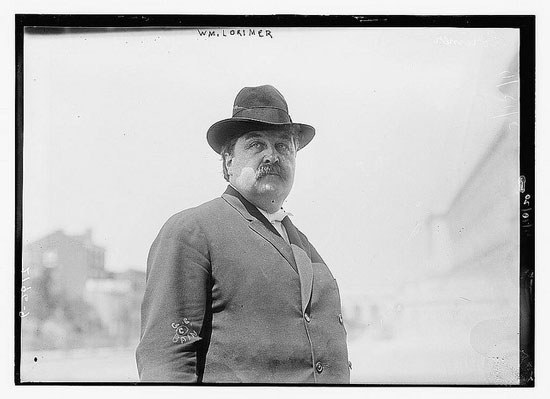
William Lorimer circa 1911 (Courtesy Library of Congress via The Commons on Flickr)

William Lorimer (1861-1934), was a rare bird indeed: a Chicago political boss who was Republican.  By the time he paused to have this photograph taken, he’d risen to a seat in US Senate, but under circumstances that steeled reformers’ determination to amend the Constitution, so that nothing of the kind would ever happen again.

Lorimer had the bored, jaded look of a man who’d been around the corner and back again.  Known as the “the Blond Boss,” Lorimer, who’d been born in Manchester, England, had risen to wealth from poverty, the son of a Scotch-Presbyterian minister who died early, leaving his family to negotiate the late nineteenth-century Chicago immortalized in works like Sister Carrie.  From the age of ten, Lorimer worked various jobs, including in the stockyards; he received negligible education.

In his early 20s, he became a street-car driver, married a woman who was Irish Catholic, and converted to her religion.  Known as a clean liver who did not drink, smoke, or attend the theater, he fathered 8 or 9 daughters, many of whom later worked for the city.

Lorimer’s determination to enter politics on the Republican side is said to have dated from 1884, when a Chicago polling place could not provide him with a Republican ballot to cast for James G. Blaine.  Lorimer became the political favorite of ethnic voters on the city’s west side, including many Russian Jews, Bohemians, and Irish who had previously voted Democratic.  Lorimer was not a reformer; he believed in competition.

He thrived by delivering on promises to supporters and friends, and by wedging himself between the Democrats and the reform wing of his own party.  Exploiting these divisions, he managed in 1908 to defeat a rival Republican for the US Senate, at a time when all Senators were chosen by state legislatures.  A year later, one Illinois state assemblyman claimed to have been paid $1,000 for his vote.  Several others joined him, claiming to have received payments from a jackpot fund set up to influence decisions in the Illinois assembly.

The allegations were investigated over the next several years by state and federal legislative committees, which could not find evidence of Lorimer’s personal wrong-doing.  But the winds of change had been blowing strongly, and eventually grew strong enough to blow Lorimer away.  Ignoring the detailed conclusions of the committees, the Senate voted to expel Lorimer in 1911.  Two years later, the nation ratified the 17th Amendment, which empowered voters to elect US senators directly.

Though Lorimer dropped dead in a Chicago train station decades ago, something of his spirit still haunts Chicago.

Image courtesy of the Library of Congress, from this source.

YOU MAY ENJOY:
Boss Lorimer and the Illinois Bribery Scandal,” New York Times, 1909.