The day after our trip to the end of the road, we took a shuttle from our hotel to a heliport, climbed into a helicopter, and flew over the part of north Hawaii Island where King Kamehameha was born in the mid-eighteenth century. (Click on images to see them alone.)
Of course, he wasn’t a king in those days. He was just another islander, albeit a special one, growing up in a rugged, roadless region, a region that remains mysterious and inaccessible today. Continue reading →
At the urging of a friend, when my husband and I were in Hawaii, we took a drive from our hotel to ‘the end of the road.’ We were staying on the west side of the Big Island around Mauna Lani. We had flown into Kona at night and driven to our hotel through pitch-black countryside. We had no idea what lay beyond the bounds of the property.
After a day of rest, we ventured forth to discover where we were. There is one major road, Highway 270, that follows the coast most of the way around the island. At the northeastern tip of the island, it ends, in the rugged region known to be the birthplace of great Hawaiian ruler, King Kamehameha. The distance there was less than forty miles. Just right for an afternoon outing. We’d be able to see the little towns of Hawi and Kapaau, too.
This short drive, one of the most dramatic I ever took, was a lesson in the micro-climates of Hawaii. The scenery was beautiful and astonishingly varied.
The greatest surprise came when we drove off the hotel’s grounds. Dry rock stretched as far as we could see. It was the broken-up refuse from a lava flow, underscoring what it meant to be on the island’s “dry side.” It’s much sunnier and less rainy here than on the island’s east side, which makes the west preferable for vacationing. The resorts here are unnaturally green and flowery, making the arid wasteland just beyond a shock to see. (Only 10 inches of rain fall annually on this part of the island, according to this interactive map from the Rainfall Atlas of Hawaii.)
Once out on the highway, we could appreciate the extent of these great lava plains. They stretched out on both sides of the road, while in the distance to our right were the heights from which the lava initially flowed.
As the lava breaks down, it supports a tough sort of grass and some scraggly trees. We drove through this sort of terrain for perhaps twelve to fifteen miles. With the ocean on our left and the land sloping gently up and away on our right, we followed the road’s simple ribbon as it threaded north.
Sometimes, peeking over the hills, we could see places that were tantalizingly green. There were clouds on the heights, possibly even rain. Up to 300 inches of rain fall annually on parts of Hawaii.
Sometimes in the distance we could see a blue cloud that I later learned was Maui.
Suddenly, in the space of a mile, the landscape around us turned dazzlingly green. The thick, tall grass was hypnotically undulating. We saw many horses and cattle grazing.
Each mile we drove was wilder and wilder. The road cut in to steep hills with cascading plants. The clouds thickened and spread, blocking out the blue.
Strong trees, including banana, towered over the road. When the road crossed a bridge, it was only one lane. Our path was hillier and tortuously winding.
Suddenly, we arrived. Parking our car, we found the camaraderie of motorists enjoying the sense of having done a great thing.
Picnic baskets came out, and cameras, too. People ambled absentmindedly, getting their bearings, heading the stiff wind, contemplating a beyond that was mysterious and foggy.
We peered toward the legendary land that had cradled a great leader: King Kamehameha, who in 1810 united the Hawaiian islands under his sole rule. The islanders who lived here centuries ago regarded Kamehameha as special from birth; it is believed he was born as Haley’s comet passed over Hawaii. He was given the name Paiea and hidden in these secluded valleys to secure his safety from warring tribes. On reaching adulthood, he became a warrior, giving almost miraculous proofs of extraordinary physical strength, such as moving the Naha Stone, weighing over 2 tons.
Today, the wonder is that anyone could grow so strong in a land so elemental and forbidding. To travel to the end of the road is to confront the earth’s natural richness and beauty, and to be awed by the astonishing resourcefulness of the humans who made this their home.
We returned to the comfort of the road, satisfied.
Visiting the Getty Center in Los Angeles was one of the high points of the season now ending. Although I’d read a lot about this museum and its architecture over the years, still I was unprepared for the aesthetic vision it embodies.
I’d never been to a museum where the building and setting so overwhelmed the art that it housed. We all know that the Getty Center is a relatively recent creation of the J. Paul Getty Trust, and that the Trust, with an endowment of some $6.2 billion, is the world’s wealthiest visual arts institution. The Getty Center is the younger sibling of the Getty Villa in Pacific Palisades—the classical pavilion that J. Paul Getty had built in the 1960s to house his personal collection of art and antiquities. The Getty Center, nestled atop a mountain near Bel Air, opened its doors in 1997, by which time Getty had been dead some 20 years.
Wealth frees the Getty Center from many of the constraints and worries that plague other museums. Transportation via tram up the hill to the museum, admission to the galleries, even audio tours are all free. The Getty makes no effort to merchandise its art (its gift shop is minuscule) and has set up an ‘open content program‘ facilitating the sharing and circulation of digital copies of works in its collections deemed to be in the public domain or to which the Getty itself holds the rights. In short, its art is not treated as property.
For these and other reasons, a trip to the top of Getty’s mountain has the character of an elevating journey. An unlikely one, too, for the visit begins in an unceremonious way, with cabs and cars circling an underground depot built into the bottom of a hill, where they disgorge passengers, as guards bark directions and urge them to keep moving. A growing crowd mills around a severely plain open-air pavilion, looking for someone to pay, and filing into line when docents tell them they are to wait for a train.
The tram line and the gardens around it are elegant and spiffy. There is a perfectly straight row of blooming crepe myrtle trees outside. Metal gleams gold out in a sculpture garden that most of us are too excited and distracted to study.
The train—a sleek pilotless funicular—arrives, and we all pile on. We ascend, snaking quietly up the steep side of a manicured mountain, as the adjacent highway and bland everyday world fall away.
On foot now, visitors climb the broad stairs to the campus of monumental buildings. An oddly communal feeling prevails as fellow-travelers disperse to explore the grounds, galleries, and terraces of what architect Richard Meier seems to have conceived of as a modern temple complex. The museum, temporary exhibitions, Getty Research Institute, and the Trust’s administrative offices occupy several interlocking buildings that give onto courtyards, gardens, and walkways. Everywhere are striking views of the landscape, gardens, ocean, and city.
Often, these views are peopled with, well, people looking, which is chiefly what makes the experience so charming. It isn’t just the beauty of nature, or the splendor of the Getty itself, but the spectacle of humans instinctively engaged in a cultural quest. A spirit of exploration and enjoyment prevails.
Inside, the Getty is like any other museum. My priority was to see the painting collection, which is arranged chronologically in a chain of second-floor galleries. Since its inception, the Getty Trust has had a reputation for building its collections by being the top bidder for masterpieces, acquiring many gems to fill out the collections its founding patron bequeathed. The collection still has a thin institutional feel. It doesn’t convey the intimate thrill one gets from viewing the Phillips Collection in DC; nor does it offer the quirky bricolage of the best larger museums, where the passions of many individual collectors have given the collections distinctive shapes and strengths over time.
Detail, “The Deposition,” by a follower of Rogier van der Weyden (circa 1490), The Getty Center, Los Angeles. Photograph by Susan Barsy.
That said, the Getty’s holdings reward careful looking. Many of the paintings are glorious—the religious paintings, old Dutch and Flemish works, and some of the French paintings, particularly.
Detail of Jacques-Louis David’s “The Sisters Zénaïde and Charlotte Bonaparte,” at The Getty Center, Los Angeles. Photograph by Susan Barsy.
The painting collection is strictly European and ends abruptly around 1870—just when art and society got interestingly messy. It is strange to see the story of painting told without anything modern or American. As it is, the permanent collection comports with the Center’s larger identity as a steward of an idealized world of order and beauty. Meanwhile, out in the garden, life goes on.
On a beautiful summer day, with visitors enjoying its views and waters, the Old North Bridge seems an unlikely spot for the beginning of a revolution. Yet here the first organized and deliberate battle of the American Revolution occurred, when, in April 1775, colonial militia intent on defending their munitions forcefully repelled regulars of the British Army. Turning them back at the Bridge, the colonials famously sniped at the British as they retreated on a heavily wooded road.
It was the beginning of an eight-year war that the revolutionaries fought with little help from outside. Once they had killed members of the British armed forces, there was no path back to peace and submission. There could be no end to defensive resistance, to a rebellion that at first had no unified, all-encompassing aim. Only after more than a year of bloodshed and ad hoc organization did the thirteen colonies unite in Declaring Independence, justifying their goal, with the aid of Thomas Jefferson’s mighty pen and mind, with the most lofty and universal terms he could devise.
During this period, George Washington transformed the initially rag-tag Revolutionary Army, using stern measures to exact loyalty and obedience, while inveigling the Continental Congress (even as revolutionaries, the colonists had a regular legislative assembly) to provide the money and measures needed to fund the Army and enhance its power to fight.
Ultimately, the colonies triumphed and went on to peacetime success not because of their military might (which arguably remained inferior to the British) but because of the political culture they embodied. The political processes and traditions that they had always relied on enabled them to retain their cohesion after throwing off the British, and, eventually, to devise a stable new nation based on the Constitution, ratified some thirteen years after the Revolution began.
❧
Far from being alien subjects, the colonists were scarcely distinguishable from their imperial adversaries. Their cause produced results because they knew and wished to preserve a civil society, in which they could be secure in their enjoyment of specific personal and political rights. The American Revolution was a narrow struggle, fought by two populations infused with the same liberal traditions and similar attitudes toward the rule of law.
Unlike the revolutions we see around us today, the American revolution was not primarily about religion, nor was it fought along tribal, sectarian, or racial lines. It was more of a family quarrel, fought between two forces of related bloodlines.
Being creatures of empire, early Americans, once free, quickly exhibited their own imperial tendencies. Today we are quick to preach power-sharing to nations fraught with internal strife, but on this score we lack an illustrious history. When it came to indigenous Americans, for example, the Anglo-Americans dominant in the 19th century pursued a policy of removal and territorial appropriation that makes the Japanese-American internment camps of the 20th century look like a friendly garden party.
The Native American tribes, though possessing deep claims to the lands of the American continent, were as unwieldy and threatening in a cultural sense as any terrorist is today. The notion that white Americans could cohabit or compromise with native peoples, or that two such dissimilar cultures could be harmonized or politically integrated, was too mind-boggling to be entertained. Instead, the American government used military and political force to extirpate Indians and push them off desirable lands. Americans’ idea of “power sharing” with the Indian “other” was to expel remaining tribes from the American body politic, cordoning them off on “reservations,” where they could no longer impinge on, or participate in, the ostensibly egalitarian government that was sovereign by then.
Similarly, in the 1860s, white Americans had to fight a Civil War among themselves, at the cost of some 600,000 lives, to establish the principle that we should not enslave persons whose skin color is different than ours. It took another hundred years to provide African-Americans with the legal protections necessary for the full exercise of their political rights.
Throughout our Civil War, the rest of the world sat on the sidelines, as the nation sought its direction through a protracted conflict that refined it and left it profoundly changed. The principles of union, federal authority, and equality that were then irrevocably established laid down the foundations of the nation’s might today.
These facts about our history must be recalled as we consider intervening in revolutionary conflicts in other countries. The paramount importance of civil culture should be borne in mind as we contemplate giving military aid or committing ourselves militarily in other ways. We tell ourselves that stepping in will lead to a more just result, or an earlier peace, but what process of internal development or resolution are we short-circuiting? We say that other countries should tolerate and politically empower radicalized or militant minorities, though this isn’t something we’ve ever done with ours.
Much as our hearts are moved with compassion for the suffering that accompanies violent conflicts that are unbounded and unequal, we should be humble in our response, recalling the long path we have traveled from Revolution to tolerance and inclusion—a centuries-long struggle that continues even now, long since peace returned to the Old North Bridge.
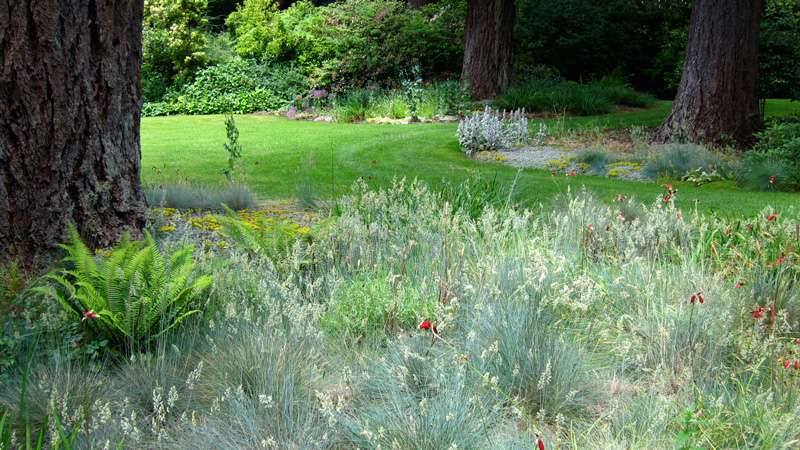
During our visit to Seattle last week, my friend Wendy offered to take us to Dunn Gardens, a little-known place in the Broadview neighborhood northeast of downtown. The gardens, which are listed on the National Register of Historic Places, were designed for the Dunn family in the 1910s. The landscape architecture firm Olmsted Brothers designed the grounds and selected all the original plants. Click on pictures to enlarge.
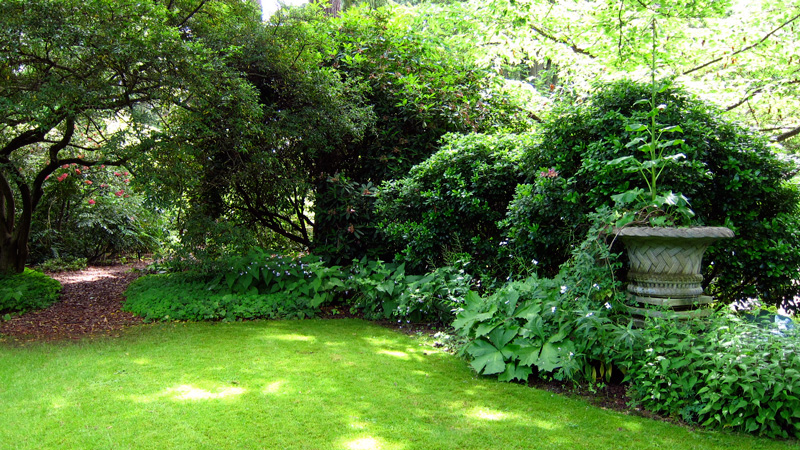
The gardens occupy a residential compound of some 10 acres, surrounding a main house and two other dwellings. The land offers a view of Puget Sound and the Olympic Mountains, which the growth of vegetation is gradually obscuring. The gardens were designed around many second-growth firs standing on the property at the time of its purchase. The massive trees lend the garden an atmosphere of seclusion and repose.
While still faithful to their original design, the gardens have evolved under the stewardship of three generations. Some plants and plantings have been added, while others have been gradually allowed to fade away, as the owners have observed plants’ changing characteristics and needs.
Several thousand plant species, many in a state of perfect maturity, contributed to a varied woodland tapestry, whose patterns and textures were too complex to apprehend on a single visit. On this afternoon, we marveled at magnificent stands of Himalayan lilies foregrounded by wisteria and boughs of pink dogwood. Starbursts of alium punctuated beds layered with grasses, sedum, and small ruby-colored lilies. The woods teemed with ferns, oxalis, hellebore, and solomon seal.
Rare and one-of-a-kind rhododendrons bred by Edward Dunn studded the forest. There were many amazing plants, but they were harmoniously incorporated into a naturalistic design.
Even the most formal parts of the grounds, like this one formed around a rectangular lawn, had an appealingly off-hand quality. The stone stairs leading out of it were one of my favorite things.
The established structure of the place supported a riot of plant life that was visually intoxicating. A Chicagoan could only envy the lushness and vitality of it all,
the plants growing upon plants,
the petals and leaves.
A superabundance of plants dripping from every ledge,