
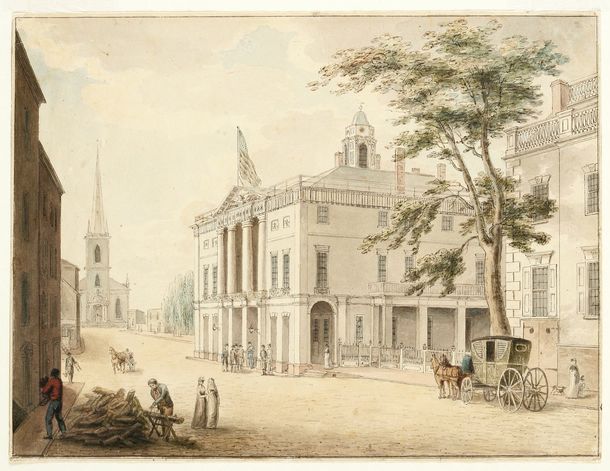
Artist William Hindley made this interesting architectural rendering of Federal Hall in the 1930s, over a century after the building was demolished in 1812 to make way for the US Custom House of the Port of New York.
Further research on Hindley might clarify whether he was in business for himself or worked for a government entity such as the National Park Service (NPS) or Works Progress Administration (WPA), which employed scores of writers, artists, and photographers to document the physical environment and condition of the country at that time. Whatever the case, Hindley made a handful of drawings aimed at preserving the characteristics of this significant building, which was the sole seat of the federal government during its first year.
It’s prudent to approach such retrospective documents warily. The specifics they present as historical may be spurious and anachronistic, sheer invention making up for a shortage of factual detail. Good artists were scarce in the early national period; the visual record of important people, places, and events then, correspondingly thin.
Here, though, Hindley generally dispels our skepticism. In the lower left legend, he states that his work was extrapolated from the scale of the old city hall, combined with “Hill’s engraving and descriptions,” and Robertson’s drawing. (The latter is a street view of Federal Hall that Archibald Robertson sketched when the building was still extant, around 1798.) In addition, later scholarly analyses of Federal Hall offer other documentary evidence corroborating Hindley.
Hindley’s drawing effectively communicates the subjective significance of L’Enfant’s smooth, symmetrical facade. Highlighted are the columns, pediment, and entablature, a fancy cupola topping off the now three-story building. The focal point of all is the new nation’s seal. The upper right-hand legend tells us that, as reward and payment for his work, the 33-year-old L’Enfant was offered “10 acres of land at Proovost [sic] Lane between E60 and E49 street with a small payment of money but declined it.”
Overstating the case a bit, Hindley avers that L’Enfant was the first architect to solve the problem of how to make a building “characteristically American,” establishing a pattern that other famous public architects of the early national period, such as Bullfinch, Thornton, Hooker, Hadley, Thompson, and Latrobe, merely followed. What can be said with authority, however, is that the stylistic elements L’Enfant combined in Federal Hall were indeed used in government buildings in the US countless times.
Image: from the National Park Service
collection of artifacts pertaining to Federal Hall,
accessed on 12 December 2012.
Click here to view two other imaginative renderings
of Federal Hall that Hindley made.


_(14779713662)_(cropped).jpg#/media/File:The_magazine_of_American_history_with_notes_and_queries_(1877)_(14779713662)_(cropped).jpg)