All About a Ball

Preparing the US National Museum for Garfield's Inaugural Ball (Courtesy the Smithsonian Institution via the Commons on Flickr)

As the day for James A. Garfield‘s inauguration rolled around, the decision was made to hold his inaugural ball in the newly constructed United States National Museum, which had not yet opened to the public.

The massive building, with its grand halls and balconies, seemed tailor-made to soothe a vexation the planning committee faced every four years: finding a venue large enough to accommodate five to ten thousand people.  The nation’s past was strewn with disastrous stories of inaugural parties gone awry: rampaging crowds, looted furnishings, overcrowded chambers, guests forced to dance in their overcoats in unheated temporary buildings.

The National Museum decorated for the 1881 inaugural ball (Courtesy of the Smithsonian via the Commons on Flickr)

The planning committee went wild preparing the still-vacant museum for the president’s gala.  They ordered up three-thousand gas lights, a temporary wooden floor, illuminated garlands, patriotic bunting, placards sporting the monograms of the new president and vice president, and a vast “Lady America” statue to transform the building.  (Wooden chairs in the photographs give an idea of the interior’s scale.)  Vast quantities of refreshments, including 15,000 “assorted cakes,” awaited the inevitable hour when dancers got hungry.

Yet, in the end, these lifeless photographs scarcely satisfy our curiosity.  For what about the ball itself?   Specifically, what about the ladies?  What were they wearing?  Here we run smack up against the bouncers of photography’s limitations, Gilded Age customs, and social mores.

Sadly, Americans couldn’t snap candids of themselves as they stepped out for the ball on that historic night.  The Brownie camera that would make amateur photography possible was twenty years in the offing.  Only by going to a studio photographer arrayed in her ball dress could a woman who went to the ball retain a souvenir of what she looked like that night.  Few such photographs are likely to exist (but let me know if they do!).

♦     ♦     ♦

1880 corset

Thank heaven for the internet, which helps dress up a scene so otherwise naked!  The foundation of every Gilded Age look was the corset, which molded women’s bodies into an idealized form.  It created the hour-glass shape, the essential female silhouette in those days.  Ladies attending Garfield’s ball wore either a corset or an evening dress reinforced inside with whalebone stays.

Dresses donned over the corset were complicated.  This evening dress was characteristic, with its curvacious form-fitting bodice, cinched-in waist, and eye-catching skirt culminating in a bustle and train.  While rigidly sculpted and richly decorated, dresses were relentlessly columnar, emphasizing the figure’s verticality.  The torso of the dress was elongated, thanks to a cut of bodice called the Cuirass, which (echoing the corset) extended smoothly beyond the waist and over the hips.  Keyhole and “V” necklines were popular then.

Even day-time skirts dripped with pleats, folds, and elaborate drapery, accentuating the hips and creating a coveted multi-layer look.  “Tie-back skirts,” though considered scandalous, were all the rage, the skirt being pulled back across the front of the body, supposedly accentuating a woman’s legs.

Evening dresses were made of silk, sometimes heavily textured, and covered with beadwork and ribbon to make them shine.  Textile makers produced vibrant colors with the help of synthetic dyes.  The surface of the dress was further built up with lace, ruffles, and ruching.  Some dresses had heavy tassels of the kind now seen only on fancy furniture and curtains.  The backs of dresses, too, were elaborate and bulky.  To see how these elements could combine, check out this gorgeous cream silk gown, designed by Frederick Worth, the leading couturier of the time.

♦     ♦     ♦

"The Inauguration of President Garfield - The Opening of the Grand Inaugural Ball" (from Leslie's Illustrated of March 19, 1881)

Such are the fashions depicted in the most lifelike extant depiction of Garfield’s ball, created when Frank Leslie’s Illustrated magazine dispatched several “special artists” to capture the scene on the night of March 4, 1881.

The resulting composite illustration includes recognizable portraits of many public figures, with the bearded president, at center, flanked by his son and daughter, and Lucretia Garfield, the new First Lady, hanging on an ambassador’s arm.  (Elsewhere, politicians and military men like Carl Schurz, William T. Sherman, John Logan, James G Blaine, and Roscoe Conkling pepper the crowd.)

Five or six ladies appear at the forefront, the artists painstakingly rendering their dresses, hair-styles, fans, jewelry, and bouquets.  We see Lucretia Garfield in her high-necked pale lavender gown, for instance, while the younger women wear dresses that are more revealing, with low-cut necklines and negligible sleeves.  Yet what joy could they have had in dancing, in such long heavy dresses, and such tight strict corsets?

Looking at this drawing, I am most struck with its subjects’ unknowing.  Little could they know that in just a few months, Garfield’s life would be taken, or that in a few decades, the constraints on women’s fashions and movements would be melting away.  That soon a woman could vote for the president, or against him, as may be, or pick up a Brownie camera and take a picture of her day.

Images: Photographs of US National Museum courtesy of the Smithsonian Institution via the Commons on Flickr; corset from this source; engraving courtesy of the Library of Congress.

RELATED ARTICLES:
Inaugural Day in Washington, The Old Print Gallery.com.

The Real Thing

Town Hall Ward, Oxford, England (Courtesy Woodrow Wilson Presidential Library via The Commons on Flickr)

It bothers me that I can’t look at this photograph without thinking of Downton Abbey.

This is a historical photograph of a WWI convalescent ward set up in the town hall of Oxford, England.  Strangely, though, memories of the fictionalized ward that featured in the BBC series now furnish my yardstick for judging its verisimilitude.

Image from this source.

American Beauty: The Inauguration as Medium and Message

President Obama taking the oath of office as his family looks on (Photograph of PBS coverage)

The American Revolution was a revolt against “kingly power,” that, upon succeeding, evolved into a gamble that ordinary people could rule themselves without a monarch.  The republican government the Framers devised nonetheless featured a novel office—that of chief executive—who, being the choice of the populace, would function as the nation’s symbolic head for four years’ time.  Without some such “people’s sovereign,” the Federalists believed, the new government would have trouble securing the affections and loyalty of the citizenry.  The ritual of the inauguration has taken shape around preoccupations like these.

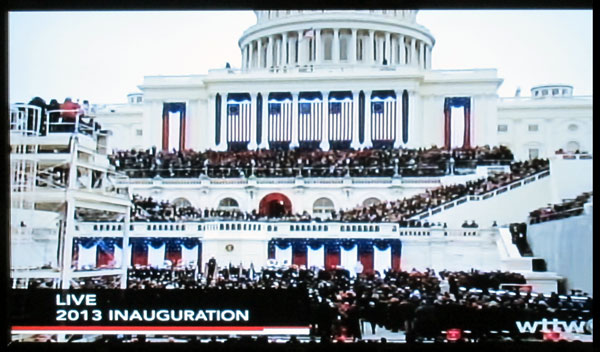
The inaugural was held on the west front of the Capitol (Photograph of PBS coverage)

Relative to the pomp surrounding British monarchical rituals, for instance, American inaugurals are low ceremonies indeed.  Since John Adams’s early disastrous experiments in aping the British monarchy, presidents and their families have avoided ostentatious costumes or trappings offensive to democratic sensibilities.  Officials take the oath of office wearing ordinary street clothes, allowing the “majesty of the people” to take center stage.

The president listening to the inaugural proceedings (Photograph of PBS coverage)

The preference has been strong for an open-air ceremony.  George Washington set the tone in 1789 with his swearing-in on the balcony of Federal Hall (then the seat of Congress) in New York City.  Though harsh weather has sometimes forced inaugurals inside, their location has generally been selected to allow them to be witnessed by largest possible number of people.

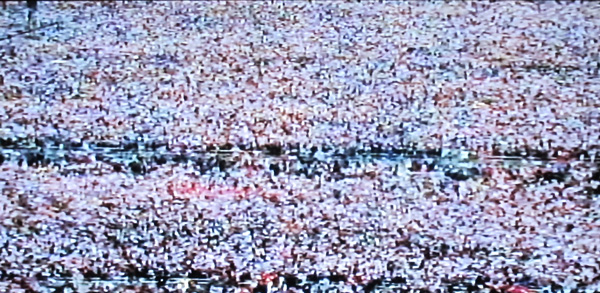
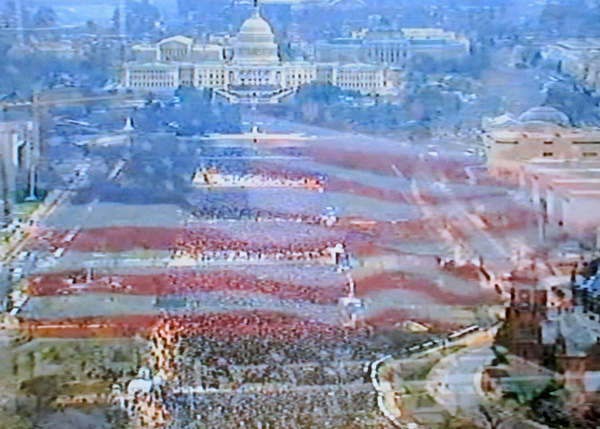
A vast crowd came to the National Mall to take part in the 2013 inauguration (Photograph from PBS television coverage)

Over time, the inaugural has evolved into a full and appropriately expressive ritual, especially through the device of the inauguration poem (a custom begun and carried on mainly by Democratic presidents) and the performance of American song.  In the right hands, the inaugural’s simple components can be coaxed into a whole of considerable beauty and eloquence, as was certainly the case with the inaugural  last Monday.

The ceremony was beautifully orchestrated, planned with an understanding of how its elements could combine.  From invocation to closing prayer, Obama’s second inaugural presented an aesthetic and patriotic vision of the American essence, receiving its purest expression during James Taylor’s simple rendition of ‘America the Beautiful’ on acoustic guitar.  At the same time, several complex political messages were effectively conveyed.

1. Ours is an inclusive, multiracial republic.

The Brooklyn Tabernacle Choir singing the Battle Hymn of the Republic (Photograph of PBS coverage)Visually and verbally, the inaugural moved beyond tokenism to demonstrate the diverse and inclusive character of the US today.  The crowd gathered on the Mall, as well as all those with an official part in the proceedings, showed the fruits of the country’s long struggle to make good on its egalitarian principles and dreams.  The reality of integration and inclusion was embodied in the faces of the military, in the diverse complexion of officialdom, and in all those clergy, singers, poets, musicians, and orators, who were called on to inspire, entertain, instruct, bless, and thrill us that day.

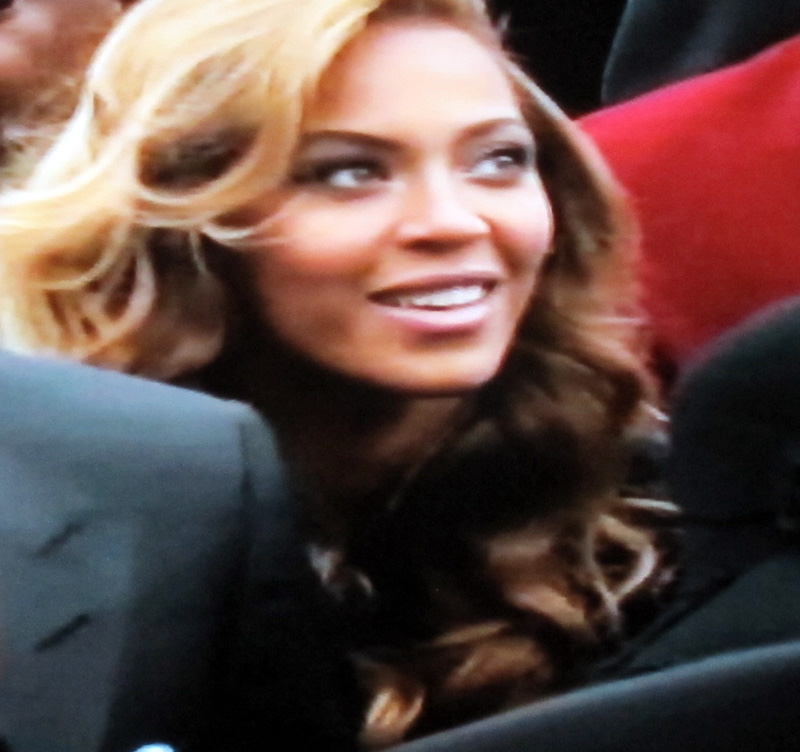
Beyonce leaving the inauguration, where she performed the national anthem (Photograph of PBS coverage)Coinciding with Martin Luther King Day, the inaugural paid homage to the nation’s centuries-long quest for civil equality, encompassing the struggle to end slavery, extend the franchise, welcome the immigrant, and end archaic practices that are discriminatory.  Progress toward these goals, though incomplete and painfully achieved, is evident, and our maturity as a pluralistic country was joyfully ratified on Inauguration Day.

2. Religion is central to American civic life, but not in the way Christian conservatives imagine.

Religious sentiment (of a peculiarly American kind) suffused the inaugural proceedings.  Its historic role in inspiring Americans to preserve and strengthen the Union and to persevere in the face of injustice was humbly acknowledged.  In the ceremony, religion figured as a fountain that Americans must continue to draw on as they seek to discern the right and the true.

Myrlie Evers-Williams somber invocation and Reverend Luis Leon’s benediction extolled the blessings of religion as a unifying and transcendent force, binding together and uplifting the American people.  Driving the point home, the multiracial Brooklyn Tabernacle Choir wowed the crowd with its rendition of the ‘Battle Hymn of the Republic,’ a Civil War-era song about militant righteousness and Union, written by northern white abolitionist Julia Ward Howe.

Was the inaugural satisfying in part because it sketched the spiritual and patriotic dimensions of the Obamas’ own deep personal faith, a faith that opponents have often assailed, belittled, and misrepresented for the sake of political gain?  At the same time, the intense but inclusive spirit of the inaugural seemed a rebuke to the more narrow and divisive Christianity that social conservatives espouse.

3. The condition of the people is the President’s main concern.  Maximize their security, happiness, and well-being, and national  prosperity will follow.

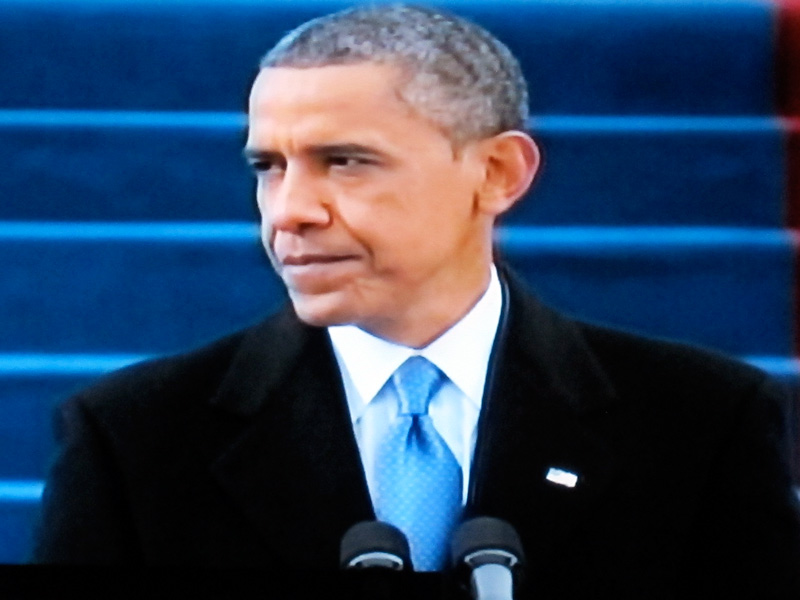
President Obama delivering his inaugural address (Photograph from PBS coverage)Jeffersonian thought has been so marginalized in political discourse that commentators hardly recognize its essence today.  President Obama’s repeated use of phrases and ideas from the Declaration of Independence in his speech signaled his interest in governing in a Jeffersonian vein.  It’s an interesting idea, but what does it mean?  For Jefferson, it meant providing a framework for the individual so that the the individual could flourish.  Jefferson was not anti-government—he was the architect of many enduring and expansive national projects—but he believed chiefly in that government necessary to protect and promote a prosperous and self-realizing citizenry.  When it came to big projects, Jefferson was all about innovation and efficiency.

4. The relationships born of our civic life enjoy a priority over those of corporations or the economy.

The Capitol as seen from the Washington Monument on January 21, 2013 (Photograph of PBS coverage)

Throughout his career, President Obama has sought to reinvigorate the potent role of citizens in political life.  David Brooks, though admiring the inaugural address, regretted the president had not devoted more of it to the budget, the markets, the economy, or free enterprise.  We’ve grown accustomed to thinking that government must be mainly about these.  But are these truly the chief interests of a republican government?  Are these the interests that need protecting?  American business will continue to find a way, whether the Obama administration puts its might behind that project, or not.  The president believes that investment in human capital is the chief requisite to making the economy thrive.  As if to underscore the point, inaugural poet Richard Blanco offered a lyrical, Whitmanesque view of American work in his spare yet impressive poem, One Today.

5. We are all citizens, and, as citizens, must fulfill certain transcendent obligations consonant with the great power reposed in us.

 The best part of the president’s speech was its conclusion.  Pointing to oath-taking as a unifying ritual, the President likened his oath to others we have taken, whether as schoolchildren, government officials, new citizens, or members of the military.  The promises we make to our country bind us together in a way that transcends the claims of self-interest and party.  The president closed with an appeal to each of us to continue to make our voices heard.

The president looks back on the Inaugural crowd (Photograph of PBS coverage)

Obamacratic Gossip

Michelle Obama during Monday's Inaugural Ceremony (Image taken from PBS Newshour coverage)

I heard it first from the security guard in my office building.  We were chatting about the inauguration, when he grew animated.  “What’s going to happen after this?” he abruptly asked me.  “The Democrats don’t have anyone to come after Obama.  They only have one person.  You know who it is?”  It astonished me to realize he meant the First Lady.

“If that happens, I’ll tell everyone I heard it here first,” I replied, taking his words as a measure of the fervid loyalty the First Family enjoys in some camps.  Whether Mrs. Obama, who has never held public office and was a reluctant first lady, would ever contemplate a presidential run seems doubtful to me.  She’s an entirely different sort than Hillary Clinton, who, since her school days, has been a political animal through and through.

Imagine my astonishment, then, when I ran across this image on a heavily visited website (The Obamacrat) that assumed the same thing: that a Michelle Obama candidacy would be viable in 2016.  If nothing else, this incipient “draft MO” movement suggests how ready citizens of perhaps any nation are to place their trust in established political families, fueling a dynastic element that has been an unmistakeable and constant feature of American politics, as evident during the Federalist era as it is today.

Photograph of Mrs Obama
made from PBS Newshour coverage of Monday’s presidential inauguration.

RELATED:
What will Michelle Obama do with four more years? Yahoo.com