Progress Isn’t Popular

YESTERDAY WAS a great day for majorities.  A majority of the Supreme Court upheld the majority of the Affordable Care Act, a complex but very necessary piece of legislation that majorities in Congress had passed more than two years back.

Besides the great satisfaction that comes from watching the various branches of our government working in the intricate ways our forefathers envisioned, yesterday’s events furnish an opportunity to reflect on the great courage required of leaders in our contentious democracy.  I hope every congressman and senator who voted for the passage of the ACA will feel more comfortable taking credit for this landmark legislation.

I’m sure the Affordable Care Act is imperfect and that down the line it will need to be tweaked.  But the complex provisions of the law are complex for the very reason that they represent an accommodation: an accommodation of many powerful private interests, institutions and professions, as well as a dizzying range of individual, programmatic, and social needs.  The health-care reform act will affect us all, and it will shift around the burdens of health care in our society; but it marks a path toward a healthier society, so far the only one a majority of our legislators has managed to agree to.

A minority of Americans will continue to rail against our national institutions, and will try to convince the rest of us to hate a measure likely to confer broad benefits on us, both individually and as a society.  May their cries fall on deaf ears, and may they remember that the very foundation of our system is a respect for majority rule.

RELATED:
Susan Barsy, A Decision We’ll All Feel, Our Polity.
David Brooks, Modesty and Audacity, New York Times.

Be Our President, Please

Forget the polls: I woke up yesterday with the cold hard conviction that Obama will lose the presidency.  It was a moment when wishes dropped away, exposing a bleak vista shaped by the President’s own choices and style of proceeding.

If only he thought of his office differently, Obama would be far more popular than he is, and his reelection would be a certainty.  From the start, he has styled himself as an activist president rather than an executive duty-bound to stand as a symbol of the whole country and its legislatively expressed will.  His would not be a role secondary to the other leaders of his party.  No, from the outset Obama has positioned himself as one who, separate from all others, would push to redirect established institutions of power.  From the vantage of the White House, he would elevate the nation to a state that had previously eluded the whole governing community and other members of his party.

This vision has given free rein to the narcissism and paternalism that are aspects of Obama’s personality.  After a point, it doesn’t matter whether the president has a good heart or an intelligent grasp of policy: what matters is that, in his zeal to do more and be better than others, he is subverting the collaboration and interdependence on which the government is premised.

When Obama was first running in 2008, I was reluctant to believe Chicago friends who told me that he was famous for throwing fellow-Democrats under the bus.   Four years later, after watching Obama tirelessly lecture and upstage everyone else in his party, I’m ready to believe.  The latest instance was on Friday, when the president couldn’t wait to strike out in a new direction on immigration policy—a complex and divisive issue whose resolution warrants the whole voice and weight of Congressional authority.

Sadly, in arrogating to himself matters more appropriately left to Congress, Obama has foregone the chance to be a different kind of executive—one who embodies the authority of the government and symbolically represents the people as a whole.  By aiming to do less, Obama could do more to uplift and unite a beleaguered country.

RELATED:
Political Affections

Political Affections

Robert Cruikshank watercolor of crowds attending Andrew Jackson's inaugural reception in 1829 (Courtesy of the Library of Congress).

Amid the strife wracking US politics, a soul can grow weary.  Why do we care?  Why do we bother—why not lay down the burden of republican citizenship and turn away?

In our hearts, most of us have a vision of a more just, peaceful, and prosperous nation.  With concerted effort and good will, we can attain a condition better than what we’ve experienced lately.  I suppose I became a historian and took the unlikely step of writing about politics because I want to make citizenship a large, evident part of my identity.  Whatever else I do, being a citizen is something that I want to achieve.

Patriotism is out of fashion with the sophisticated.  We think about “going into politics” as a sort of careerism; and, if we don’t do that, it’s pretty much understood that we are on the sidelines.  It would be difficult for us to make sense of the 19th-century statesman who, on his death, was eulogized as a “pure patriot. . . whose brain and heart and means and energies were all at the service of his country.” We can understand the part about the brain and the heart—but to commit all one’s means and energies to the country?  That’s alien.

Yet the many-sided commitment of self to public life was once a commonly held American ideal, which individuals pursued in the hope of gaining a special kind of honor and esteem.  Conversely, the wholehearted identification of one’s personal destiny with that of the nation was a crucial element on which the future of the republic was thought to depend.

Queen Elizabeth’s Diamond Jubilee last week stirred up many warm feelings, underscoring the important role of human affection in maintaining a government and a country.  Having a queen may seem useless from a functional standpoint, but symbolically Elizabeth represents the nation in her person.  To love Elizabeth is to love Britain, which isn’t too hard, especially when she is looking so darned benign and motherly.

Photograph of Queen Elizabeth II wearing a hat adorned with flowers

Yet the sentiment the Queen evokes isn’t particularly cozy.  Often she evokes awe, especially when projecting loftiness, magnificence, or a tireless duty.  All the qualities associated with the Queen serve to bridge a gulf that might otherwise exist between her subjects and that abstraction that is their nation.  It’s precisely because Elizabeth is a person—rather than a building, say, or a flag—that she can embody so many varying qualities that, taken all together, help maintain something distinctive in Brits’ feeling for their country.

In the words of the 19th-century Englishman Walter Bagehot, the queen “excites and preserves the reverence of the population,” thereby helping to bind their sentiments to the state.

Besides her gobs of jewels, her surreally one-of-a-kind existence, and her heavily photographed family, what I like most about the queen is the way she styled herself as a sort of sacrificial über-citizen, beginning on the very first day of her reign.  On the evening of her Coronation in 1952, the young queen made this declaration to the people of her country.

I have in sincerity pledged myself to your service, as so many of you are pledged to mine. Throughout all my life and with all my heart I shall strive to be worthy of your trust.

Thus began sixty fairly unsensational years of color-coordinated dressing and the performance of millions upon millions of prescribed and customary royal duties.  At the end of the day, it’s hard not to admire Elizabeth’s dogged commitment to all the formalities and tedious conventionalities that are part and parcel of her country’s monarchical tradition.

When it came time to draw up our own Constitution in the 1780s, the Revolutionary generation was conscious that, in rejecting monarchical government, they had given up something that, in good times, helped secure citizens’ attachment and loyalty.  What, in a republic, could substitute for monarchy’s appealing glitter, pomp, and ceremony?  What could the framers devise to cultivate the people’s respect and embody the fledgling nation’s character and authority?

Ironically, the answer they came up with is the presidency.  The framers hoped that the occupant of this new-fangled office would function as “the people’s sovereign.”  Federalists like John Adams hoped that the style presidents adopted would be sufficiently “splendid and majestic” to instill a sense of the dignity and authority of the nation in the public mind.  In addition, members of the federal government took care to develop a set of forms and customs for capital life that might earn the republic respect, both at home and abroad.

Still, it would be hard to claim that the Founders solved the problem satisfactorily.  In the years before the Civil War, observers recognized that the federal government exercised only a weak, secondary claim on many Americans’ loyalties—secondary to their homes and to the states where they were raised.

As we contemplate the narcissism and partisanship permeating the competition for the presidency, we may be justified in doubting whether the work of securing the affection and loyalty of the people remains a priority today.

Image: Robert Cruikshank’s watercolor,
“President’s Levee, or all Creation going to the White House”
(published 1841), from this source.

Should Leaders Who Can’t Govern Their Party Govern the Country?

This is the question that the turmoil within the Republican Party prompts these days, as the moderate wing of the party battles to maintain control over a grass-roots extremism it has legitimated.

Is this what a dying political party looks like?  This is what flashes through my mind when I read or hear about the Republican Party.  The party isn’t dying, at least not yet: but the very forces of intolerance and intransigence it encouraged are assailing it from within.  Unless the moderate wing of the GOP can reassert itself and prevail, the party will continue its disastrous turn to the right.  Not only will its prospects for power dim, but the entire country will suffer, too.

Extreme conservatism is a minority view
Despite the media hype—fanned by talk radio and cable TV—extreme conservatism is not the dominant American viewpoint.  We are not a nation of extremists.  The desire of the country’s majority for sophisticated, moderate leadership was expressed in its 2008 rejection of Sarah Palin and, more recently, in Republican voters’ resounding rejection of conservative presidential hopefuls Rick Santorum, Michele Bachmann, and Rick Perry.  Each of these candidates received lavish publicity, arousing fears that they represented the new face of America; in each case, support for these candidates proved meager indeed.

Weakening the fiber of nation and party
Yet the fate of the Republican Party is being directed by this assertive minority.  It’s the faction that Rick Santorum and Newt Gingrich chose to pander to.  It’s the faction that hates the separation of church and state, that would attack the independence of our judiciary.  It’s the faction that’s against modern medicine.  That’s against female contraception.  That’s uncomfortable with racial equality.  In their quest for power, these conservatives have begun chipping away at principles and institutions that formerly sacred to all Americans and protective of us all.

Moderate Republicans are captive
In the face of this, the only Republicans to speak out against extremism have been members of the Bush family.  During the primary season, Jeb Bush distanced himself from the new conservatism while signalling disappointment at the Party’s loss of vision.  Barbara Bush has repeatedly expressed dismay at Republicans’ uncivil conduct and their disavowal of compromise.

These, though, are just two voices in a party that, by and large, has chosen to amplify and accommodate spurious right-wing demands.  Prior to 2010, there were reasons to hope that the social conservative wing of the party, for want of a victory, was moving into a more quiescent, marginal phase.  Unfortunately, the emergence of the Tea Party, with its new crop of faces, its fiscal focus, and its idealistic hatred of our federal tradition, has given new energy to the disparate elements that make up social conservatism.

Citizens United has further exaggerated the significance of rabble-rousing candidates like Newt Gingrich, whose funding was all out of proportion to the support he enjoyed. 

A terrible tactical decision
All along, moderate Republicans could have tamped down and disavowed right-wing extremism as it began taking hold, like crabgrass, on their impeccably manicured property.  Republicans could have chosen not to assimilate the Tea Party.  They could have refused funding to candidates whose intolerance is extreme enough to qualify as unpatriotic. They could have silenced the racist “dog whistle” that goes by the name of the birther movement.  Instead, moderates have chosen to go along and get along with a dangerous minority.  Why?  Because they need the support and approval of these voters too badly.  Without this virulent sub-population, moderate Republicans cannot hope to attain the majority needed to elect a president or control Congress.

Consumed by a wasting disease from inside
Now this emboldened faction is paralyzing and destroying moderate Republican leaders.  In recent primaries, Tea Partiers have targeted old-line Republicans like Richard Lugar for defeat.  They have reduced House Speaker John Boehner to impotence by stalemating last year’s negotiations over the debt ceiling by refusing to compromise.  Boehner bristled at David Axelrod’s recent allusion to a “Republican reign of terror” but, in truth, moderate Republicans are beginning to bear the brunt of  a “reign of terror” that their conservative wing is waging from inside.

Is Mitt Romney the man to speak truth to power?
It’s hard to imagine Mitt Romney, who wants so badly to be liked, disciplining and harmonizing the unwieldy elements that now constitute “the Grand Old Party.”  In his eagerness to gain office, Romney has promised to be the conservatives’ standard-bearer, while hoping the rest of us won’t consider what that means.  Unlike Jeb and Barbara Bush, Romney lacks the gumption to speak out against a strain of political intolerance that could spell the ruin of Republicanism—and that’s begun to harm the republic, too.

RELATED:
Is the Republican Party Dying?

The Closed-Door Campaign

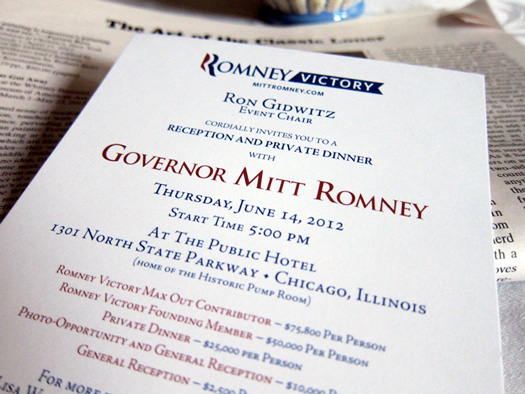
Photograph of an invitation to a Romney fund-raising event (Credit: Susan Barsy)

A piece of high-end junk mail appeared in my P.O. box the other day.  An invitation to an upcoming Romney fundraiser, it is a perfect souvenir of this campaign season.  For just $75,800, I can become a “Romney Victory Max Out Contributor,” and perhaps sit next to someone powerful in the old Pump Room.

Now that the suspense has gone out of the primaries, a superficial calm has fallen over the presidential campaign.  Tune out the perfunctory stump speeches and ramped-up media campaigns, and you will hear the ching-ching! of aggressive fund-raising, as both Romney and the president crisscross the country desperately scrounging up cash, now taken as a proxy for popular support.

Have you been reading about the changing style of presidential fundraising?  Whereas in 2008 Obama made securing small contributions a priority, his style of fund-raising is now virtually indistinguishable from that of Mitt Romney.  Both rely mainly on high-end fundraisers, hosted by celebrities or other ultra-wealthy Americans and typically kept at a distance from the public eye.  “Few Witnesses to Obama, Romney, As They Raise $1.5 Billion,” read a recent Bloomberg headline.

In many ways, this cozy relationship between leading politicians and the wealthy merely mirrors the relationship the two groups have enjoyed historically.  Go back to the Revolutionary Era or the early republic, and you will find that wealthy Americans led the colonies and states, wrote the Constitution, and dominated high office.  All throughout the nineteenth century, the line between public interest and private remained  suspiciously murky.  In fact, that a politician represented his own financial interest and that of his friends was taken more or less for granted; it was rarely viewed as criminal, certainly.

At present, however, the candidates’ attentiveness to wealth smacks of a politics of avoidance that is gripping the country.  For the people, indeed.  The candidates offer platitudes to a populace who are suffering, disillusioned, and angry, but it’s probably more fun to dine with the wealthy and promise to supply the things that they need.  Yet as long as the nation’s leading classes remain locked in this romantic tango, behind closed doors, a true economic recovery is unlikely to occur.

RELATED:
Susan Barsy, Mitt Romney as Exhibit A, Our Polity.
Julie Pace, What $40,000 Gets You in Presidential Fundraising, Yahoo/AP.