
In November 1860, Abraham Lincoln was elected president of the United States. By the time he turned 52, on February 12, 1861, the Union was crumbling. The day of his inauguration, March 4, had yet to arrive. Continue reading
Tag Archives: 1860s
Sisterhood on ice

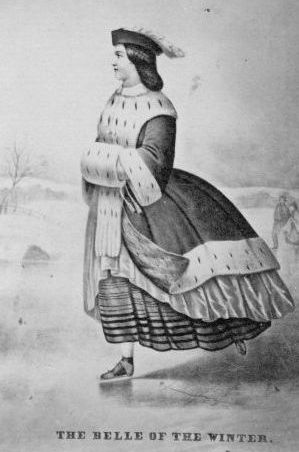
As ice-skating became a leading pastime in the 1860s, pictures of ice-skating and ice-skaters proliferated in the popular press, recording its impact on society. Looking at such pictures, it’s hard to escape the conclusion that skating represented something special in the lives of women, while also violating existing norms. If skating let women escape a certain social confinement, it rendered them more vulnerable, too. Ice-skating, though fun and bold, exposed women to certain perils, among them a mixing of classes and sexes that nineteenth-century society was set up to avoid.
This print by Winslow Homer (1836-1910) encapsulates such strains. Continue reading
Thanks to ice-skating, ladies’ skirts rise

The ice-skating craze that swept the northern US in the 1850s cracked the shell of stiff propriety imprisoning respectable women then. Normally, women were obliged to swaddle themselves in yards and yards of fabric, to garb themselves in full-length dresses and hoop-skirts completely concealing their lower bodies. Even equestrianism, which offered upper-class women a welcome chance to get some exercise, entailed riding side-saddle in a skirt that was abnormally long.
When Cole Porter penned the line, “In olden days a glimpse of stocking was looked on as something shocking,” he summed up the 1850s economically.
Ice-skating changed that in a snap—as long as ladies and gentlemen were on the ice. To step onto a frozen pond was to sail into a world where the rules of genteel behavior were relaxed, strangers mingled, and even women could get a little bit wild.
This opening for women was symbolized in the creation of a special petticoat, designed to be worn as activewear under their skirts. The Balmoral petticoat, as it was called, was associated with Queen Victoria and the outdoor pastimes—such as skating, hiking, hunting, and riding—that she and her family were known to pursue on their country estate in Balmoral in the Scottish Highlands.

Fashion plates, like this one, and this one, showing skaters in balmoral petticoats, underscore the connection between this article of dress and an active outdoor life. Women donned such petticoats to skate or, in warmer months, to play croquet.

According to Leimomi Oakes, who writes about historical fashion at dreamstress.com, the balmoral petticoat typically had broad stripes at the bottom. Sometimes it was made of a colorful plaid. The petticoat was made to show off, furnishing a flash of color under drawn-up skirts. While full enough to be worn over a hoop, when it was not, it showed off the wearer’s ankles and legs. The full effect could be startlingly bold, as in the cover illustration for the song, “The Gal with the Balmoral” (1861).
Women began wearing these shortened skirts as soon as they began learning to skate. The petticoat was in vogue by 1859, as this print shows.
So, for a brief time in the 1850s and 60s, ice-skating offered a taste of sweet liberation, when women could pin up their skirts and have fun outside.
 Sheet music cover, circa 1868
Images: Courtesy of the Library of Congress.
For further information click here and here.
This is the sixth in an occasional series on ice-skating. Click here to read from the beginning.
Ice skates circa 1850

This pair of American-made ice skates, dating from 1840-1859, is part of the collection of the Costume Institute at the Metropolitan Museum of Art. The ice skaters I’ve been writing about lately would have been wearing skates similar to these.
While these skates were of a style that had been used for centuries, skate design was on the cusp of dramatic change. The 1850s saw many innovations, as ice-skating boomed in popularity. Many different styles of clip-on and strap-on skates were being brought to market, as makers vied to make skates stronger, faster, and more stable. The toe pick and the elongated blade extending beyond the back of the skate, both features of modern figure skates, hadn’t yet been thought of. Stopping or turning in these old skates could be tricky! Note the nail sticking up from the platform of the skate, which embedded itself in the heel of the wearer’s shoe, as a means of making the skate more stable.

Skating ahead of the Curve documents the newfangled skates being made at the time. These skates, dating from 1840-60, have taken a leap forward in material and design. Made mainly of metal, including cast steel, they feature a heel cup and thick leather straps that would have attached firmly to a boot or shoe.

The heel cup is decorated with a skating scene.
For more on 19th-century skates and skating,
see “Ice Skating in the 1860s: A Fashion and a Passion,”
a wonderful article by Betty Hughes.
see “Ice Skating in the 1860s: A Fashion and a Passion,”
a wonderful article by Betty Hughes.
This is the fourth in an occasional series on ice-skating. Click here to read from the beginning.
The real stuff of history

Woman’s shoes, circa 1845, featured on “In the Swan’s Shadow.“
As a result of the internet revolution, the historian (whether armchair or professional) has better materials to work with than ever before. Museums, libraries, antique dealers, auction houses, even private collectors are increasingly sharing images of their holdings online, giving the material culture of the past a prominence and visibility that it lacked formerly. Hidden away for centuries in cellars and attics, History’s shoes and dresses, waistcoats and wallpapers, jewelry, love letters, paintings, and furnishings are suddenly everywhere, courtesy of digital photography.
The impact of these items can be surprisingly revolutionary, correcting and revitalizing the past that has come down to us through historical writing. Architecture, photography, and other vestiges of material culture together impart a more accurate and sophisticated view of earlier cultures. Rather than growing dimmer, views of nineteenth-century America, for instance, are growing more vivid each day.
Dipping into that past is the business of “In The Swan’s Shadow,” a blog that’s been around for about 5 years. The unidentified blogger who puts it out is amazingly dedicated and prolific, posting 1,560 items in 2013.
The site is a trove of images of items surviving from the era of the American Civil War, documenting the lives of women (and children) in particular. There are laces and shawls, bonnets and gloves, cameos, fancy dresses, portraits big and small, genre paintings, fashion illustrations, Victorian earrings and bracelets made of jet and turquoise, old photographs of women, hair-do designs, crinolines—you name it. I love the items the “ebon swan” features.
Popular interest in the Civil War period, about what women wore and how they looked, has been stoked by historical re-enactment and its sister art, historical costuming, both of which are the focus of innumerable blogs. A desire to re-create and re-inhabit the past, however briefly, has proved a powerful motive for taking history apart at the seams.

1859 fashion plate featured in a post on “In the Swan’s Shadow“
Thanks to an unsung army of hobbyists, curators, shopkeepers, and bloggers, two great gains for history are being achieved. First, the scrim of drab sentimentalism that formerly enveloped the antebellum and war period is being torn away. The era’s clothes, jewelry, and pictures bring back a culture that was sumptuous, passionate, colorful, and edgy. The heavy clothes that, in fashion plates, look only imprisoning can now also be appreciated as opulent expressions of female power and dignity.

Dress with black buttons in the Kentucky Historical Society‘s collection. Featured in a post on “In the Swan’s Shadow.”
Second, nineteenth-century America’s participation in a trans-Atlantic culture has never been more plain. Many Americans lived in primitive conditions in the early national and pre-Civil War periods, but others had access to goods that were dazzling. Lacking a fully developed sensibility, upper-class Americans continued to rely on Europe for luxury goods and ideas—for the glamour distilled in a fine silk damask, or in the light flutter of a lady’s fan.

Feathered fan in the collections of the Museum of Fine Arts, Boston, featured on “In the Swan’s Shadow.” Click here to go to the MFA site.
Yes, the real stuff of history is piling up at a crucial intersection of proof and inspiration, offering its mute truths as a feast to our vision.