♦ A HISTORICAL ANALYSIS OF PRESIDENT OBAMA’S ACCEPTANCE SPEECH ♦
♦
Theodore Roosevelt, though a fine president in many ways, left behind one baleful legacy: the idea of the presidency as a ‘bully pulpit,’ by which he meant a superb vantage from which to preach to others about how the nation should be. When you hear presidential candidates speaking confidently of the miraculous feats that will follow from their being elected, it’s the misleading cadences of a bully-pulpit preacher you’re hearing.
THEODORE ROOSEVELT RESHAPES THE PRESIDENCY
To an extent difficult for us to appreciate today, Roosevelt’s conception of the president as an active visionary was revolutionary, departing in significant ways from the executive role the Constitution laid out. Our scheme of government assigns the president a few plain duties, which, given the size and scope of the government and its role in the world, constitute a staggering burden. In addition to serving as the symbolic and ceremonial head of the nation, the president executes the laws, conducts foreign policy, commands the armed forces. Presidents often function as party leaders, but their constitutional function is essentially one of interdependence, for a president cannot make a law, placing every president in that regard very much at the mercy of Congress.
THE CHANCE TO BECOME A SCINTILLATING STAR
During the first century of the nation’s life, presidents grappled with this limitation in various ways, but Teddy was the first to dare to act as though it didn’t exist. He was determined to make the president the determining force in all things. Like Satan—the most powerful angel in Milton’s celestial firmament—, he chafed at playing second fiddle; he longed to be God. Suiting actions to words, Roosevelt broke the mold, becoming a media-oriented president intent on using his considerable intellect and celebrity to reshape the nation and govern Congress. Initiative pulsated from the White House. It was all very thrilling. Moreover, it kept Roosevelt constantly in the spotlight, which was something he liked.
WHICH BULLY PULPIT PREACHERS PLEASE US MORE
Since then, Roosevelt’s conception of the presidency has become our conception, too. In what is a sad distortion of the Founders’ vision, we expect the president—a single person—to do the work that Congress should be doing. This, in turn, leads to a confusion about where responsibility lies. The American people spend more and more time agonizing over presidential choice, more and more time trying to decide which campaign promises and bold visions please them more.
A PRESIDENT IN THE ROOSEVELTIAN VEIN
It was clear from the start that Barack Obama sought to be an activist president in the Rooseveltian vein. His entire campaign the first time around was based on the premise that he could “change Washington,” reorganize the business of politics, and define a new political epoch singlehandedly. For much of his first term, he seemed at odds with the presidential role, chafing at its limitations and behaving as though his ability to extract specific laws from Congress was the sole yardstick later generations would measure him by.
Influencing Congress became his preoccupation. Whether the issue was health care or the debt ceiling, President Obama spent much of his first term lecturing Congress and the public—chiding and exhorting the nation to embrace his vision for us. His love of showing his mettle prompted him to become over-involved in fruitless wrangles whose results were properly the responsibility of a weak and recalcitrant Congress. The “victories” so gained were costly indeed: witness a health-care bill ahead of its time that, regardless of its merits, heightened partisan rancor and left much of the nation resentful and unpersuaded.
THE BULLY PULPIT’S NOT ALL IT’S CRACKED UP TO BE
As recently as January, the president’s bully-pulpit predilections were on full display, when he chose to use the State of the Union address to tell Congress its business rather than report candidly on governmental progress. Yet, between then and now, Obama has seen the light about an activist presidency, about what a dead-end it is, how it takes a certain set of conditions to achieve. In the meantime, he has racked up a steady tally of gains, showing himself to be very able in directing foreign affairs and the military. And he retains the support of a large part of the electorate, who value his honesty and intelligence and see him as persistent, prudent, and humane.
FOUR YEARS OUT
Which brings us to the president’s recent acceptance speech. Some listeners were disappointed; others found the speech a bit desperate or weak. We all noticed a difference. The bully-pulpit fervor we’ve grown so accustomed to was missing.
Instead, the President re-articulated his fundamental role as ‘the people’s sovereign’—the keeper of the people’s interest, uniquely entrusted to embody and articulate their general sentiments and needs. This emphasis on the president’s traditional role as the national symbol of the people’s rule enabled the President to remind his listeners of their primary role as citizens, in a system in which his power is ‘from the people.’
A JUSTER RECOGNITION OF PRESIDENTIAL DUTY
Lacking the glitz and razzmatazz of his earlier speeches, the president’s speech that night was pitched in a lower key. Its high points were not remarkable for policy specifics, but for their embrace of a more constitutionally sound notion of the presidency, one focused on executing the will of the people and the astute exercise of presidential duty. The speech’s most important moment came when Obama said, “I’m not a just candidate for the presidency. I am the president,” a simple declaration that eloquently accounted for his changed tone.
For a sitting president who a year ago styled himself an underdog, this embrace of experience and authority marked a great leap toward political maturity. Scaling back the high-flown rhetoric and grand visions of which he has been so fond, the president has raised his ambitions in another way: making a bid for greatness by renouncing a view of office that offers self-gratification now.
Regardless of the continuing deep divisions in Congress, the nation can repose confidence in the seasoned president we have now. All in all, it was a moment I rejoiced to see: a prisoner of the bully pulpit breaking free.

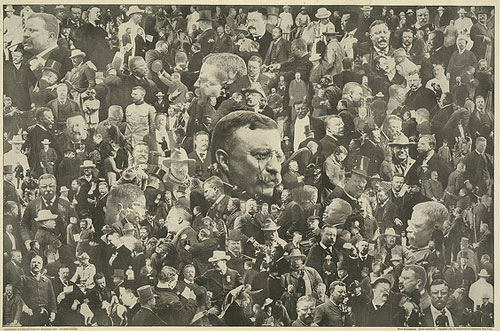
Top image: “Five hundred different views of Theodore Roosevelt,” from this source.
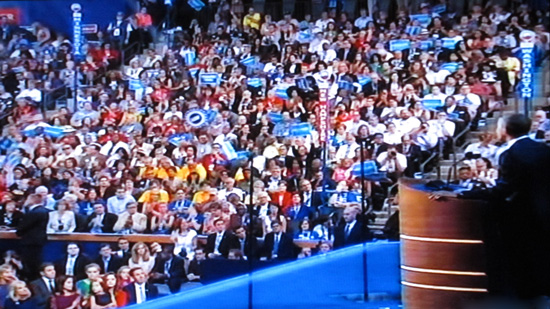
Bottom image: Screen capture of PBS Newshour coverage of the Democratic National Convention.