Charles Thomson and The Great Seal of the United States

An artistic depiction of a bald eagle with outstretched wings, holding a shield featuring three horizontal stripes and a branch in one talon. Above, there is a banner reading 'E Pluribus Unum' and a starry sky.

Judging from depictions of Federal Hall that I’ve been discussing, some version of the Great Seal of the United States crowned Federal Hall. Every view of the long-defunct building shows some version of the Great Seal as the dominant feature of the pediment. This is noteworthy, because, when the pediment was created in 1788, the “Great Seal” itself was just a few years old.

The tricky business of coming up with symbols to express American nationhood began during the Revolution (1775-1783), when officials of the Continental Congress felt the practical need for a iconography to represent unity. The symbols they came up with were often clumsy: first stabs at projecting power, capturing the unique identity of the United States, and distinguishing their new self-governing nation from old European monarchies. This new symbolic language, marking the states’ rapid transition to a nation, appeared on currency, official documents, flags, military insignia, and eventually buildings.

Charles Thomson, a Philadelphian who served as Congress’s secretary, designed the Great Seal in collaboration with William Barton, an attorney who had made a study of heraldry. According to historian Ben Irvin, in his Clothed In Robes of Sovereignty: The Continental Congress and the People Out of Doors, Thomson and Barton were the first to come up with the combination of the eagle and the shield, which are the essence of the Great Seal. Congress officially adopted the seal on June 30, 1782.

Thomson and Barton’s design incorporated much of the iconography popularized during the war, including the red and white stripes on a field of blue; the number thirteen, as manifest in the bundle of arrows; and the ‘new constellation’ of stars. The eagle, however, was an innovation, and in certain respects a curious one.

Irvin goes on to explain that, in 1775, Ben Franklin had issued a three-dollar bill as Continental currency, depicting Britain as an eagle and America as “a weaker bird.” Franklin despised Thomson and Barton’s choice of the eagle to depict the newly independent nation, arguing that the eagle was a scavenger, “a Bird of bad moral Character. He does not get his Living honestly.” Should the new United States be depicted as predatory?

Others, however, approved of the eagle, viewing it as “a symbol of empire.” Even then, some Americans were thinking of the United States in imperial terms. As for Barton, who first proposed the eagle, he assigned it a different, very specific meaning. Barton explained that his eagle was the “Symbol of supreme Power & and Authority, and signifies the Congress.” Note that the official seal predates the Constitution and the creation of the presidency.

Despite early federalism’s structural weaknesses, the Great Seal signified the aspirations of a new, self-governing people—to rule themselves through the mechanism of Congress. It has proved an enduring ideal. This aspiration was integrated into the face of the building where the First Congress met. It’s something to ponder as we gaze on the modern version of the Great Seal of the United States, prominently displayed on the dais where President Trump stands.

Image: from this source.

L’Enfant’s “Characteristically American” Federal Hall

Architectural drawing of Federal Hall, showcasing the front elevation and detailing from the 18th century. Features include the central dome, columns, and inscriptions about Major Pierre Charles L'Enfant.

Artist William Hindley made this interesting architectural rendering of Federal Hall in the 1930s, over a century after the building was demolished in 1812 to make way for the US Custom House of the Port of New York.

Further research on Hindley might clarify whether he was in business for himself or worked for a government entity such as the National Park Service (NPS) or Works Progress Administration (WPA), which employed scores of writers, artists, and photographers to document the physical environment and condition of the country at that time. Whatever the case, Hindley made a handful of drawings aimed at preserving the characteristics of this significant building, which was the sole seat of the federal government during its first year.

It’s prudent to approach such retrospective documents warily. The specifics they present as historical may be spurious and anachronistic, sheer invention making up for a shortage of factual detail. Good artists were scarce in the early national period; the visual record of important people, places, and events then, correspondingly thin.

Here, though, Hindley generally dispels our skepticism. In the lower left legend, he states that his work was extrapolated from the scale of the old city hall, combined with “Hill’s engraving and descriptions,” and Robertson’s drawing. (The latter is a street view of Federal Hall that Archibald Robertson sketched when the building was still extant, around 1798.) In addition, later scholarly analyses of Federal Hall offer other documentary evidence corroborating Hindley.

Hindley’s drawing effectively communicates the subjective significance of L’Enfant’s smooth, symmetrical facade. Highlighted are the columns, pediment, and entablature, a fancy cupola topping off the now three-story building. The focal point of all is the new nation’s seal. The upper right-hand legend tells us that, as reward and payment for his work, the 33-year-old L’Enfant was offered “10 acres of land at Proovost [sic] Lane between E60 and E49 street with a small payment of money but declined it.”

Overstating the case a bit, Hindley avers that L’Enfant was the first architect to solve the problem of how to make a building “characteristically American,” establishing a pattern that other famous public architects of the early national period, such as Bullfinch, Thornton, Hooker, Hadley, Thompson, and Latrobe, merely followed. What can be said with authority, however, is that the stylistic elements L’Enfant combined in Federal Hall were indeed used in government buildings in the US countless times.

Image: from the National Park Service
collection of artifacts pertaining to Federal Hall,
accessed on 12 December 2012.

Click here to view two other imaginative renderings
of Federal Hall that Hindley made.

New York: The Old City Hall

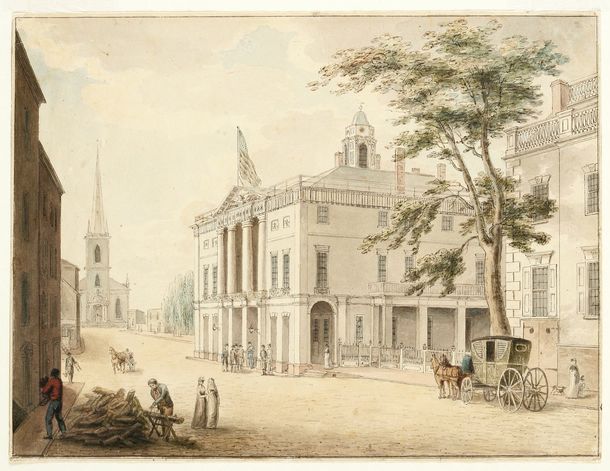
Watercolor illustration of the Old City Hall on Wall Street, built in 1699, showing its classical architecture and surrounding trees.

New York’s old city hall, pictured above, was remodeled at the time of the Founding and renamed Federal Hall. By then, the building was 90 years old, having been built in 1699. It was the administrative center of old New York, housing not only the mayor’s office but the city firehouse and a debtor’s prison, as well as the municipal court.

After the Revolution, this building became the seat of the Confederation Congress of the United States. The Congress, then the nation’s sole governing body, met here from 1785 until the Constitution was ratified and put into operation (04 Mar 1789), two days after the Confederation was formally dissolved. The First Congress convened here. New York remained the temporary capital of the US for one year.

As the new government formed, leading New Yorkers began maneuvering to have their city chosen as the permanent capital that the Constitution required. They raised funds to transform the Old City Hall into a more imposing structure imbued with Federal style. They employed a French-born artist, Pierre (“Peter”) L’Enfant, an officer of the Army Corps of Engineers and veteran of the Revolution, to furnish the plans. Occasionally during 1788, the Confederation Congress met at Fraunces Tavern, as workmen renovated the old city hall.

RELATED:
Fortenbaugh, Robert, The Nine Capitals of the United States (Internet Archive)
Historic Battlefield Trust, Early Capitals of the United States
US House of Representatives, Meeting Places for the Continental Congresses and the Confederation Congress, 1774–1789


Image: from this source.

The Toxic Vibe at Antietam

A view of "Bloody Lane" from the observation tower.

Every Civil War battlefield is poignant, preserving within itself a base, murderous vibe.  Each speaks to us in its own way of American folly.  Nowhere is the vibe more toxic than at Antietam.

What led Americans to murder one another there in record numbers?  They had lost patience over a complex problem that they failed to solve politically, and each set of murderers would be damned before they would see their opponents prevail.  And so they were.

In a quiet corner of rural Maryland just off the Potomac River, legions of Union and Confederate soldiers—Americans all—converged in cornfields and country lanes outside Sharpsburg, shooting, bombing, and bayoneting one another in a merciless bloodbath.  It was just one day in a civil war that lasted four years and destroyed the lives of hundreds of thousands of young men, scarring their families and traumatizing a proud, optimistic nation.  There in the vicinity of Antietam Creek, on September 17, 1862, some 23,000 Americans were wounded or killed.

Masses of dead Americans lying in a field after Antietam in 1862

They were the victims of party politics.  The lofty language Lincoln and others used to give meaning to the Civil War tends to obscure the truth that the war was a travesty, a rebuke to the pretensions of republican government.  The Civil War was the nasty afterbirth of a colossal political deadlock that upended the political system and plunged the nation into catastrophe.  We rarely acknowledge the deeply shameful character of this domestic rumble. The nation’s leadership class so failed the people that at last they and their states lost patience, gave up negotiating, and gambled on settling their differences by force.

When the Civil War broke out, the United States was a young, forward-looking nation.  Its people were migratory and accustomed to risk.  They were experimental, improvisational, adept at breaking with established ways.  Yet, when it came to slavery, their leaders were blinkered.  They were irresponsible and cowardly.  (Historian James G. Randall once dubbed them “the blundering generation.”)  In the first half of the 19th century, when other countries were advancing toward the gradual abolition of slavery (often in their colonial possessions), a generation of American leaders proved incapable of finding a peaceful way past white Southerners’ longstanding reliance on negro slaves.

An enormous literature catalogs the reasons these “antebellum” statesmen failed.  Slavery was deeply rooted in the South’s colonial past. The slaveholding class perceived owning “property” in slaves as vital to Southern prosperity, which was based on export commodities (chiefly tobacco and cotton).  White Southerners also enjoyed more than their fair share of representation in Congress, thanks to the three-fifths clause of the Constitution.

Northern politicians meanwhile turned a blind eye to slavery (the “peculiar” institution), in part because of the North’s own variety of anti-black feeling, but also because agitating for change with respect to slavery threatened the solidarity of the political class across the North-South divide.  No one in power could envision the US with a large free black population.

Northern Democrats, whose party was pro-slavery, were keen to steer clear of the slavery issue because they wanted to remain in power.  They wanted their party to remain dominant and keep control of the White House.  They were committed to preventing the federal government from infringing on the rights of slave-holding states or individual slaveholders.

In short, until the rise of the Republican Party in the late 1850s, slavery was an uncomfortable issue that no mainstream politician wanted to face.  Slavery, that “fire bell in the night,” as Jefferson memorably described it circa 1820, was so potentially divisive a matter that, for many decades, American statesmen conspired to keep it from interfering in national life.

Politically, this strategy of avoidance allowed northern and southern states to enjoy a balance of power.  As territories were settled and new states admitted to the Union, Congress passed various measures in an attempt to ensure that the number of free and slave states would remain equal.  The Missouri Compromise (1820), the Compromise of 1850, and the Kansas-Nebraska Act of 1854 were all constructed along these lines.

When an initially tiny group of antislavery politicians succeeded in organizing the new Republican Party and putting their candidate Abraham Lincoln in the White House in 1860, Southern legislators were certain they knew what the future held.  They were convinced that the Republicans’ success (though attained solely with the support of Northern states) presaged slavery’s doom—and their own.  Southern leaders who might have stayed in power to mitigate the effects of this untoward political development, recoiled against their minority status.  Fearful and defiant, they withdrew from national politics.  Then they went home and convinced their states to withdraw from the Union.  In doing so, they placed themselves on the wrong side of history, failing their states and fellow-citizens, and spinning a narrative of bitterness and alienation that some Southerners continue to lean on today.

Suddenly, because of all that, the residents who had heretofore ferried back and forth across the Potomac on their daily errands became mortal enemies.  Confederates blew up the bridge at Shepherdstown, Virginia, that was normally used to get to the Maryland side.  Then, after the bridge was gone, tens of thousands of troops who were part of Lee’s Army of Northern Virginia waded across the river at night to wage war in what was called the Maryland Campaign.

Lee sought to attack and defeat the Union Army on northern soil, but, even at this early point in the war, his soldiers and he may well have sensed the terrible futility and shamefulness of their resort to violence—the civic degeneration that “freed” them to attack their erstwhile compatriots, whose ancestors had fought with theirs to attain independence in the American Revolution.  Having disavowed their faith in federal politics and the Constitution, Southern “rebels” now poured their energies into slaughtering whomever they encountered in the “bloody cornfield.”

After both sides sickened from their atrocious duties, Lee’s forces retreated back across the river into rebel territory, an admission that their aggressive foray against the defenders of federalism had failed.

In retrospect, we can see how the visceral drama and valor of the Civil War took the heat off “the blundering generation.”  We do not excoriate the political establishment of that time for failing to hang together, for their cowardly abandonment of the federal system.

Because the Civil War at last secured the great goal of emancipation, we can easily be fooled into thinking of it as a noble, progressive event.  It’s blasphemy to admit the war was a terrible disservice to the nation, which would have been better off abolishing slavery by consensual means.  The partisan and sectional conflict leading up to the Civil War exposed frightening vulnerabilities in our Constitutional system, vulnerabilities that are still there, waiting for a freak combination of circumstances to exploit them again.

Sadly, the resort to force did not “settle our differences.”  A vast change in our internal relations occurred when slavery ended, but, as for the necessary change of heart, we’re waiting for it still.  Southern slaveholders never assented to slavery’s end.  Northerners never got serious about the concessions that might have induced the South to give up an immoral labor practice at odds with the nation’s ideals.  Ultimately, enslaved blacks attained freedom despite violent Southern opposition, engendering animosities that confound Americans still.  Still, America lacks consensus on racial equality as a fact and a blessing; still retrograde elements valorize their resistance to modern popular will.

How Wonderful It Would Be

Man cutting out stars in a flag factory (Courtesy Library of Congress)

“It would just be so wonderful if the answers could actually come from the South itself,” Isabella Wilkerson said.  She was talking about the Charleston shootings, the Confederate flag, and the influence the South’s slave-holding past continues to have on the region.  The race hatred that motivated a young white gunman to kill nine African-Americans in their own church is an extreme manifestation of the bitterness and resentment still lingering in some hearts after the Civil War—a conflict whose one-hundred-and-fiftieth anniversary the nation has just observed.

That long-ago conflict determined the superior power of the federal government over the states, while putting an end to Southern slavery.  The citizens of the sections warred against one another, one side sold on the merits of federalism, the other desiring to preserve states’ autonomy.  The South went to war over the right to pass and uphold whatever laws it pleased—specifically those that sanction chattel slavery.

The Union’s victory invalidated the rebels’ arguments, while setting up an asymmetrical dynamic vis-à-vis the South that persists.  In the wake of this rebuke, the federal government (in the so-called “Reconstruction” era) ruled Southern state governments for ten years, fearing that, if given political autonomy, the states would use it to resurrect slavery.  Later in the century, Southern states achieved something approximate through the Jim Crow laws.  During the civil rights era of the 1960s, the federal government again intervened to help secure and uphold black Southerners’ claims to legal and civil equality.  This legacy of intervention achieved progress by coercion–an achievement very different than that of racial reconciliation and political healing from inside.

When I traveled to Mississippi in the early 1990s, I was shocked to encounter whites who felt they couldn’t ‘win’ because of the weights the Civil War had placed on them.  They still felt diminished and beaten, and still resented and feared the state’s large black population, which could attain hegemony if empowered.  Enmeshed in an archaic social paradigm, they still regarded their black brethren as something other than Southern and equal.

The Southern tendency to predicate the present on this past is a baleful impediment to Southern progress.  It is, moreover, a baleful impediment to the vitality and strength of the entire country.  People of all sections are affected by the conditions prevailing in this one region.  Just imagine the transforming effects upon the entire nation if the South were finally to heal its own historical wounds!

Above: A man cuts out stars for a flag with a machine, in a photograph probably taken in 1909.
Image courtesy of the Library of Congress.