What The Democrats Must Do

A group of four individuals dressed in early 20th-century formal attire, including hats and coats. The group consists of two men on either side, a woman in the center, and another man on the right. They are posing outdoors, with trees visible in the background.

Listen to the podcast version here.

The Democratic Party is, at present, the only political organization in the nation capable of defeating Trump.  In the last election, voters looked to the Democrats to rise to the occasion, and Democrats let us down.  I’m looking for signs that the party as a whole has absorbed the lessons of 2024, but so far its leaders don’t seem to see the need to unite and act in concert; they don’t seem to realize how ideologically broken and blown they are.

The Trump era will end when his many opponents unite in a disciplined way around an adequate, innovative ideology. An “adequate ideology” would map out an alternative path to achieving prosperity and security for American citizens, while reviving a sound and balanced federalism. Given Americans’ grave dissatisfaction with both political parties, success depends on peeling away support from the Republicans, while embracing ideas that will induce independents to join a majoritarian coalition.

    As we all know, Trump’s outrageous style of governing tends to dominate the national discourse, leaving little room for the growth of this oppositional vision. Living in the Trump era is like having a neighbor blasting your least favorite music 24-7 while you are trying to write beautiful poetry. Instead of writing your master-work, you are screaming at the neighbor to stop with the noise. Trump distracts you from your own virtues, your own manners, and, especially, your own ambitions. Instead of figuring out how to restore civic trust and reform Congress, you are talking about Greenland, Venezuela, and—the newest distraction—the Epstein files. We’re all spending a lot of time thinking and talking about matters that are tangential to the survival of American self-government, even as Trump is diminishing our capacity to govern ourselves and knocking down the pillars of civil society.

    It’s very difficult to ignore and look past Trump, but the only way to vanquish him and his Republicans is to treat their actions as irrelevant to the nation’s future. It’s necessary to dream a constructive and counterfactual dream. If Trump were not in power, what could the future of the United States be? Democrats must retreat to a tranquility chamber together and dream that dream. They mustn’t be haters, critics, or skeptics: they must recall the good deeds that American government has done. They must extol everything that’s still good and sound in American society, and they must map out how its people can propel this country to a new modern high.

    For, where do ordinary voters fit in to the American equation any more? Individuals are increasingly extraneous in a technological mass society that, in the form of “the AI revolution,” is bifurcating the nation’s economy into a hyper-capitalized empire run by an investor class, who are engrossing all the goodies, at the majority’s expense. This out-of-control juggernaut is flattening the lives and hopes of a vast range of workers and property-owners. Media companies are turning our lives into data mills at the expense of our privacy and freedom to associate—to act, to argue, and to organize.

    Meanwhile, since Kamala Harris’s undemocratic nomination, voters recognize that their traditional power to choose their own party’s leaders, and to bring those leaders to heel, has somehow disappeared. The process the Democrats relied on to anoint Biden’s successor was an untoward event that the party’s leaders have yet to reckon with or formally acknowledge. They owe the voters and state-level pols an apology. The elite of the Democratic Party should reform its convention rules and restore delegates’ freedom to choose a representative presidential nominee. Every effort should be made to be a party that runs on commitment not cash. Reliance on the collective will and power of the people must be restored.

    Ideologically, Democrats cling to a globalist perspective out of step with the most pressing problems facing the US now. Trump’s vision for this country, no matter how antagonistic to its founding principles, prioritizes nation-state survival and acknowledges that changing demographics and other geopolitical conditions (such resource scarcity) threaten the integrity of the US, both as a republic and the world’s biggest economy. Democrats have yet to accept and get in front of trends that are transforming attitudes toward national security and identity all across Europe and the western world. Western liberalism must survive, but to do so it must take on a nationalist form, mindful of the special circumstances (including property ownership, cultural homogeneity, and limited government) that have historically been productive of personal liberty. Democrats have yet to accept that we are no longer in a period of boundlessness: we are in a period of consolidation.

    Whether we like it or not, borders will be closed; trade alliances will be confined to countries that are ideologically similar to ours; immigration policies will be more discriminating; and the quest for natural materials and energy will grow ever keener and more problematic, given the overcrowding and degradation the planet is suffering. Democrats are not practicing realpolitik, though. They’re stuck in a reactive, defensive mode, clinging to the ideals of FDR and LBJ, still fighting for the Great Society. Democrats are fighting battles that they’ve lost already, when they should be totting up their losses and stomaching the ideological tradeoffs they must make to attain solid majorities in the states and take control of Congress again. To do so, they must look past the superficial traits of identity and concentrate on what will enhance the dignity and security of all Americans, without respect to living condition or creed.

    Prevailing over Trump requires advocating for border control and for new immigration policies that are stricter yet fairer to all involved. It means restoring the substance of ordinary Americans’ power over their representatives. And it means doubling-down on resource conservation and asserting Americans’ common right to essentials such as land and water that data-center developers and other corporate interests are engrossing with frightening speed.

    Whether Democrats are high-minded enough to reshape American politics in the people’s interest, though, remains to be seen.

    Image: Delegates, including
    Elizabeth Dunster Gibson Foster of Washington State,
    at the 1916 Democratic National Convention in St. Louis, Missouri,
     from this source.

    A Touch of Covid Immobilizes

    It’s my turn to have a covid infection.  I developed a cough on the eve of an appointment to get the bivalent vaccine.  Just a little cough.  So I took a home test and was surprised when it showed a faint positive line.  No bivalent vaccine for me.

    So, the immobility.  I retreated to the guest bedroom Wednesday, where I’ve been since, except for venturing briefly (in a mask) to other rooms for necessities.  No TV.  If I stay here for five days, the minimum period of self-isolation that the CDC recommends to anyone who tests positive or has covid symptoms, it will represent an immobility utterly new to me.  Never have I been confined to one room for days at a time.

    The utter absence of bedside companionship makes it strange.  No one to come in with chicken broth or sit in the corner to pass the time.  My going out to lie on the sofa in the living room is out of the question, too.  If I had an ordinary flu or cold, such would be my choice for seeing it through.

    The isolation covid requires is elaborate and severe.  It’s no wonder that household infection rates are so high (50% or more).  Most families lack the room that the authorities say a self-isolating covid patient requires.  Not every household has a bed and bathroom to devote to self-isolation. Also, the goal of keeping the covid patient isolated from others at meals is attainable only if eating schedules can be staggered or someone else can wait on the covid patient in his or her room.  This is impossible if a household is cramped or its members have other obligations.

    No wonder many Americans dismiss or ignore the official guidelines.  For thousands, these guidelines are impracticable, outlandishly so.  Space considerations aside, many workers can ill afford to stay home for so many days; those without sick leave forfeit their pay.

    Global forces have found their way into my guest room via my lungs.  Large events, such as covid, the January 6th insurrection, and the war in Ukraine, define our times historically.  These vast, complex dramas, which are too large for any ordinary person to influence or control, have powerfully and lastingly transformed the tenor of our milieu.  Yet, even as covid sweeps over society and every one of us individually, its effects on us are isolating.  Just as covid’s dangers have jeopardized the institutions and customs that define society, so masking divorces us from one another.  Being sick with covid not only removes us from society; it disrupts our households and families.  Official policies regarding covid estrange people from one another and challenge individuals to live according to scientific standards at the expense of their own time-honored ways.

    The nation’s response to covid is not necessarily objectionable.  It can be defended on humanitarian grounds.  At the same time, I get why segments of the population view the fight against covid as quixotic and ineffectual.  Even as I adhere to prevailing guidance (which I need my doctor to interpret for me), I’m aware of its byzantine, hieratic qualities, which make compliance a kind of luxury.

    Why Trump Wins

    A previously unpublished post from 2016

    close-up of the Republican candidate talking

    “It’s the economy, stupid”—Bill Clinton

    The painfully long GOP primary season reached its climax Tuesday, as real-estate mogul Donald Trump secured a victory in Indiana that scuttled his two remaining opponents and all but gave him the presidential nomination.  In recent contests, Trump has scored lopsided victories, finding support in suffering areas of the Rust Belt, as well as among the residents of northern cities and coastal states.  In New York and Pennsylvania, for example, Trump carried every county except his own Manhattan Borough.

    Trump’s emergence as a political force is engendering widespread irritation and dismay, even alarm.  Trump has a vicious streak; he is not a gentleman.  He affronts the Republican establishment by upending their principles; he affronts everyone else by eschewing the etiquette of statesmanship.  At rallies, he turns on the crowd by stoking base tendencies, insinuating that it’s okay to be violent; it’s okay to hate.  In a stagnant political moment, Trump promises radical and stark action on middle-American issues.  On policy, he’s cagey.  Unfortunately, it’s impossible to separate the message from the man.  He’s driving a stake through the heart of the parties and feeding on identity politics’ innards, horrifying every decorous conservative and liberal.  Donald Trump is free speech at its worst.

    Last night, CNN’s large panel of political experts squirmed in their chairs, their very skirts and suits discomfited as they contemplated the magnitude of Donald Trump’s triumph over a field that once included 17 talented and determined rivals. This morning, the New York Times ran an editorial, ‘GOP Steps Deeper Into Darkness,’ essentially skirting the dilemma of millions of voters and lamenting that ‘Instead of rejecting what Trump stands for, the Republican Party is falling in line behind his nomination.’  Meanwhile, Donald Trump subliminally responds, “It’s the economy, stupid,” in every one of his victory speeches.  In truth, we have no way of knowing what part of his crowd is evil and what part is wise.

    Beating Trump will depend on honing in on the part of his message that’s constructive and co-opting it.  Trump is unique in his focus on the downside of unbounded global capitalism.  He’s winning because of his prescriptions for the American economy, prescriptions unpalatable to an upper-class establishment that shrugs off evidence of declining US prestige and lower-class suffering.  Trump is winning because he has a consistent perspective on a few key issues, expressed in a compellingly urgent way.  He’s winning because the complacency that has allowed our infrastructure to decline and industries to decay must end.

    Trump is rising despite lacking the virtue that republican government requires.  His election would further dim the light of American ideals.  If only Trump’s opponents were equally gutsy in acknowledging and promising to redress the nation’s ills.  Ultimately, their failure is why Trump wins.

    A nation of bankers and shopkeepers

    capital-projectWhen my father could still speak, he would sometimes ask, “Do we really want to be a nation of bankers and shopkeepers?”  By which he meant, “Do we really want to become a nation that doesn’t make things?”  And, when talking about the nation of “bankers and shopkeepers,” he would inevitably mention England, a once-great manufacturing power that had allowed its amazing industrial advantages to wither away, leaving only “the capitalists,” who controlled and circulated most of the wealth, and “the shopkeepers”—everyone else—who retailed things. Continue reading

    A President Ventures Abroad

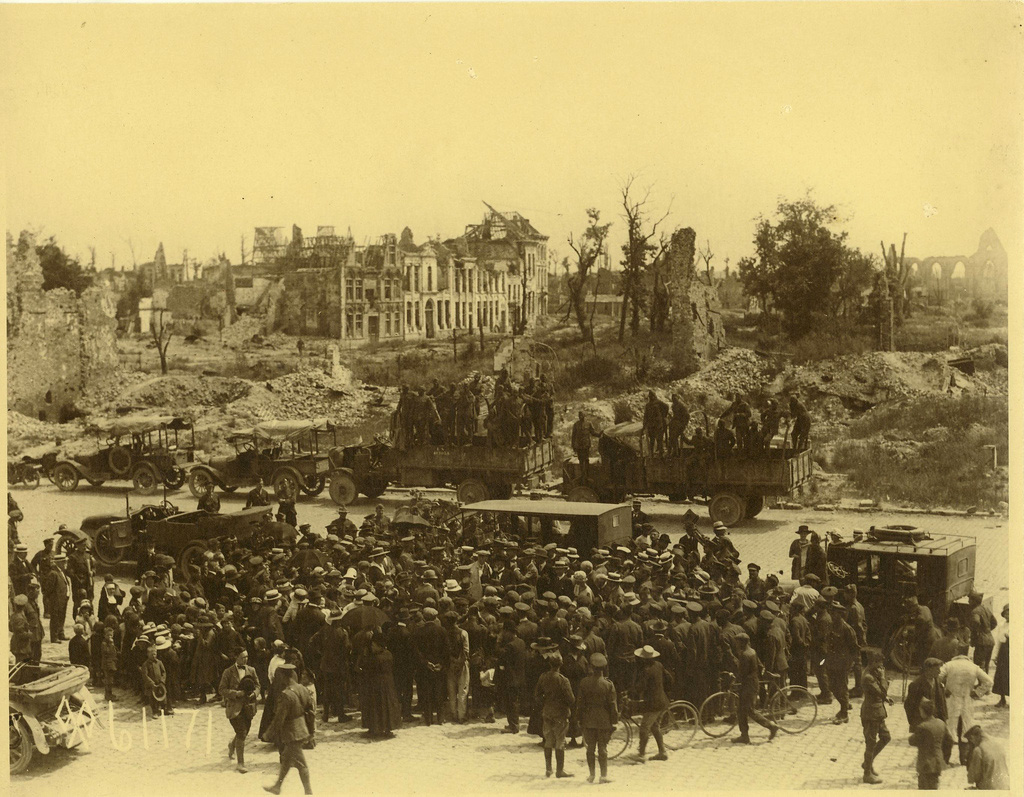
    President Wilson and the King and Queen of Belgium at Ypres, 1919 (Courtesy: Woodrow Wilson Presidential Library via the Commons on Flickr)

    Given the international status of the United States today, the home-bound nature of the presidency during the first century-plus of the nation’s existence is hard to imagine.  The first president to venture beyond the western hemisphere was Woodrow Wilson, who in 1919 traveled to Europe at the conclusion of the First World War to participate in the negotiations that produced the Treaty of Versailles.

    During his trip, Wilson and his entourage visited Belgium, touring Ypres and other areas that had been devastated by the fighting.  An anonymous photographer attached to the US Signal Corps documented the president’s tour of the war-torn landscape.  The resulting deep-focus sepia prints preserve the occasion on which Wilson first saw something of late war in which he and the rest of the nation had been engaged.

    Image: from this source.
    Click image to enlarge.