A Cracking Veneer

heavily tweeked aerial shot of downtown and industrial Chicago
I’ve been away.  To Puerto Rico, ironically, which like Illinois is bankrupt, but which is free of the pretensions of grandeur that make living in Chicago, Illinois such a political and spiritual nightmare.

While I’ve been away,

A woman fleeing a gang of 10 youths in Streeterville ran out onto the Drive, where she was killed by a car.

Sixty-nine people were shot over the holiday weekend, 6 fatally.

The City of Chicago paid $2 million to settle a lawsuit that whistle-blowing cops had brought, heading off a trial that would have centered on the police department’s code of silence.  Mayor Emanuel, who was to have been called to testify, figured this was a good use of citizens’ money.  What use is justice here anymore, anyway?

In the state capital, the legislature once again ended its spring session without passing a budget.  The legislature has now failed of its duty for two years.  According to the website Truth in Accounting, Illinois’s debt burden is $187 billion.  Others place it at $148 billion.  Illinois lawmakers are too cowardly to face the pain entailed in getting the state’s finances back in balance again.  It’s difficult to divine why they are in office.

Chicago is a microcosm of all that troubles the nation now.  The racial divisions, out-of-control violence, and public corruption are corrosive.  Public order is fragile and in jeopardy.  Over all this is a posturing ‘leadership’ that cares mainly for reputation and the superiority of being part of a political elite.

Image © Susan Barsy

Trump at the Top of the GOP Heap

The GOP heap (April 2016), © 2016 Susan Barsy
With Donald Trump’s sweep of five more states yesterday, his two remaining opponents in the GOP are looking more and more like also-rans.  Trump has not yet sewn up the nomination, but the odds that he will are increasing.  His victory in the so-called ‘Acela’ states demonstrated, perhaps more than any win up to now, that he is not a fringe candidate—that he has broad geographic appeal and can secure votes among diverse demographics.  Last night, for example, he carried the Philadelphia suburbs, defying those who imagine that Trump’s followers are mainly people of low means and education.

Last night, Trump won more than 53 percent of the Republican vote.  Ted Cruz, his nearest rival, polled dismally, placing third in four of the five contests, more damning proof of the Texan’s unpopularity in the moderate eastern regions.  In remarks following his victory, Trump deftly portrayed Cruz’s recent procedural maneuvering (e.g. wooing convention delegates) as ethically dubious and irrelevant.  While Cruz hopes to win nomination on the convention’s second ballot, Trump expects to win on the first, rendering Senator Cruz’s efforts nugatory.

And, honestly, if Trump continues to moderate his tone, it is difficult to avoid concluding he will be the Republican nominee.  Last night’s remarks showed him looking confidently ahead to Indiana and beyond that to the general election, where he will offer Secretary Clinton a formidable challenge.

Our Political Parties Are Behind the Times

REAL CLEAR POLITICS is offering a mind-bending set of survey results showing how respondents would vote in hypothetical general-election match-ups.  A number of organizations conduct these surveys, and at the moment the results of all of them are pretty consistent.

Clinton vs. Trump
Clinton would win

Clinton vs. Cruz
Clinton would win, but more narrowly

Clinton vs. Kasich
Kasich would win

Sanders vs. Trump
Sanders would win

Sanders vs. Kasich
Sanders would win

Sanders vs. Cruz
Sanders would win

These fascinating results help correct the myopia that sets in during the primary season, when passions within the parties control the focus.  On the Democratic side, Sanders is losing the delegate race to Clinton, yet in a general election he might fare better than she.  His positions, though untenable, might be more palatable than the kinds of ideas the Republicans are touting, for according to the polls, he would beat any of the remaining GOP candidates handily.

Interestingly, Clinton, though holding her own within her party, would fare less well than Sanders nationally.  She will be lucky if Donald Trump becomes the Republican nominee, because, of the three remaining GOP candidates, he is the only one she can probably beat.  She might be beaten by Cruz, and the lowly Kasich, according to these numbers, would defeat her easily.

Overall, these surveys highlight the blinkered condition of the parties.  Sanders, the candidate the Democratic establishment has refused to accept, points up the existence of a dominant voter base that Clinton’s candidacy isn’t capturing.  Clinton is electable, but Sanders is even more electable than she.  Old-style Democrats don’t want to see this.  They don’t want to abandon the comfortable centrist positions they’ve grown accustomed to.  They’re ignoring the reveille: new, more egalitarian policies are what the nation wants and needs.

On the Republican side, we see confirmation of what we knew from the start, that the Republican field was weak though large.  The two Democratic candidates are more in sync with national sentiment than are their counterparts in the GOP.  Overall, the Democrats are more likely to prevail.  Meanwhile, the GOP’s most viable candidates, Trump (on the basis of primary support) and Kasich (on the basis of electability), are those the party has been most unfriendly toward.  Cruz’s candidacy provides the sole hope for the staunchly conservative wing of the Republican party, a minority element that continues to jeopardize the health of a national mainstream Republicanism.

Neither political party has proved adept at accommodating the sentiments of the voters, who are demanding new leadership and significant ideological reform.

When A Party Divides: The Democrats in 1860

Stephen Douglas and James Buchanan as cocks fighting to the death.
This masterly drawing from 1860 captures the terror and ugliness of the break-up of the then-dominant Democratic party.  At the time, the Democrats were by far the nation’s oldest political party.  In fact, since the break-up of the fitfully successful Whig party a few years earlier, the Democrats had faced only a fractured opposition, a situation that the emergence of a new, national, anti-slavery party was about to change.  Shortly before this print was struck, the nascent Republican party had met in a convention at Chicago, where they had chosen an outlier, Abraham Lincoln, as their presidential nominee.

The Democrats had flourished by being laissez-faire on slavery.  They stood for a limited federal government, which, in their view, meant leaving slavery and slave-owners strictly alone.  The entire party had been organized around the goal of keeping the federal government from ‘interfering’ with slavery, a goal which enjoyed broad appeal in both North and South.  As slavery became more controversial, however, it became more difficult to rally around this leading idea.  Democrats had controlled the White House since 1852, but who could they put up to succeed the incumbent president, James Buchanan, an elderly former diplomat, who alone could conciliate the party’s fractious northern and southern wings?

In the presidential election of 1860, Democrats watched their party collapse, as its leading figures fought one another for the nomination and the power to chart the party’s future.  By Election Day, the Democrats had split into three parts, backing three rival candidates, opening the way for Lincoln’s unlikely victory.

Stephen Douglas, the strongest of the Democratic contenders, was so controversial a pick that the Democrats’ first nominating convention in Charleston, adjourned without selecting anybody.  Douglas had kept his lead through 18 ballots but could not muster the support needed for victory.  The party convened a second time in Baltimore, where Douglas was finally nominated. His opponents rebelled.  Fire-eaters who wanted a more vociferously pro-slavery candidate bolted to form the Southern Democratic Party, choosing Vice President John C. Breckinridge of Kentucky as their nominee.  A third faction, alarmed at the prospect of a national schism over slavery, eschewed these choices, banding together to form the Constitutional Union party, with Tennessee’s John Bell as their nominee (and the northerner Edward Everett as his running-mate).

The Democrats’ crisis hinged on a failure of leadership and ideology.  The party’s main idea was exhausted and untenable, while its chief figures, though able and patriotic, stubbornly clung to incompatible strategies.  None had the genius, nor the humility, to reconcile the party’s increasingly discordant aims.  Even as the crisis unfolded, observers knew it signified diminishing prospects for ‘the Democracy.’  The party was going to be smaller and weaker, a reality that the creator of the Currier and Ives ‘cartoon’ captures very effectively.

In the ensuing election, Lincoln would win, though receiving just 39.8 percent of all the votes cast.  The Democratic vote would have swamped him if combined.  Douglas won 1,380,202 votes; Breckinridge, 848,019; and Bell 590,901, for a total of 2,819,122, whereas Lincoln polled just 1,865,908.  He won in the North but nowhere else, leading Southerners to style his an illegitimate presidency.  By Lincoln’s inauguration, the Southern states had begun to secede.  With the bombardment of Fort Sumter on April 12, 1861, the American civil war got underway.

Democrats felt justified in breaking with their party, but, in all of American history, no election-year choice proved more costly.  The Democrats feared the end of slavery, but, had they ignored their differences and rallied around Douglas, the transition to freedom might have been far less catastrophic and bloody.  Lincoln would not have been elected, and the Civil War as we know it might not have occurred.

As it was, an estimated 620,000 Americans lost their lives.  The Democratic party was dishonored and eclipsed.  It was not until 1885, with the victory of Grover Cleveland, that a Democrat again occupied the presidency.

Image from this source.

The cartoon, published just after Stephen Douglas’s nomination at Baltimore, portrays the struggle within his party as a life-or-death blood sport.  The triumphant ‘Illinois Bantam’ (Douglas) crows over a prostrate ‘old cock’ symbolizing President Buchanan.  The old bird is dying, his great size signifying the power of a united party.  Douglas, flush with victory, boasts of his ability to beat both Lincoln and Breckinridge, the head of the strongest rival Democratic faction.  But just as the victorious Douglas is much smaller than the tough old bird he defeated, so Breckinridge is much smaller than he.  The ‘Kentucky chicken’ looks openly afraid as his handler puts him in the ring.  On the left is a philosophical figure who might represent the machine politicians of Tammany.

Master the CPS Pension Crisis in 5 Easy Steps

Playing Teacher (Prang Co. lithograph), Courtesy Library of Congress.

Should we sympathize with the Chicago Teachers Union (CTU)?  On Friday, the teachers walked off the job and took to the streets, ostensibly on a crusade, not principally for their own benefit, but for the sake of increasing education funding more generally.  Union boss Karen Lewis, looking jaunty, proclaimed, ‘We’re dying a death of a 1,000 cuts,’ implying that teachers were among Governor Bruce Rauner’s victims, and that all would be well if only the union could squeeze more money out of the state and its taxpayers.

Yet, if a report of the Illinois Policy Institute is correct, the financial woes of the Chicago school system and its teachers are largely internal and have been brought on by themselves.  The Chicago Teachers Union has been complicit in the ruin of the pension system established to provide retirement security, allowing money to be diverted from the fund while accepting overly generous increases in working teachers’ salaries.  Meanwhile, the Chicago Public Schools (CPS) leadership has so mismanaged its finances that a pension system that was fully funded in 1999 now represents a $9.5 billion liability, despite the fact that, over the same period, public funding for CPS has increased at 150% of the rate of inflation, when calculated on a per-student basis.

The IPI’s report, published in late 2015, analyzes the funding of teachers’ pay and pensions over several decades.  It explains the arrangements that have created the pension crisis while debunking some leading claims about where the solution lies.

1. Pension pick-ups:  In 1981, when Ruth Love was CPS superintendent, the district and teachers agreed that the district would pay the part of the teachers’ pension contributions.  Instead of pension contributions coming out of teachers’ pay, a part of their share would come out of the schools’ general operating funds.  These pension “pick-ups,” which continue today, amount to a loss of operating revenue of $1.266 billion over the last decade.  Meanwhile, the pick-up has not been counted as part of the CPS’s mandated contribution to the pension fund.

2. Pension holidays: On two occasions, in 1995 and again in 2010, the General Assembly allowed the CPS to forego paying in to the teachers’ pension fund as mandated.  The first of these ‘pension holidays’ lasted from 1995 to 2006.  During this period, the school system diverted all the money that should have gone for pensions (amounting to $1.5 billion) into its general operating funds.  During the second pension holiday, from 2011 to 2013, the CPS diverted another $1.3 billion from the pension fund.

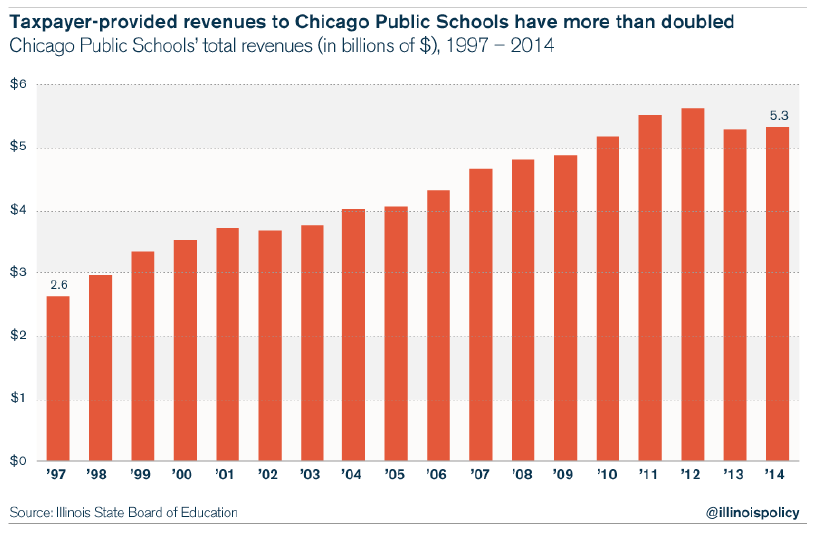
3. Colossally bad management: While the public is constantly being told that the schools’ problems stem from under-funding, the IPI claims that ‘Tax-payer provided revenues for the Chicago Public Schools have more than doubled‘ between 1997 and 2014, rising from $2.6 to $5.3 billion annually.  Meanwhile, the size of the student population has dropped by about 7 percent, from a high of roughly 383,000 students in 2003 to 355,634 students in 2014.  In 2014, the CPS received revenue of $15,011 for each child enrolled.

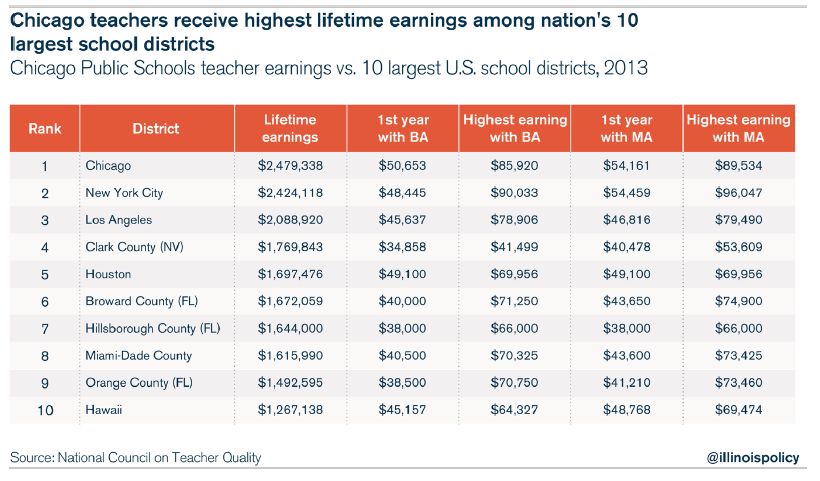
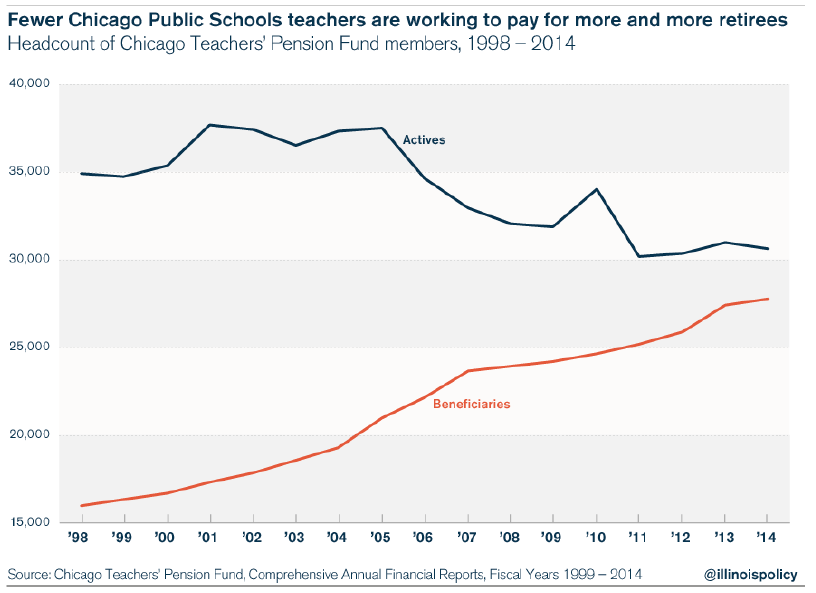
4. Unwise salary increases: The lifetime compensation of CPS teachers is the highest in the nation, relative to other major urban school systems.  A beginning teacher with a BA earns $51,092 a year.  Salaries increase rapidly during the first decade of service, so that teachers with 10-14 years of service earn an average pay of over $84,000 per year.  The salary structure increases the pension benefits of teachers earlier in their careers, enhancing the payout to younger ‘retirees.’  In 2014, over 72% of teachers in the Chicago schools had less than 14 years’ seniority.  The pension fund’s pool of beneficiaries is increasing, while the number of teachers paying into it is declining, another factor pushing it toward insolvency.

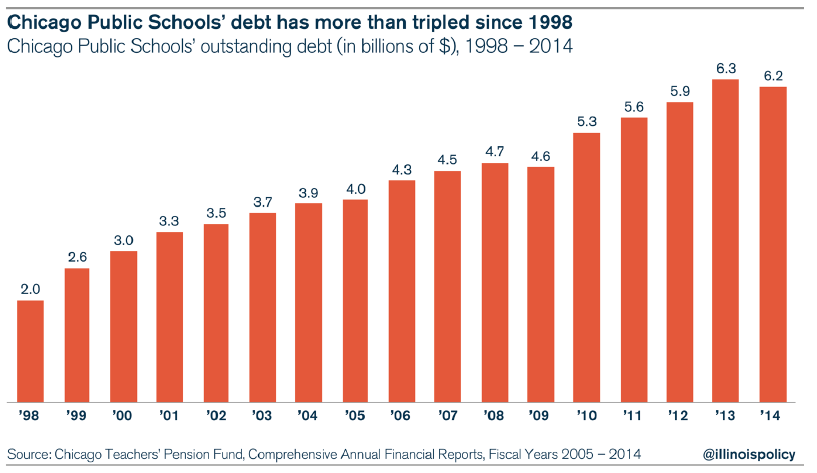
5. Reckless borrowing: It’s hard to escape concluding that the Chicago schools have been terribly mismanaged. Between 1998 and 2014, despite enjoying many years of pension ‘holidays,’ the CPS sank ever more deeply into the red, borrowing instead of confronting its true fiscal constraints.  CPS indebtedness totaled $6.2 billion in 2014.  Its bond offerings have been floated at ever higher rates of interest, even as its bond rating tanks.  Today, nearly eight percent of the CPS budget goes right to debt payments.  Another 68 percent goes to compensation costs, leaving just 24 percent for all the other expenses of running the schools.

Image: “Playing Teacher”
(1890 Prang Company lithograph)
from this source.