Will the Electorate Destroy the Political Parties?

Artist's sketch shows men talking excitedly at an open-air polling place in NYC.

Something utterly unforeseen could happen in this election cycle: the electorate could destroy one or both of the parties through primary voting.

Both the Democrats and Republicans are ‘hearing from ordinary America’, and the message is hostile.  On the Republican side, voters are heavily favoring Trump, a sometime Democrat and independent only weakly identified with the Republican Party.  On the Democratic side, voters have shown an unexpected interest in Sanders, a lifelong independent who is parasitically exploiting the Democratic brand.  Meanwhile, the veteran politicians who have come up through the parties have had an unexpectedly hard time making inroads against the spoilers, a sign that the parties are badly out of touch with the times.

We hear about the ‘establishment,’ but what is it really?  The parties, we are discovering, are impotent.  There is little capacity for concerted action among party politicians themselves.  If there were, they would have stopped these threatening insurgencies long ago, shutting out Trump and denying Sanders his putative connection with the Democratic Party.

Trump and Sanders are political bounders.  Who are their friends on the Hill?  How would either of them accomplish anything, were either handed the presidency?  Who would their advisers be?

Yet, faced with such a sub-optimal outcome, the senators, governors, and leading congressmen within each party have exerted no discipline, done nothing in unison.  Democratic governors and senators are not speaking out, urging voters to back Hillary.  Leading Republicans watch helplessly as, with each gladiatorial debate, their candidates further damage and degrade the party.  In the process, party feeling—that most basic of bonds—is being destroyed.

And all because Congress has failed to serve ordinary America.  The national leadership of both parties, as embodied in Congress, has shirked its duties.  Congress has not worked to create the virtuous circle of corporate responsibility, abundant skilled employment, and robust domestic consumption that would make our economy strong.  It has not confronted our ridiculous trade imbalance with China.  It has not resolved the issues around immigration and citizenship that are practically and symbolically urgent to millions of Americans.  Finally, Congress has ignored the fact that it must rein itself in and show the American people that it cares about efficient and effective governing.  Those who serve in the House and Senate have no sense of urgency—the urgency that both Trump and Sanders, for all their defects, are brilliantly communicating.

It’s wild and alarming to imagine the parties being destroyed from inside.  If Trump wins the delegate race, for instance, others within the GOP will face a choice: either embrace him and his ideology, back a ‘protest’ candidate, or break away to form their own new party.  Americans witnessed something of this sort back in the 1850s, when, over the course of a decade and in response to the festering problem of slavery, the Whig Party fell apart, the Democratic Party split into northern and southern wings, and the Republican party emerged out of nowhere, sweeping Lincoln to prominence and victory.

Nothing so cataclysmic has happened in our lifetimes.  Yet, many signs indicate that the current party system is losing its salience because it has grown deaf to the people’s needs.  In such circumstances, parties can become defunct with surprising speed.  Trump, Sanders, and even Bloomberg understand that, for an intrepid candidate, the parties’ senescent condition spells personal opportunity.  Any of these candidates, if successful, would force a dramatic shakeup within the parties, transforming the political landscape of the nation and the capital.

RELATED:
Inside the Republican Party’s Desperate Mission to Stop Donald Trump’ (NYT)

Image: from this source.

This artist’s sketch from Frank Leslie’s Illustrated Newspaper shows voters talking excitedly at an open air polling place in 1856.  The caption reads ‘Scene at the polls.  Boxes for the distribution of tickets.  Everybody busy.’  At that time, voting consisted of obtaining a pre-printed party ticket and putting it in a ballot box.  The three booths are labelled with the names of the three presidential candidates: Buchanan, the Democrat and victor; Fremont, the nominee of the new Republican (anti-slavery) Party; and Fillmore, who represented the anti-immigrant, anti-Catholic Know-Nothing Party.  Though the Democrats were victorious, the Republicans’ success in carrying some northern and eastern states created the impetus that would bring the new party to power four years later.

Campaign Notes (The GOP)

The GOP-Heap after Iowa 2016, © Susan Barsy
In the wake of the Iowa caucuses, GOP candidates are dropping like flies. In a more insensitive time, they would be likened to the ten little Indians, who dwindled, through various mishaps, to the point of annihilation.

In truth, it’s fair to wonder whether at this point, with nine GOP presidential candidates remaining, they are not already annihilated.  Is any of them a nationally electable candidate?  Would the nation really elevate a Bible-thumping Ted Cruz to the presidency?  Would it tolerate having as its symbolic representative someone as indelicate and bellicose as Donald Trump? As priggish as Marco Rubio?  One senses it is already over for the Republicans—that, despite all the hubbub and incessant media attention, the party is in the throes of something ugly, something momentous, even life-threatening.

The ‘establishment’ of the Republican Party appears weak indeed.  It is being weakened cannibalistically, as hostile forces (the ‘anti-establishment’) eat away at it from inside.  Ted Cruz’s campaign manager, Rick Tyler, described the situation brilliantly in a post-Iowa interview with the Newshour‘s Gwen Ifill.  Usually, he said, ‘the establishment has one well-funded candidate, and the conservative [wing] has a lot with no money.  This time, we’re the well-funded candidate, and the establishment, there’s a lot of them, and they don’t have the money.’

The situation points up the party’s growing incapacity to influence who will become its nominee.  The national party structure is more or less irrelevant to the primary process, where individual choice and extraneous forces (ranging from mega-donors to cable networks) increasingly shape the candidate field.  The pruning of candidates is being accomplished by entities like Fox and CNN rather than by the Republican National Committee.

The fallout from Iowa, where the three top candidates garnered 75% of the vote and nine ‘trailing’ candidates split the remainder, shows the prescience of former candidate Scott Walker’s warning to his rivals back in September, when weak early poll numbers based on his debate performances prompted him to drop out.  Others should follow his lead, Walker argued, so that the party could coalesce quickly around an alternative to Trump.  Three candidates–Paul, Santorum, and Huckabee–finally quit the race this week.  By now, however, the opportunity to create an impression of unity is gone.

Be careful what you wish for.  The Republican party’s disarray and fragmentation is accelerating under the impact of  Citizens United, the ironically titled Supreme Court decision widely regarded as conferring an advantage on Republicans and the wealthy cliques selectively backing them.  Now it appears that, with outside money flowing into the campaign process unimpeded, the power of the Party to govern itself and its nominating process has been fatally weakened.  As Mr Tyler notes, candidates like Cruz, whom the establishment hates, now have the money and staying power.  There’s little to keep such creatures from claiming the party’s mantle–whether the GOP likes it or not.

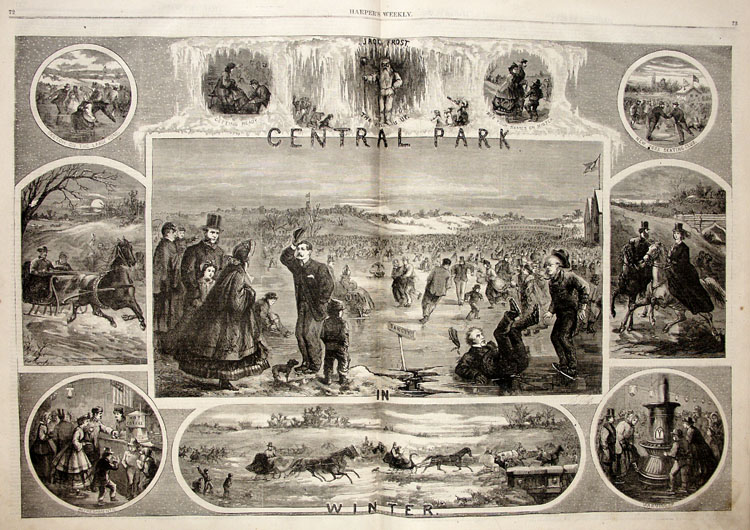
Thomas Nast’s ‘Central Park in Winter’

Two scenes, showing skating and sleighing in Central Park. The top panel includes drawings of James Gordon Bennett Sr and Horace Greeley
For the January 30, 1864, issue of Harper’s Weekly, Thomas Nast drew a many-paneled illustration of Central Park in winter.  Like many of his works, this one featured a large central drawing, surrounded by smaller vignettes in round and elliptical frames.  The main drawing shows New Yorkers ice-skating on Central Park’s Pond.  (The Park was then only a few years old.)  Below that is a rather wild sleighing scene, in which genteel New Yorkers ride through a desolate terrain, as urchins throw snowballs or rocks at them.

The opening of Central Park coincided with ice-skating’s growing popularity, which took hold in earnest in the 1850s.  The Park was most heavily visited in winter, when its pond became crowded with thousands of skaters, whose activities Nast captures here in wonderful detail.  (Note the woman in the skating chair.)

Perhaps inevitably, Nast’s wonderland contains some politics, too.  Two months earlier, President Lincoln had been reelected as an inconclusive Civil War dragged on, inflicting terrible casualties.  New York, being a commercial center, had always viewed the war with ambivalence.  The conflict was contrary to the city’s interests, disrupting a lucrative trade with the South on which New York’s economy relied.  While many New Yorkers were ardent Unionists and Republicans, the city also had a large Democratic constituency, including a politically active immigrant population, which resented the war, the federal government, and the fuss about slaves.  Many, wishing a return to peace, had lately voted for Lincoln’s challenger, Democrat George McClellan.

Anger over the federal government’s war policies had boiled into violence the previous July.  New York became the scene of bloody draft riots, in which rioters lynched at least 11 blacks and 120 people were killed in street fighting between protesters and the police.  Poor whites were inflamed against a draft bill that Congress had recently passed: while ostensibly requiring all fit men to serve in the Union military, it contained a loophole that wealthier Northerners would use to evade the draft: arranging for a replacement by paying a bounty.

In the foreground of his skating scene, Nast (who ardently supported Lincoln and the war) highlights several figures, including a military man at the far left wearing a kepi—a reminder of high-minded Northerners voluntarily leading the Union effort as officers.  At right are two prominent New York newspaper editors, James Gordon Bennett Sr and Horace Greeley, who have run into trouble on proverbially thin ice.  Greeley is teetering, while Bennett has fallen, both near a hole signifying treachery.  Bennett had been an outspoken critic of Lincoln and proponent of McClellan, whereas Greeley, while fitfully supportive of the war, had recently embarrassed the Lincoln administration by engaging in bogus ‘peace negotiations’ with some Confederate representatives who turned out to be fakes.

Both editors, though overwhelmingly influential, earned Nast’s scorn because they were feckless peace-mongers.  To have ended the Civil War through a settlement at that juncture would have rendered the suffering of the soldiers in vain.

Their presence heightens the allegorical meaning of the left side of the tableau, where three figures guard the safety of the family and society.  Besides the Union officer, who holds a small boy in his arms, Nast’s own editor Fletcher Harper (with mutton-chop whiskers) stands over a young girl protectively, while a third man (unidentified, but probably a prominent editor, too) deferentially greets a woman standing at the edge of the ice.  Nast depicts these figures as both benevolent and patriotic.  Harper gave Nast a venue for his pro-Union and radically egalitarian views.

So what at first glance passes for an innocuous pleasure scene is a comment on specific editors, and a paean to the value of virtuous editors in a conflict-ridden time.

Image from this source.

The Biggest Worries of 2016

An empty dining room decorated in an opulent European style.

Optimism is to be cherished, but, given the state of the world, it may be a foolish indulgence.  The times call for levelheaded engagement, not the dreamy complacency that optimism breeds.  Faith in our political system, in the American people, or in the capacities of elected leaders: faith like that has yielded small rewards lately.  The glue of trust that valorizes American government is disintegrating.

That the US has fallen into troughs of mediocrity before (think of the Gilded Age culture Mark Twain pilloried) is one of the few thoughts that consoles me.

Our national capacities matter more then ever, given the dire condition of the world, our institutions, and many of our communities.  What can we bring to 2016’s daunting prospect, a prospect defined by several cosmic and worrisome possibilities?

1. World War Three?

If it breaks out, it will be a war like no other, as was also true of World Wars One and Two.  In fact, it may already be underway.  We may not know it, simply because we are in the same situation as those who lived through other world wars. We watch as an unconventional conflict erupts and spreads in a fashion that the world order is unprepared to protect itself against.  In Syria and with the Islamic State, aggressors are working with playbooks that defy borders and prevailing conceptions of war and nationality.  As in previous wars, the Middle East’s war-within-a war has geographic and strategic traits that have already begun enmeshing a widening set of parties, both psychologically and militarily.

2. The decline of national sovereignty

World order as we know it is based on the concept of the nation-state: that states and powers have boundaries, and that, within those boundaries, all are subject to a nation’s laws.  The international order and our concepts of war are built on the notion that nations are sovereign.  In the many parts of the world, the concept of the nation-state has allowed humans to live peacefully under the rule of law.

These days, the integrity of the nation-state and the inviolable nature of national sovereignty are losing salience.  A host of contributing forces, both economic and geopolitical, was strikingly evident in 2015.  While Greece’s economic crisis exposed the mutual discontents inherent in the great experiment known as the European Union, its member-states are increasingly fractious, as the incidence of terrorism and a massive influx of refugees from war-torn and dysfunctional parts of the world have highlighted their loss of internal control.

Global mobility has increasingly challenged the static bulwark of the nation state, but the world’s leading powers have also rained insults on its integrity. Whether it’s Russia in the Ukraine, or the US in Syria, the superpowers frequently allow their desires to override their respect for the sovereignty of nations that they dislike.  Their increasing resort to overt and covert interventionism mocks the concept of national sovereignty.  Even changes in technology–such as the increasing sophistication of air-to-ground warfare–have made it easier to ignore and violate the clear boundaries that formerly protected nations from one another and impeded a general descent into war.

3. Witchy weather

Climate change, global warming—call it what you will, it’s a major worry.  Unbreathable air; murderous landslides; droughts and forest fires; glaciers melting, oceans rising.  Whether you’re a scientist or a believer in the Biblical end-time, you may agree (while wearing shorts in winter) that ‘Old Mother Nature’ is trying to tell us something.  Resource exhaustion is how a planet’s inhabitants typically do themselves in.  With omens like this, why worry about bombs?

4. The twin bankruptcies of Chicago and Illinois

Chicago and the State of Illinois are bankrupt already.  They just haven’t admitted it yet because of the shame.  The most powerful people in our state, especially the state legislators and Speaker of the Illinois House, Mike Madigan, will be remembered as the people at the helm when the ship went down.

Poor governance alone is to blame for Chicago and Illinois’s difficulties, for, ironically, both are richly endowed entities, with great human capital and masses of valuable resources and assets, including some of the world’s most productive farmland.  Illinois has one of the largest GDPs in the country, but it is saddled with a growing and inescapable debt load consisting chiefly of unmet pension obligations, the legacy of decades of corrupt and self-interested leadership.

The collapse of a major American city and its state AT THE SAME TIME has no precedent in US history.  History will remember and damn the leading politicians who for decades have written bad laws and abused the people’s trust.  Hold on to your hats, all Illinois!  2016’s going to be a bumpy ride.

5. A Donald Trump presidency

Beyond the well-aired controversies that Donald Trump inflames, his ascendancy portends chaos in the political realm.  Not only does Trump’s unwelcome prominence prove that the Republican National Committee has lost control of the party; it also shows the degree to which both parties and their personnel have lost touch with the sentiments of the electorate.  Whether Trump can convert viewers into votes remains to be seen, but if he polls well, we’re going to find out what happens when a candidate upends an entrenched national party.

Image: Carol M. Highsmith, Marble House, Newport, Rhode Island,
from this source.

George & Martha Washington’s Christmas Pye

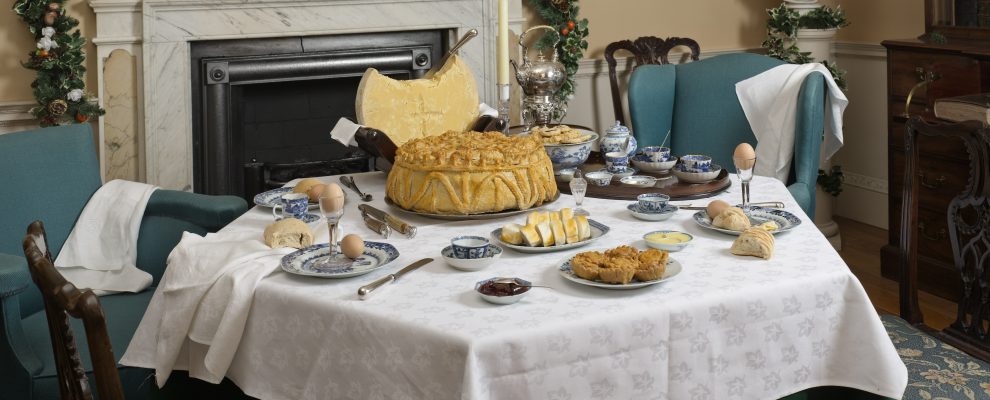
Virginia dining room from the Founding era (Thorne miniature)

In the Thorne Rooms of the Art Institute is a placard describing a special pie that George and Martha Washington are thought to have served on Christmas at Mount Vernon.

First make a good standing crust, let the wall and bottom be very thick; bone a turkey, a goose, a fowl, a partridge, and a pigeon. Season them all very well, take half an ounce of mace, half an ounce of nutmegs, a quarter of an ounce of cloves, and half an ounce of black pepper, all beat fine together, two large spoonfuls of salt, and then mix them together. Open the fowls all down the back, and bone them; first the pigeon, then the partridge, cover them; then the fowl, then the goose, and then the turkey, which must be large; season them all well first, and lay them in the crust, so as it will look only like a whole turkey; then have a hare ready cased, and wiped with a clean cloth. Cut it to pieces; that is joint it; season it and lay it as close as you can on one side; on the other side woodcocks, moor game, and what sort of wild fowl you can get. Season them well, and lay them close; put at least four pounds of butter into the pie, then lay on your lid, which must be a very thick one, and let it be well baked. It must have a very hot over, and will take at least four hours.

I puzzled to imagine the result of this outrageous recipe: a stew in a deep pot, swimming in butter?  Weren’t the Washingtons cooking up a food-borne disease?  The realities of their experience, though, turn out to have been far more pleasant and sophisticated; to an informed sensibility, the virtues of their Christmas Pie were considerable indeed.

Benjamin Latrobe, "Mount Vernon with the Washington family on the terrace" (Courtesy of Wikipedia)

In November 1786, Washington’s old friend and military aide, David Humphreys, wrote the retired general regretting that he would “not have the felicity of eating Christmas Pie at Mount Vernon.”  Afterward, Washington replied that he could have used Humphrey’s “aid in the Attack of Christmas Pyes . . . on which all the company . . . were hardly able to make an impression.”

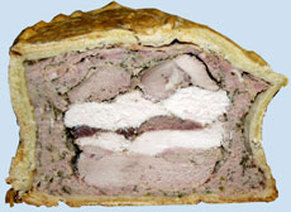
Ivan Day’s research into food history illuminates what the Washingtons’ Christmas pie looked like and how the dish was actually consumed.  The recipe above, meant to be eaten cold, was for a standing Yorkshire pie well known throughout Georgian England.  According to an interview Day gave to The Hill, the crust served only as a standing vessel for the meats and was not meant to be eaten.  Instead, the crust and the thick seal of butter encased the meat, preserving it air-tight, not just for days but weeks.  The main ingredients, spiced and tightly packed inside one another, created concentric circles in the cooked pie when sliced.  When the pie was ready to be served, the top was broken off and guests feasted on the terrine-like concoction resting inside.  (For representative pictures, click here, here, or here.)

Raised pies (Illustration from Mrs Beeton's)

Victorian-era illustration featuring meat and game pies.

The Yorkshire pie was a towering work of gastronomy and ‘a universal favourite at Christmas time.’  Making such a pie demanded time, ample resources, and patience, but the result was a showy presentation of the choicest meat delicacies, baked in a fashion that sealed in their flavors.

On both sides of the Atlantic, the Yorkshire Christmas pie, which remained popular for at least a century, became a calling card of the powerful and wealthy.  The Washingtons’ recipe, from Hannah Glasse’s The Art of Cookery Made Plain and Easy (London: 1784), explains that

This crust will take a bushel of flour. . . . These pies are often sent to London in a box, as presents; therefore the walls of the crust must be well-built.

The Washingtons’ pie was not just massive and delicious, but a sign of their means and their ability to bestow largesse on other people.  Around the same time, the future English abolitionist William Wilberforce was arriving at a similar understanding.  Then a student at Cambridge, “he was truly hospitable,” for “there was always a great Yorkshire pie in his rooms, and all were welcome to it,” according to R. V. Taylor, in his Yorkshire Anecdotes, or, Remarkable incidents in the lives of celebrated Yorkshire men and women.

Merry Christmas, everyone!