Hello, February

Ice skating; The Lincoln Memorial in the background, Washington, DC (Courtesy of the Library of Congress).

February is seldom as fun as I hope it will be.  I dream of escaping to the sledding hill or spending an afternoon out ice-skating, but instead I end up trapped at my desk, thinking of dead presidents, the white and black races, and slavery.

Its calendar page filled with the birthdays of Abraham Lincoln and George Washington, the birth and death dates of Frederick Douglass, and the observance of Black History Month, February is a minefield of historic associations, of significance buried but waiting to explode.  Continue reading

After the Red Wave: What Democrats Should Do

2014midtermcolorbar
Republican gains in Tuesday’s elections delivered a stunning rebuke to Democrats and their party.  The GOP is resurgent, despite having teetered after the 2012 election on the verge of disintegration and decline.

The Republicans achieved this gain primarily by telling voters that, under President Obama and the Democrats, the nation has fared badly.  Republican candidates attacked both the style and substance of the administration.  They assailed a government that they styled as autocratic, expensive, and ineffective.  They railed against government intrusion, and (in the case of illegal immigration) against governmental laxness, too.  They chafed against laws and constraints they don’t believe in.  Most of all, Republicans succeeded by denigrating what will surely be regarded as this era’s most significant achievements, such as the government’s success at bringing the nation back from the brink of all-out economic collapse and at passing a radical yet tenable and comprehensive health-care reform bill.

Strategically, the GOP also took care to marginalize some of the worst kooks seeking to work their way up in the party’s ranks.  The Republican National Committee under Reince Priebus encouraged and supported more electable candidates whose messages would still resonate with conservatives.  The policy also served the goal of producing a Republican Congress that is more homogeneous and governable.  Anyway, as campaign strategy, it worked.  Even weak candidates like Senator Pat Roberts of Kansas won.

Sadly, the Democrats were afraid to be identified with their party’s strengths.  They also failed to deliver a vision of government, that, if consonant with their recent achievements, was fresh and forward-looking.  As the president’s time in office wanes, Democrats should be thinking about how to catch the next wave.  What should the Democratic Party be about, once heavyweights like Obama and the Clintons are gone?  The Dems are notably short on galvanizing up-and-comers who could breathe new life into what has become a too-staid and centrist political party.

Chiefly, though, the Democrats have failed to accommodate and adapt to legitimate criticisms of Democratic governance and ideology.  In particular, they do not seem attuned to the people’s desire for a government that, if powerful, is deft and efficient.  They have not cared enough about the national mood to break with the president and demand Congressional debate on issues like our open-ended bombing campaign against the Islamic State.*  Nor have Democrats cared enough about the middle and lower classes to attack the glaring issue of corporate responsibility, favoring a rise in the minimum wage, yes, but remaining silent on a host of policies that work against working-class prosperity while benefiting corporations and the interests of global capital unduly.

Renew themselves: in short, this is what the Democrats must do.  Dare to be a more interesting, local, peaceful, green, and economical party.  Dare to think small, and find new ways to promote prosperity that rely less on government spending and more on shrewd uses of information and technology.  Scour the countryside for young, charismatic, ardent, and innovative political thinkers.  Restore pride in American citizenship and civic culture.  And move beyond the paradigm of the social-welfare state in trying to figure out how to give a stagnant, suffering America what it wants and needs.

* The president has since called on Congress to debate and authorize the bombing campaign.

It was a very good day for Charles M Schwab

Woodrow Wilson with Charles M Schwab (Courtesy Woodrow Wilson Historical Association via the Commons on Flickr)

An old photograph shows Charles M Schwab on top of the world.

True, the most recognizable figure in the photograph is President Woodrow Wilson, who looks down on Schwab from the platform of his special train car.  The day is sunny.  Wilson’s secret-service man and his second wife, Edith Bolling Galt Wilson, stand in the shadows.  Something has just happened or is about to happen.  A large floral arrangement leans against the train’s railing, its funny shape capped with a flamboyant bow.

Edith’s presence in what appears to be an official photograph (the widowed president married her on December 18, 1915) establishes that this photograph was taken no earlier than 1916.  The carefree postures of the figures and their light-colored clothing indicate that it’s spring or summer.  The president, always natty, is decked out in a light-colored suit and a boater.  Summer it was—sometime between Memorial and Labor Day.

Though the president is bathed in light, charisma emanates from the homely yet somehow magisterial Charles M. Schwab (1862-1939).  Here, with his back to the president—as though ignorant of his presence—, Schwab looks straight into the camera, his bluff exuberance setting the tone.  He and his two unidentified companions share a joke, as if they posed with the president every day.  Certainly, Schwab and the younger men exude solidarity, though he is evidently more powerful than they.

As for the young men themselves, what unconventional outfits they are wearing!  The one on the left wears a tie with his overalls; the one on the right, though seemingly equally careless of his dress, wears a good striped dress shirt (without the customary collar or tie) under a smock-like jacket.  No belt to the pants but two large buttons on his lapel.  Are they campaign buttons?  No, for they contain only numbers rather than words.  They are more like badges, some sort of ID.

One more figure is implied the scene: Carl T. Thoner (1888-1938), the photographer, whose name is stamped on the photograph’s corner.  Thoner worked for the war department, so this scene was part of Wilson’s presidency—pertaining to governing rather than running for office.  Yet the fact that the photograph bears Schwab’s signature and later ended up in the Woodrow Wilson Presidential Library testifies to the personal significance the occasion had for both men.

When did the careers of Wilson and Schwab intersect?  Schwab was one of the greatest industrialists of his time, a great steel man, self-made, a “master hustler,” some called him.  He’d learned what he knew from the likes of J. P. Morgan and Andrew Carnegie.

Born in Pennsylvania, Schwab had worked his way up in Carnegie’s mills, becoming president of Carnegie Steel while in his thirties.  After helping to found United States Steel Corporation and being its first president, he broke out on his own to take control of a smaller competitor, Bethlehem Steel.  Under Schwab’s ownership, Bethlehem Steel became the one of the world’s largest and most important heavy-manufacturing concerns.

In Schwab, a deftness with finance and industrial relations combined with innovative ideas about how to make steel.  He became great by perceiving the importance of the so-called I-beam, a product that, because of its great tensile strength, made possible skyscrapers, enormous ships, better bridges—all the emblems of modernity.  Hitherto, steel had been made in shorter lengths, requiring more welding and lacking the I-beam’s versatility.  By retrofitting his steel works around the beam’s production and more closely integrating steel-making more generally, Schwab increased Bethlehem’s annual sales from $10 million in 1904 to $230 million in 1916.  In the process, Schwab became immensely wealthy, embracing philanthropic causes but also living in a recklessly lavish style.

As part of his corporate stewardship, Schwab developed one of the nation’s most successful early soccer teams.  Founded in 1907, Bethlehem Steel Football Club hit its stride in 1913, winning a string of national championships thereafter, thanks in part to Schwab’s recruiting top talent from Scotland.  Was the man standing next to Schwab a soccer player?  The players, who worked in Schwab’s plants, were given time off to practice and travel to games.

No, the key to this photograph is Schwab’s appointment to head up the nation’s Emergency Fleet Corporation in the summer of 1918.  World War I was wearing on, and the nation’s program to produce a large number of ships for the merchant marine was faltering.  Schwab put his own life’s work on hold to move down to Philadelphia, where the government’s new Hog Island shipyard was located.  There, he reinvigorated the nation’s shipbuilding program.  The completion of the Quistconck (the subject of my previous post) in record time was attributed largely to Schwab’s energy and ability.

So, this photograph, like the one I wrote about previously, was taken at Hog Island, Philadelphia, on August 5, 1918.  The president and his wife had come down from Washington by train for the day, where, at noon, they presided over the Quistconck’s christening.  The men flanking Schwab are shipyard workers, one almost certainly the foreman MacMillan, who had driven the first rivet of the Quistconck on Feb 18, 1918, and was being celebrated at the christening as a near-hero.  The many thousand workers who had worked on the ship each contributed a mite to buy an enormous bouquet of roses, which was presented to the First Lady that day.

This photograph records the Wilsons’ final moment at the shipyard, when, just before their train pulled away, the President leaned over to give his best to Charles M. Schwab.

Image from this source.

Christening the Quistconck

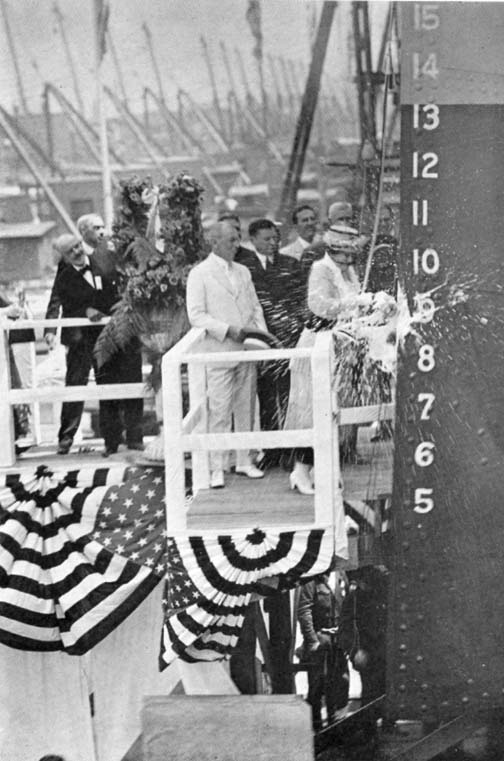
The SS Quistconck launched (Courtesy of the NARA via Wikimedia Commons)

5 August 1918

There were no speeches, it being a hot day.  So, with a minimum of ceremony, and before a crowd of some 60,000 people, the new First Lady Edith Bolling Galt Wilson, clumsily christened the new cargo ship, the champagne splashing off its hull and all over her lovely dress of lavender voile.  A small detail lost in the excitement of the moment, as the enormous freighter slid down the ways under the gaze of dignitaries, the tens of thousands of shipyard workers who built her, and their families.  Meanwhile Edith’s husband, the President Woodrow, suddenly boylike, waved his hat in the air and led the crowd in a riotous patriotic cheer.  Bands played tinny airs, almost drowned out, while flags flapped in a sultry breeze.

It was a curious phase of WWI, with the long war nearly over and America’s concomitant shipbuilding effort only just then hitting its stride.  After years of maintaining its neutrality, the United States had entered the war in the spring of 1917, partly in response to Germany’s relentless U-Boat attacks upon all trans-Atlantic shipping.  It was another year before the US had embarked on an ambitious breakneck program to build a whole fleet of ships to replace the many US vessels that German submarines had destroyed.  (Germany sank some 6.2 million tons of Allied and neutral ships in 1917 alone.)

One result of this determination was the overnight creation of the vast Hog Island shipyard on the outskirts of Philadelphia.  Built on swampy outlying land (where the Philadelphia airport stands today), the shipyard consisted of 50 enormous bays.  Covering 1.25 miles of land along the Delaware River, the yard, which 30,000 workers labored in harsh winter conditions to build, was the largest of any in the world.  Though something of a boondoggle (the $50-million shipyard was essentially defunct by 1921), Hog Island was at the same time a source of great national pride, a proof of what American industry and a common sense of mission could together accomplish.

(Some scholars also credit Hog Island workers, who lived in an instant city and represented many food traditions, with giving the bulky sandwich known as the hoagie to the world.)

The Quistconck was the first vessel to be launched, of the hundreds that Hog Island was expected to produce.  Though some of the ships were never built (the end of the war made them unnecessary), the Hog Island shipyard produced 248 5500-ton steel vessels over a two-year period, at the unprecedented rate of one every three to four days.  The shipyard was innovative in applying standardized assembly-line techniques to shipbuilding, helping to restore and modernize the nation’s inadequate and sadly decimated merchant marine.  Essential to any military effort abroad, many of these ugly supply vessels saw service in WWII.

Mrs Wilson, who had been married to the president for less than a year, was given the privilege of naming many of the vessels.  Believing she was descended from Pocahontas and therefore a living representative of America’s indigenous nobility, Edith Wilson gave the ships Indian names.  Quistconck was Hog Island’s native Delaware name.

The ships are coming (Courtesy of Wikimedia Commons)The Quistconck’s christening celebrated the mobilization of a whole society around the national interests perceived to be in play during WWI.  Whether or not this was the whole story of the shipyard, art and photography record the vigor of patriotic sentiment that kept the crowds cheering on that hot August day.

Top image from this source.
Poster by James Henry Daughetry, courtesy of Wikimedia Commons.
Click here to see other WWI shipbuilding posters on the website
of the American Merchant Marine at War.

The Burial of the Unknown Soldier

Arrival of the remains of the unknown, November 1921 (Courtesy of the DC Public Library via the Commons on Flickr)

In 1918, on the 11th hour of the 11th day of the 11th month, an armistice ended World War One.

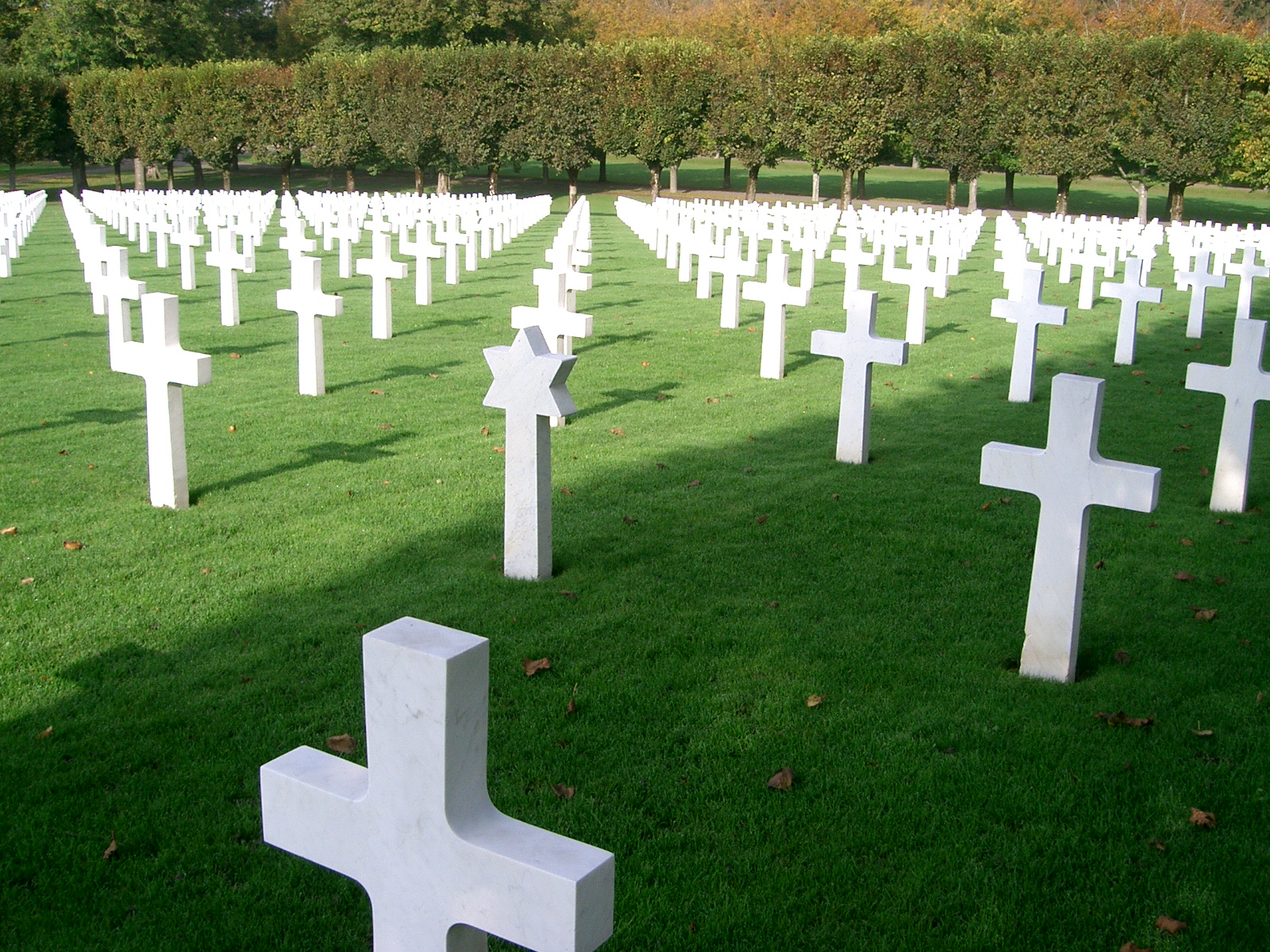
Some 1.2 million American troops were massed on the western front, in France.  In the last two months, they had aggressively and successfully battled German troops for control of the Argonne Forest.  This massive, culminating Allied assault, which compelled Germany to seek a negotiated peace, left some 26,000 Americans dead and another 95,000 wounded.  Their commanders knew an armistice was imminent, yet nearly 11,000 Americans were lost on the war’s final day.

Cruel as the costs of the battle were, American casualties in ‘the Great War’ (1914-1918) paled beside those of Europe.  France’s casualties alone totaled over 6.1 million, representing 73 percent of its mobilized force.  Of these, over a half-million were listed as prisoners or missing.  Britain’s casualties were more than 3.1 million, while Russia, which had mobilized 12 million men during the war (an astonishing number), saw 4.9 million wounded, 1.7 million killed.

Comprehending the magnitude of these losses and the nature and extent of the war’s damage was a social and philosophical struggle that would last for years.  The nations’ profound grief found expression in many forms.  Land and culture would long continue to bear the scars.

The war left soldiers without any recollection of their identity; it left psyches shattered from shell-shock, nerves damaged by gas.  Faces and limbs mutilated.  Corpses far too incorporeal to identify.  The war truly annihilated many combatants, depriving families the consolation of reclaiming their loved one’s remains.

In response, several nations moved to enact the symbolic burial of an unknown soldier in a ceremonial Tomb.  By interring a single anonymous warrior, they sought to honor and immortalize all who were lost and nameless.  The Tombs offered national recognition to numberless soldiers and their families, whose losses and sacrifices History had otherwise rubbed out.

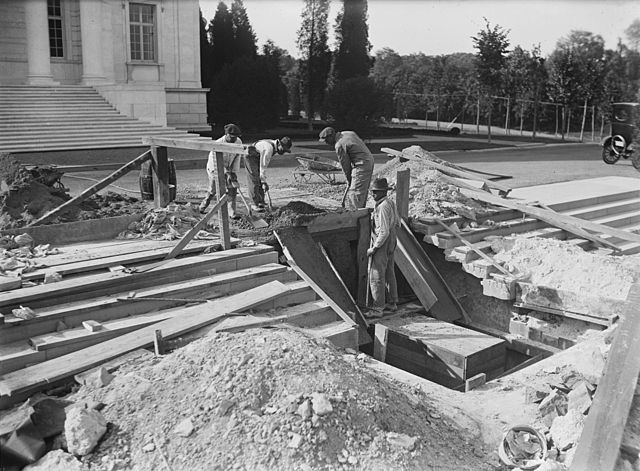
Workers constructing the Tomb of the Unknown at Arlington House.

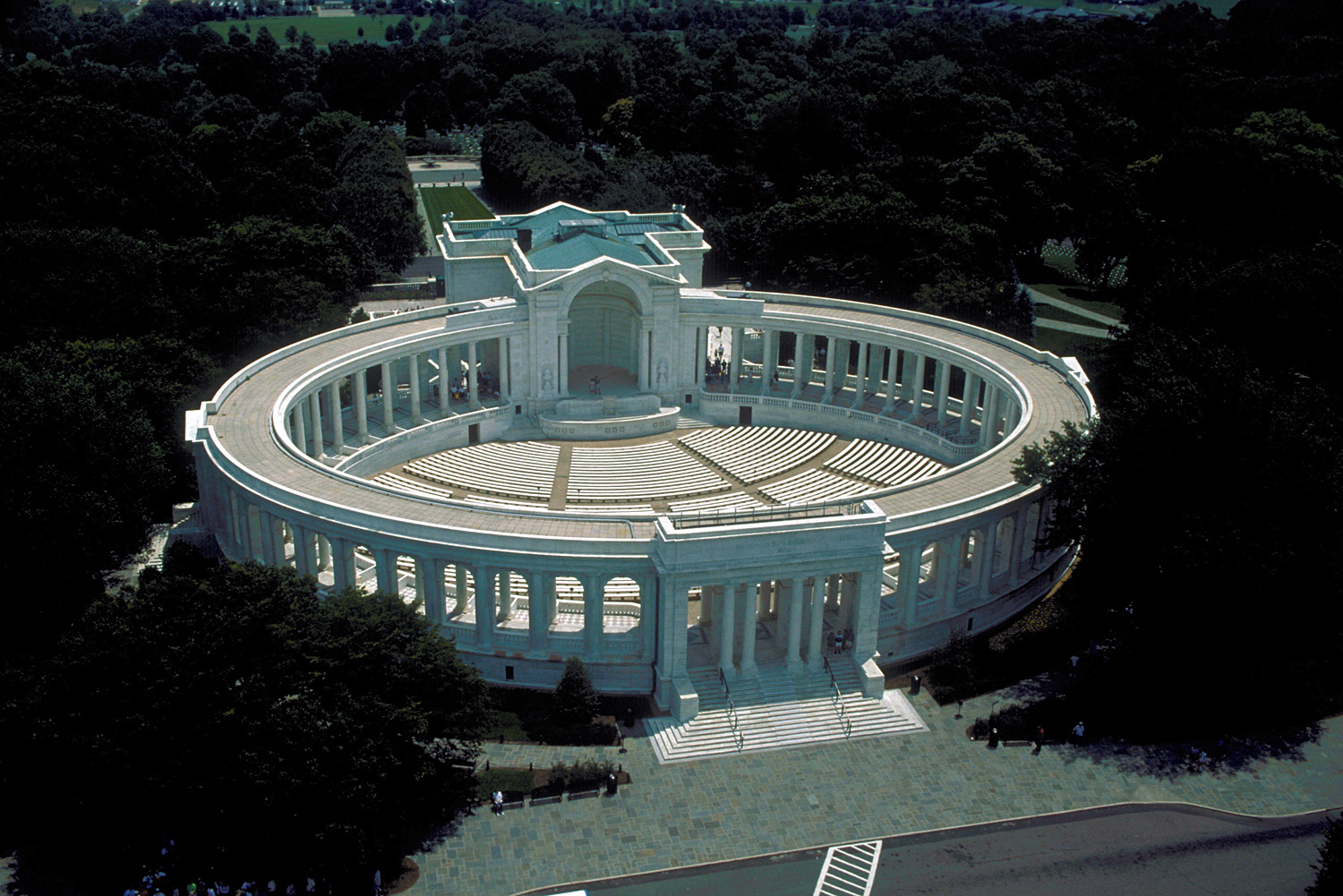
In 1920, France and England were the first to bring such plans to fruition.  They interred their ‘unknowns’ in tombs at the Arc de Triomphe and Westminster Abbey.  The United States followed suit in 1921, bringing the remains of an unknown American soldier back from France for ceremonial reburial at Arlington Cemetery.  Workers labored for months, building the Tomb and a new Memorial Amphitheater too.

The ceremony was scheduled for November 11, which Congress declared should henceforth be known not as Armistice, but as Veterans, Day.  The coffin of an unknown American who died in the war’s last battle was randomly chosen from among four specially exhumed from the American cemetery at Meuse-Argonne.

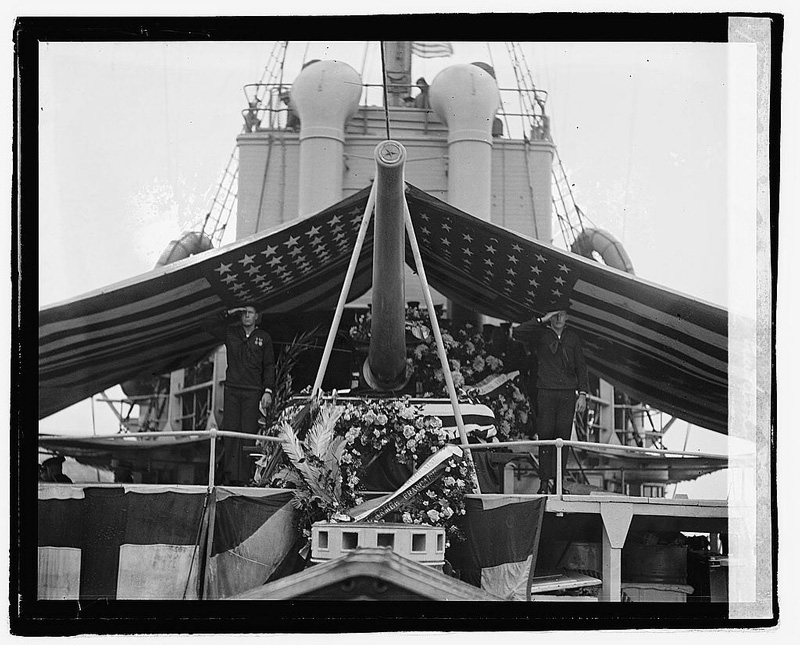
The coffin of the unknown soldier aboard the USS Olympia (Courtesy of the Library of Congress)

Transported across the Atlantic in the U.S.S. Olympia, the body arrived at the Navy Yard in Washington DC on November 9.  General Pershing and other top brass received the body in an  elaborate disembarkation ceremony. The day was rainy.  The coffin lay on an upper deck under a tent of flags.

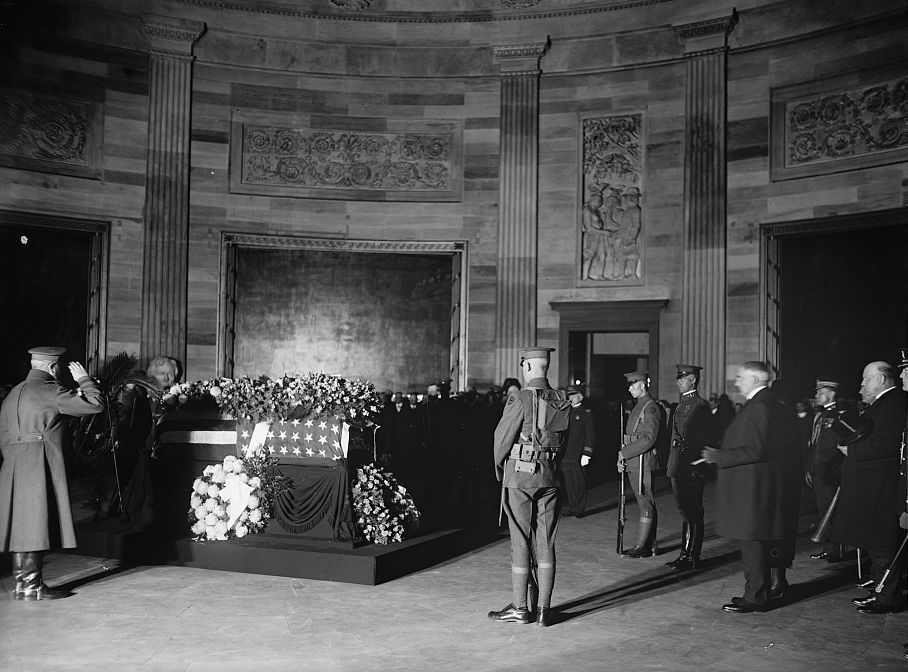
Lying in state in the Capitol Rotunda (Courtesy of the Library of Congress via Wikimedia)

The body was taken to the Capitol, where, with the honors usually reserved for deceased presidents, it lay in state in the Rotunda, under a military guard.  President Harding (at right) and others (General Pershing, at left) came to pay their respects.  The bier was heaped with funeral wreaths, with more arriving every minute from all over the country.

Burial procession of the unknown, November 1921 (Courtesy of the DC Public Library via the Commons on Flickr)

On Veterans Day, crowds clogged the streets, leaned from windows, and climbed rooftops, to witness the funeral cortege as it rolled by.  Six black horses pulled the caisson, at the head of a long procession that included President Harding, former President Woodrow Wilson, and ranks of the military.

President Wilson en route to the burial of the Unknown Soldier (Courtesy Library of Congress)

President Wilson rode in a carriage, even though he was an auto enthusiast and horse-drawn conveyances were by then an anachronism.

The Unknown Soldier's funeral cortege (Courtesy of the Library of Congress)

Crossing the Potomac into Virginia, the procession finally neared the grave.

Cameramen atop the Memorial Amphitheater (Courtesy Library of Congress)

Crowded atop the colonnade of the new amphitheater, cameramen documented the vistas, the participants, the pageantry, the scene.

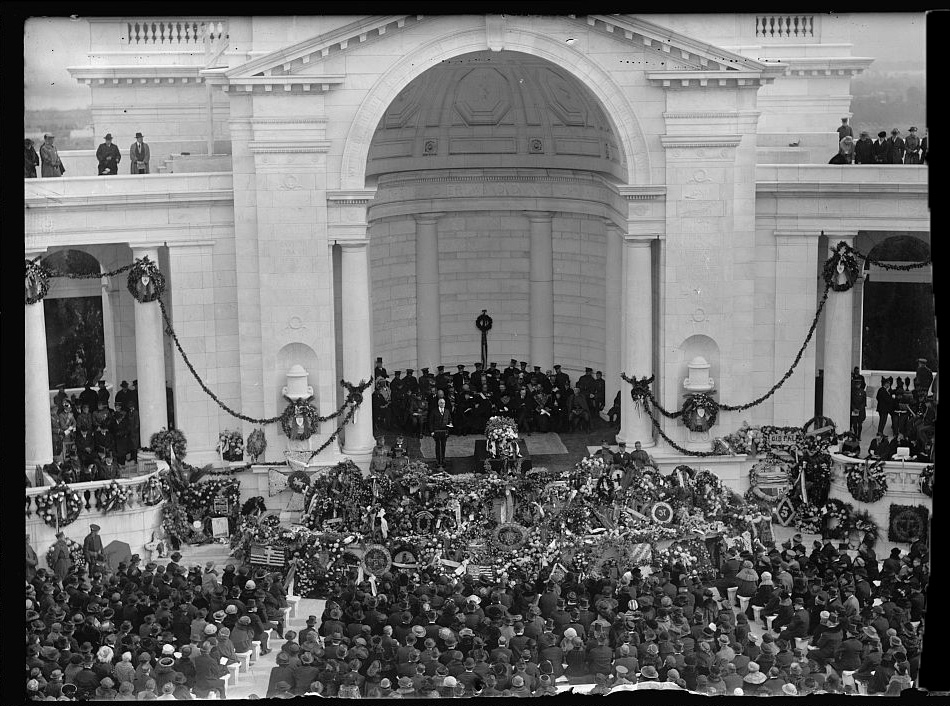
President Warren G Harding beside the remains of the unknown soldier, Arlington Memorial Amphitheater, November 11, 1921 (Courtesy of the library of Congress via Wikipedia)

On a dais banked with flowers and festooned with funerary garlands, President Harding stood by the casket of the Unknown Soldier and addressed the crowd.

The Unknown Soldier being laid to rest (Courtesy of the Library of Congress)

Finally, the unknown soldier was laid to rest, while, beyond the crush of attentive mourners, a peaceful countryside stretched.

Some of the day’s events were even captured on film.

Hand-colored photographs are from the E.B. Thompson Collection,
courtesy of the DC Public Library via the Commons on Flickr.

Film clip courtesy of historycomestolife.
All other photographs courtesy of the Library of Congress.

RELATED:
Faked Repatriation of US Military Remains Today, the Daily Mail (UK).