The GW Who Lacks a Memorial

Watercolor portrait of George Watterston circa 1811 (Courtesy of the Library of Congress)

George Watterston (1783-1854) was perhaps the most prominent writer to establish himself in early Washington, DC, and one of the first people to head up the Library of Congress.  He was the author of a number of satirical novels about social life in the young capital, which is how I first became acquainted with him.

Watterston was born with the nation, in the year that marked the end of the Revolution, to an unknown mother aboard a ship docked in New York City harbor.  His father, a Scottish immigrant and master builder, moved the family to the District of Columbia in 1791, soon after it was designated as the location for the new capital.  Watterston’s development and that of “Washington City” were thus closely intertwined.

Watterston was educated as a lawyer but turned away from the profession in distaste.  Instead, he wrote a novel entitled The Lawyer; Or, Man as He Ought Not to Be, published anonymously in 1808, and with that his literary career was launched.  In 1813, Watterston became the editor of the Washington Star Gazette, a Republican newspaper, promoting and chronicling Washington as it grew.

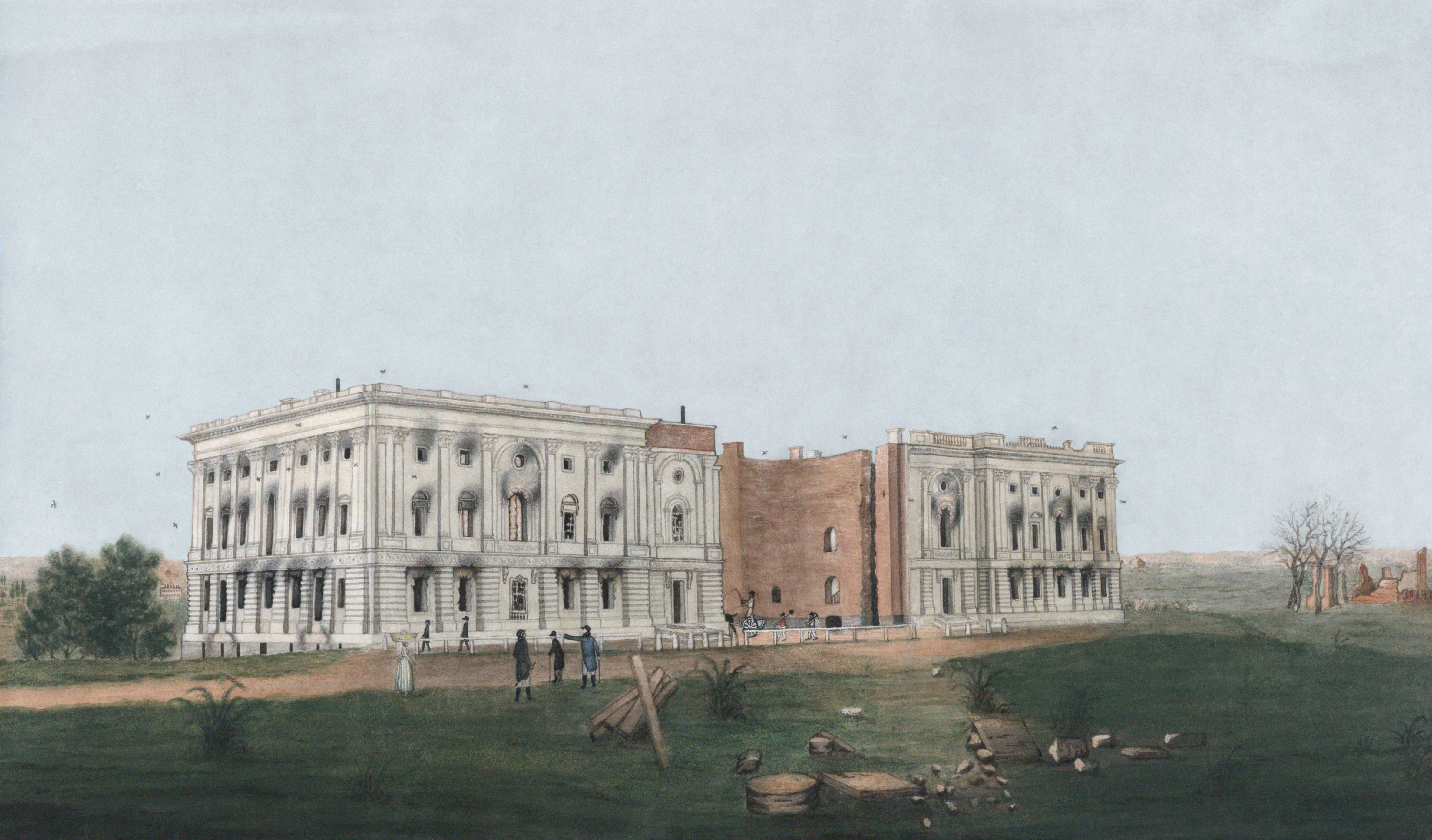
Two years later he was named Librarian of Congress, the Congressional Library being then a young and small institution.  What there was of it had, in fact, been destroyed in 1814, when the British succeeded in invading the capital, torching the Congress’s new home and the books inside.  Watterston rebuilt the collection, aided by Thomas Jefferson, who generously donated his personal library.

Watterston’s patronage job, which he held for the next 15 years, freed him to write.  His literary output entailed funny, shrewdly observed novels; statistical compendia; books on gardening and landscaping; sketches of political figures, and traveler’s guides.  A Whig in politics, he got a rude jolt when Andrew Jackson became president and promptly dismissed him from his post as Librarian, in order to put a Democratic supporter in.

The Washington Monument under Construction, ca. 1876, courtesy of the US National Archives via the Commons on Flickr.

The Washington Monument, circa 1876.

Watterston then founded the Washington Monument Building Society, which envisioned and built the massive obelisk that dominates the Mall.  This massive and expensive undertaking, begun in 1833, would not be complete until 1885.  At the time of Watterson’s death in the mid-185os, the Monument had attained a height of just 150 feet.  Still, I think it’s a terrific thing to have to one’s credit, don’t you?  Watterston deserves a biography, if not a modest monument of his own.

Images from this source and this.

1913: A Beginning More Modern Than Intended

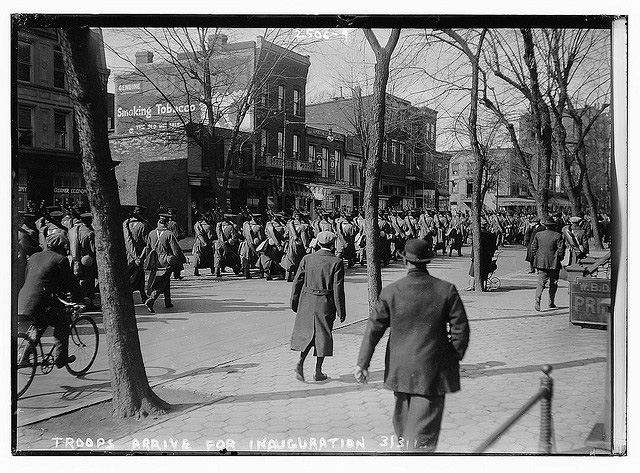
Troops marching into Washington for Wilson's inauguration (Courtesy Library of Congress)
A hundred years ago today, excitement gripped Washington, as crowds flooded the capital in anticipation of Woodrow Wilson’s inauguration the next day.

Wilson’s swearing-in marked an unlooked-for turn in American politics.  As an intellectual, a Democrat, and a Southerner, he promised to introduce a national tone quite different than what the US had been used to under his Republican predecessor, William Taft.  Wilson’s election was a heady coup for the Democrats, whose victory owed much to divisions within the Republican Party, which had split apart into conservative and progressive wings, aligned around Taft and Theodore Roosevelt respectively.

1913preparations

Wilson, who strove to present himself as a reformer and people’s champion, understood the value of publicity.  Preparations for his inaugural were elaborate and included a kind of triumphal procession toward Washington beginning from his birthplace in Staunton, Virginia.  Every aspect of the undertaking was heavily publicized, including the stringing of electric lights along Pennsylvania Avenue, which was breathtakingly modern at the time.

Pennsylvania Avenue strung with lights for Wilson's inauguration (Courtesy Library of Congress)

1913inauglights-level

There was just one complication Wilson hadn’t given much thought to.  His idea of political progress didn’t include the ladies, who he believed shouldn’t vote, lest they become “unsexed” and manly.  So, for months, mainly beyond his consciousness, a feminine maelstrom of discontent had been brewing.

Captains of the women's suffrage parade (Courtesy Library of Congress via the Commons on Flickr))

A young college graduate named Alice Paul and her fellow activists were intent on organizing a vast suffrage parade, to take place in the capital on March 3, the day before Wilson’s inauguration, stealing his thunder and symbolically following the same route to power as he.

After three months of frantic planning, Paul and her committee had raised $14,908.06 in funds (at a time when the average yearly wage was $621), mobilized thousands of like-minded women all over the country, and laid the groundwork for a parade with floats, delegations, and an allegorical pageant to be performed on the steps of the Treasury Building.

Women en route to the suffrage parade (Courtesy Library of Congress)

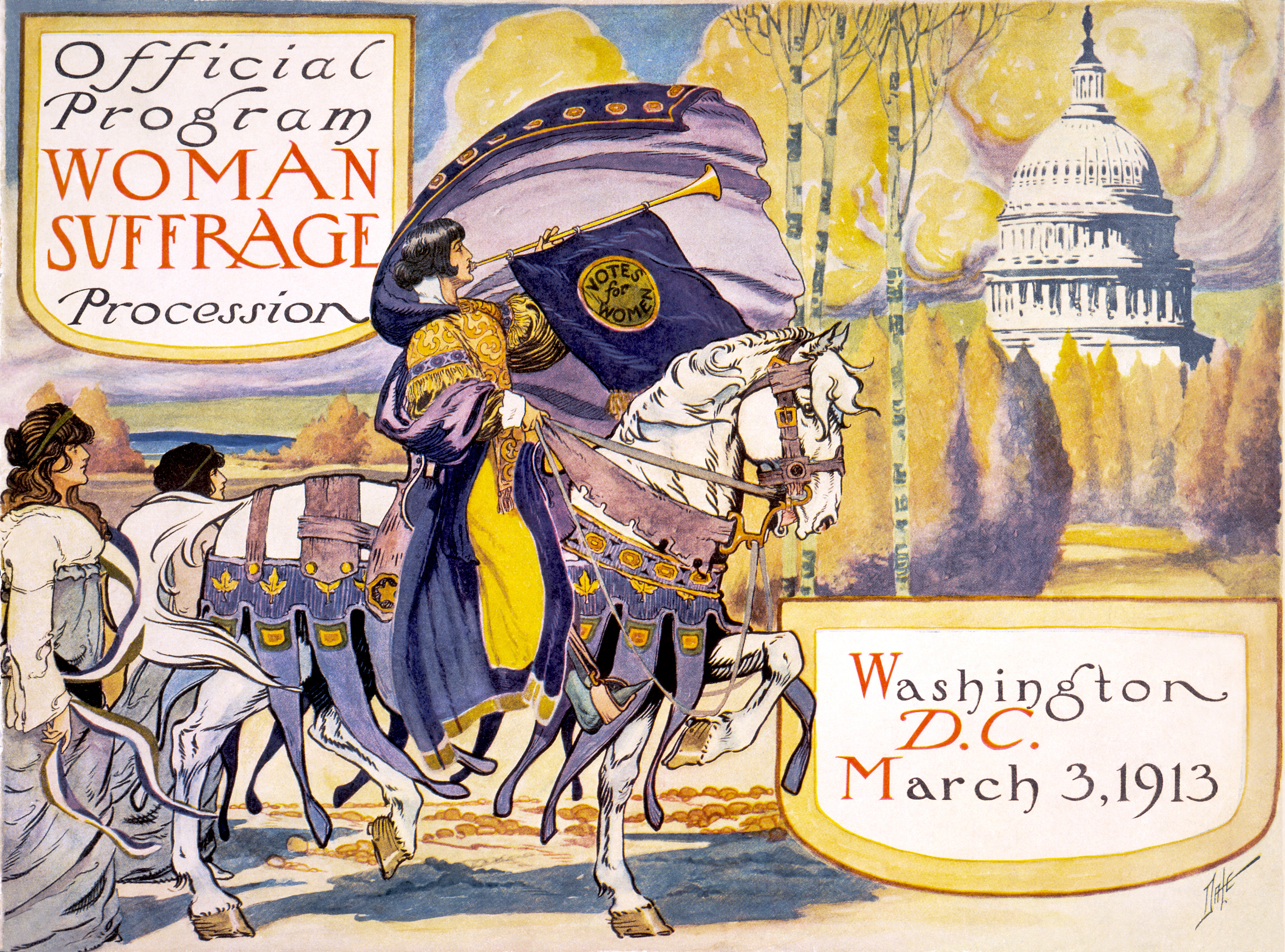
Women from all over donned protest garb and walked, rode, and sailed to take part in the great Woman Suffrage Parade.  There were delegations from Europe, marchers from places like Chicago, Oklahoma, New York, and Ohio, and women from all walks of life.  They bore colorful banners and distributed lavishly expensive programs trumpeting the day’s official proceedings.

suffrageprogram

In the hours before the commencement of the parade, the capital’s streets became choked with people, as skeptical men and more than 5,000 female demonstrators and their allies arrived.

Police were unprepared to deal with the dense masses of spectators and protestors.  Authorities viewed the effort dismissively.  They had not planned to clear the streets, imagining that the sidewalks would suffice for a ladies’ parade.  The streetcars were still running, as pandemonium brewed.

Pandemonium before the suffrage parade

Finally, the streets were cleared and the parade began.  The suffragettes marched several blocks unimpeded, but gradually men began surging into the street, making it almost impossible for the women to pass.  The mood turned ugly and openly insulting.  Marchers struggled to get past the hecklers, their path reduced to a single file.  The men were emboldened by the police, who refused to protect the marchers and instead joined in their humiliation.  Helen Keller, who was among the marchers, found the experience profoundly enervating and exhausting.  Nearly 100 of the marchers were hospitalized.

The chief of police, realizing too late how he had miscalculated, called on Secretary of War Harold Stimson to send out an infantry regiment to restore order and control the crowd.  In the wake of the Congressional inquiries that followed, that police chief would lose his job.

Wilson’s arrival in town was barely noticed that day.  His inauguration, though orderly, was eclipsed by the more truly electrifying Suffrage Parade.  The bold strategies of Alice Paul and her sisters succeeded brilliantly, breathing new life into women’s quest for the vote, a goal they would finally achieve in 1920.

Images courtesy of the Library of Congress.

All About a Ball

Preparing the US National Museum for Garfield's Inaugural Ball (Courtesy the Smithsonian Institution via the Commons on Flickr)

As the day for James A. Garfield‘s inauguration rolled around, the decision was made to hold his inaugural ball in the newly constructed United States National Museum, which had not yet opened to the public.

The massive building, with its grand halls and balconies, seemed tailor-made to soothe a vexation the planning committee faced every four years: finding a venue large enough to accommodate five to ten thousand people.  The nation’s past was strewn with disastrous stories of inaugural parties gone awry: rampaging crowds, looted furnishings, overcrowded chambers, guests forced to dance in their overcoats in unheated temporary buildings.

The National Museum decorated for the 1881 inaugural ball (Courtesy of the Smithsonian via the Commons on Flickr)

The planning committee went wild preparing the still-vacant museum for the president’s gala.  They ordered up three-thousand gas lights, a temporary wooden floor, illuminated garlands, patriotic bunting, placards sporting the monograms of the new president and vice president, and a vast “Lady America” statue to transform the building.  (Wooden chairs in the photographs give an idea of the interior’s scale.)  Vast quantities of refreshments, including 15,000 “assorted cakes,” awaited the inevitable hour when dancers got hungry.

Yet, in the end, these lifeless photographs scarcely satisfy our curiosity.  For what about the ball itself?   Specifically, what about the ladies?  What were they wearing?  Here we run smack up against the bouncers of photography’s limitations, Gilded Age customs, and social mores.

Sadly, Americans couldn’t snap candids of themselves as they stepped out for the ball on that historic night.  The Brownie camera that would make amateur photography possible was twenty years in the offing.  Only by going to a studio photographer arrayed in her ball dress could a woman who went to the ball retain a souvenir of what she looked like that night.  Few such photographs are likely to exist (but let me know if they do!).

♦     ♦     ♦

1880 corset

Thank heaven for the internet, which helps dress up a scene so otherwise naked!  The foundation of every Gilded Age look was the corset, which molded women’s bodies into an idealized form.  It created the hour-glass shape, the essential female silhouette in those days.  Ladies attending Garfield’s ball wore either a corset or an evening dress reinforced inside with whalebone stays.

Dresses donned over the corset were complicated.  This evening dress was characteristic, with its curvacious form-fitting bodice, cinched-in waist, and eye-catching skirt culminating in a bustle and train.  While rigidly sculpted and richly decorated, dresses were relentlessly columnar, emphasizing the figure’s verticality.  The torso of the dress was elongated, thanks to a cut of bodice called the Cuirass, which (echoing the corset) extended smoothly beyond the waist and over the hips.  Keyhole and “V” necklines were popular then.

Even day-time skirts dripped with pleats, folds, and elaborate drapery, accentuating the hips and creating a coveted multi-layer look.  “Tie-back skirts,” though considered scandalous, were all the rage, the skirt being pulled back across the front of the body, supposedly accentuating a woman’s legs.

Evening dresses were made of silk, sometimes heavily textured, and covered with beadwork and ribbon to make them shine.  Textile makers produced vibrant colors with the help of synthetic dyes.  The surface of the dress was further built up with lace, ruffles, and ruching.  Some dresses had heavy tassels of the kind now seen only on fancy furniture and curtains.  The backs of dresses, too, were elaborate and bulky.  To see how these elements could combine, check out this gorgeous cream silk gown, designed by Frederick Worth, the leading couturier of the time.

♦     ♦     ♦

"The Inauguration of President Garfield - The Opening of the Grand Inaugural Ball" (from Leslie's Illustrated of March 19, 1881)

Such are the fashions depicted in the most lifelike extant depiction of Garfield’s ball, created when Frank Leslie’s Illustrated magazine dispatched several “special artists” to capture the scene on the night of March 4, 1881.

The resulting composite illustration includes recognizable portraits of many public figures, with the bearded president, at center, flanked by his son and daughter, and Lucretia Garfield, the new First Lady, hanging on an ambassador’s arm.  (Elsewhere, politicians and military men like Carl Schurz, William T. Sherman, John Logan, James G Blaine, and Roscoe Conkling pepper the crowd.)

Five or six ladies appear at the forefront, the artists painstakingly rendering their dresses, hair-styles, fans, jewelry, and bouquets.  We see Lucretia Garfield in her high-necked pale lavender gown, for instance, while the younger women wear dresses that are more revealing, with low-cut necklines and negligible sleeves.  Yet what joy could they have had in dancing, in such long heavy dresses, and such tight strict corsets?

Looking at this drawing, I am most struck with its subjects’ unknowing.  Little could they know that in just a few months, Garfield’s life would be taken, or that in a few decades, the constraints on women’s fashions and movements would be melting away.  That soon a woman could vote for the president, or against him, as may be, or pick up a Brownie camera and take a picture of her day.

Images: Photographs of US National Museum courtesy of the Smithsonian Institution via the Commons on Flickr; corset from this source; engraving courtesy of the Library of Congress.

RELATED ARTICLES:
Inaugural Day in Washington, The Old Print Gallery.com.

Looking In on Lincoln’s Inaugurations

Inauguration of Mr. Lincoln (1861), photograph courtesy of the Library of Congress

How fortunate we are that Lincoln’s presidency came just after the development of photography!  Of course, by the time he first took office in 1861, certain photographic processes, notably daguerreotypes, had been around for decades.  But only around mid-century did photography develop into a versatile, practical, and widely circulating medium.  As a consequence, whereas photographs of Lincoln’s predecessors in the White House are scarce, Lincoln and his political contemporaries had their pictures taken many, many times.  Some even became shrewd retailers of their mechanically reproduced selves.

The result, from the point of view of the present, is an opening-wide of the window onto history.  Whereas details of James Buchanan‘s 1857 inauguration come down to us mainly through artistic and verbal description (there is this one blurry photograph), good photographs documenting both of Lincoln’s inaugurals survive.  From 1861, for instance, there are several fine distant views of Lincoln taking the oath of office, though none of them is close enough for us to make out his great defeated rival, Senator Stephen A Douglas, who, according to historical testimony, is said to have been looking on from a seat nearby.

These photographs remind us of the immature, precarious state of the Union at the time.  The great addition of the new Capitol dome was incomplete, and, even as Lincoln moved to forward to assume his elected office, the elements that made up the nation were breaking apart.  Prior to March 4, 1861, when this picture was taken, seven pro-slavery states had seceded, and afterward, four more southern states would depart.  On April 12th, with the firing on Fort Sumter, the nation would descend into a state of war.

A closer view of Abraham Lincoln's Inauguration in 1861 (Courtesy of the Library of Congress) of Abraham Lincoln in 1865

The crowd gathered for the swearing-in knew that they were witnessing a momentous scene.  The crowd was thick; most had furled their umbrellas; men, straining for the best possible view, mounted light poles and trees.  Motionless, they strained to hear the unamplified proceedings, the camera preserving the style of their hats and clothing.  Two men turn to face the camera, cannily.

The succeeding years saw a widening use of open-air photography, so that we know with some immediacy the Civil War’s corpse-strewn scenes.  Photographers like Alexander Gardner (by then working for Mathew Brady) tirelessly trailed the armies, unflinchingly recording the realities of camps, hospitals, and battle-fields.  By the time of Lincoln’s second inaugural, in 1865, the war was in its final months, slaves had been liberated, and the nation had become accustomed to seeing itself through the lens of photography.

The crowd at Lincoln's Second Inauguration, March 4, 1865 (Courtesy of the Library of Congress)

This wonderful photograph by Gardner captures the look of that later crowd.  Here, the people themselves, not the government nor the army, nor their most powerful representatives, are recognized as camera-worthy, as they gather on an inauguration day that is once again wet and muddy.  Great coats and banners billow in the breeze, as knots of spectators stand about, chatting or strolling as they please.  In time, they part to make way for the inaugural parade, in which Union regiments of both races proudly march.

Alexander Gardner, Stereographic view of the crowd at Lincoln's Second Inauguration, March 4, 1865 (Courtesy of the Library of Congress) Lincoln's Inaugural Parade (1865)

Is it my imagination, or is there a touch of jubilation here, missing from the earlier proceedings?  Though the war had yet to end, the prospects for the Confederacy were dwindling sharply, and Americans who had fought to keep the nation together knew that their victory was sure.

Alexander Gardner photograph of Lincoln delivering his second inaugural address as President of the United States (Courtesy of the Library of Congress)

Bare-headed, Lincoln reads his message of reconciliation to a crowd radiating around him like magnetic filings, the dais overflowing with dignitaries.  A miscellaneous crowd of watchers stands beneath him, studying the crowd while listening.  It is a homely scene with little pageantry, suited to a federal republic that, though riddled with conflict, has endured trials to grow in confidence and power.  Outside the frame, the Capitol dome has been completed, and stands triumphantly capped with the Statue of Freedom.

All images from the collections of the Library of Congress.
Click on the images for more information and larger views.

A Glimpse of Another Christmas

Washington DC market scene by E. B. Thompson (Courtesy DC Library via the Commons on Flickr)

E.B. Thompson was a successful photographer active in Washington DC in the early decades of the 20th century.  Thompson, who was probably born around the time of the Civil War, gained prominence around the same time as Theodore Roosevelt; indeed, the Rough Rider may have been Thompson’s chief patron.  Readers may recall reading this post about Thompson’s 1899 photograph of the coffins of American war dead awaiting burial at Arlington Cemetery.

Besides documenting the political scene, Thompson created and preserved many other pictures—photographs and stereographs—of everyday life in the District and other subjects of local and personal appeal.  Among them was this picture of a turn-of-the-century open-air market, taken around Christmastime, as you can see.

Evidence internal to the photograph (such as the clothing and shutter speed) suggests it was taken no earlier than 1905.  Prints of the original image were then colorized for sale.  The color does a lot to draw us back into that earlier time.

Image: from this source.