The Burial of the Unknown Soldier

Arrival of the remains of the unknown, November 1921 (Courtesy of the DC Public Library via the Commons on Flickr)

In 1918, on the 11th hour of the 11th day of the 11th month, an armistice ended World War One.

Some 1.2 million American troops were massed on the western front, in France.  In the last two months, they had aggressively and successfully battled German troops for control of the Argonne Forest.  This massive, culminating Allied assault, which compelled Germany to seek a negotiated peace, left some 26,000 Americans dead and another 95,000 wounded.  Their commanders knew an armistice was imminent, yet nearly 11,000 Americans were lost on the war’s final day.

Cruel as the costs of the battle were, American casualties in ‘the Great War’ (1914-1918) paled beside those of Europe.  France’s casualties alone totaled over 6.1 million, representing 73 percent of its mobilized force.  Of these, over a half-million were listed as prisoners or missing.  Britain’s casualties were more than 3.1 million, while Russia, which had mobilized 12 million men during the war (an astonishing number), saw 4.9 million wounded, 1.7 million killed.

Comprehending the magnitude of these losses and the nature and extent of the war’s damage was a social and philosophical struggle that would last for years.  The nations’ profound grief found expression in many forms.  Land and culture would long continue to bear the scars.

The war left soldiers without any recollection of their identity; it left psyches shattered from shell-shock, nerves damaged by gas.  Faces and limbs mutilated.  Corpses far too incorporeal to identify.  The war truly annihilated many combatants, depriving families the consolation of reclaiming their loved one’s remains.

In response, several nations moved to enact the symbolic burial of an unknown soldier in a ceremonial Tomb.  By interring a single anonymous warrior, they sought to honor and immortalize all who were lost and nameless.  The Tombs offered national recognition to numberless soldiers and their families, whose losses and sacrifices History had otherwise rubbed out.
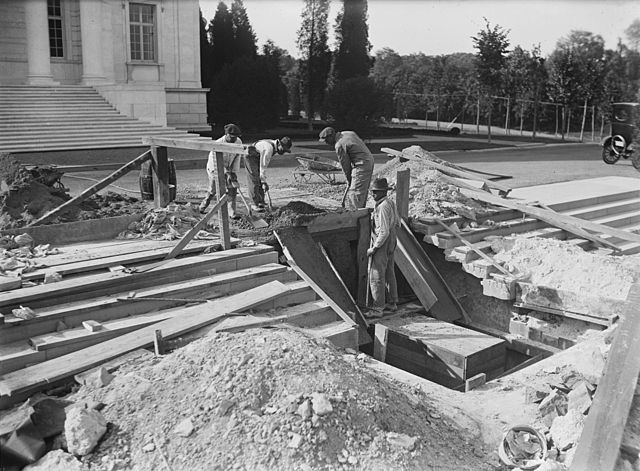
Workers constructing the Tomb of the Unknown at Arlington House.

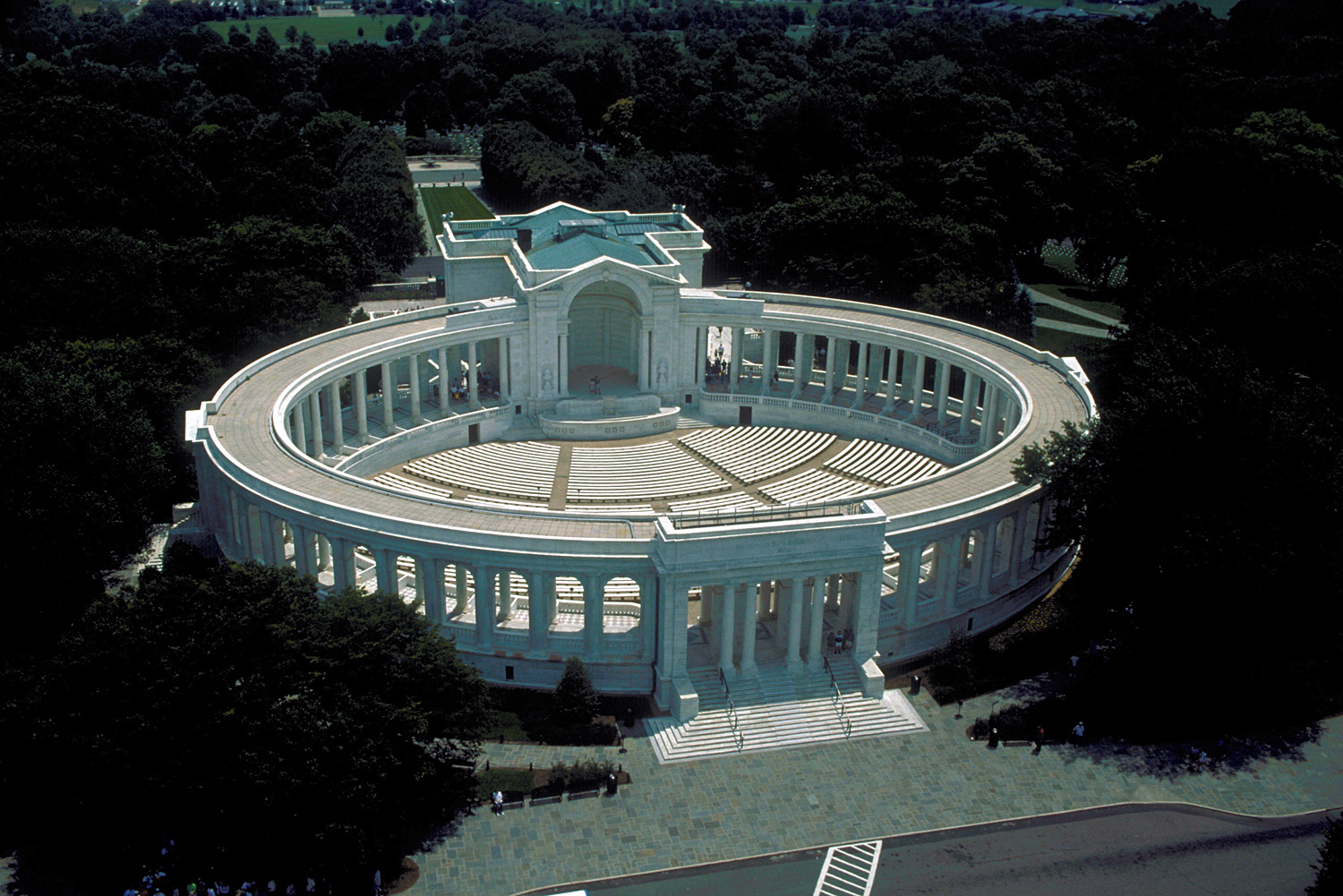
In 1920, France and England were the first to bring such plans to fruition.  They interred their ‘unknowns’ in tombs at the Arc de Triomphe and Westminster Abbey.  The United States followed suit in 1921, bringing the remains of an unknown American soldier back from France for ceremonial reburial at Arlington Cemetery.  Workers labored for months, building the Tomb and a new Memorial Amphitheater too.

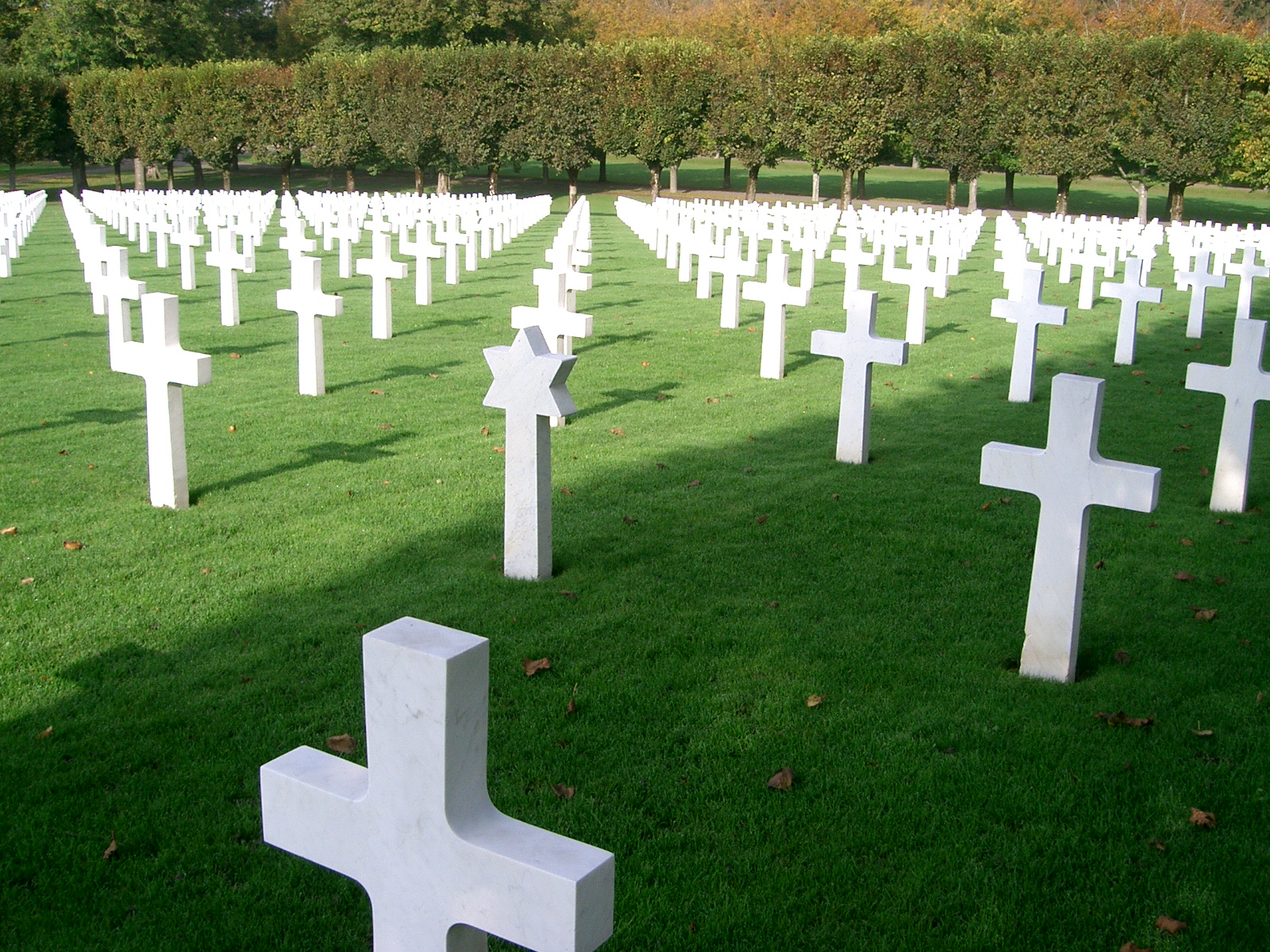
The ceremony was scheduled for November 11, which Congress declared should henceforth be known not as Armistice, but as Veterans, Day.  The coffin of an unknown American who died in the war’s last battle was randomly chosen from among four specially exhumed from the American cemetery at Meuse-Argonne.
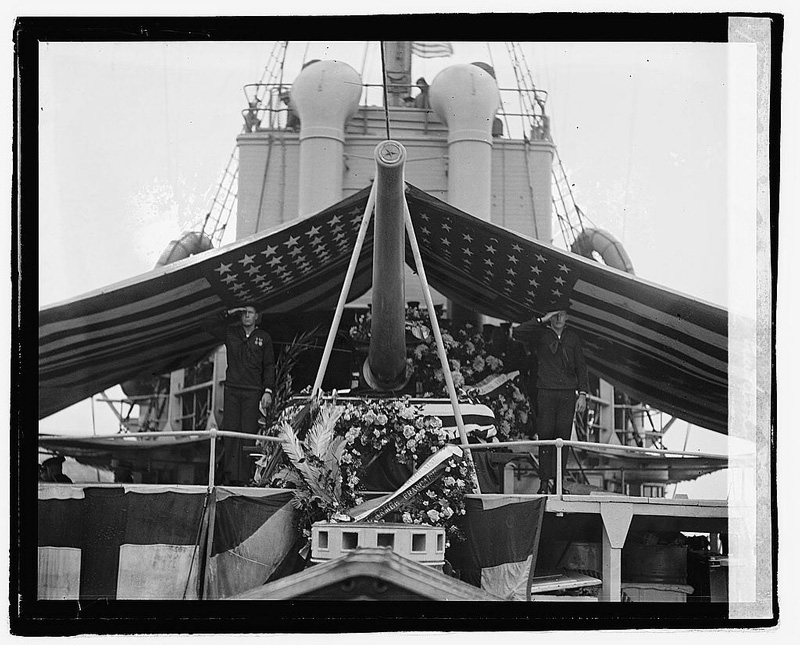
The coffin of the unknown soldier aboard the USS Olympia (Courtesy of the Library of Congress)

Transported across the Atlantic in the U.S.S. Olympia, the body arrived at the Navy Yard in Washington DC on November 9.  General Pershing and other top brass received the body in an  elaborate disembarkation ceremony. The day was rainy.  The coffin lay on an upper deck under a tent of flags.
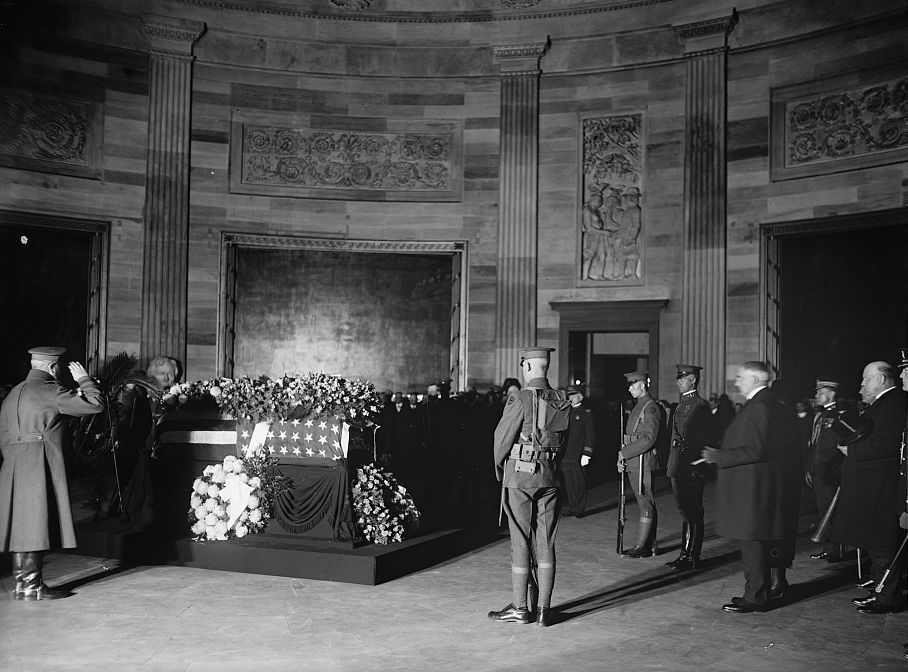
Lying in state in the Capitol Rotunda (Courtesy of the Library of Congress via Wikimedia)

The body was taken to the Capitol, where, with the honors usually reserved for deceased presidents, it lay in state in the Rotunda, under a military guard.  President Harding (at right) and others (General Pershing, at left) came to pay their respects.  The bier was heaped with funeral wreaths, with more arriving every minute from all over the country.

Burial procession of the unknown, November 1921 (Courtesy of the DC Public Library via the Commons on Flickr)

On Veterans Day, crowds clogged the streets, leaned from windows, and climbed rooftops, to witness the funeral cortege as it rolled by.  Six black horses pulled the caisson, at the head of a long procession that included President Harding, former President Woodrow Wilson, and ranks of the military.

President Wilson en route to the burial of the Unknown Soldier (Courtesy Library of Congress)

President Wilson rode in a carriage, even though he was an auto enthusiast and horse-drawn conveyances were by then an anachronism.

The Unknown Soldier's funeral cortege (Courtesy of the Library of Congress)

Crossing the Potomac into Virginia, the procession finally neared the grave.

Cameramen atop the Memorial Amphitheater (Courtesy Library of Congress)

Crowded atop the colonnade of the new amphitheater, cameramen documented the vistas, the participants, the pageantry, the scene.
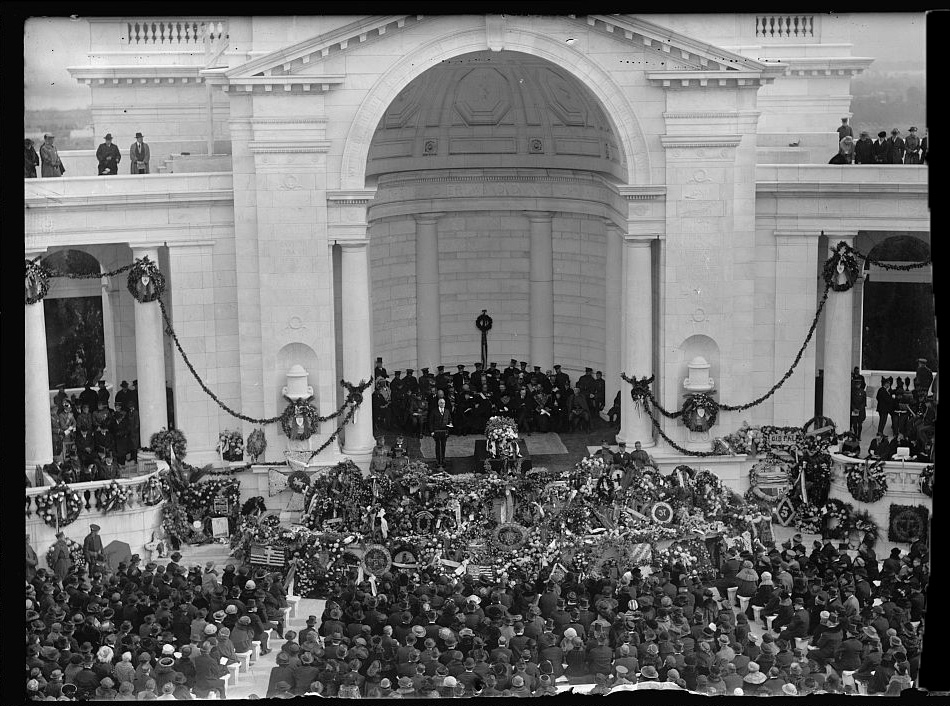
President Warren G Harding beside the remains of the unknown soldier, Arlington Memorial Amphitheater, November 11, 1921 (Courtesy of the library of Congress via Wikipedia)

On a dais banked with flowers and festooned with funerary garlands, President Harding stood by the casket of the Unknown Soldier and addressed the crowd.

The Unknown Soldier being laid to rest (Courtesy of the Library of Congress)

Finally, the unknown soldier was laid to rest, while, beyond the crush of attentive mourners, a peaceful countryside stretched.

Some of the day’s events were even captured on film.

Hand-colored photographs are from the E.B. Thompson Collection,
courtesy of the DC Public Library via the Commons on Flickr.

Film clip courtesy of historycomestolife.
All other photographs courtesy of the Library of Congress.

RELATED:
Faked Repatriation of US Military Remains Today, the Daily Mail (UK).

The Era of the Dynamite Girl

Aftermath of bombing at the Chicago Federal Courthouse, 1918 (Courtesy of the National Archives via Flickr Commons)

The years after the end of WWI were turbulent ones in the United States.  A slump came with peace, as wartime demand for American agricultural and industrial output weakened, diminishing American opportunities.  The Russian Revolution of 1917, and the radical political ferment that contributed to it, had a profound effect on political activism in the States, as workers and intellectuals explored whether communist or socialist doctrines could be used to revolutionize a capitalist system that was generating unacceptably high levels of inequality and suffering.  The anarchist sentiment that had triggered the outbreak of WWI had never vanished, and it combined with other domestic conditions, including historically high rates of immigration from Eastern and Southern Europe, to make the years before 1920 ones of conflict and unease.

The threat of domestic violence, and the fear of such threats, was felt in many parts of the country.  These were the years of the Palmer Raids and the Red Scare, as well as a deadly race riot in Chicago and the dubious prosecution and execution of Sacco and Vanzetti in New England.

In Chicago, the year 1918 got underway with the arrest of a nineteen-year-old Italian-born radical named Gabriella Antolini, who was found carrying a satchel full of dynamite (36 pounds) along with a loaded pistol through Union Station.  The press immediately dubbed her ‘the Dynamite Girl.’  A professed follower of anarchist Luigi Galeani, Antolini served eighteen months in prison.  She was a sympathizer of the IWW, the radical labor union headed by Big Bill Haywood and headquartered in the city.  That summer, Chicago tried to stay steady amid a series of bombings and attempted bombings, typically connected with labor disputes, and some seemingly involving IWW members, known as Wobblies.

On September 4, 1918, a bomb exploded in the north lobby of Chicago’s Federal Building, killing four people.  According to later accounts, a man in a tan raincoat had been seen pacing around the building around 3:00pm with a cigar box with a string dangling from one side of it under his arm.  He was seen to drop the cigar box and kick it under a radiator near the Adams Street entrance before hurrying away.  According to Sean Deveney, writing on his website The Original Curse, the explosion was so powerful that it ripped open the Federal Building and threw from their seats employees at work inside the neighboring Marquette and Edison Buildings.  The buildings’ windows were shattered, shards of glass raining onto the streets.  Although many suspected a connection to the recently concluded trial and conviction of some 100 IWW officials, the perpetrator of the crime was never found.

Image: The wreckage of Chicago’s Federal Building, 1918, from this source.

The Real Thing

Town Hall Ward, Oxford, England (Courtesy Woodrow Wilson Presidential Library via The Commons on Flickr)

It bothers me that I can’t look at this photograph without thinking of Downton Abbey.

This is a historical photograph of a WWI convalescent ward set up in the town hall of Oxford, England.  Strangely, though, memories of the fictionalized ward that featured in the BBC series now furnish my yardstick for judging its verisimilitude.

Image from this source.

A President Ventures Abroad

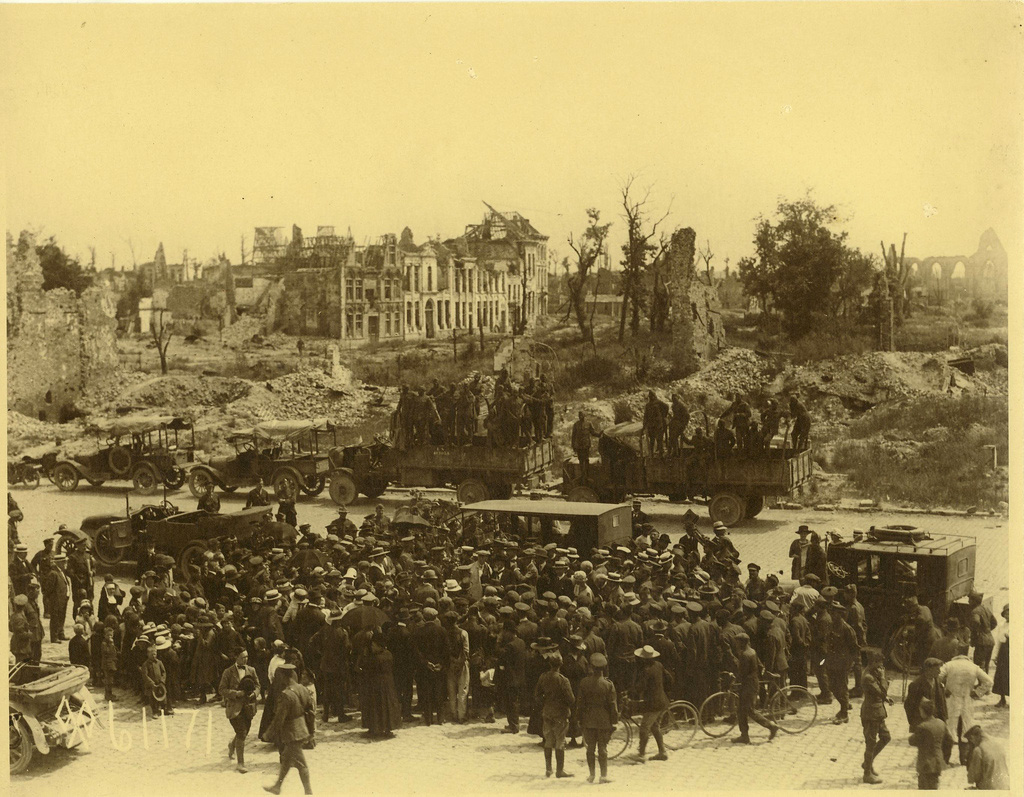
President Wilson and the King and Queen of Belgium at Ypres, 1919 (Courtesy: Woodrow Wilson Presidential Library via the Commons on Flickr)

Given the international status of the United States today, the home-bound nature of the presidency during the first century-plus of the nation’s existence is hard to imagine.  The first president to venture beyond the western hemisphere was Woodrow Wilson, who in 1919 traveled to Europe at the conclusion of the First World War to participate in the negotiations that produced the Treaty of Versailles.

During his trip, Wilson and his entourage visited Belgium, touring Ypres and other areas that had been devastated by the fighting.  An anonymous photographer attached to the US Signal Corps documented the president’s tour of the war-torn landscape.  The resulting deep-focus sepia prints preserve the occasion on which Wilson first saw something of late war in which he and the rest of the nation had been engaged.

Image: from this source.
Click image to enlarge.