
This is an important late 18th-century view of New York’s Federal Hall, showing the style of adjacent buildings. Tiny print on the lower left side explains that this lithograph, published by C. Currier, was based on a drawing by George Holland made in 1797. The process of lithography came into use only several decades later, facilitating the mechanical production of works in color. This one was made by Charles Currier, who, like his more famous brother Nathaniel, was a skilled printer whose work met the public’s appetite for American scenes.
Here, the colors of the print accentuate the contrast between Federal Hall’s refined facade and the more utilitarian mercantile establishments that typified the neighborhood around Wall Street.
It’s worth noting that during the Revolution, the British army had attacked and occupied New York City. Much of the old city was destroyed, and its population shrank. By the time of the Founding, the city had come roaring back. Building boomed, and the population tripled to some 30,000 people. Many of the buildings in this scene were likely rehabbed or new, just like the newly refurbished Federal Hall.
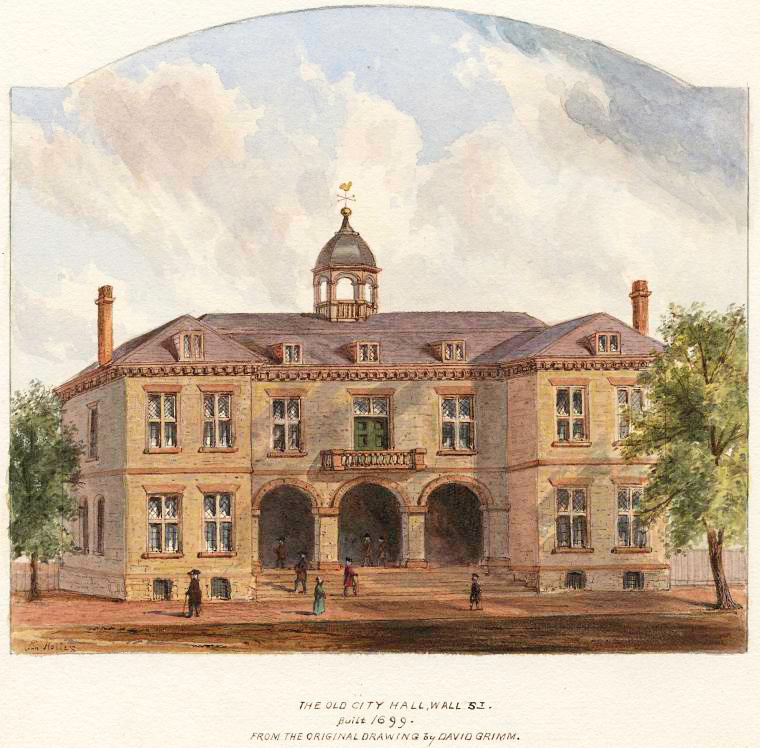
Holland’s drawing captures the modern yet workaday character of the neighborhood where the Congress first convened under the Constitution. Yet, Federal Hall had likely been destroyed by the time Currier’s lithograph appeared. Other features of the scene endure today, notably Trinity Church, whose spire is visible at left.
Image: from this source.