This print from the mid-nineteenth century is a vivid reminder that George Washington had a pre-history with New York City, prior to his 1789 presidential inauguration at Federal Hall. The print commemorates “Evacuation Day,” when, on November 25, 1783, Continental troops under General Washington entered the city in triumph, officially marking the end of its occupation by the British during the Revolutionary War. Given that the British had controlled the city for seven years, ruling it under martial law, the rejoicing was general and profound. New Yorkers continued to celebrate Evacuation Day for over 100 years.
This representation of “Washington’s Triumphal Entry Into New York,” was the work of Christian Inger, a German emigre who settled in Philadelphia in the 1850s and worked as a lithographer.
In 1789, Philadelphia’s Columbian Magazine published this “View of the Federal Edifice in New York.” It’s one of a handful of extant contemporary depictions of the defunct Federal Hall, showing its location at the T where Nassau intersects with Wall Street in Manhattan’s First Ward. This engraving captures the appearance of the building in the year George Washington was inaugurated on its balcony.
The most notable feature of the print is its rendering of the Great Seal, particularly the rendering’s inaccuracy. Here, the eagle rises above the shield and a free-floating olive branch: this is substantially wrong. (cf. the previous post on the Great Seal). The artist either drew the Seal wrong from memory or neglected even to study this feature of the building in person. Maybe he copied from another artist. It’s also possible that the Great Seal was improperly rendered on the building itself.
In any event, this illustration is a significant reminder that the Great Seal was newly invented and its features not well-known to Americans when federalism under the Constitution got going in 1789. It also highlights the ambiguity of much documentary “evidence.”
Judging from depictions of Federal Hall that I’ve been discussing, some version of the Great Seal of the United States crowned Federal Hall. Every view of the long-defunct building shows some version of the Great Seal as the dominant feature of the pediment. This is noteworthy, because, when the pediment was created in 1788, the “Great Seal” itself was just a few years old.
The tricky business of coming up with symbols to express American nationhood began during the Revolution (1775-1783), when officials of the Continental Congress felt the practical need for a iconography to represent unity. The symbols they came up with were often clumsy: first stabs at projecting power, capturing the unique identity of the United States, and distinguishing their new self-governing nation from old European monarchies. This new symbolic language, marking the states’ rapid transition to a nation, appeared on currency, official documents, flags, military insignia, and eventually buildings.
Charles Thomson, a Philadelphian who served as Congress’s secretary, designed the Great Seal in collaboration with William Barton, an attorney who had made a study of heraldry. According to historian Ben Irvin, in his Clothed In Robes of Sovereignty: The Continental Congress and the People Out of Doors, Thomson and Barton were the first to come up with the combination of the eagle and the shield, which are the essence of the Great Seal. Congress officially adopted the seal on June 30, 1782.
Thomson and Barton’s design incorporated much of the iconography popularized during the war, including the red and white stripes on a field of blue; the number thirteen, as manifest in the bundle of arrows; and the ‘new constellation’ of stars. The eagle, however, was an innovation, and in certain respects a curious one.
Irvin goes on to explain that, in 1775, Ben Franklin had issued a three-dollar bill as Continental currency, depicting Britain as an eagle and America as “a weaker bird.” Franklin despised Thomson and Barton’s choice of the eagle to depict the newly independent nation, arguing that the eagle was a scavenger, “a Bird of bad moral Character. He does not get his Living honestly.” Should the new United States be depicted as predatory?
Others, however, approved of the eagle, viewing it as “a symbol of empire.” Even then, some Americans were thinking of the United States in imperial terms. As for Barton, who first proposed the eagle, he assigned it a different, very specific meaning. Barton explained that his eagle was the “Symbol of supreme Power & and Authority, and signifies the Congress.” Note that the official seal predates the Constitution and the creation of the presidency.
Despite early federalism’s structural weaknesses, the Great Seal signified the aspirations of a new, self-governing people—to rule themselves through the mechanism of Congress. It has proved an enduring ideal. This aspiration was integrated into the face of the building where the First Congress met. It’s something to ponder as we gaze on the modern version of the Great Seal of the United States, prominently displayed on the dais where President Trump stands.
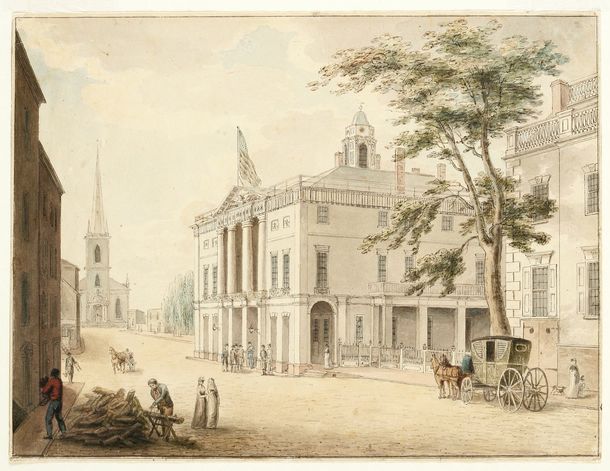
This is an important late 18th-century view of New York’s Federal Hall, showing the style of adjacent buildings. Tiny print on the lower left side explains that this lithograph, published by C. Currier, was based on a drawing by George Holland made in 1797. The process of lithography came into use only several decades later, facilitating the mechanical production of works in color. This one was made by Charles Currier, who, like his more famous brother Nathaniel, was a skilled printer whose work met the public’s appetite for American scenes.
Here, the colors of the print accentuate the contrast between Federal Hall’s refined facade and the more utilitarian mercantile establishments that typified the neighborhood around Wall Street.
It’s worth noting that during the Revolution, the British army had attacked and occupied New York City. Much of the old city was destroyed, and its population shrank. By the time of the Founding, the city had come roaring back. Building boomed, and the population tripled to some 30,000 people. Many of the buildings in this scene were likely rehabbed or new, just like the newly refurbished Federal Hall.
Holland’s drawing captures the modern yet workaday character of the neighborhood where the Congress first convened under the Constitution. Yet, Federal Hall had likely been destroyed by the time Currier’s lithograph appeared. Other features of the scene endure today, notably Trinity Church, whose spire is visible at left.
Artist William Hindley made this interesting architectural rendering of Federal Hall in the 1930s, over a century after the building was demolished in 1812 to make way for the US Custom House of the Port of New York.
Further research on Hindley might clarify whether he was in business for himself or worked for a government entity such as the National Park Service (NPS) or Works Progress Administration (WPA), which employed scores of writers, artists, and photographers to document the physical environment and condition of the country at that time. Whatever the case, Hindley made a handful of drawings aimed at preserving the characteristics of this significant building, which was the sole seat of the federal government during its first year.
It’s prudent to approach such retrospective documents warily. The specifics they present as historical may be spurious and anachronistic, sheer invention making up for a shortage of factual detail. Good artists were scarce in the early national period; the visual record of important people, places, and events then, correspondingly thin.
Here, though, Hindley generally dispels our skepticism. In the lower left legend, he states that his work was extrapolated from the scale of the old city hall, combined with “Hill’s engraving and descriptions,” and Robertson’s drawing. (The latter is a street view of Federal Hall that Archibald Robertson sketched when the building was still extant, around 1798.) In addition, later scholarly analyses of Federal Hall offer other documentary evidence corroborating Hindley.
Hindley’s drawing effectively communicates the subjective significance of L’Enfant’s smooth, symmetrical facade. Highlighted are the columns, pediment, and entablature, a fancy cupola topping off the now three-story building. The focal point of all is the new nation’s seal. The upper right-hand legend tells us that, as reward and payment for his work, the 33-year-old L’Enfant was offered “10 acres of land at Proovost [sic] Lane between E60 and E49 street with a small payment of money but declined it.”
Overstating the case a bit, Hindley avers that L’Enfant was the first architect to solve the problem of how to make a building “characteristically American,” establishing a pattern that other famous public architects of the early national period, such as Bullfinch, Thornton, Hooker, Hadley, Thompson, and Latrobe, merely followed. What can be said with authority, however, is that the stylistic elements L’Enfant combined in Federal Hall were indeed used in government buildings in the US countless times.
Image: from the National Park Service collection of artifacts pertaining to Federal Hall, accessed on 12 December 2012.
Click here to view two other imaginative renderings of Federal Hall that Hindley made.