Philadelphia on ice

Colorful lithograph showing skaters crowding the ice near the Philadelphia Navy Yard, 1856.
The winter of 1856 was one of the coldest in the nineteenth century.  It was so cold that the Ohio River froze solid from bank to bank, creating a path for southern slaves to escape, just as Harriet Beecher Stove had envisioned in Uncle Tom’s Cabin two years before.  Elsewhere, the long stretches of cold weather created favorable conditions for Americans’ new favorite pastime, ice-skating, then enjoying great burst of popularity.

This scene, of city-dwellers crowding the ice on the Delaware River in Philadelphia, furnishes a gauge of the strength of the trend.  For though ice skating had been practiced for centuries, until 1850, skate blades were crafted only of wood or bone.  A Philadelphia businessman, Edward W Bushnell, is credited with revolutionizing the sport of skating, by being the first to manufacture a blade of steel.  Strapped and clamped to the bottoms of shoes, the sharp metal blades gave skaters unprecedented speed and control.

The excitement was considerable as the innovation took hold.  The Quakers of Philadelphia had always carried on their hereditary skating traditions, but steel skates led to many novelties.  By the time lithographer James Fuller Queen captured this scene, many men and boys had paid up for the new skates, which were very expensive at $30 a pair.  Most of the ladies and townspeople pictured are spectators only, standing still as bold skaters thread their way through the crowd.

According to John Frederick Lewis, author of Skating and the Philadelphia Skating Club (1895), a Miss Van Dyke, daughter of James C Van Dyke, US attorney for Philadelphia, was the first woman in Philadelphia to appear on skates; she “rapidly became skillful and expert” in 1854.  Other ladies followed her lead, making skating fashionable, once concerns about safety and possible harassment from ruffians had been cleared away.

Image: from this source.
Click on the image for a much larger view.

This is the third in an occasional series on ice-skating.  Click here to go to the first post.

Cool girls with skates

Four young women with ice skates on a Chinatown street.
Four girls with ice skates walk down a street in New York’s Chinatown.  It’s 1965, Mott Street, a sunny day—and late April, which heightens the incongruity of what we’re seeing.  While the setting grounds them to their roots and history, the girls are American and of the moment, with loose hair styles, jackets, and dungarees.  The photographer, Ed Ford of the New York World Telegram & Sun, captured a carefree, top-of-the-world moment effectively.

Since ice skating originated in Northern Europe and developed as a result of American and European innovations, the ice skates are a token of westernization (as well as a capacity to have fun).

Image: from this source.

This is the second in an occasional series on ice-skating.
  Click back and forward to see the others.

Jamaica Pond ice-skaters, 1859

A crowd of men, women, and children skate under a cloudy sky.

In the 1850s, a rage for dancing and ice-skating swept America.  Both the ball room and the surface of an icy pond offered antebellum northerners a way to escape the stiff conventionality of everyday society and discover different ways of moving and being.

This beautiful old print, a 1859 view of skaters on Jamaica Pond outside Boston, captures this well.  Look closely and you may see a lady with a hockey stick.

The hazards of the ice justified the suspension of some proprieties.  Top hats flew as gentlemen lost their dignity.  Beneath the ladies’ long, voluminous skirts, their calves and ankles were plainly showing.  Shocking!

While some women in the picture are wearing the floor-length skirts typical of the time, others are wearing shorter skating skirts which were more novel, freer and more daring.

Image: from this source.  Click to enlarge.

This is the first in an occasional series on ice skating.  Click forward to see the others.

The Summer without a Summer

Currier and Ives hand-colored lithograph, "Winter in the Country: A Cold Morning" (1863), courtesy of the Library of Congress.

In 1872, near the end of his life, New York newspaperman Horace Greeley recalled a summer in his childhood that pushed his family to the brink of want and insolvency.  It was the summer of 1816, when weather abnormalities reached catastrophic levels, producing a summer without summer, the typically warm months instead punctuated with snows and frost.

Greeley recalls waking on June 8th of that year to find an inch of snow blanketing his family’s farm in Amherst, New Hampshire.  Frosts occurred in all the summer months, destroying crops and yielding only a ‘dubious harvest.’

The conditions Greeley described were general throughout the northeastern United States and felt as far south as Thomas Jefferson’s Virginia.  Newspapers and diaries document the freakishly cold weather that rattled Americans, whose lives then depended almost entirely on what farms in their vicinity could produce.  (Importing food from a distance was untenable before the age of rail.)  Though New England was never a great breadbasket, its farms usually produced enough grains and vegetables to support the human population and some livestock farming.

That summer, persistent cold and frosts produced widespread crop failures.  On each morning from June 8 through 10, frosts were reported throughout much of New England, causing the trees’ foliage to blacken.  In July, a powerful Canadian cold front moved in, killing off tender plants such as beans, cucumbers, and squash, and raising the first fearful prospects of famine.  Yet, according to meteorologist Lee Foster, who has analyzed the agricultural impact of the weather that summer, hardy crops such as wheat, rye, and potatoes managed to hang on.

In the middle of August, any prospect of a normal harvest vanished when frost again hit New England and upstate New York.  Violent thunderstorms followed the cold, with still more frost striking around August 20 and 28, killing the corn and effectively ending the growing season.

Those in northern inland regions suffered the most.  Newspapers recorded June snowfalls of 10 inches in Vermont and 7 inches in parts of Maine.  Newly shorn sheep froze to death; fruit was destroyed.  Farmers went about in coats and mittens.  By the end of the summer, domestic animals were starving.  Much of the human population was famished, too.

Throughout the affected areas, livestock were hastily slaughtered, creating a glut that drove down prices, while the price of grains, particularly corn, began skyrocketing.  While families accustomed to subsistence agriculture were rich in tactics for making do in hard times, the poor harvests of 1816 left them in debt and without the cash or seeds needed to get started the next growing season.  The bankruptcies and penury that followed in the wake of “summer that wasn’t” caused widespread land forfeiture and precipitated the first great out-migration of farmers to the virgin Midwest from eastern parts.

Scientific knowledge and understanding were then insufficient to account for the strange weather Americans were seeing, though some conjectured that sunspots or a solar ellipse (both recently observed) were a probable cause.  Well-informed Americans understood, though, that the peculiar meteorological conditions they were experiencing were more than a local phenomenon.  Their newspapers were reporting similarly catastrophic conditions across Europe, where cold and dark weather was producing dire food shortages, including Ireland’s infamous potato famine.

Today, meteorologists attribute the adverse atmospheric conditions of 1816 to a colossal volcanic eruption that occurred the previous year and half a world away.  On April 8, 1815, Mount Tambora, a volcano east of Java in the Dutch East Indies (modern-day Indonesia), began erupting.  According to a new book by William Klingaman and Nicholas Klingaman, the explosion, a hundred times more powerful than the 1980 eruption of Mount St Helens, was the largest volcanic disturbance in the last 2,000 years and the deadliest in recorded time.  Some 12,000 people living near Tambora died at once, with another 70,000 dying from the toxic fallout in Indonesia alone.

Blasts from the volcano, audible 800 miles away, blew 3,000 feet off the mountaintop, spewing millions of tons of ash, dust, and sulfur-dioxide gas into the sky, the lightest particles flying up more than twenty miles.  Within twenty-four hours of the climactic eruption, an impenetrable cloud the size of Australia had formed.  Particles in the stratosphere were slow to disperse, but winds gradually distributed them, reducing the amount of sunlight reaching the earth.  The impact on climate peaked in 1816, when the Northern Hemisphere felt its withering chill.

Americans today worry about global warming, but early Americans had more to fear from the cold.  Mount Tambora’s eruption intensified conditions associated with the “Little Ice Age” that prevailed from around 1400 to 1850, when the sun’s lower output produced harsher winters, shorter summers, and more aridity—conditions that, like today’s weather abnormalities, created unanticipated hazards and human suffering.  As for the future, who can say?  The new global cooling may be just a volcano away.

Image: Hand-colored lithography by Currier and Ives, “Winter in the Country: A Cold Morning” (1863), in the Library of Congress.  To go to the source, click here.

1913: A Beginning More Modern Than Intended

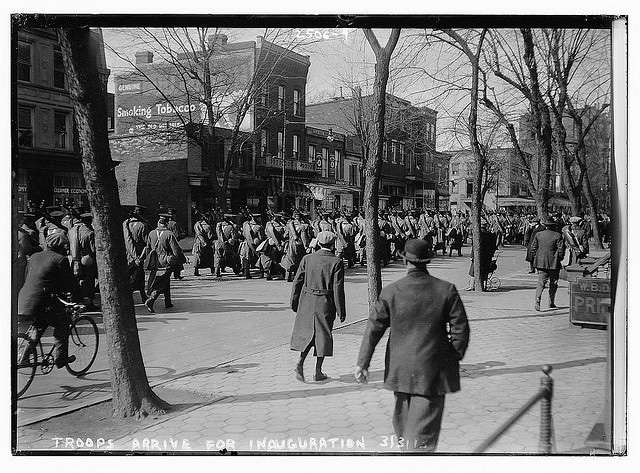
Troops marching into Washington for Wilson's inauguration (Courtesy Library of Congress)
A hundred years ago today, excitement gripped Washington, as crowds flooded the capital in anticipation of Woodrow Wilson’s inauguration the next day.

Wilson’s swearing-in marked an unlooked-for turn in American politics.  As an intellectual, a Democrat, and a Southerner, he promised to introduce a national tone quite different than what the US had been used to under his Republican predecessor, William Taft.  Wilson’s election was a heady coup for the Democrats, whose victory owed much to divisions within the Republican Party, which had split apart into conservative and progressive wings, aligned around Taft and Theodore Roosevelt respectively.

1913preparations

Wilson, who strove to present himself as a reformer and people’s champion, understood the value of publicity.  Preparations for his inaugural were elaborate and included a kind of triumphal procession toward Washington beginning from his birthplace in Staunton, Virginia.  Every aspect of the undertaking was heavily publicized, including the stringing of electric lights along Pennsylvania Avenue, which was breathtakingly modern at the time.

Pennsylvania Avenue strung with lights for Wilson's inauguration (Courtesy Library of Congress)

1913inauglights-level

There was just one complication Wilson hadn’t given much thought to.  His idea of political progress didn’t include the ladies, who he believed shouldn’t vote, lest they become “unsexed” and manly.  So, for months, mainly beyond his consciousness, a feminine maelstrom of discontent had been brewing.

Captains of the women's suffrage parade (Courtesy Library of Congress via the Commons on Flickr))

A young college graduate named Alice Paul and her fellow activists were intent on organizing a vast suffrage parade, to take place in the capital on March 3, the day before Wilson’s inauguration, stealing his thunder and symbolically following the same route to power as he.

After three months of frantic planning, Paul and her committee had raised $14,908.06 in funds (at a time when the average yearly wage was $621), mobilized thousands of like-minded women all over the country, and laid the groundwork for a parade with floats, delegations, and an allegorical pageant to be performed on the steps of the Treasury Building.

Women en route to the suffrage parade (Courtesy Library of Congress)

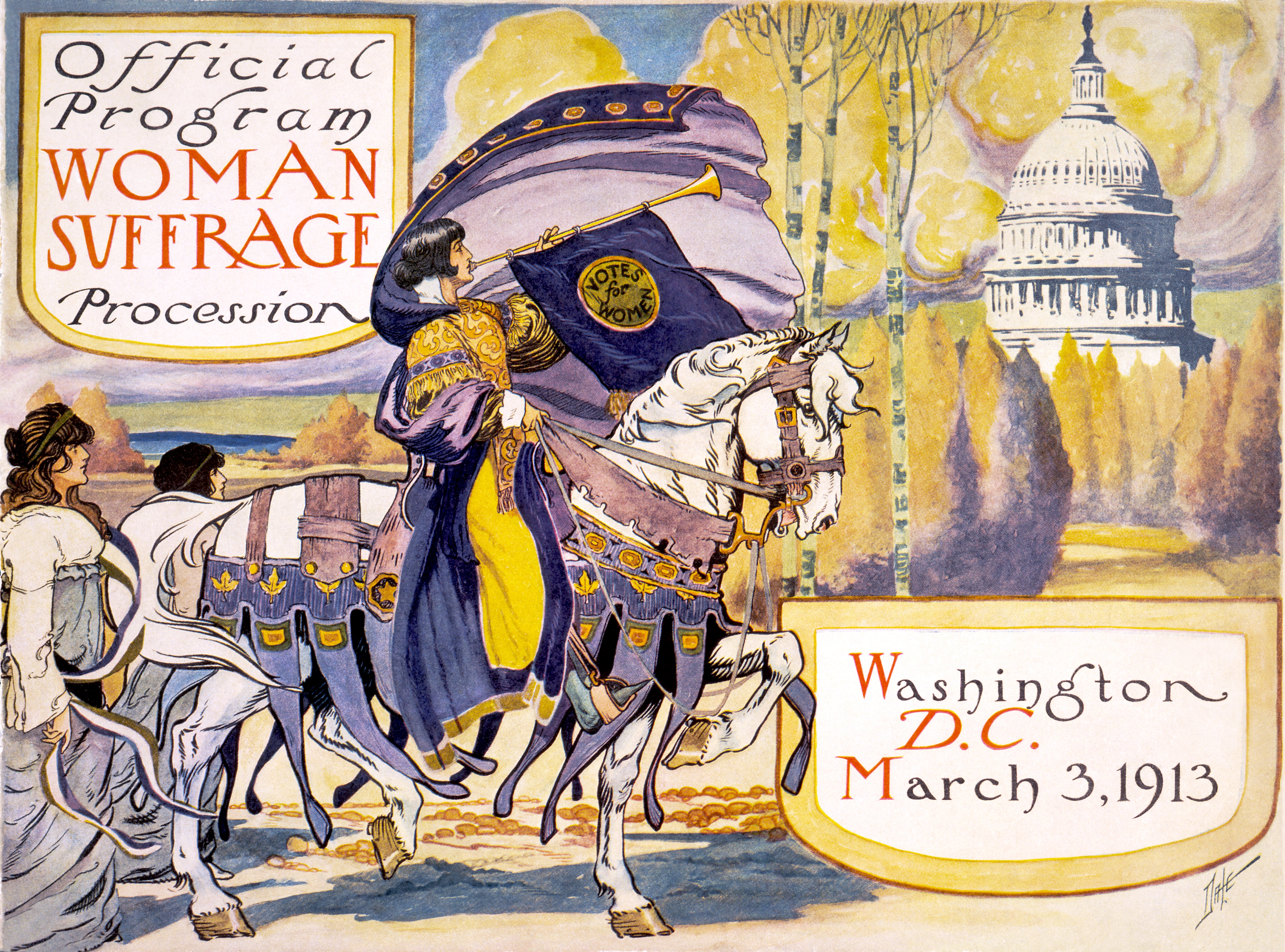
Women from all over donned protest garb and walked, rode, and sailed to take part in the great Woman Suffrage Parade.  There were delegations from Europe, marchers from places like Chicago, Oklahoma, New York, and Ohio, and women from all walks of life.  They bore colorful banners and distributed lavishly expensive programs trumpeting the day’s official proceedings.

suffrageprogram

In the hours before the commencement of the parade, the capital’s streets became choked with people, as skeptical men and more than 5,000 female demonstrators and their allies arrived.

Police were unprepared to deal with the dense masses of spectators and protestors.  Authorities viewed the effort dismissively.  They had not planned to clear the streets, imagining that the sidewalks would suffice for a ladies’ parade.  The streetcars were still running, as pandemonium brewed.

Pandemonium before the suffrage parade

Finally, the streets were cleared and the parade began.  The suffragettes marched several blocks unimpeded, but gradually men began surging into the street, making it almost impossible for the women to pass.  The mood turned ugly and openly insulting.  Marchers struggled to get past the hecklers, their path reduced to a single file.  The men were emboldened by the police, who refused to protect the marchers and instead joined in their humiliation.  Helen Keller, who was among the marchers, found the experience profoundly enervating and exhausting.  Nearly 100 of the marchers were hospitalized.

The chief of police, realizing too late how he had miscalculated, called on Secretary of War Harold Stimson to send out an infantry regiment to restore order and control the crowd.  In the wake of the Congressional inquiries that followed, that police chief would lose his job.

Wilson’s arrival in town was barely noticed that day.  His inauguration, though orderly, was eclipsed by the more truly electrifying Suffrage Parade.  The bold strategies of Alice Paul and her sisters succeeded brilliantly, breathing new life into women’s quest for the vote, a goal they would finally achieve in 1920.

Images courtesy of the Library of Congress.