Society

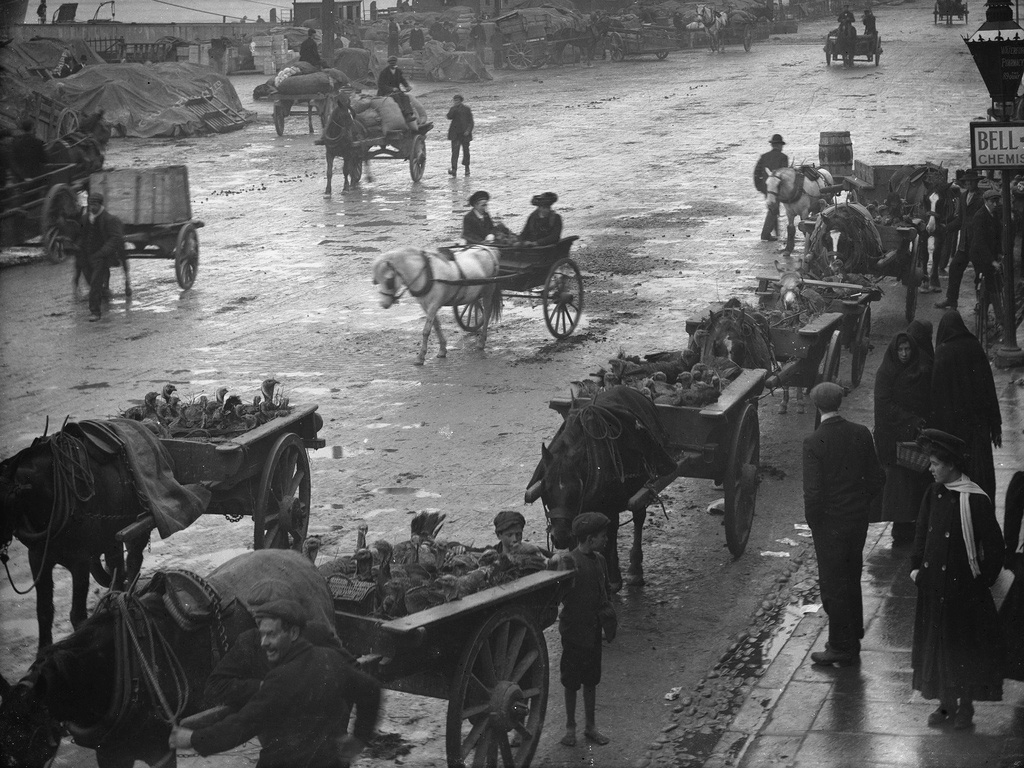
A street in Ireland, 1907 (Courtesy National Library of Ireland via the Commons on Flickr)

Among the hundreds of historical photographs I’ve looked at this week, this one stands out, jarring my sensibilities, its everydayness so strikingly at odds with ours.  Whereas many historical photographs appeal because of their near-resemblance to the life we know, others are fascinating in their strangeness, in their capacity to demand independent consideration.

So it is with this photograph from the National Library of Ireland.  It shows a muddy street in the port city of Waterford, where teamsters are conveying several carts of live turkeys up from the wharves.  Their destination may be a local poultry store, where the turkeys were likely to be sold to customers live, then kept at home and butchered by those in the kitchen for the holiday meal.  The date is December 16, 1907.  To have a rich turkey feast was then, as in Dickens’ time sixty years earlier, a singular joy and a sure token of prosperity.

There was a different appearance to a street.  The bricks of the gutter are evident, but the rest of the paving is scarcely visible beneath a thick layer of mud and animal waste, which night crews may have periodically combed smooth.  The only conveyances in sight are carts and wagons, though elsewhere, we know, automobiles were beginning to appear.  Besides teamsters hauling goods away from the harbor, the only other traffic is a pair of ladies in decent hats, driving themselves on their calls and errands.

The real point of interest, though, is along the curb, where we see a barefoot boy standing in the road.  He and his friend may be hoping to earn a few coins by helping the teamsters unload the turkeys.  Just a few feet away are a well-dressed lady and gentleman, and behind them are a trio of poorer, working-class women known as ‘shawlies.’  Whereas the lady has a proper overcoat or wrapper and a fur hat, the other women go about with their heads and bodies unceremoniously wrapped in shawls for warmth.  They carry baskets.

Class was different then, as clothing and shoes and manners marked out very visibly just how different one type of person was from the other.  Though the classes rubbed elbows much more intimately than they do today, the gulf between rich and poor was more evident and less was done to ameliorate it, to ease the suffering of the barefoot and hungry.

Image from this source.
Click on the image to enlarge it.

A Glimpse of Another Christmas

Washington DC market scene by E. B. Thompson (Courtesy DC Library via the Commons on Flickr)

E.B. Thompson was a successful photographer active in Washington DC in the early decades of the 20th century.  Thompson, who was probably born around the time of the Civil War, gained prominence around the same time as Theodore Roosevelt; indeed, the Rough Rider may have been Thompson’s chief patron.  Readers may recall reading this post about Thompson’s 1899 photograph of the coffins of American war dead awaiting burial at Arlington Cemetery.

Besides documenting the political scene, Thompson created and preserved many other pictures—photographs and stereographsof everyday life in the District and other subjects of local and personal appeal.  Among them was this picture of a turn-of-the-century open-air market, taken around Christmastime, as you can see.

Evidence internal to the photograph (such as the clothing and shutter speed) suggests it was taken no earlier than 1905.  Prints of the original image were then colorized for sale.  The color does a lot to draw us back into that earlier time.

Image: from this source.

A President Ventures Abroad

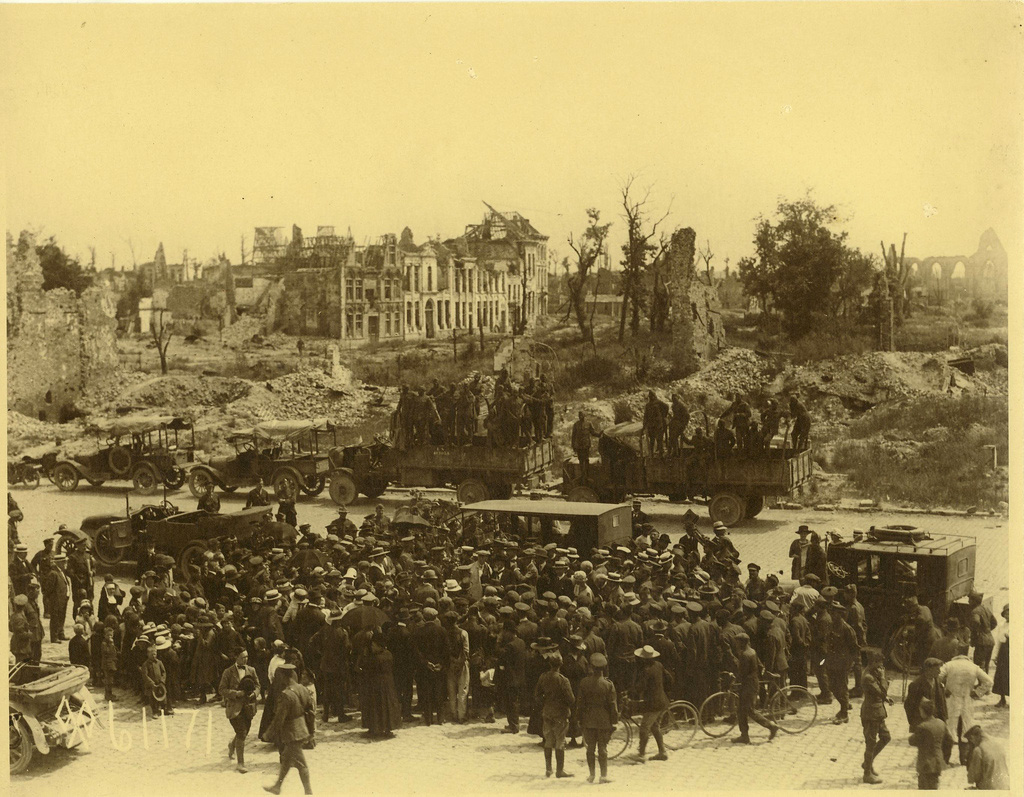
President Wilson and the King and Queen of Belgium at Ypres, 1919 (Courtesy: Woodrow Wilson Presidential Library via the Commons on Flickr)

Given the international status of the United States today, the home-bound nature of the presidency during the first century-plus of the nation’s existence is hard to imagine.  The first president to venture beyond the western hemisphere was Woodrow Wilson, who in 1919 traveled to Europe at the conclusion of the First World War to participate in the negotiations that produced the Treaty of Versailles.

During his trip, Wilson and his entourage visited Belgium, touring Ypres and other areas that had been devastated by the fighting.  An anonymous photographer attached to the US Signal Corps documented the president’s tour of the war-torn landscape.  The resulting deep-focus sepia prints preserve the occasion on which Wilson first saw something of late war in which he and the rest of the nation had been engaged.

Image: from this source.
Click image to enlarge.

Woodrow Wilson Casts His Ballot

Woodrow Wilson Casts His Ballot, 1912 (Courtesy Princeton University Library via Flickr Commons)

I’d been looking for an excuse to write about Woodrow Wilson when Monday’s presidential debate, with its exchange over “horses and bayonets” and the WWI navy, came along especially to encourage me.

An interesting cache of photographs put online by the Woodrow Wilson Library includes this one of Wilson casting his ballot in the presidential election of 1912.  Wilson, then governor of New Jersey and the Democratic candidate for president, won the election in a landslide.

The photograph, with its mesh ballot receptacle, handwritten records, and air of social intimacy, casts doubt on some time-honored political verities.  How free and fair were the elections conducted with this “technology”?  Did our elective process, so often derided as “broken,” really work better in an earlier day?

In 1912, most black Americans were barred or discouraged from voting.  Community norms and party interests inflected how election rules were applied.  Until the ‘Australian’ ballot was universally adopted, casting a vote was a social act, not granted any privacy.  And party loyalty was the grease that kept the machinery running: for much of the nineteenth century, “voting” typically meant nothing more than delivering to the poll a ballot that your party had already completed for you.

Wilson’s ascent coincided with a move toward a more participatory democracy.  In 1912, US senators were still elected, not by the populace, but by the state legislatures.  A Constitutional amendment changing that would be ratified the next year.  The nominating conventions of 1912 were historic, because they were the first to include delegates chosen, not by party operatives, but by popular votes cast in the nation’s first presidential primaries.

*     *     *

A scholar-statesman not unlike Barack Obama, Wilson, a noted professor of political science and former president of Princeton University, spent just two years as New Jersey’s chief executive before catapulting to the presidency.

His path to the White House was more than a little unlikely.  The 1912 election pitted him against three other candidates: the Socialist Eugene Debs, incumbent President William Taft, and former president Theodore Roosevelt, the latter two representing the Conservative and Progressive wings of the Republican Party, respectively.  Only deep divisions within the Republican Party enabled Wilson, the first Southerner to be elected to the White House since Zachary Taylor, to succeed.  Wilson had been a dark horse in the fight for his party’s nomination, triumphing over the favorite, James Beauchamp Clark, a popular House Speaker, in the eleventh hour.

Wilson’s agenda was progressive and sophisticated, but the fractious political environment prevented him from realizing many of his cherished visions, dealing him some notable humiliations instead.  In 1913, John McCutcheon drew this cartoon drubbing Wilson’s first-year performance, yet in the succeeding years Wilson presided over many liberal reforms (e.g. women’s suffrage) and fiscal innovations (e.g. the income tax) that shape our political landscape today.  While Wilson’s approach to the Great War was adroit, he suffered a rebuke heard round the world when a Republican-controlled Senate jettisoned US participation in the new League of Nations and refused to ratify the Treaty of Versailles.  (Unbelievably, Wilson was the first US president to make an official trip abroad when he traveled to Europe to negotiate the Treaty in 1919.)

Image: Wilson voting in New Jersey, from this source.

Stephen Colbert on the recent attacks against the 17th Amendment here.