Faces of the Thirties

Carl Van Vechten, Portrait of Earl Jones in Langston Hughes's "Don't You Want to Be Free?" (Courtesy of the Library of Congress).

Among the heroes of public culture, James Billington, the long-serving Librarian of Congress, ranks high.  Under his leadership, the Library of Congress has been on a drive to digitize its vast collections and make them accessible online to a global public.  Sound recordings, films, photographs, old prints, drawings, maps, manuscripts—millions of items can now be viewed and freely used, to the extent that copyright law allows.  Many of the illustrations on Our Polity are from its website.

Among the Library’s holdings are a collection of photographic portraits by Carl Van Vechten, taken mainly in the 1930s.  Van Vechten (1880-1964) was an Iowa native and graduate of the University of Chicago who, in 1903, moved to New York City and became a journalist under the tutelage of Theodore Dreiser.

Van Vechten first made his reputation as an art and music critic, writing mainly for the New York Times, where he was a champion of then-neglected forms of popular music such as folk, jazz, and blues.  He also wrote about, and got to know, the many gifted African-American artists, writers, and intellectuals who, in what was referred to as the Harlem Renaissance, were first making their mark at this time.

Carl Van Vechten, Portrait of Ethel Waters (Courtesy of the Library of Congress).     Carl Van Vechten, Portrait of Ram Gopal (Courtesy of the Library of Congress)    Carl Van Vechten, GertrudeStein with American flag backdrop, 1935 (Courtesy of Library of Congress)    Carl Van Vechten, Portrait of Leontyne Price (Courtesy of the Library of Congress).    Carl Van Vechten, Photograph of F. Scott Fitzgerald (Courtesy of the Library of Congress).

Only in the 1930s did Van Vechten turn to photography, the field in which he scored his greatest lasting achievement.  Several thousand of his portraits survive, most but not all taken in his studio, amounting to a fascinating collective portrait of cultural life of the time.  Included among his subjects were noted composers, actors, singers, ballerinas, folk artists, novelists, poets, and prize fighters.  Many were Van Vechten’s friends; others were new or making a passing appearance on the scene.

Van Vechten’s photographs mirror the diversity that was then a new feature of America’s culture.  It was our first truly cosmopolitan, modern decade.  The Russian ballerinas, Jewish publishers, gay expatriate arts patrons, Spanish surrealists, and black opera-singers that thronged the cities represented a welcome and radical shift in a culture that had long been dominated by a pale, genteel population that was far more narrow and homogeneous.  In the thirties, American culture came of age, incorporating into itself the global currents that formed, and continue to influence, the culture of the present day.

Images from the Van Vechten Collection: (top) Actor Earl Jones; (inset, left to right)
Ethel Waters, Ram Gopal,
Gertrude Stein, Leontyne Price, F. Scott Fitzgerald.
Courtesy of the Library of Congress.

Ferris: His Wonderland

The First Ferris Wheel, Chicago, 1893; photograph by Starks W. Lewis (Courtesy Brooklyn Museum via the Commons on Flickr)

Around this time of year in 1893, millions of people were flocking to Chicago to see the great world’s fair the city was hosting.  Formally known as the World’s Columbian Exposition, the fair belatedly commemorated the 400th anniversary of Columbus’s “discovery” of the New World.

In a bid for national and international celebrity, Chicagoans (whose young city had burned to the ground 22 years earlier) went all out in constructing the fair’s great White City: acres and acres of magnificent pavilions, illuminated at night by millions of dazzling electrical lights, and all organized around a network of waterways.

To make it even more special, the organizing committee hired a young engineer named George Washington Gale Ferris, Jr., to dream up something similar to the amazing tower that George Eiffel had designed for the world’s fair in Paris in 1889.  Similar to that tower, but better.  Yet at first the organizers of Chicago’s fair were doubtful about the idea that Ferris came up with.

Ferris, 34 years old (and destined to die of typhoid fever just three years later), had already gained an impressive reputation as an engineer and bridge-builder, a reputation that sprang from his understanding of steel.  The design that he proposed to the fair’s organizers was for a gargantuan wheel, that, if built, would tower above everything and lift passengers effortlessly, treating them to aerial views from astonishing heights.

Starks W. Lewis, an amateur photographer who managed to get his camera (it would have been pretty bulky) set up on the wheel, captured the wonder of it all.  From his vantage, the intricate workmanship of the wheel itself, as well as size and design of the passenger cars, each of which was designed to hold 60 people, is clearly revealed.

Despite organizers’ fears, Ferris’s daring contraption worked perfectly.  Rising to a height of 264 feet and measuring 825 feet around, the Wheel weighed more than 2.6 million pounds.  It was powered by two 1,000-horsepower steam engines and operated reliably, unimpaired by lightning and gale-force winds.  According to Judith Adams-Volpe, writing about Ferris in the American National Biography, the wheel became the Fair’s leading attraction, the first instance of “technology being harnessed purely as a pleasure machine.”

View of the Fair from the Ferris Wheel, 1893 photograph by Starks Lewis (Courtesy of the Brooklyn Museum via Flickr Commons)

What steel gave society was the capacity to rise above the earth and gain an entirely new perspective on itself.  The people who visited the Fair from all over the US could see their world as they had never seen it, from a perspective previously offered only by mountains or the occasional steeple.  In the wondrous aerial vision Ferris gave the world came a hint of the built marvels that were still to come.

Images: Photographs of and from the first Ferris Wheel
by Starks W. Lewis, 1893, courtesy of the Brooklyn Museum, from this source.

Lorimer

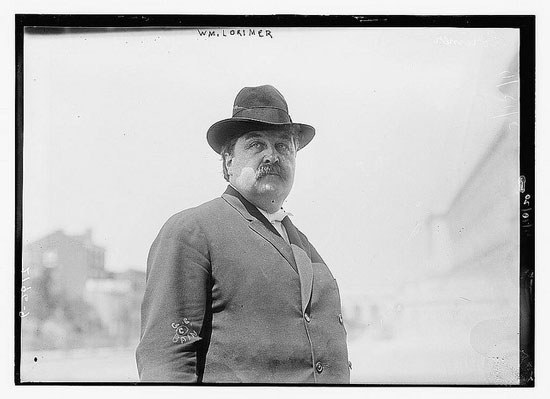
William Lorimer circa 1911 (Courtesy Library of Congress via The Commons on Flickr)

William Lorimer (1861-1934), was a rare bird indeed: a Chicago political boss who was Republican.  By the time he paused to have this photograph taken, he’d risen to a seat in US Senate, but under circumstances that steeled reformers’ determination to amend the Constitution, so that nothing of the kind would ever happen again.

Lorimer had the bored, jaded look of a man who’d been around the corner and back again.  Known as the “the Blond Boss,” Lorimer, who’d been born in Manchester, England, had risen to wealth from poverty, the son of a Scotch-Presbyterian minister who died early, leaving his family to negotiate the late nineteenth-century Chicago immortalized in works like Sister Carrie.  From the age of ten, Lorimer worked various jobs, including in the stockyards; he received negligible education.

In his early 20s, he became a street-car driver, married a woman who was Irish Catholic, and converted to her religion.  Known as a clean liver who did not drink, smoke, or attend the theater, he fathered 8 or 9 daughters, many of whom later worked for the city.

Lorimer’s determination to enter politics on the Republican side is said to have dated from 1884, when a Chicago polling place could not provide him with a Republican ballot to cast for James G. Blaine.  Lorimer became the political favorite of ethnic voters on the city’s west side, including many Russian Jews, Bohemians, and Irish who had previously voted Democratic.  Lorimer was not a reformer; he believed in competition.

He thrived by delivering on promises to supporters and friends, and by wedging himself between the Democrats and the reform wing of his own party.  Exploiting these divisions, he managed in 1908 to defeat a rival Republican for the US Senate, at a time when all Senators were chosen by state legislatures.  A year later, one Illinois state assemblyman claimed to have been paid $1,000 for his vote.  Several others joined him, claiming to have received payments from a jackpot fund set up to influence decisions in the Illinois assembly.

The allegations were investigated over the next several years by state and federal legislative committees, which could not find evidence of Lorimer’s personal wrong-doing.  But the winds of change had been blowing strongly, and eventually grew strong enough to blow Lorimer away.  Ignoring the detailed conclusions of the committees, the Senate voted to expel Lorimer in 1911.  Two years later, the nation ratified the 17th Amendment, which empowered voters to elect US senators directly.

Though Lorimer dropped dead in a Chicago train station decades ago, something of his spirit still haunts Chicago.

Image courtesy of the Library of Congress, from this source.

YOU MAY ENJOY:
Boss Lorimer and the Illinois Bribery Scandal,” New York Times, 1909.

War Dead

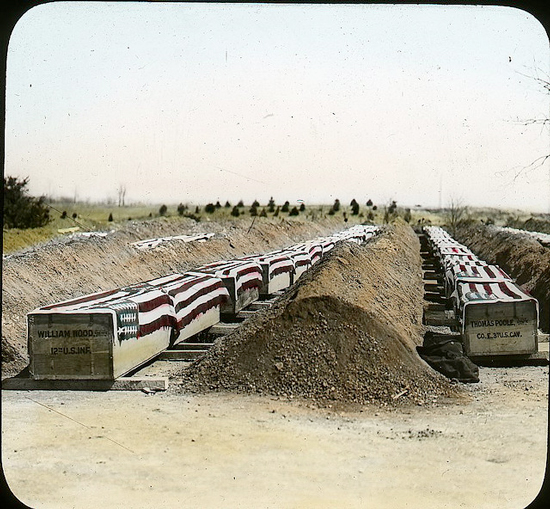
The remains of American soldiers awaiting internment at Arlington National Cemetery (Photograph by E.B. Thompson, courtesy DC Public Library via Flickr Commons)

On April 6, 1899, Washington DC photographer E. B. Thompson rode out to the cemetery at Arlington, where the remains of several hundred officers and soldiers were about to be buried.  The men had died in the late war with Spain, a brief affair that both began and ended the previous year, bringing the US control of Spain’s former island possessions—Guam, Puerto Rico, and the Philippines—and the independence of Cuba.

The coffins represented a fraction of the 3,000 Americans who died, felled not so much by their adversaries as by tropical diseases like malaria and yellow fever.

Now, belatedly, they were to be buried.  The coffins lay suspended over long trenches dug in a new section of the cemetery.  Many of the remains were unidentified, so coffins of the known dead were carefully positioned at the ends of the rows that would be most visible during the ceremony.  Thompson positioned himself near the presidential viewing stand and took this picture.  It is an image as raw as the landscape itself, the kind of grim tribute to the fallen that we hardly ever see.  It was colorized later.

A crowd of some 15,000 people, along with President McKinley and other dignitaries, gathered for the funeral rites.  A newspaper in New Brunswick, Canada, carried a full account of the proceedings.   The work of burying the coffins began after the crowd dissipated, a tough, tedious job that took several days.

Image: E.B. Thompson photograph, “Interment at Arlington National Cemetery,” 1899.
Courtesy DC Public Library Commons, from this source.

An Old-Time Speaker

Photograph of House Speaker James Beauchamp Clark in 1911 (Courtesy Library of Congress)

I spend a lot of time looking at old photographs, often when I’m having trouble writing, when I’m tired or don’t know what else to do.

Historians struggle with the relative invisibility of the topics they write about; that’s why it’s so nice when there are visual vestiges.  They feed and correct the imagination, and if you’re clever you can take what you see and use it to write more vividly.

Photographs also prompt discovery.  I love this picture of James Beauchamp Clark, a Speaker of the House I’d never heard of before.  Not just because it’s a well-composed photograph, with the vantage conveying its subject’s power; I love its realism, the way it’s slightly tattered, used-up, off-kilter.  Politics back then lacked the cosmetics of today.

Clark (1850-1921) was a Democrat, a contemporary and sometime rival of Woodrow Wilson, with whom he is pictured below.  According to a sketch by Lewis Gould in the American National Biography, Clark was born in Kentucky, the son of a traveling dentist and buggy-maker.  He received scant education but nonetheless became a schoolteacher at age 15.  Later matriculating to Transylvania University (in KY) he got expelled for shooting a gun at another student.  Back in school (law school, by this time), he shortened his name to Champ Clark because it would better fit in a newspaper headline.  These were just his beginnings.

He moved to Missouri and gradually became a power in the Democratic party as it struggled to regain supremacy after the glory years of Republican reign under McKinley, Teddy Roosevelt, and Taft.  Clark was more peaceful and anti-imperial than Wilson.  I love this “casual” photograph of the two men together, don’t you?

Woodrow Wilson and Champ Clark at Sea Girt, New Jersey (Courtesy Library of Congress via Flickr Commons)

Top: House Speaker James Beauchamp Clark in 1911, from this source.
Bottom: Woodrow Wilson and Champ Clark, from this source.