Looking In on Lincoln’s Inaugurations

Inauguration of Mr. Lincoln (1861), photograph courtesy of the Library of Congress

How fortunate we are that Lincoln’s presidency came just after the development of photography!  Of course, by the time he first took office in 1861, certain photographic processes, notably daguerreotypes, had been around for decades.  But only around mid-century did photography develop into a versatile, practical, and widely circulating medium.  As a consequence, whereas photographs of Lincoln’s predecessors in the White House are scarce, Lincoln and his political contemporaries had their pictures taken many, many times.  Some even became shrewd retailers of their mechanically reproduced selves.

The result, from the point of view of the present, is an opening-wide of the window onto history.  Whereas details of James Buchanan‘s 1857 inauguration come down to us mainly through artistic and verbal description (there is this one blurry photograph), good photographs documenting both of Lincoln’s inaugurals survive.  From 1861, for instance, there are several fine distant views of Lincoln taking the oath of office, though none of them is close enough for us to make out his great defeated rival, Senator Stephen A Douglas, who, according to historical testimony, is said to have been looking on from a seat nearby.

These photographs remind us of the immature, precarious state of the Union at the time.  The great addition of the new Capitol dome was incomplete, and, even as Lincoln moved to forward to assume his elected office, the elements that made up the nation were breaking apart.  Prior to March 4, 1861, when this picture was taken, seven pro-slavery states had seceded, and afterward, four more southern states would depart.  On April 12th, with the firing on Fort Sumter, the nation would descend into a state of war.

A closer view of Abraham Lincoln's Inauguration in 1861 (Courtesy of the Library of Congress) of Abraham Lincoln in 1865

The crowd gathered for the swearing-in knew that they were witnessing a momentous scene.  The crowd was thick; most had furled their umbrellas; men, straining for the best possible view, mounted light poles and trees.  Motionless, they strained to hear the unamplified proceedings, the camera preserving the style of their hats and clothing.  Two men turn to face the camera, cannily.

The succeeding years saw a widening use of open-air photography, so that we know with some immediacy the Civil War’s corpse-strewn scenes.  Photographers like Alexander Gardner (by then working for Mathew Brady) tirelessly trailed the armies, unflinchingly recording the realities of camps, hospitals, and battle-fields.  By the time of Lincoln’s second inaugural, in 1865, the war was in its final months, slaves had been liberated, and the nation had become accustomed to seeing itself through the lens of photography.

The crowd at Lincoln's Second Inauguration, March 4, 1865 (Courtesy of the Library of Congress)

This wonderful photograph by Gardner captures the look of that later crowd.  Here, the people themselves, not the government nor the army, nor their most powerful representatives, are recognized as camera-worthy, as they gather on an inauguration day that is once again wet and muddy.  Great coats and banners billow in the breeze, as knots of spectators stand about, chatting or strolling as they please.  In time, they part to make way for the inaugural parade, in which Union regiments of both races proudly march.

Alexander Gardner, Stereographic view of the crowd at Lincoln's Second Inauguration, March 4, 1865 (Courtesy of the Library of Congress) Lincoln's Inaugural Parade (1865)

Is it my imagination, or is there a touch of jubilation here, missing from the earlier proceedings?  Though the war had yet to end, the prospects for the Confederacy were dwindling sharply, and Americans who had fought to keep the nation together knew that their victory was sure.

Alexander Gardner photograph of Lincoln delivering his second inaugural address as President of the United States (Courtesy of the Library of Congress)

Bare-headed, Lincoln reads his message of reconciliation to a crowd radiating around him like magnetic filings, the dais overflowing with dignitaries.  A miscellaneous crowd of watchers stands beneath him, studying the crowd while listening.  It is a homely scene with little pageantry, suited to a federal republic that, though riddled with conflict, has endured trials to grow in confidence and power.  Outside the frame, the Capitol dome has been completed, and stands triumphantly capped with the Statue of Freedom.

All images from the collections of the Library of Congress.
Click on the images for more information and larger views.

A Working Holiday

Map of US Territorial Acquisitions (Credit: National Atlas of the United States via Wikimedia Commons)

New Year’s has often been a working holiday for American statesmen.  More than a day of moral resolution, January 1st marks the anniversary of several bold, ambitious actions that have opened new eras and horizons for Americans as a people.

1. SCOUTING THE WEST

New Year’s Day in 1803 found Thomas Jefferson secretly laying the groundwork for the Lewis and Clark Expedition, a scheme that had to be covert because it proposed scouting out vast tracts of land that at the time belonged to other countries.  The French lands now referred to as the Louisiana Purchase would not belong to the United States until the spring, while the Oregon Territory would remain the property of England for many decades.  Yet Jefferson was undeterred in his determination to familiarize himself with, and strengthen American claims to, these unknown neighboring regions.

So he began crafting a confidential message to Congress, describing the possible benefits of reconnoitering these lands and asking for an appropriation of the $2,500 necessary to supply the journey.   Congress looked with favor on his request, thus inaugurating a initiative that pioneered knowledge of the West’s lands, resources, and native peoples.

A map from the Lewis and Clark Expedition (Courtesy of Yale University Library via Wikimedia Commons).

The government was rewarded with a treasure-trove of maps and documents that facilitated its later dealings with, and gradual displacement of, native American tribes.  Today, we tend to discount the expansionist ambitions that motivated Jefferson, instead lauding the Expedition as an early model of the many progressive scientific projects and surveys the US government would subsequently fund.

2. FREEING THE SLAVE

Sixty years later, President Lincoln spent New Year’s Day greeting callers to the White House and putting his signature on the final version of his Emancipation Proclamation, which was sent out over the telegraph wires later that day.  Not unlike the Lewis and Clark expedition, Lincoln’s statement had had a long fruition, with earlier drafts of the measure being floated and discussed the previous fall.  Lincoln’s determination to associate the waging of the Civil War with the moral cause of ending slavery marked a tipping point in the long struggle to secure for African-Americans personal freedom and civil equality, a struggle begun decades earlier and continuing on for more than a century, even down to today.

Watch meeting in Massachusetts

The executive order, which famously declared the freedom of all slaves held in rebel states, was on display at the National Archives in Washington yesterday, on the occasion of its 150th anniversary.  Though limited in its scope and practical effects, the proclamation spelled liberation for a people who had suffered oppression since colonial times.  Lincoln’s deliberate blow to slavery paved the way for its complete and permanent abolition, accomplished through the ratification of the 13th Amendment to the Constitution.

3. WELCOMING THE IMMIGRANT

Finally, on New Year’s Day in 1892, the first immigrant (of some 16 million) passed through the doors of Ellis Island.  It is commonly said that “American is a nation of immigrants,” but the establishment of Ellis Island and other formal points of entry gave that rite of passage a dignity and regularity that was previously missing.

Immigrants arriving at Ellis Island, 1905 (Courtesy of the Library of Congress)

Located near the Statue of Liberty, Ellis Island bestowed welcome and the necessary paperwork on immigrants who had previously been less distinguishable from American citizens.  At a time when many born Americans went through life without the legal documentation of a birth certificate, Ellis Island conferred a bureaucratic identity on the newly arrived, routinizing a more paper-bound and legalistic conception of Americanness that is with us still.  Today, however, Ellis Island stands as a cherished symbol of the rational means the government employed to bind its disparate population into one people.

May these complex and impressive projects inspire today’s political leaders to lift up their sights and grapple bravely with the issues confronting the nation now.

The Good News? A Dollar Can’t Vote

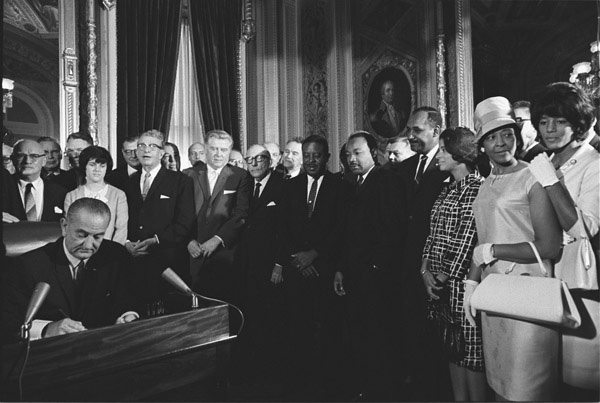
LBJ signing the 1965 Voting Rights Act as Martin Luther King Jr and others look on (Courtesy of the Library of Congress via the Commons on Flickr)

As Election Day dawns, final tallies of money spent on the 2012 campaign are appearing.  In a country where a dollar is sometimes taken as a measure of all things, it’s worth remembering that these billions have been expended in the hope of bending the great will that collectively lies with the American people.

That’s right, fellow citizens: at the end of the campaign, it all comes down to you.  The special interests, the media, the national parties, the consultants: in the end they’re all equally powerless.  It’s up to you to get out and vote today.  Ignore the cynics: your action—no matter where you live—is an expression of power that remains awesome and singular.  No matter who has the money or how it’s spent, the voter’s mind and heart are where power lives.

So get out and exercise your power today: vote for the best men and women, and may the best of them win!

Image: Lyndon Johnson signing the 1965 Voting Rights Act as Martin Luther King Jr. and others look on, from this source.

Political Affections

Robert Cruikshank watercolor of crowds attending Andrew Jackson's inaugural reception in 1829 (Courtesy of the Library of Congress).

Amid the strife wracking US politics, a soul can grow weary.  Why do we care?  Why do we bother—why not lay down the burden of republican citizenship and turn away?

In our hearts, most of us have a vision of a more just, peaceful, and prosperous nation.  With concerted effort and good will, we can attain a condition better than what we’ve experienced lately.  I suppose I became a historian and took the unlikely step of writing about politics because I want to make citizenship a large, evident part of my identity.  Whatever else I do, being a citizen is something that I want to achieve.

Patriotism is out of fashion with the sophisticated.  We think about “going into politics” as a sort of careerism; and, if we don’t do that, it’s pretty much understood that we are on the sidelines.  It would be difficult for us to make sense of the 19th-century statesman who, on his death, was eulogized as a “pure patriot. . . whose brain and heart and means and energies were all at the service of his country.” We can understand the part about the brain and the heart—but to commit all one’s means and energies to the country?  That’s alien.

Yet the many-sided commitment of self to public life was once a commonly held American ideal, which individuals pursued in the hope of gaining a special kind of honor and esteem.  Conversely, the wholehearted identification of one’s personal destiny with that of the nation was a crucial element on which the future of the republic was thought to depend.

Queen Elizabeth’s Diamond Jubilee last week stirred up many warm feelings, underscoring the important role of human affection in maintaining a government and a country.  Having a queen may seem useless from a functional standpoint, but symbolically Elizabeth represents the nation in her person.  To love Elizabeth is to love Britain, which isn’t too hard, especially when she is looking so darned benign and motherly.

Photograph of Queen Elizabeth II wearing a hat adorned with flowers

Yet the sentiment the Queen evokes isn’t particularly cozy.  Often she evokes awe, especially when projecting loftiness, magnificence, or a tireless duty.  All the qualities associated with the Queen serve to bridge a gulf that might otherwise exist between her subjects and that abstraction that is their nation.  It’s precisely because Elizabeth is a person—rather than a building, say, or a flag—that she can embody so many varying qualities that, taken all together, help maintain something distinctive in Brits’ feeling for their country.

In the words of the 19th-century Englishman Walter Bagehot, the queen “excites and preserves the reverence of the population,” thereby helping to bind their sentiments to the state.

Besides her gobs of jewels, her surreally one-of-a-kind existence, and her heavily photographed family, what I like most about the queen is the way she styled herself as a sort of sacrificial über-citizen, beginning on the very first day of her reign.  On the evening of her Coronation in 1952, the young queen made this declaration to the people of her country.

I have in sincerity pledged myself to your service, as so many of you are pledged to mine. Throughout all my life and with all my heart I shall strive to be worthy of your trust.

Thus began sixty fairly unsensational years of color-coordinated dressing and the performance of millions upon millions of prescribed and customary royal duties.  At the end of the day, it’s hard not to admire Elizabeth’s dogged commitment to all the formalities and tedious conventionalities that are part and parcel of her country’s monarchical tradition.

When it came time to draw up our own Constitution in the 1780s, the Revolutionary generation was conscious that, in rejecting monarchical government, they had given up something that, in good times, helped secure citizens’ attachment and loyalty.  What, in a republic, could substitute for monarchy’s appealing glitter, pomp, and ceremony?  What could the framers devise to cultivate the people’s respect and embody the fledgling nation’s character and authority?

Ironically, the answer they came up with is the presidency.  The framers hoped that the occupant of this new-fangled office would function as “the people’s sovereign.”  Federalists like John Adams hoped that the style presidents adopted would be sufficiently “splendid and majestic” to instill a sense of the dignity and authority of the nation in the public mind.  In addition, members of the federal government took care to develop a set of forms and customs for capital life that might earn the republic respect, both at home and abroad.

Still, it would be hard to claim that the Founders solved the problem satisfactorily.  In the years before the Civil War, observers recognized that the federal government exercised only a weak, secondary claim on many Americans’ loyalties—secondary to their homes and to the states where they were raised.

As we contemplate the narcissism and partisanship permeating the competition for the presidency, we may be justified in doubting whether the work of securing the affection and loyalty of the people remains a priority today.

Image: Robert Cruikshank’s watercolor,
“President’s Levee, or all Creation going to the White House”
(published 1841), from this source.

A World Without Lincoln

sketch by Charles Dix of Fort Monroe in the offing, 1863 (private collection)

For those whose consciousness is tuned to the Civil War, April is strewn with anniversaries.  The war began April 12th, 1861, with the Confederate barrage of Fort Sumter.  Four years later, it ended on April 9th, with the rebels’ surrender at Appomattox.  A week later, President Lincoln was slain while sitting in a box at Ford’s Theater.  That spring the injured nation lay under a blanket of a peace, a peace fraught with exhaustion, anger, uncertainty.

It’s hard to fathom what Americans at that time felt, experienced.  On the far side of a dreadful, violent division, they had run a course that intransigence — impatience — and distrust — dictated.  To say Progress Is Unpopular is putting it mildly.  Those who could not put up with change, those unhappy with the course of progress, those who were sick of compromise and unwilling to think even for one minute of living without slavery — these were the people who threw in the towel.  They walked away from Congress, from compromise and debate.  Rather than accept a turn of events they conceived of as a humiliating political defeat, they rebelled against the federal government and sought to go their own way.  The ensuing war was coercive, decisively establishing the ultimate authority of the Union and the federal government relative to other interests and claims.

Among my belongings is a small drawing, a bit of memorabilia from that unhappy time.  It’s a tiny sketch on Union stationery, showing a view of Fort Monroe from the water.  The artist was a young man, Charles T. Dix, whose father, John, was in charge of Union forces there at the time.

Located in Virginia at the tip of the peninsula formed by the confluence of the James and York Rivers, Fort Monroe became a haven for former slaves who gained their freedom by leaving rebel territory.  After the war, the fort was where former leaders of the Confederacy were imprisoned.  Jefferson Davis was held there for what many considered to be an unconscionably long period.  Hitting on the appropriate way to treat men who had presided over such a protracted and devastating rebellion took a long time.

It has taken far longer to discover how to realize the dream of freedom and equality that was an inseparable part of that dark struggle.  Ultimately, though, we have struggled toward it, however benightedly, struggled toward it with and without great statesmen, struggled toward it in a world without Lincoln.