Peaceful co-existence

Modern life is war, © 2013 Susan Barsy

Peaceful coexistence: this is my prayer.

With respect to Syria:

1.  If the US is intent on avenging deaths from chemical weapons, it should be asking, “Why these deaths?” and “Why should we be the avenging party?”

2. If the US is seeking to punish those guilty of using chemical weapons, it should do so in a way that punishes only the guilty.  This would suggest using mechanisms set up for bringing to justice persons guilty of crimes against humanity, or possibly using covert means.

3.  If the US is seeking to reinforce the general prohibition against chemical-weapons use, it should use a strategy that will really achieve this aim.  Bombing Syria to cripple its air power (and hence its capacity to “deliver” chemical weapons) is a crude and doubtful means to achieve this aim.  Nor will bombing Syria have the effect of deterring Iran from developing a nuclear bomb.

The United States has fallen into a bad habit of being over-active militarily.  Its leaders say it is in the nation’s interests to bomb Syria, that it will advance many sweeping aims, like making the US itself safer from chemical weapons attacks.  Instead, its interventions in remote countries have the opposite effect, sowing hatred and resentment in the hearts of foreign peoples–and justifiably so.

A courageous power would turn away from the temptation of easy violence, which Americans perpetrate readily, thinking it bears no cost to themselves.  The day the United States chooses to conduct itself as a nation among nations is the day it confirms its status as a mature and lasting power.

Papal Charisma

Pope Francis

The Papacy is only as good as the person in it, at best.  With the accession of the new pope and his first few dazzling gestures and appearances, the prevailing tone of Catholicism has quickened, with adherents daring to think new thoughts and regard the future more hopefully, sensing the power of a new point of view to create openings.

Whether the church on the ground can keep up with the change, Pope Francis has begun clearing paths for a global communion of followers.  His response to their desire for inspiration has been direct and almost disconcertingly unmediated.  There’s no question that Catholicism has entered a new era.

Francis’s stellar début marks the emergence of a charismatic leader.  Weber famously defined charismatic authority as “resting on [a] devotion to the exceptional sanctity, heroism or exemplary character of an individual person, and to the normative patterns or order he reveals or ordains.”  In short, charisma exists where followers acknowledge it to.  A rare in-dwelling quality, charisma is the genuine form of a sort of appeal that American politicians desperately try to acquire with the aid of polling, statistics, and consultants.  In Catholic believers’ spontaneous and enthusiastic response to Francis, we see a faith in leadership largely absent from American democracy.

Charisma, however wondrous, is problematic.  In Francis’s case, it remains first to be seen whether his acts and leadership justify the adulation he is receiving.  For now, we see mainly the strength of the laity’s pent-up desire to repose trust in a virtuous leader.  Second, as Francis’s time in the Papacy lengthens, we shall see whether his charismatic authority is powerful enough to wreak change in a vast yet morally compromised global bureaucracy.  Or will his charisma be muted as he attempts to reinvigorate a hierarchy so routinized and entrenched?

The Summer without a Summer

Currier and Ives hand-colored lithograph, "Winter in the Country: A Cold Morning" (1863), courtesy of the Library of Congress.

In 1872, near the end of his life, New York newspaperman Horace Greeley recalled a summer in his childhood that pushed his family to the brink of want and insolvency.  It was the summer of 1816, when weather abnormalities reached catastrophic levels, producing a summer without summer, the typically warm months instead punctuated with snows and frost.

Greeley recalls waking on June 8th of that year to find an inch of snow blanketing his family’s farm in Amherst, New Hampshire.  Frosts occurred in all the summer months, destroying crops and yielding only a ‘dubious harvest.’

The conditions Greeley described were general throughout the northeastern United States and felt as far south as Thomas Jefferson’s Virginia.  Newspapers and diaries document the freakishly cold weather that rattled Americans, whose lives then depended almost entirely on what farms in their vicinity could produce.  (Importing food from a distance was untenable before the age of rail.)  Though New England was never a great breadbasket, its farms usually produced enough grains and vegetables to support the human population and some livestock farming.

That summer, persistent cold and frosts produced widespread crop failures.  On each morning from June 8 through 10, frosts were reported throughout much of New England, causing the trees’ foliage to blacken.  In July, a powerful Canadian cold front moved in, killing off tender plants such as beans, cucumbers, and squash, and raising the first fearful prospects of famine.  Yet, according to meteorologist Lee Foster, who has analyzed the agricultural impact of the weather that summer, hardy crops such as wheat, rye, and potatoes managed to hang on.

In the middle of August, any prospect of a normal harvest vanished when frost again hit New England and upstate New York.  Violent thunderstorms followed the cold, with still more frost striking around August 20 and 28, killing the corn and effectively ending the growing season.

Those in northern inland regions suffered the most.  Newspapers recorded June snowfalls of 10 inches in Vermont and 7 inches in parts of Maine.  Newly shorn sheep froze to death; fruit was destroyed.  Farmers went about in coats and mittens.  By the end of the summer, domestic animals were starving.  Much of the human population was famished, too.

Throughout the affected areas, livestock were hastily slaughtered, creating a glut that drove down prices, while the price of grains, particularly corn, began skyrocketing.  While families accustomed to subsistence agriculture were rich in tactics for making do in hard times, the poor harvests of 1816 left them in debt and without the cash or seeds needed to get started the next growing season.  The bankruptcies and penury that followed in the wake of “summer that wasn’t” caused widespread land forfeiture and precipitated the first great out-migration of farmers to the virgin Midwest from eastern parts.

Scientific knowledge and understanding were then insufficient to account for the strange weather Americans were seeing, though some conjectured that sunspots or a solar ellipse (both recently observed) were a probable cause.  Well-informed Americans understood, though, that the peculiar meteorological conditions they were experiencing were more than a local phenomenon.  Their newspapers were reporting similarly catastrophic conditions across Europe, where cold and dark weather was producing dire food shortages, including Ireland’s infamous potato famine.

Today, meteorologists attribute the adverse atmospheric conditions of 1816 to a colossal volcanic eruption that occurred the previous year and half a world away.  On April 8, 1815, Mount Tambora, a volcano east of Java in the Dutch East Indies (modern-day Indonesia), began erupting.  According to a new book by William Klingaman and Nicholas Klingaman, the explosion, a hundred times more powerful than the 1980 eruption of Mount St Helens, was the largest volcanic disturbance in the last 2,000 years and the deadliest in recorded time.  Some 12,000 people living near Tambora died at once, with another 70,000 dying from the toxic fallout in Indonesia alone.

Blasts from the volcano, audible 800 miles away, blew 3,000 feet off the mountaintop, spewing millions of tons of ash, dust, and sulfur-dioxide gas into the sky, the lightest particles flying up more than twenty miles.  Within twenty-four hours of the climactic eruption, an impenetrable cloud the size of Australia had formed.  Particles in the stratosphere were slow to disperse, but winds gradually distributed them, reducing the amount of sunlight reaching the earth.  The impact on climate peaked in 1816, when the Northern Hemisphere felt its withering chill.

Americans today worry about global warming, but early Americans had more to fear from the cold.  Mount Tambora’s eruption intensified conditions associated with the “Little Ice Age” that prevailed from around 1400 to 1850, when the sun’s lower output produced harsher winters, shorter summers, and more aridity—conditions that, like today’s weather abnormalities, created unanticipated hazards and human suffering.  As for the future, who can say?  The new global cooling may be just a volcano away.

Image: Hand-colored lithography by Currier and Ives, “Winter in the Country: A Cold Morning” (1863), in the Library of Congress.  To go to the source, click here.

The GW Who Lacks a Memorial

Watercolor portrait of George Watterston circa 1811 (Courtesy of the Library of Congress)

George Watterston (1783-1854) was perhaps the most prominent writer to establish himself in early Washington, DC, and one of the first people to head up the Library of Congress.  He was the author of a number of satirical novels about social life in the young capital, which is how I first became acquainted with him.

Watterston was born with the nation, in the year that marked the end of the Revolution, to an unknown mother aboard a ship docked in New York City harbor.  His father, a Scottish immigrant and master builder, moved the family to the District of Columbia in 1791, soon after it was designated as the location for the new capital.  Watterston’s development and that of “Washington City” were thus closely intertwined.

Watterston was educated as a lawyer but turned away from the profession in distaste.  Instead, he wrote a novel entitled The Lawyer; Or, Man as He Ought Not to Be, published anonymously in 1808, and with that his literary career was launched.  In 1813, Watterston became the editor of the Washington Star Gazette, a Republican newspaper, promoting and chronicling Washington as it grew.

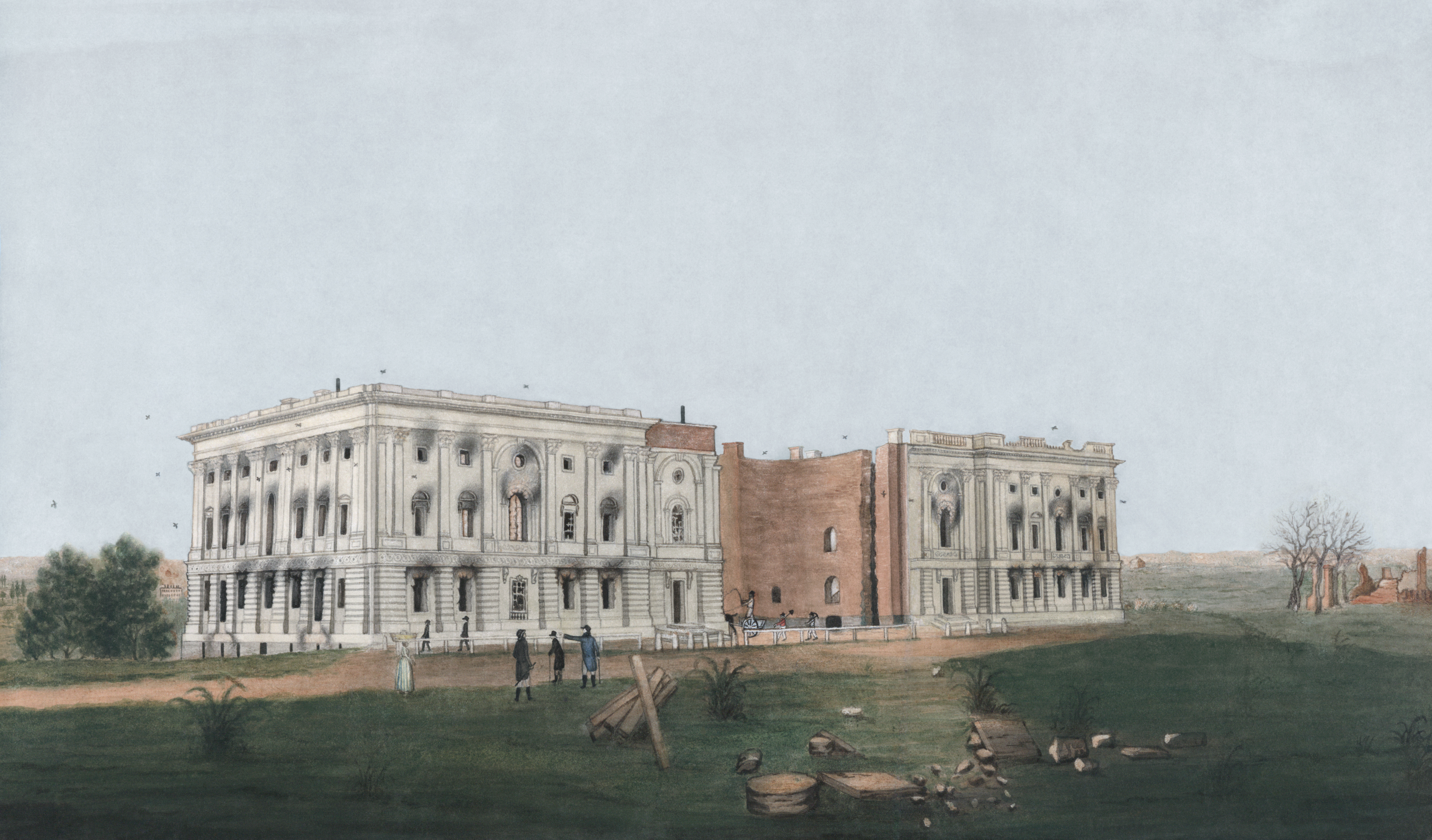
Two years later he was named Librarian of Congress, the Congressional Library being then a young and small institution.  What there was of it had, in fact, been destroyed in 1814, when the British succeeded in invading the capital, torching the Congress’s new home and the books inside.  Watterston rebuilt the collection, aided by Thomas Jefferson, who generously donated his personal library.

Watterston’s patronage job, which he held for the next 15 years, freed him to write.  His literary output entailed funny, shrewdly observed novels; statistical compendia; books on gardening and landscaping; sketches of political figures, and traveler’s guides.  A Whig in politics, he got a rude jolt when Andrew Jackson became president and promptly dismissed him from his post as Librarian, in order to put a Democratic supporter in.

The Washington Monument under Construction, ca. 1876, courtesy of the US National Archives via the Commons on Flickr.

The Washington Monument, circa 1876.

Watterston then founded the Washington Monument Building Society, which envisioned and built the massive obelisk that dominates the Mall.  This massive and expensive undertaking, begun in 1833, would not be complete until 1885.  At the time of Watterson’s death in the mid-185os, the Monument had attained a height of just 150 feet.  Still, I think it’s a terrific thing to have to one’s credit, don’t you?  Watterston deserves a biography, if not a modest monument of his own.

Images from this source and this.

A Meditation on the Old North Bridge

The Old North Bridge, © 2013 Susan Barsy

On a beautiful summer day, with visitors enjoying its views and waters, the Old North Bridge seems an unlikely spot for the beginning of a revolution.  Yet here the first organized and deliberate battle of the American Revolution occurred, when, in April 1775, colonial militia intent on defending their munitions forcefully repelled regulars of the British Army.  Turning them back at the Bridge, the colonials famously sniped at the British as they retreated on a heavily wooded road.

It was the beginning of an eight-year war that the revolutionaries fought with little help from outside.  Once they had killed members of the British armed forces, there was no path back to peace and submission.  There could be no end to defensive resistance, to a rebellion that at first had no unified, all-encompassing aim.  Only after more than a year of bloodshed and ad hoc organization did the thirteen colonies unite in Declaring Independence, justifying their goal, with the aid of Thomas Jefferson’s mighty pen and mind, with the most lofty and universal terms he could devise.

During this period, George Washington transformed the initially rag-tag Revolutionary Army, using stern measures to exact loyalty and obedience, while inveigling the Continental Congress (even as revolutionaries, the colonists had a regular legislative assembly) to provide the money and measures needed to fund the Army and enhance its power to fight.

Ultimately, the colonies triumphed and went on to peacetime success not because of their military might (which arguably remained inferior to the British) but because of the political culture they embodied.  The political processes and traditions that they had always relied on enabled them to retain their cohesion after throwing off the British, and, eventually, to devise a stable new nation based on the Constitution, ratified some thirteen years after the Revolution began.

Far from being alien subjects, the colonists were scarcely distinguishable from their imperial adversaries.  Their cause produced results because they knew and wished to preserve a civil society, in which they could be secure in their enjoyment of specific personal and political rights.  The American Revolution was a narrow struggle, fought by two populations infused with the same liberal traditions and similar attitudes toward the rule of law.

Unlike the revolutions we see around us today, the American revolution was not primarily about religion, nor was it fought along tribal, sectarian, or racial lines.  It was more of a family quarrel, fought between two forces of related bloodlines.

Being creatures of empire, early Americans, once free, quickly exhibited their own imperial tendencies.  Today we are quick to preach power-sharing to nations fraught with internal strife, but on this score we lack an illustrious history.  When it came to indigenous Americans, for example, the Anglo-Americans dominant in the 19th century pursued a policy of removal and territorial appropriation that makes the Japanese-American internment camps of the 20th century look like a friendly garden party.

The Native American tribes, though possessing deep claims to the lands of the American continent, were as unwieldy and threatening in a cultural sense as any terrorist is today.   The notion that white Americans could cohabit or compromise with native peoples, or that two such dissimilar cultures could be harmonized or politically integrated, was too mind-boggling to be entertained.  Instead, the American government used military and political force to extirpate Indians and push them off desirable lands.  Americans’ idea of “power sharing” with the Indian “other” was to expel remaining tribes from the American body politic, cordoning them off  on “reservations,” where they could no longer impinge on, or participate in, the ostensibly egalitarian government that was sovereign by then.

Similarly, in the 1860s, white Americans had to fight a Civil War among themselves, at the cost of some 600,000 lives, to establish the principle that we should not enslave persons whose skin color is different than ours.  It took another hundred years to provide African-Americans with the legal protections necessary for the full exercise of their political rights.

Throughout our Civil War, the rest of the world sat on the sidelines, as the nation sought its direction through a protracted conflict that refined it and left it profoundly changed.  The principles of union, federal authority, and equality that were then irrevocably established laid down the foundations of the nation’s might today.

These facts about our history must be recalled as we consider intervening in revolutionary conflicts in other countries.  The paramount importance of civil culture should be borne in mind as we contemplate giving military aid or committing ourselves militarily in other ways.  We tell ourselves that stepping in will lead to a more just result, or an earlier peace, but what process of internal development or resolution are we short-circuiting?  We say that other countries should tolerate and politically empower radicalized or militant minorities, though this isn’t something we’ve ever done with ours.

Much as our hearts are moved with compassion for the suffering that accompanies violent conflicts that are unbounded and unequal, we should be humble in our response, recalling the long path we have traveled from Revolution to tolerance and inclusion—a centuries-long struggle that continues even now, long since peace returned to the Old North Bridge.