Use Post Offices to Turn Obamacare Enrollment Into a Smashing Success

Remember that vast chain of derided properties that the US postal service owns?  Have you recently driven or walked past a post office?  I bet that you have.

With some 32,000 post offices in virtually every inhabited corner of the country, the postal service offers a nexus for interacting with the public that few other federal entities can rival.  For this reason, in the past US post offices have sometimes been made to serve double duty.  Until recently, the IRS used the post offices to make printed tax forms available to taxpayers.  The Selective Service has used the post office for decades for draft registration.  Post offices house passport services on behalf of the State Department.  Historically, the post office has been the communications hub connecting the government at Washington with the people at large.  The local, face-to-face character of the post office makes it ideal for placing an initiative within reach of the people.

Now, the Department of Health and Human Services could use the post offices to facilitate Americans’ enrollment in ACA-compliant health-insurance policies listed on the federal insurance exchange.  Even if the HealthCare.gov website were fixed overnight, most citizens could still use help figuring out how to apply—how to negotiate the website—their eligibility for subsidies—that sort of thing.  Given all the concern about the under-utilization of post offices as federal property, pressing them into service at this juncture would be a crowd-pleaser—one justified on grounds of efficiency, too.  Teams of HHS and IRS personnel (or even volunteers from Americorps) could be enlisted to staff these physical exchanges, where citizens could learn about the policies and sign up for them, with the aid of old-fashioned paper forms, if need be.  The New York Times recently reported on the success of one such face-to-face state-level system in Kentucky.

I sincerely hope that the Administration will think more creatively about how to bring Obamacare’s promises to the public without more delay.  Given the vast resources of the government, there is no single right way, but many ingenious strategies that will advance the nation toward attaining health-care coverage for all.

© 2013 Susan Barsy

On John Kerry’s eerie resemblance to George Washington

John Kerry 1795, after Gilbert Stuart © 2013 Susan Barsy

Have you noticed that, as John Kerry has aged, he looks a lot like George Washington?

His similarity to the great Founding Father and Commander-in-Chief is unnerving.  It’s as though the ghost of Washington is haunting us, reminding us of his legacy, just in time for Halloween.  When Secretary Kerry appears on television, he unwittingly channels the ghost of Washington.  It’s cautionary.

The ghost prompts the question, “What would George Washington think of our actions overseas?”  Would he have condoned the President’s hawkish determination to punish Syria with military force for its use of chemical weapons against its people?  Would he have applauded the US intelligence forces’ capture of a suspected terrorist in the Libyan capital?  More generally, would George Washington, if alive in our time, be inclined toward intervention, or isolation?

The value of these conjectural questions lies in reminding us of the intimate connection between internal strength and influence abroad.  We need a fixed yardstick against which to measure our global acts and ambitions, which are more over-reaching and morally dubious than they were back in Revolutionary days.  Conscious of enjoying military and technological advantages and relatively ample means, the US frequently intervenes just because it can.  Because it can, our government has been spying on Angela Merkel, of all people.

Alternately, our government follows a schoolyard logic: if Johnny Johnson jumps off a bridge, then so will we.  If our strength relative to other nations continues to supply an irresistible rationale for scatter-shot decisions, soon that strength will be gone; what remains of our moral integrity will vanish, too.

When the United States were weaker, they had little choice but to be savvy about what fights they took on.  In George Washington’s time, a time of global conflict if ever there was one, even the most powerful Americans understood the truly vital importance of focusing on ‘within’ while exercising caution abroad.  While General Washington (1732-1799) was the preeminent ‘hawk’ of his day, he was also a prime founder of the powerful civic institutions that, in their fruition, secured broad national safety and prosperity.

The blessings of that peace were hard-won.  The North America of Washington’s lifetime was shaped by the great global conflict between France and Britain.  As a youth, Washington was one of the earliest participants in the French and Indian War (1754-1763), an expensive multinational conflict waged on the borders of the American colonies that lasted nine years. He then reluctantly led the colonial Revolutionary Army in its War of Independence against the British, a wearisome duty that absorbed him for another eight years’ time (1775-1783).

Given the tortuous path the young nation followed toward establishing a viable government under the US Constitution, George Washington was relatively old by the time he became the nation’s first president.  He governed those eight years with a consciousness of the nation’s fragility, respecting the preciousness of what it had achieved.

Little wonder that, on leaving office, Washington famously warned the nation to avoid the dangers of “foreign entanglements.”  Americans still faced the daunting challenge of growing together as a Union.  The last thing they needed was to become enmeshed in the machinations of world’s great powers.  Violent conflict throughout Europe marked the final years of Washington’s presidency.  Napoleon’s star had begun to rise. The year Washington died, the long Napoleonic Wars (1799-1815) were just beginning.  Protecting ourselves from the debilitating snares of global conflict was an important early contributor to our national growth, our 1812 war with England notwithstanding.

There is much to be said for shaping a foreign policy as creditable to a puny government as to one that’s strong.  Sadly, Kerry’s resemblance to Washington is only skin-deep, and President Obama doesn’t resemble George Washington at all.

© 2013 susanbarsy.com

The GOP’s marriage of convenience turns sour

Back in the spring of 2012, I wrote a post, Is the Republican Party Dying?, in which I surmised that the GOP, despite its already apparent fissures, was unlikely to collapse any time soon, because of the broad popularity it continued to enjoy at the state level in many parts of the country.  Now, in the wake of last week’s House vote on a bill to reopen the government, we have fresh evidence with which to assess the current condition of the party.

The GOP’s troubles appear to be growing, for, with the House vote that ended the government shutdown, the relative strength of the GOP’s intransigent right wing is clear to see.

Here is the vote count and its geographic distribution as depicted in a New York Times interactive graphic on October 17.  The yes vote (totaling 235 votes) was composed of 198 Democrats and 87 Republicans.  The no vote (totaling 144 votes) was composed entirely of Republicans unwilling to compromise, or to adhere to the advice of the moderate leadership of the party, as embodied in the House Speaker, John Boehner.

The size of the “no vote” is significant and startling, establishing that the more radical “Tea Party” element in the GOP, far from being a minority tendency as often depicted, comprises a MAJORITY of all House Republicans.  Far from being a “tail” that is “wagging the dog,” the Tea Partiers have morphed into the dog itself.  The only wonder is that they have not yet used their power to depose John Boehner–a miracle that has probably astonished the Speaker himself.

Regarding the “upcountry” character of these more radical Republican characters, the NYT map illuminates how difficult it will be to dislodge them, and why this faction so consistently overestimates its prospects for influencing the mass of the American population.  In many states where the suicide caucus lives, it enjoys a virtual monopoly.  In 12 states—including Georgia, South Carolina, Tennessee, Missouri, Texas, and Arizona—all the Republican representatives are of the intransigent kind.

These blinkered souls believe, despite the mounting evidence of public opinion polls, that their views command the assent of the American mainstream, and they are confidently planning to extend their geographical sweep into more moderate Republican territory.  In the meantime, moderates, alarmed at the immoderation of their right wing, have begun planning to challenge them in the primaries.  The battle for control of the GOP will be hard-fought.

But for now, the rest of us have seen how dangerous and desperate political actors can be when trying to hold together a party that’s imploding.  Should we condemn John Boehner for accommodating the radicals, or be relieved that no more radical obstructionist is replacing him?  The GOP truly is a grand old party, and should its literally elephantine organization collapse, the attendant damage would be catastrophic, not just for the party, but, as we have seen, for the nation too.

Looking back on this period, historians will puzzle over the decision of the GOP to welcome this radical fringe into their party.  Even now, the traditional Republicans could recover their dominance by unceremoniously cutting the Tea Party loose.  Without the GOP’s support and legitimation, the radicals’ spell would be broken, and their national influence would evaporate overnight.

Moderate Republicans who believe that such destructive zealots are necessary to their party have forgotten about the massive bloc of disaffected voters in the center of the political spectrum, waiting for forward-looking parties and personalities to appeal to them.

The GOP obstructionists

Who are the obstructionists intent on defunding Obamacare and delaying its implementation?

I appended to Monday’s post on Republican Fire-Eaters this list, compiled by fellow blogger Eric Prileson, giving the names and phone numbers of the 228 Republicans and 2 Democrats who passed a House spending bill to this effect on September 20.

The determination of the House to “hold up” the government until the Affordable Care Act is modified to its liking solidified when House Speaker Boehner and other G.O.P. moderates decided, once again, to cave in to the far-right members of their party.  The 80 radical Republicans leading the charge have been nicknamed the “suicide caucus”–an apt coinage highlighting their resemblance to a terrorist group.

As Thomas L Friedman and others have noted, this group is a minority with some striking geographical and sociological peculiarities.  I encourage you to read Ryan Lizza’s geographical analysis of the suicide caucus, recently published on the New Yorker website.  Accompanying it is a dandy map, based on data from The Cook Political Report, showing the “upcountry” character of the caucus’s constituency. Click on the map to go to its source.

congressdistricts_final-01.png

Lizza:

The geography of the suicide caucus shows . . . [that] half of these districts are concentrated in the South, and a quarter of them are in the Midwest, while there’s a smattering of thirteen in the rural West and four in rural Pennsylvania (outside the population centers of Philadelphia and Pittsburgh) . . . . there are no members from New England, the megalopolis corridor from Washington to Boston, or [from] along the Pacific coastline.

These eighty members represent just eighteen per cent of the House and just a third of the two hundred and thirty-three House Republicans. They were elected with fourteen and a half million of the hundred and eighteen million votes cast in House elections last November, or twelve per cent of the total.

The districts represented are also whiter than the nation as a whole.

The South, where many of the obstructionists live, is home to some of the nation’s unhealthiest populations.  Most Southern states, under Republican control, have decided against implementing the ACA-funded expansion of Medicare that might have benefited their neediest citizens.  This interactive map, published in today’s New York Times, shows the millions of people who will be affected by their choice.

*     *     *

Minorities, if sufficiently intransigent, can cause great harm if the majority fails to neutralize or contain them, leading to a frightful dynamic that President Lincoln, long ago, most eloquently described.

Republican Fire-Eaters

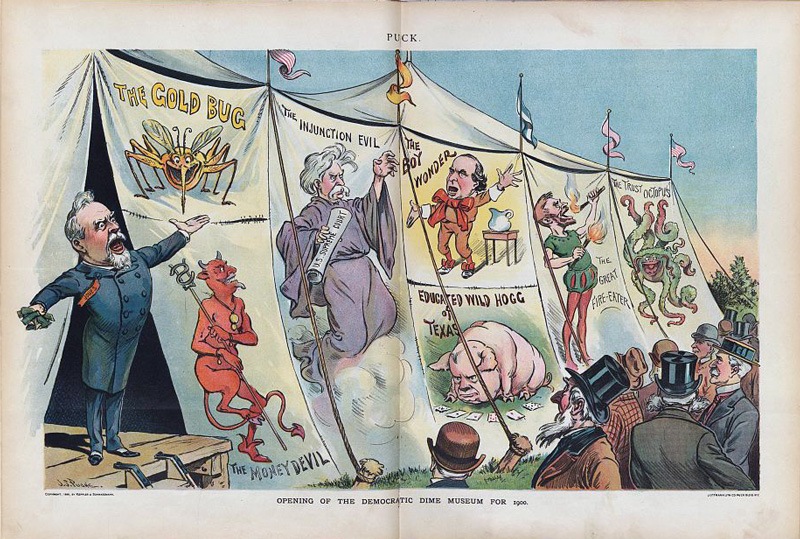
Political cartoon from Puck, showing various political types, including the "fire-eater" (Courtesy Library of Congress)

In politics, as in the circus world, a fire-eater is a performer who will swallow fire to attract a crowd and earn a living.  This aptly describes the tawdry crowd of grand-standing Republicans threatening to shut down the federal government today.

Their behavior resembles nothing so strongly as that of radical pro-slavery men, who, before the Civil War, threatened angrily to secede from the Union whenever the federal government wasn’t going their way.  Antebellum fire-eaters pretended to be great patriots and high-minded constitutionalists while actually serving the retrograde interests of a minority.

So it is with today’s right-wing Republicans, whose aversion to President Obama and health-care reform is so intense as to drive them along a reckless and self-defeating course.  Ted Cruz is, if anything, more self-serving and sophomoric than leading pro-slavery apologists–men such as William Lowndes Yancey of Alabama or Robert Barnwell Rhett of South Carolina–whose parochial defense of slave-holding and states’ rights marred careers as distinguished as any in their day.  In the end, these men could not love the United States more than they loved holding slaves, leading them to sacrifice true patriotism to an ignoble cause.

By now it has dawned on many Americans that those in Congress intent on derailing Obamacare at all costs are more like demagogues than patriots.  In their stubborn attempt to thwart the inclinations of a national majority, stand in the way of progress, and sabotage the federal government, Cruz and his ilk recall the secessionists whose noblest vision was to arouse local populations to follow them.  Intent on justifying their contempt of the federal government with high-toned ideas, the first fire-eaters used every conceivable means they could to oppose the federal government and the will of the majority, ultimately succeeding in persuading their fellow-citizens to withdraw from the Union and take up arms.

So it is with the current Republican spoilers, laboring unceasingly to deprive Americans of access to the new ACA-mandated health-insurance plans.  Don’t they realize that most Americans are tired of extremism, tired of factions intent only on undoing?  Republican fire-eaters would be better off quitting the circus and getting down to the sober, un-sensational business of governing.

Image: A 1900 political cartoon from Puck showing various American political types, including the fire-eater at right, courtesy of the Library of Congress.

Want to tell the fire-eaters what you think of their actions?
FOR A HANDY LIST OF THEIR TELEPHONE NUMBERS, COMPILED BY FELLOW BLOGGER ERIC PRILESON,
CLICK HERE