Presidential Selection

Washington Death Mask

Halloween is just around the corner, when, by tradition, all souls departed return to their earthly haunts for a night.

Were the spirits of our Founding Fathers to be among them, I wager that no change in our political system would astonish them more than the monstrous process we rely on to fill the presidency.

Certainly, the bitter and protracted process we have today bears little resemblance to the simple one that twice elevated our first executive, George Washington, to the post.  Washington, whose spotless reputation helped reassure Americans that the novel office of a civilian executive could be filled responsibly, was the near-unanimous choice of the small group of electors, appointed by the state legislatures, who gathered to settle the issue in 1789 and again in 1792.  He did not campaign for the office, and no promises were made.

Washington, as famous for his ardent federalism as for his total abhorrence of political parties, would be horrified at the prevailing partisan strife and competition.  He would find appalling the careerism that prompts unfit and unlikely candidates to vie for eminence.  He would be chagrined to learn that our national energies, which should be devoted to the arduous work of governing, are instead being diverted into a vitiating quest for party supremacy, which dominates a greater part of the calendar with each election cycle.

Above all, Washington would revile the self-aggrandizing impulse that, as it continues unchecked, erodes the vitality of a great government whose genius rests on interdependency.

Image: Life mask of George Washington, from this source.

What If They Can’t Take The Capital?

H. H. Green, "Bird's Eye View of Washington, DC," 1916 (Courtesy of the Library of Congress)

We may not have reached the turning point in the 2012 campaign, but Mitt Romney‘s impolitic behavior has got me thinking about what it might mean for the Republican Party if it fails to take the presidency this time around.

The party wars raging these days are much like real wars in which a few goals are recognized as being of overwhelming importance.  In military conflict, taking or holding a capital is often paramount to victory. The force that fights to take a capital but never succeeds condemns itself to a war without end.  It never gains sway.

The outlook for the GOP

Despite the Republicans’ emphasis on unity, theirs is a badly divided party, composed of two parts, ideologically riven, and in real danger of breaking apart.  Throughout the campaign, moderates within the party have been hoping that its two wings can be welded together sufficiently to secure a presidential victory.  Should the Republican party fail of this goal, it will have difficulty convincing us that it remains a dominant political force.

The Republican Party still has vast resources and an impressive organization; it has some intelligent personnel and many, many backers and devotees.  Despite all this, it could go into decline, if the presidential contest suggests that it is no longer organized around ideas and policies that have national appeal, that can command the assent of a voting majority.

A party shy of the presidency

Is winning the presidency all that important to the life of a party?  It is when the party has been struggling for several presidential election cycles to demonstrate that its candidates truly represent the will of the people.  Historically, when a party cannot win the White House, that party fades.  It happened with the Federalist party to which the Founders belonged.  It happened to the Whig Party in the 1850s.  It happens when a perfectly good party lack leaders capable of reshaping the party’s ideology for changing times.

A party that cannot win the presidency risks the loss of its adherents and its leadership, too.  Without the presidency, a party cannot initiate and bring legislation to fruition without cooperation from the other side.  The Republican Party has set itself in opposition to the Democratic Party.  Instead of building the goodwill that has historically proved the salvation of a minority party, it has shown open and increasing enmity toward the other side.

Emphasis on controlling the electoral process

Anxiety pervades the Republican Party, which since the year 2000 has concentrated more and more, not on recasting itself ideologically, but on controlling the electoral process in hope of achieving a favorable return.  Ever since George W. Bush’s contested win that year, which came down to interpreting a bunch of chads clinging to physical ballots in Florida, the Republicans have become obsessed with state-level control of the election rolls.

G. W. Bush’s re-election in 2004 occurred amid controversies over voter suppression in states like Ohio, where Republicans had succeeded in removing voters from the rolls through aggressive challenges.  In the current election cycle, we have seen concerted efforts in several Republican-controlled states to tighten up voting requirements and to make it more difficult for certain classes of voters to gain representation or vote early.

Only respect for the electorate can save the GOP

It’s a shame, because intelligent leadership and constructive ideas are what the GOP needs.  In the end, only better ideas and a genuine respect of the electorate can save the Republican Party from the minority status that threatens it now.

Image: H. H. Green, “Bird’s eye view of Washington, DC” (1916), from this source.
Other wonderful old maps and views of the nation’s capital are here.

RELATED ARTICLES:
Voter Harassment, Circa 2012, New York Times.
Is the Republican Party Dying?, Our Polity.
A Great White Nation of Self-Made Men, Our Polity.
Democrats: Shake It Up, Our Polity.
2008: The Critical Election That Wasn’t (Part II), Our Polity.

A Prisoner of the Bully Pulpit Breaks Free

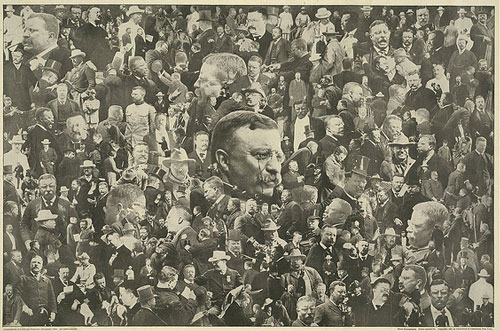
Photomontage of Theodore Roosevelt (Courtesy of Cornell University Library via Flickr Commons)

♦ A HISTORICAL ANALYSIS OF PRESIDENT OBAMA’S ACCEPTANCE SPEECH ♦
♦

Theodore Roosevelt, though a fine president in many ways, left behind one baleful legacy: the idea of the presidency as a ‘bully pulpit,’ by which he meant a superb vantage from which to preach to others about how the nation should be.  When you hear presidential candidates speaking confidently of the miraculous feats that will follow from their being elected, it’s the misleading cadences of a bully-pulpit preacher you’re hearing.

THEODORE ROOSEVELT RESHAPES THE PRESIDENCY

To an extent difficult for us to appreciate today, Roosevelt’s conception of the president as an active visionary was revolutionary, departing in significant ways from the executive role the Constitution laid out.  Our scheme of government assigns the president a few plain duties, which, given the size and scope of the government and its role in the world, constitute a staggering burden.  In addition to serving as the symbolic and ceremonial head of the nation, the president executes the laws, conducts foreign policy, commands the armed forces.  Presidents often function as party leaders, but their constitutional function is essentially one of interdependence, for a president cannot make a law, placing every president in that regard very much at the mercy of Congress.

THE CHANCE TO BECOME A SCINTILLATING STAR

During the first century of the nation’s life, presidents grappled with this limitation in various ways, but Teddy was the first to dare to act as though it didn’t exist.  He was determined to make the president the determining force in all things.  Like Satan—the most powerful angel in Milton’s celestial firmament—, he chafed at playing second fiddle; he longed to be God.  Suiting actions to words, Roosevelt broke the mold, becoming a media-oriented president intent on using his considerable intellect and celebrity to reshape the nation and govern Congress.  Initiative pulsated from the White House.  It was all very thrilling.  Moreover, it kept Roosevelt constantly in the spotlight, which was something he liked.

WHICH BULLY PULPIT PREACHERS PLEASE US MORE

Since then, Roosevelt’s conception of the presidency has become our conception, too.  In what is a sad distortion of the Founders’ vision, we expect the president—a single person—to do the work that Congress should be doing.  This, in turn, leads to a confusion about where responsibility lies.  The American people spend more and more time agonizing over presidential choice, more and more time trying to decide which campaign promises and bold visions please them more.

A PRESIDENT IN THE ROOSEVELTIAN VEIN

It was clear from the start that Barack Obama sought to be an activist president in the Rooseveltian vein.  His entire campaign the first time around was based on the premise that he could “change Washington,” reorganize the business of politics, and define a new political epoch singlehandedly.  For much of his first term, he seemed at odds with the presidential role, chafing at its limitations and behaving as though his ability to extract specific laws from Congress was the sole yardstick later generations would measure him by.

Influencing Congress became his preoccupation.  Whether the issue was health care or the debt ceiling, President Obama spent much of his first term lecturing Congress and the public—chiding and exhorting the nation to embrace his vision for us.  His love of showing his mettle prompted him to become over-involved in fruitless wrangles whose results were properly the responsibility of a weak and recalcitrant Congress.  The “victories” so gained were costly indeed: witness a health-care bill ahead of its time that, regardless of its merits, heightened partisan rancor and left much of the nation resentful and unpersuaded.

THE BULLY PULPIT’S NOT ALL IT’S CRACKED UP TO BE

As recently as January, the president’s bully-pulpit predilections were on full display, when he chose to use the State of the Union address to tell Congress its business rather than report candidly on governmental progress.  Yet, between then and now, Obama has seen the light about an activist presidency, about what a dead-end it is, how it takes a certain set of conditions to achieve.  In the meantime, he has racked up a steady tally of gains, showing himself to be very able in directing foreign affairs and the military.  And he retains the support of a large part of the electorate, who value his honesty and intelligence and see him as persistent, prudent, and humane.

FOUR YEARS OUT

Which brings us to the president’s recent acceptance speech.  Some listeners were disappointed; others found the speech a bit desperate or weak.  We all noticed a difference.  The bully-pulpit fervor we’ve grown so accustomed to was missing.

Instead, the President re-articulated his fundamental role as ‘the people’s sovereign’—the keeper of the people’s interest, uniquely entrusted to embody and articulate their general sentiments and needs.  This emphasis on the president’s traditional role as the national symbol of the people’s rule enabled the President to remind his listeners of their primary role as citizens, in a system in which his power is ‘from the people.’

A JUSTER RECOGNITION OF PRESIDENTIAL DUTY

Lacking the glitz and razzmatazz of his earlier speeches, the president’s speech that night was pitched in a lower key.  Its high points were not remarkable for policy specifics, but for their embrace of a more constitutionally sound notion of the presidency, one focused on executing the will of the people and the astute exercise of presidential duty.  The speech’s most important moment came when Obama said, “I’m not a just candidate for the presidency.  I am the president,” a simple declaration that eloquently accounted for his changed tone.

For a sitting president who a year ago styled himself an underdog, this embrace of experience and authority marked a great leap toward political maturity.  Scaling back the high-flown rhetoric and grand visions of which he has been so fond, the president has raised his ambitions in another way: making a bid for greatness by renouncing a view of office that offers self-gratification now.

Regardless of the continuing deep divisions in Congress, the nation can repose confidence in the seasoned president we have now.  All in all, it was a moment I rejoiced to see: a prisoner of the bully pulpit breaking free.

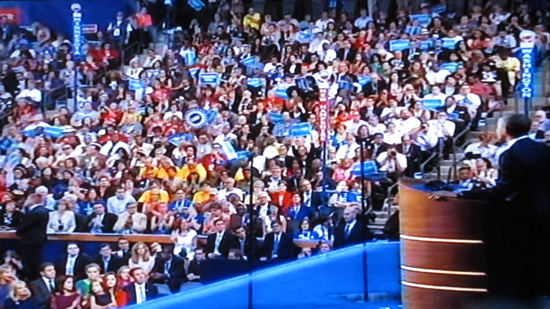
President Obama delivering his acceptance speech before the Democratic National Convention, Sept 6, 2012 (Screen shot courtesy of WTTW Channel 11 Chicago)

Top image: “Five hundred different views of Theodore Roosevelt,” from this source.
Bottom image: Screen capture of PBS Newshour coverage of the Democratic National Convention.

A Great White Nation of Self-Made Men

The Republican National Convention created a strange impression, painting a peculiar picture of the US economy and its citizens’ woes.  Not only the present was distorted, but history, too.  I listened carefully to what the speakers and party-sponsored commercials praised, and compared it to the nation and the realities I knew.   There was a huge gap between the two.

America is at a cross-roads for many reasons, among them the fact that several enormous historical advantages we’ve enjoyed are waning.  The nation that once enjoyed an immense over-supply of land and relative scarcity of labor has matured into a nation where resources are becoming more precious and the population is more and more exposed to underemployment and fierce competition.  Global change is reinforcing the trend.  Yet rather than acknowledge or adjust to the change, Republicans have decided to dismiss it and argue that a flawed president is to blame.  Only bad people stand between us and the restoration of the nation’s former glory.

No credit was allowed to the great federal structure that allowed us to flourish in the first place, nor to the amazing natural inheritance that sustains the US—superior natural resources that should be husbanded rather than squandered or spoiled.

The vast historic role of the state in nation-building went unacknowledged—was belittled, even.  Rand Paul jeered at the idea that infrastructure investment creates prosperity, insisting the opposite was somehow the case.  Try telling that to the great 19th-century railway magnates, who depended entirely on land grants and laws enacted by Congress to create their lines.  Or to the era’s land-speculators, who knew that towns would grow mainly where railroads were placed.  Or to the first telegraph companies, whose networks piggybacked on the railroad rights-of-way that federal legislation had so thoughtfully made.  Without the federal government, states would have built useless networks of dead-end roads.

Even America’s private enterprises might have remained small had it not been for the protection that early Supreme Court decisions gave them.  Without such protection, all corporate entities would have been stymied, including those that built the nation’s first roads, bridges, and schools.

The Republicans committed other disturbing elisions.  I listened to the praise for families; I admired the attractiveness of Jenna Ryan and Ann Romney; their picture-perfect children were impressive, too.  The world of the 2012 Republicans is a world of stay-at-home mothers who don’t need to worry about limiting their family size or figuring out how to feed an additional mouth.  It’s a world where there’s plenty of time for charity, because the fortunate people in it somehow have plenty to spare.  And that’s good, because in this Republican world, government help is bad.  All we want, Paul Ryan tells us, is to be left alone.

Absent was any acknowledgment of the demographic trends of the last several decades, which have seen the rise of delayed child-bearing, increased family limitation and planning, and the rise of two-career couples working outside the home.  The party celebrated its female members—but these women apparently never needed a student loan, never needed protection from workplace bias, never needed family planning or contraception while single.  One must suppose this, because the Republicans have been active in opposing, attacking, and weakening the structure of support that has enabled more American women to gain education, control reproduction, contribute more to the family economy, and earn decent livings.

Without such support, how are young women supposed to take care of themselves and their families?  Implicit in the worldview paraded at the convention is that marriage in itself provides wives and mothers with adequate financial protection.  Yet the number of women living the dream that the beautiful Republican spouses embody is painfully few.

The Republican convention’s treatment of race was perhaps most astonishing.  The party sought to promote itself as a “brand” friendly to minorities, despite the fact that it has been working hard in states such as Texas, Ohio, and Pennsylvania to raise voting requirements, restrict early voting, and redraw districts in a way that make it harder for minorities to vote or gain representation.

I was agog at efforts to depict President Obama as a lazy, do-nothing character who did not understand struggle, success, or hard work.  It was a “dog-whistle” portrayal of a super-high-achieving guy that played off of deeply engrained racial stereotypes.  The topper came when Clint Eastwood re-imagined the president as someone who was anti-social and vulgar, enacting a racist fantasy (perhaps unwittingly) at the close of his imaginary dialogue with the president by encouraging the crowd to chant “Make My Day.”  We all know what happens to low-lifes who dare to mess with Dirty Harry.

It was a shameful spectacle spelling a new nadir for the G. O. P.

RELATED:
The Map of Federal Benefits, Our Polity.