Theodore Roosevelt Jumping, 1902

Rear view of an action photograph unusual for the time.

As one of history’s most active presidents came on the stage, photography raced to catch up with him.  This rather extraordinary photograph from 1902 shows Teddy Roosevelt, then president, jumping his horse over a split-rail fence.  Such beautifully crisp shots of objects in motion were exceedingly rare at that date. Continue reading →

The Bicycle Starts a Revolution

A couple dressed in cycling clothes congratulates themselves for leaving the cumbersome fashions of the nineteenth century behind.
THE BICYCLE possessed some kind of magic, its mute presence transforming American society.  Originally known as a velocipede, the bicycle had been around since the early nineteenth century, but only after 1890 did the contraption become safer and gain popularity throughout the States as something associated with freedom and pleasure. Continue reading →

March 4: Old Inauguration Day

two matched photographic plates showing the scene around the Capitol on inauguration day.

Historically, March 4 is a day for beginning.  In 1789, it was the day the federal government first convened under the US Constitution. From that date through 1933, it was the day when presidents–from George Washington through FDR–were inaugurated.  Then, pageantry, ritual, excitement, and uncertainty ruled the capital, combining in astonishing scenes richly documented in newspapers, eyewitness accounts, sketchbooks, albumen prints, and later celluloid.

Here is just one such image by way of tribute to our national birthdays past: a magnificent panoramic view of the Capitol on the inauguration of Theodore Roosevelt on March 4, 1905.  Please click on the image for a much enlarged view.

Image: panoramic photograph by George R Lawrence
from this source.

Speed Skater Hugh Palliser

Hugh Palliser skating toward the camera circa 1904 (Courtesy of the Library of Congress)

The speed skater circa 1905 stood out as an other-worldly figure, his gear and garb outlandish to those around him.  Here is Hugh Palliser, a gifted amateur skater, manifesting the transformation that a trending obsession with speed brought on.  His clothing, his hat, his skates, his stance: all set him off from skaters out only for recreation.

His simple tunic, tight woolen leggings, and practical beanie register how science was changing the centuries-old sport of skating.  Hugely popular as a late-nineteenth-century pastime, skating was developing a more serious side, as passionate competitors like Palliser pondered how to apply the new principles of efficiency to the business of getting across the ice.

The speed skater shunned the bulky street clothes his contemporaries were wearing.  For the sake of speed, he donned a minimalist outfit one step away from wearing nothing.  Equipment manufacturers like Spalding were producing new kinds of skates, with blades engineered with speed in mind.  American skaters had begun looking beyond their nation’s boundaries, racing against Europeans and Canadians, and forming a cosmopolitan fraternity that fostered a flow of innovation.
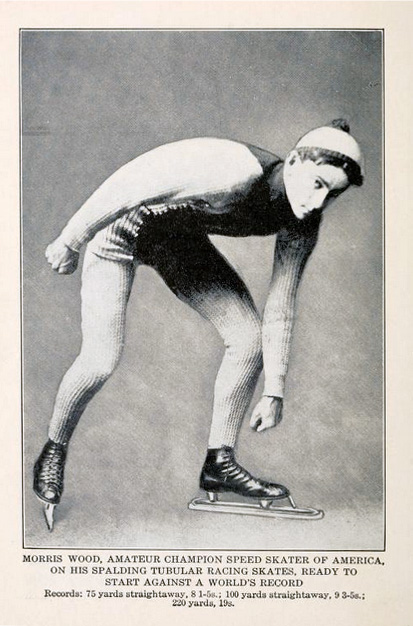
Champion speed skater Morris Wood

Palliser skated for the Euclid School in Brooklyn, NY, then one of the nation’s top speed-skating teams.  His teammates included national champion Morris Wood, Allen Taylor, and ‘Gus’ Stolz.  All four appeared as poster-boys for their sport in Spalding Athletic Library’s 1904 How To Become a Skater, which introduced a new generation to the gospel of speed.

Images: from this source and this.
This is the eighth in an occasional series of posts on ice-skating.

February 12–Lincoln’s Birthday

Thomas Fogarty's "February 12--Lincoln's Birthday," 1901 (Courtesy of the Library of Congress).
Drawing by Thomas Fogarty, originally published in Collier’s on February 9, 1901.

Fogarty (1873-1938) imagines a group of female well-wishers paying Lincoln their respects on his birthday.  Girls and a fashionable lady cluster affectionately about the president, who holds a beaming child on his arm.

Image courtesy of the Library of Congress.
Click here to learn more.