Susan H. Douglas: She Collected the Stuff of American Politicking

Presidential portrait tray from the Susan Douglas Collection at Cornell University

Their heads on a platter: Presidential portrait tray.  Susan H. Douglas Collection of Political Americana, Cornell University Library.

Susan Havey Douglas (1901-1962) was an affluent stay-at-home wife and mother whose husband, Damon G., ran a successful commercial construction firm in New Jersey.  Susan, a native of Yonkers, NY, had dropped out of college to marry her husband.  Damon was a graduate of Cornell, where he had studied engineering.

'William H Harrison and Reform' Portrait Textile from the campaign of 1840 (Courtesy Cornell University Library via the Commons on Flickr)

‘William H Harrison and Reform’: A piece of fabric incorporating political images from the ‘Log Cabin’ campaign of 1840. Susan H Douglas Collection of Political Americana, Cornell University Library.

The Douglas’s children were Damon Jr., and two daughters, Sally and Susan.  The latter died of a streptococcus infection and spinal meningitis at the age of seven, a heartbreaking loss occurring in 1936.

GOP elephant bank from the 1900 presidential campaign.  Susan H Douglas Collection of Political Americana, Cornell University Library.

GOP elephant bank from the 1900 presidential campaign. Susan H Douglas Collection of Political Americana, Cornell University Library.

Mr Douglas was a serious collector of coins by then.  He wrote papers on numismatics and served as president of the New York Numismatic Society circa 1940.  A passion for collecting gripped the family.  Around 1941, his wife, ultimately the more notable collector, began visiting curio shops with her son to help him fill out his “Lincoln and Indian penny-board collection.”  There, she began noticing campaign memorabilia, which became her special branch of collecting.

Campaign 'coins' from the 1830s, expressing various views of Andrew Jackson and his monetary policies.  Susan H Douglas Collection of Political Americana, Cornell University Library.

Campaign ‘coins’ from the 1830s, expressing various views, some satirical, of Andrew Jackson and his controversial money policies. Susan H Douglas Collection of Political Americana, Cornell University Library.  One coin depicts Jackson as a Roman emperor; another, as a pirate, waving a saber in one hand and bag of gold in the other, proclaiming, “I take the responsibility.”

Among the first items Douglas bought were old campaign medals, which resemble coins. They were but one of many types of political objects she collected over the next twenty years.  Wonderful in its size and range, her collection eventually encompassed 5,500 items, including sheet music, engravings, hair combs, convention ribbons, political torches, posters, lunch pails, pin boxes, tea trays, even beer glasses stamped with the images of political heroes and wannabees.  (I have often featured pictures from her collection on my blog.)

Snuff boxes and campaign medals bearing the image of Zachary Taylor, along with other political ephemera dating from the late 1840s.

Snuff boxes and campaign medals bearing the image of Zachary Taylor, along with other political ephemera dating from the late 1840s.

Beginning at a time when few collectors cared about these items, Douglas amassed a large and important body of American political memorabilia, including some of the earliest campaign trinkets ever made.  Dating from the late 1820s-1840, these early objects were invented at a time when American politics was becoming more thoroughly democratized, and industrial advances made it possible to produce cheap objects to mobilize the masses and build political community.  Ultimately, Douglas’s collection spanned an entire century, containing items up through the 1940s.

Candle lantern from the McKinley-Roosevelt campaign, stamped with the slogan "Four Years More of the Full Dinner Pail."  Susan H Douglas Collection of Political Americana, Cornell University Library.

Candle lantern from the McKinley-Roosevelt campaign, stamped with the slogan “Four Years More of the Full Dinner Pail.” Susan H Douglas Collection of Political Americana, Cornell University Library.

Such objects expressed the bonds between political leaders and their followers, providing voters with a tangible means to express opinions and loyalties.  Ephemeral objects that instead proved surprisingly long-lasting, the items preserve by-gone political ideas and passions, while offering clues to how politics featured in the lives of ordinary people.  As political ideas and customs have changed, so too have the props of political theater.

By the 1950s, the caliber and breadth of Mrs Douglas’s collection had gained recognition.  In 1952, the US State Department borrowed 500 items for a government-sponsored exhibition to be displayed in London at the Pan American Building.  According to the Mason City Globe Gazette, which interviewed Mrs Douglas in 1956, “17,000 Britons visited the exhibit, which portrayed political Americans and was designed to help Britons understand the Eisenhower-Stevenson campaign then underway.”

In the late 1950s, Mrs Douglas sold her collection of political Americana to Cornell University Library.  She died in Orange, New Jersey on April 14, 1962.  Her collection has been digitized and is freely accessible to the public online.

A canvas bag, circa 1920, the year American women won the right to vote.  Susan H Douglas Collection of Political Americana, Cornell University Library.

A canvas bag, circa 1920, the year American women won the right to vote. Susan H Douglas Collection of Political Americana, Cornell University Library.  Did Mrs Douglas use this when she was young?

Left unanswered is what motivated Douglas as a collector.  Why did she have such a passion for political things?  Why was she so in love with the ‘love affair” that is part of every presidential campaign?  Douglas came of age in 1920, just as the long campaign to secure women’s right to vote reached its glorious culmination.  When the Nineteenth Amendment was ratified that year, she became part of the first generation of American women free to vote and participate in politics on an equal footing.  Whatever the source of Douglas’s enthusiasm, it continues to light up our sense of political tradition.

© 2014 Susan Barsy.

Doings

William Russell Birch, A view of the Capitol at Washington (c 1800), courtesy of the Library of Congress

I haven’t been posting on politics lately.  In January, I resolved to revise a book I’ve written about 19th-century Washington, which a publisher has told me can be published.

Still, I hope to keep my site from going dormant entirely.  My original wish in starting this blog was to analyze politics, something I continually long to do.  With any luck, I will be able to manage the occasional post.

In the meantime, accept my thanks for your continuing interest.  If you don’t already subscribe, you may wish to do so using the form at right.  It’s a safe and convenient way to keep up with any new posts.  Plus it keeps up my morale!

Thank you,
Susan


Image:
William Russell Birch, “A view of the Capitol of Washington before it was burnt down by the British” (c 1800), from this source.

It was a very good day for Charles M Schwab

Woodrow Wilson with Charles M Schwab (Courtesy Woodrow Wilson Historical Association via the Commons on Flickr)

An old photograph shows Charles M Schwab on top of the world.

True, the most recognizable figure in the photograph is President Woodrow Wilson, who looks down on Schwab from the platform of his special train car.  The day is sunny.  Wilson’s secret-service man and his second wife, Edith Bolling Galt Wilson, stand in the shadows.  Something has just happened or is about to happen.  A large floral arrangement leans against the train’s railing, its funny shape capped with a flamboyant bow.

Edith’s presence in what appears to be an official photograph (the widowed president married her on December 18, 1915) establishes that this photograph was taken no earlier than 1916.  The carefree postures of the figures and their light-colored clothing indicate that it’s spring or summer.  The president, always natty, is decked out in a light-colored suit and a boater.  Summer it was—sometime between Memorial and Labor Day.

Though the president is bathed in light, charisma emanates from the homely yet somehow magisterial Charles M. Schwab (1862-1939).  Here, with his back to the president—as though ignorant of his presence—, Schwab looks straight into the camera, his bluff exuberance setting the tone.  He and his two unidentified companions share a joke, as if they posed with the president every day.  Certainly, Schwab and the younger men exude solidarity, though he is evidently more powerful than they.

As for the young men themselves, what unconventional outfits they are wearing!  The one on the left wears a tie with his overalls; the one on the right, though seemingly equally careless of his dress, wears a good striped dress shirt (without the customary collar or tie) under a smock-like jacket.  No belt to the pants but two large buttons on his lapel.  Are they campaign buttons?  No, for they contain only numbers rather than words.  They are more like badges, some sort of ID.

One more figure is implied the scene: Carl T. Thoner (1888-1938), the photographer, whose name is stamped on the photograph’s corner.  Thoner worked for the war department, so this scene was part of Wilson’s presidency—pertaining to governing rather than running for office.  Yet the fact that the photograph bears Schwab’s signature and later ended up in the Woodrow Wilson Presidential Library testifies to the personal significance the occasion had for both men.

When did the careers of Wilson and Schwab intersect?  Schwab was one of the greatest industrialists of his time, a great steel man, self-made, a “master hustler,” some called him.  He’d learned what he knew from the likes of J. P. Morgan and Andrew Carnegie.

Born in Pennsylvania, Schwab had worked his way up in Carnegie’s mills, becoming president of Carnegie Steel while in his thirties.  After helping to found United States Steel Corporation and being its first president, he broke out on his own to take control of a smaller competitor, Bethlehem Steel.  Under Schwab’s ownership, Bethlehem Steel became the one of the world’s largest and most important heavy-manufacturing concerns.

In Schwab, a deftness with finance and industrial relations combined with innovative ideas about how to make steel.  He became great by perceiving the importance of the so-called I-beam, a product that, because of its great tensile strength, made possible skyscrapers, enormous ships, better bridges—all the emblems of modernity.  Hitherto, steel had been made in shorter lengths, requiring more welding and lacking the I-beam’s versatility.  By retrofitting his steel works around the beam’s production and more closely integrating steel-making more generally, Schwab increased Bethlehem’s annual sales from $10 million in 1904 to $230 million in 1916.  In the process, Schwab became immensely wealthy, embracing philanthropic causes but also living in a recklessly lavish style.

As part of his corporate stewardship, Schwab developed one of the nation’s most successful early soccer teams.  Founded in 1907, Bethlehem Steel Football Club hit its stride in 1913, winning a string of national championships thereafter, thanks in part to Schwab’s recruiting top talent from Scotland.  Was the man standing next to Schwab a soccer player?  The players, who worked in Schwab’s plants, were given time off to practice and travel to games.

No, the key to this photograph is Schwab’s appointment to head up the nation’s Emergency Fleet Corporation in the summer of 1918.  World War I was wearing on, and the nation’s program to produce a large number of ships for the merchant marine was faltering.  Schwab put his own life’s work on hold to move down to Philadelphia, where the government’s new Hog Island shipyard was located.  There, he reinvigorated the nation’s shipbuilding program.  The completion of the Quistconck (the subject of my previous post) in record time was attributed largely to Schwab’s energy and ability.

So, this photograph, like the one I wrote about previously, was taken at Hog Island, Philadelphia, on August 5, 1918.  The president and his wife had come down from Washington by train for the day, where, at noon, they presided over the Quistconck’s christening.  The men flanking Schwab are shipyard workers, one almost certainly the foreman MacMillan, who had driven the first rivet of the Quistconck on Feb 18, 1918, and was being celebrated at the christening as a near-hero.  The many thousand workers who had worked on the ship each contributed a mite to buy an enormous bouquet of roses, which was presented to the First Lady that day.

This photograph records the Wilsons’ final moment at the shipyard, when, just before their train pulled away, the President leaned over to give his best to Charles M. Schwab.

Image from this source.

Christening the Quistconck

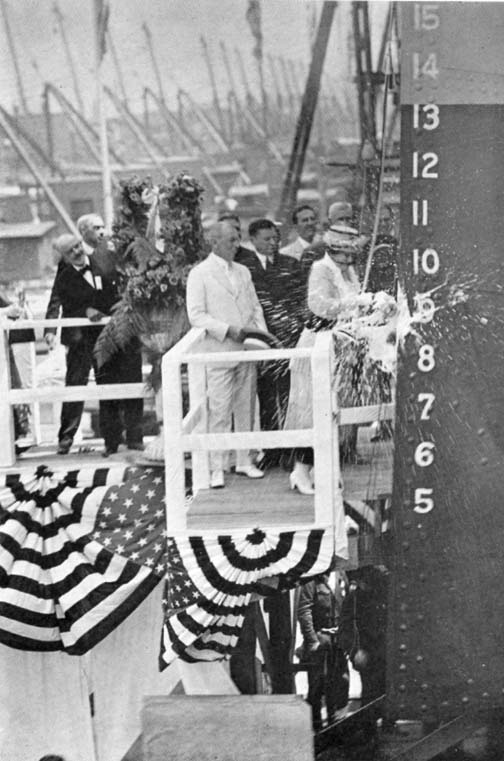
The SS Quistconck launched (Courtesy of the NARA via Wikimedia Commons)

5 August 1918

There were no speeches, it being a hot day.  So, with a minimum of ceremony, and before a crowd of some 60,000 people, the new First Lady Edith Bolling Galt Wilson, clumsily christened the new cargo ship, the champagne splashing off its hull and all over her lovely dress of lavender voile.  A small detail lost in the excitement of the moment, as the enormous freighter slid down the ways under the gaze of dignitaries, the tens of thousands of shipyard workers who built her, and their families.  Meanwhile Edith’s husband, the President Woodrow, suddenly boylike, waved his hat in the air and led the crowd in a riotous patriotic cheer.  Bands played tinny airs, almost drowned out, while flags flapped in a sultry breeze.

It was a curious phase of WWI, with the long war nearly over and America’s concomitant shipbuilding effort only just then hitting its stride.  After years of maintaining its neutrality, the United States had entered the war in the spring of 1917, partly in response to Germany’s relentless U-Boat attacks upon all trans-Atlantic shipping.  It was another year before the US had embarked on an ambitious breakneck program to build a whole fleet of ships to replace the many US vessels that German submarines had destroyed.  (Germany sank some 6.2 million tons of Allied and neutral ships in 1917 alone.)

One result of this determination was the overnight creation of the vast Hog Island shipyard on the outskirts of Philadelphia.  Built on swampy outlying land (where the Philadelphia airport stands today), the shipyard consisted of 50 enormous bays.  Covering 1.25 miles of land along the Delaware River, the yard, which 30,000 workers labored in harsh winter conditions to build, was the largest of any in the world.  Though something of a boondoggle (the $50-million shipyard was essentially defunct by 1921), Hog Island was at the same time a source of great national pride, a proof of what American industry and a common sense of mission could together accomplish.

(Some scholars also credit Hog Island workers, who lived in an instant city and represented many food traditions, with giving the bulky sandwich known as the hoagie to the world.)

The Quistconck was the first vessel to be launched, of the hundreds that Hog Island was expected to produce.  Though some of the ships were never built (the end of the war made them unnecessary), the Hog Island shipyard produced 248 5500-ton steel vessels over a two-year period, at the unprecedented rate of one every three to four days.  The shipyard was innovative in applying standardized assembly-line techniques to shipbuilding, helping to restore and modernize the nation’s inadequate and sadly decimated merchant marine.  Essential to any military effort abroad, many of these ugly supply vessels saw service in WWII.

Mrs Wilson, who had been married to the president for less than a year, was given the privilege of naming many of the vessels.  Believing she was descended from Pocahontas and therefore a living representative of America’s indigenous nobility, Edith Wilson gave the ships Indian names.  Quistconck was Hog Island’s native Delaware name.

The ships are coming (Courtesy of Wikimedia Commons)The Quistconck’s christening celebrated the mobilization of a whole society around the national interests perceived to be in play during WWI.  Whether or not this was the whole story of the shipyard, art and photography record the vigor of patriotic sentiment that kept the crowds cheering on that hot August day.

Top image from this source.
Poster by James Henry Daughetry, courtesy of Wikimedia Commons.
Click here to see other WWI shipbuilding posters on the website
of the American Merchant Marine at War.

On John Kerry’s eerie resemblance to George Washington

John Kerry 1795, after Gilbert Stuart © 2013 Susan Barsy

Have you noticed that, as John Kerry has aged, he looks a lot like George Washington?

His similarity to the great Founding Father and Commander-in-Chief is unnerving.  It’s as though the ghost of Washington is haunting us, reminding us of his legacy, just in time for Halloween.  When Secretary Kerry appears on television, he unwittingly channels the ghost of Washington.  It’s cautionary.

The ghost prompts the question, “What would George Washington think of our actions overseas?”  Would he have condoned the President’s hawkish determination to punish Syria with military force for its use of chemical weapons against its people?  Would he have applauded the US intelligence forces’ capture of a suspected terrorist in the Libyan capital?  More generally, would George Washington, if alive in our time, be inclined toward intervention, or isolation?

The value of these conjectural questions lies in reminding us of the intimate connection between internal strength and influence abroad.  We need a fixed yardstick against which to measure our global acts and ambitions, which are more over-reaching and morally dubious than they were back in Revolutionary days.  Conscious of enjoying military and technological advantages and relatively ample means, the US frequently intervenes just because it can.  Because it can, our government has been spying on Angela Merkel, of all people.

Alternately, our government follows a schoolyard logic: if Johnny Johnson jumps off a bridge, then so will we.  If our strength relative to other nations continues to supply an irresistible rationale for scatter-shot decisions, soon that strength will be gone; what remains of our moral integrity will vanish, too.

When the United States were weaker, they had little choice but to be savvy about what fights they took on.  In George Washington’s time, a time of global conflict if ever there was one, even the most powerful Americans understood the truly vital importance of focusing on ‘within’ while exercising caution abroad.  While General Washington (1732-1799) was the preeminent ‘hawk’ of his day, he was also a prime founder of the powerful civic institutions that, in their fruition, secured broad national safety and prosperity.

The blessings of that peace were hard-won.  The North America of Washington’s lifetime was shaped by the great global conflict between France and Britain.  As a youth, Washington was one of the earliest participants in the French and Indian War (1754-1763), an expensive multinational conflict waged on the borders of the American colonies that lasted nine years. He then reluctantly led the colonial Revolutionary Army in its War of Independence against the British, a wearisome duty that absorbed him for another eight years’ time (1775-1783).

Given the tortuous path the young nation followed toward establishing a viable government under the US Constitution, George Washington was relatively old by the time he became the nation’s first president.  He governed those eight years with a consciousness of the nation’s fragility, respecting the preciousness of what it had achieved.

Little wonder that, on leaving office, Washington famously warned the nation to avoid the dangers of “foreign entanglements.”  Americans still faced the daunting challenge of growing together as a Union.  The last thing they needed was to become enmeshed in the machinations of world’s great powers.  Violent conflict throughout Europe marked the final years of Washington’s presidency.  Napoleon’s star had begun to rise. The year Washington died, the long Napoleonic Wars (1799-1815) were just beginning.  Protecting ourselves from the debilitating snares of global conflict was an important early contributor to our national growth, our 1812 war with England notwithstanding.

There is much to be said for shaping a foreign policy as creditable to a puny government as to one that’s strong.  Sadly, Kerry’s resemblance to Washington is only skin-deep, and President Obama doesn’t resemble George Washington at all.

© 2013 susanbarsy.com