After the Red Wave: What Democrats Should Do

2014midtermcolorbar
Republican gains in Tuesday’s elections delivered a stunning rebuke to Democrats and their party.  The GOP is resurgent, despite having teetered after the 2012 election on the verge of disintegration and decline.

The Republicans achieved this gain primarily by telling voters that, under President Obama and the Democrats, the nation has fared badly.  Republican candidates attacked both the style and substance of the administration.  They assailed a government that they styled as autocratic, expensive, and ineffective.  They railed against government intrusion, and (in the case of illegal immigration) against governmental laxness, too.  They chafed against laws and constraints they don’t believe in.  Most of all, Republicans succeeded by denigrating what will surely be regarded as this era’s most significant achievements, such as the government’s success at bringing the nation back from the brink of all-out economic collapse and at passing a radical yet tenable and comprehensive health-care reform bill.

Strategically, the GOP also took care to marginalize some of the worst kooks seeking to work their way up in the party’s ranks.  The Republican National Committee under Reince Priebus encouraged and supported more electable candidates whose messages would still resonate with conservatives.  The policy also served the goal of producing a Republican Congress that is more homogeneous and governable.  Anyway, as campaign strategy, it worked.  Even weak candidates like Senator Pat Roberts of Kansas won.

Sadly, the Democrats were afraid to be identified with their party’s strengths.  They also failed to deliver a vision of government, that, if consonant with their recent achievements, was fresh and forward-looking.  As the president’s time in office wanes, Democrats should be thinking about how to catch the next wave.  What should the Democratic Party be about, once heavyweights like Obama and the Clintons are gone?  The Dems are notably short on galvanizing up-and-comers who could breathe new life into what has become a too-staid and centrist political party.

Chiefly, though, the Democrats have failed to accommodate and adapt to legitimate criticisms of Democratic governance and ideology.  In particular, they do not seem attuned to the people’s desire for a government that, if powerful, is deft and efficient.  They have not cared enough about the national mood to break with the president and demand Congressional debate on issues like our open-ended bombing campaign against the Islamic State.*  Nor have Democrats cared enough about the middle and lower classes to attack the glaring issue of corporate responsibility, favoring a rise in the minimum wage, yes, but remaining silent on a host of policies that work against working-class prosperity while benefiting corporations and the interests of global capital unduly.

Renew themselves: in short, this is what the Democrats must do.  Dare to be a more interesting, local, peaceful, green, and economical party.  Dare to think small, and find new ways to promote prosperity that rely less on government spending and more on shrewd uses of information and technology.  Scour the countryside for young, charismatic, ardent, and innovative political thinkers.  Restore pride in American citizenship and civic culture.  And move beyond the paradigm of the social-welfare state in trying to figure out how to give a stagnant, suffering America what it wants and needs.

* The president has since called on Congress to debate and authorize the bombing campaign.

A Talent Gap That Favors the GOP

THE REPUBLICAN PARTY, no matter how retrograde its ideas, has long outshone Democrats in its ability to attract galvanizing up-and-comers.  Eric Cantor’s startling fall is just the latest instance of a conservative “star” self-destructing, but one that underscores the Party’s uncanny ability to spot and exploit a long string of controversial media darlings: Sarah Palin, Michele Bachmann, Rick Santorum, Rick Perry, Ted Cruz, Marco Rubio, Paul Ryan . . . the length of the list is downright alarming.

Cantor, though departing the House under a cloud, had become a nationally known leader at an impressively young age.  Figures like Cantor, Paul Ryan, and Rand Paul have few Democratic counterparts.  Rising Democrats like Kristen Gillibrand and Elizabeth Warren have yet to be given leading roles that would signal their stature within their party, and Warren, a latecomer to politics, is only now beginning to hit her stride.  Only the GOP has a cadre of young iconoclastic lieutenants with big responsibilities and long resumes.

The GOP’s leadership advantage derives not just from personality but from the very ideological conflict that has threatened to weaken it as a party.  In the last presidential election, outsized but deeply flawed figures like Palin or Herman Cain held our attention because they stood for something, because they were staking their claim to the soul of their party, and because something dramatically different was going to happen if they gained enough popularity.  Even as we despised them, they contributed paradoxically to the political system’s health, energizing the opposition and re-establishing the voting public’s unwillingness to tolerate meanness, character flaws, or dangerous ideas.

Only when President Obama leaves office will it be clear how decrepit the Democratic Party has become.  His youth and charisma have tended to compensate for the Democrats’ bland leadership and ideology, concealing how staid and, well, conservative, its major figures are.  Figures like Hillary Clinton, John Kerry, Nancy Pelosi, and Joe Biden are wonderful public servants, but they can hardly be said to represent a vanguard.

Disarray in the Republican Party has given the Democrats an opportunity to dominate and prevail.  Instead, the Democratic Party is languishing.  Democratic leaders have grown unaccustomed to risk-taking, and they have lacked the energy required to consolidate their power in the states, win back the South, or expand the breadth and fervor of their support among voters nationally.  Meanwhile, their inability to cultivate young talent leaves them poorly positioned to weather the generational change at hand.

A feather in her cap, or a fire in her belly?

hard-choices

A feather in her cap, or a fire in her belly:

Such are the twin engines of a possible Hillary run.

They won’t both fire, though; only one.

If appetite consumed her, she’d have made her decision.

If a feather is her motive, she’ll surely lose.


Mrs Clinton is on tour promoting her book Hard Choices
published by Simon and Schuster.

The Incredible Shrinking GOP

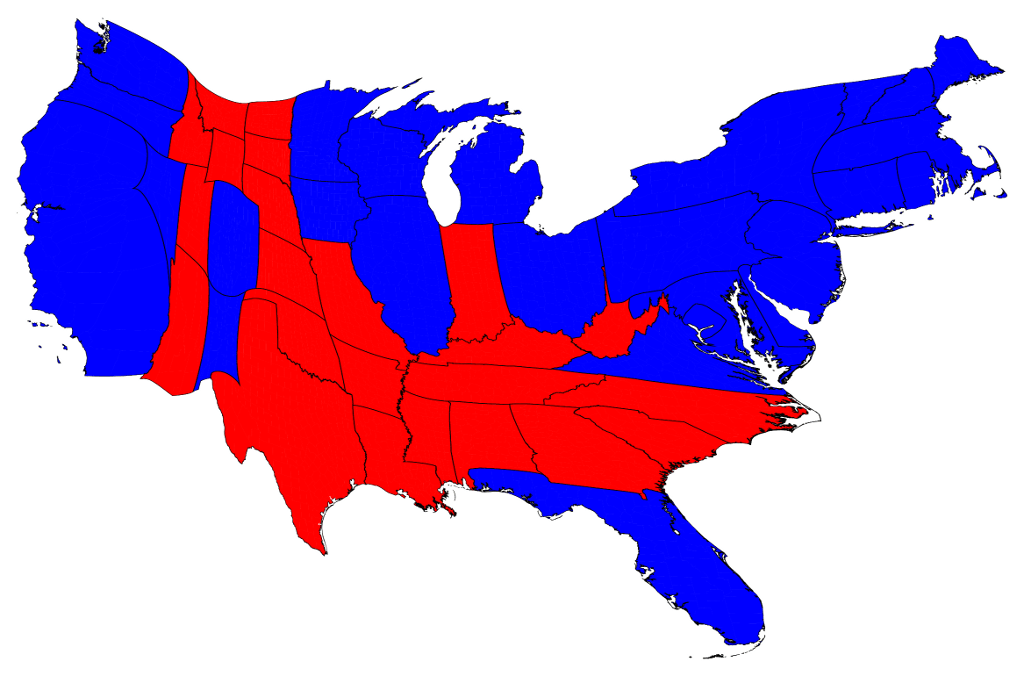
Cartagram by Mark Newman showing the relative strength of the Democratic and Republican vote.

The results of Tuesday’s election, in which Republicans failed of their two principal goals, and indeed lost ground even in the House, indicate that the GOP is in danger of becoming a minority party.

The cartogram above, one of a series of maps created by Mark Newman of the University of Michigan to show the real strength and distribution of the popular vote, depicts the limits of the GOP’s popular appeal.

While the Republican party continues to command the allegiance of bands of Americans in southern and land-locked western states, these states are not particularly populous.  In the more heavily populated and cosmopolitan areas of the United States, the Democratic Party under Barack Obama is consolidating its hold.

Voting strength of Democrats and Republicans by county, with purple showing county-level mix

Moreover, many of the counties that the Republicans managed to win Tuesday are actually divided and could readily swing back the other way.  In the county-level map above, only the streaks that are pure red and reddish can be regarded as Republican strongholds.

The Republicans in denial

Interestingly, the Republican leadership seems incapable of grasping the fact that its positions and values are increasingly out of step with those of the nation.  John Dickerson of Slate, appearing on Washington Week on Friday, described the Romney-Ryan campaign’s illusory anticipation of victory: it simply couldn’t imagine there being enough Americans to support the President, though numerous polls had shown that support for him was holding and building.  A contempt for the whole of the electorate, and an inability to embrace its diversity, spelled doom for Republicans in the 2012 campaign.

Look for Republicans to continue to grasp at procedural, legal, monetized, and PR-based tactics to sustain the illusion that they remain a formidable party.  In fact, unless the Republican Party dramatically transforms itself, renounces extremism, and embraces diversity and moderation, its showing will be even weaker next time.

Click here to view all of Mark Newman’s maps and learn more about what they mean.

MORE ON MY TAKE ON THE GOP:
What If They Can’t Take the Capital? September 2012.
A Great White Nation of Self-Made Men, September 2012.
Moment of Truth for the GOP’s Conservative Wing, August 2012.
Should Leaders Who Can’t Govern Their Party Govern the Country? June 2012.
Is the Republican Party Dying? March 2012.
2008: The Critical Election That Wasn’t (Part II), January 2012.
Parties Made New: Our Critical Elections February 2012.