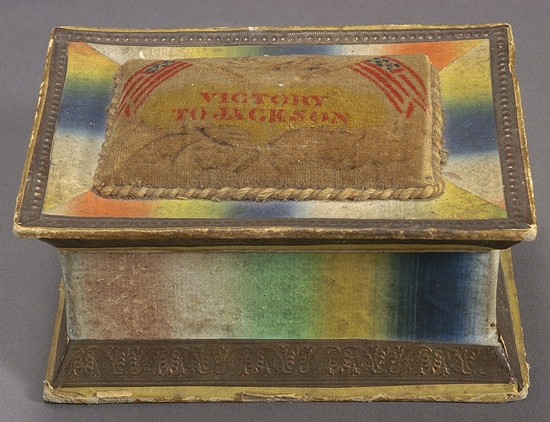
Some objects retain their charm long after their usefulness is gone. This 180-year-old sewing box, bearing the words “Victory to Jackson,” is one of them. Notwithstanding its worn corners and faded velvet, it is still expressive of a quiet, feminine hope, cherished at a time long before any American woman had the right to vote.
This exclusion did nothing to keep women from following politics and having political opinions anyway. I would have loved to see this box and its owner back in the day. Who was the owner of this rainbow-colored trinket, and where had she gotten it? How had she become a Jackson supporter? Was she a rural or a city dweller? And was the box homemade?
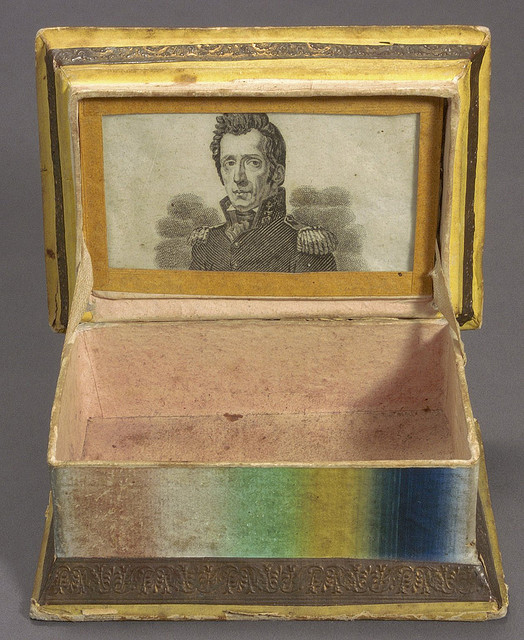
The elaborate materials of the box are impressive for 1828 or 32, when it would have been made. The stamped metal trim, the multi-colored dyed velvet, and the special, machine-stamped, fabric inset on top, with its crisp flags and still brightly emblazoned lettering, suggest that its maker had easy access to goods made in factories. The way the fancy velvet coordinates so perfectly with the colors of the inset top makes me wonder whether this might have been a mass-produced item. The box’s interior, though, with its pasted-in picture of Jackson—probably taken from a newspaper or quarterly—, is so shrine-like that it’s tough to avoid concluding that the item was homemade.
Certainly, the creation of this political trinket was painstaking. Even the cardboard box that supplied its core was heavily worked over. The result is a powerful item, that, whether placed in a sitting room or used quietly by a hearth, was not just a proud declaration of sentiment but a daring conversation piece. Who could see such a thing in a woman’s home and not begin talking?
The object of all the fuss was General Andrew Jackson, who in 1828 made a no-holds-barred bid for the presidency. His campaign was famous for its unprecedented reach, for tapping into popular loyalties to vanquish a retrograde elite. Once in office, he was a tireless champion of democracy, and, though his years in office were remarkable for their controversy, he easily won election to a second term.
Jackson had true star power. He was widely celebrated as a military hero. In an age when Americans relied on newspapers, letters, and word of mouth to get their news, he is said to have been the most widely known figure in the country. Everyone knew who he was. If nothing else, they knew he was the hero of the Battle of New Orleans—the man who, in vanquishing British troops in 1815, had given Americans a new reason to be proud of their nationality.
His broad fame engendered curiosity about what he actually looked like, making likenesses of him prized. Such likenesses could then become objects of adoration, as had clearly been the case with our sewing-box lady. To obtain the likeness of a leading man wasn’t an easy thing. It’s not surprising that, when photography came along in the 1840s and 50s, politicians were among the first to have their pictures taken.
We are far removed from the world that once worshipped its heroes. Politics was no less nasty then than now, but the emphasis on excellency was more thorough-going. The political realm was the only one promising true celebrity, leading the best men to compete there for popular affection and renown.
At the same time, statesmen’s practical remoteness made it easier for citizens to cherish their own homemade visions of their leaders, endowing them with fantastical virtues and showering them with the love that was once regarded as one of the chief compensations of public service.
The sewing box is part of the Susan H. Douglas Collection of Political Americana
at Cornell University Library, which has made digital images of it publicly available via Flickr Commons.
To see other items in the collection, click here.
RELATED
Parties Made New: Our Critical Elections
Political Affections