The Democrats: Anger in a Different Key

low-angle black and white photograph of a startled-looking Hillary Clinton
For years, the Democratic Party has pursued a comfortably centrist agenda while relying on identity politics to sustain its popularity.  It has pursued social good without much regard for economy or efficiency, and, primarily for that reason, has alienated many business interests and ordinary, thrifty, business-like people.  In Illinois, the good that individual Democratic officeholders seek to do hardly makes up for the many instances of criminal corruption and abuse of trust that stain the reputation of the party.

Though Democrats purport to fight the scourge of poverty and ignorance, that goal has lost its urgency, the how of it suffocated under layers of bombast and bureaucracy.  Even health-care reform, which has given millions of Americans better access to medicine and stands as this era’s chief domestic initiative, has driven up premiums and supplied fresh evidence of federal ineptitude.

Whatever Hillary Clinton’s merits (and they are many), she personifies the compromised condition of the Democratic Party.  Like her party, she wants to be all things to all people.  That very characteristic disables her from accommodating and channeling the ire festering in the hearts of the Democratic electorate, the ire that is powering the “Feel the Bern” movement.

However worthy her intentions, Clinton cannot step out of her skin.  She can’t disavow her wealth and celebrity, can’t ditch her myriad A-list connections, can’t dis-entrench herself from the inner workings of her party.  She can’t re-imagine Democratic ideology for fear of upsetting the apple cart that’s carrying her along.  And she can’t set herself at odds with the past without diminishing the legacy of her husband, Bill.   Being so closely identified with the ex-president is proving a big liability.  All these factors prevent Hillary Clinton from being the change agent Democratic voters want and need.

Bernie Sanders represents this constituency, which amounts to approximately 43 percent of all Democrats voting in this primary season.  Sanders doesn’t want to please anyone, and he (like Trump) isn’t very concerned about the tenability of his program.  Sanders’ goal is to redefine the purposes of the Democratic Party.  Sanders’ voters will be lost unless someone else comes along who can do this well.

It’s a shame, because the Democratic Party is ripe for radical reform.  It could transform itself into a proponent of internal economic growth, with a focus on the intensive cultivation of the nation’s human and physical capital.  It could be a party of peace, a party of green.  Once upon a time, the Democratic Party stood for reform, retrenchment, and economy.  Could the right leader make the Democratic Party great again?

Image:  “First Lady Hillary Clinton, Speaker of the House Tom Foley,
and House Majority Leader Richard Gephardt speak at a press conference at the U.S. Capitol,”
1993 photograph by Laura Patterson, courtesy of the Library of Congress.
For more information click here.

 

The Democratic Party of My Dreams

I’m still waiting for a breakout Democrat to cast the party along new lines. I’m tired of the old Democratic party, which still plays identity politics, makes bad bargains with public resources, and is generally very loose with money. I’m tired of big government that’s inefficient and behind the times.  I want a small powerful government that does things well.

I’m waiting for a new Democratic party to come along, that’s resolutely focused not on unions but on all who work.  Most workers are not, and may never be, organized.  For their sake, the party needs to demand corporate responsibility and corporate investment in our citizens and our native economy.  I’m waiting for a new party that cares about industry and sustainability, that’s ardent and uncompromising about making high-quality, next-generation goods here in the States, and that believes in the collective capacities of the citizenry to take the US economy higher.

I’m waiting for a party that’s proud of universal health coverage, that insists on quality public education, and favors everything local and green.  I want a party that’s candid about globalism’s dark side.  That wants to curtail immigration sharply for a while, in order to take into account all who are here, strengthen our civic fabric, and restore American citizenship’s prestige.

I’m waiting for Democrats who will demand peace: who will foreswear the siren song, the illusory notion that we can ever really “protect American interests abroad.”  I’m waiting for a party that will respect the sovereignty of other nations and that’s clear-eyed enough to refrain from unending militarism abroad.

I’m waiting, and I’m sure that a large population waits with me.

The Incredible Shrinking GOP

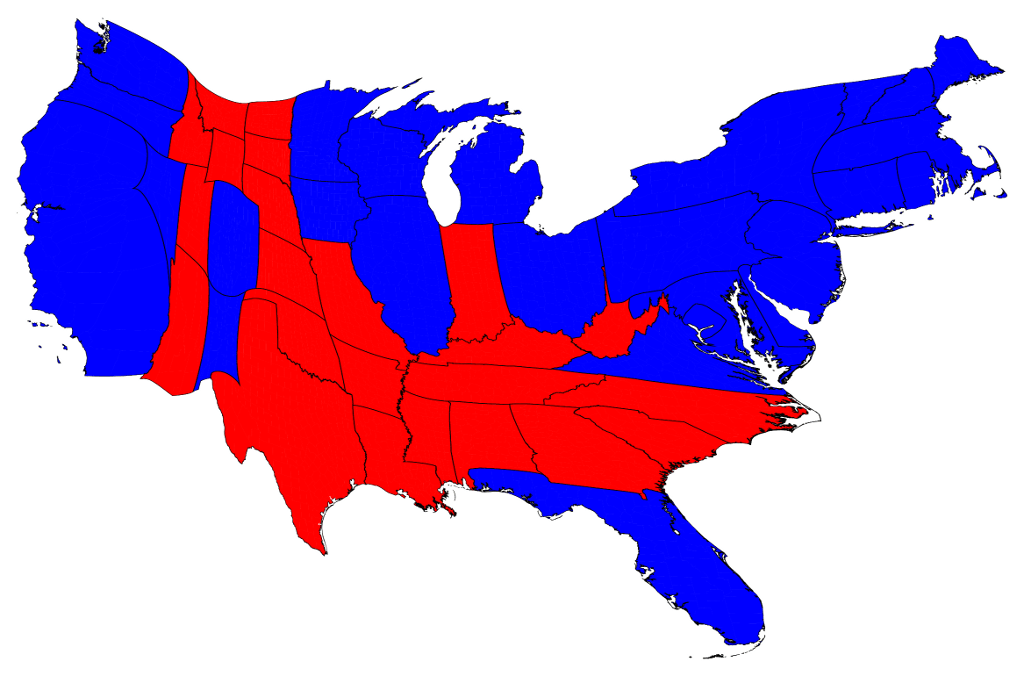
Cartagram by Mark Newman showing the relative strength of the Democratic and Republican vote.

The results of Tuesday’s election, in which Republicans failed of their two principal goals, and indeed lost ground even in the House, indicate that the GOP is in danger of becoming a minority party.

The cartogram above, one of a series of maps created by Mark Newman of the University of Michigan to show the real strength and distribution of the popular vote, depicts the limits of the GOP’s popular appeal.

While the Republican party continues to command the allegiance of bands of Americans in southern and land-locked western states, these states are not particularly populous.  In the more heavily populated and cosmopolitan areas of the United States, the Democratic Party under Barack Obama is consolidating its hold.

Voting strength of Democrats and Republicans by county, with purple showing county-level mix

Moreover, many of the counties that the Republicans managed to win Tuesday are actually divided and could readily swing back the other way.  In the county-level map above, only the streaks that are pure red and reddish can be regarded as Republican strongholds.

The Republicans in denial

Interestingly, the Republican leadership seems incapable of grasping the fact that its positions and values are increasingly out of step with those of the nation.  John Dickerson of Slate, appearing on Washington Week on Friday, described the Romney-Ryan campaign’s illusory anticipation of victory: it simply couldn’t imagine there being enough Americans to support the President, though numerous polls had shown that support for him was holding and building.  A contempt for the whole of the electorate, and an inability to embrace its diversity, spelled doom for Republicans in the 2012 campaign.

Look for Republicans to continue to grasp at procedural, legal, monetized, and PR-based tactics to sustain the illusion that they remain a formidable party.  In fact, unless the Republican Party dramatically transforms itself, renounces extremism, and embraces diversity and moderation, its showing will be even weaker next time.

Click here to view all of Mark Newman’s maps and learn more about what they mean.

MORE ON MY TAKE ON THE GOP:
What If They Can’t Take the Capital? September 2012.
A Great White Nation of Self-Made Men, September 2012.
Moment of Truth for the GOP’s Conservative Wing, August 2012.
Should Leaders Who Can’t Govern Their Party Govern the Country? June 2012.
Is the Republican Party Dying? March 2012.
2008: The Critical Election That Wasn’t (Part II), January 2012.
Parties Made New: Our Critical Elections February 2012.

What If They Can’t Take The Capital?

H. H. Green, "Bird's Eye View of Washington, DC," 1916 (Courtesy of the Library of Congress)

We may not have reached the turning point in the 2012 campaign, but Mitt Romney‘s impolitic behavior has got me thinking about what it might mean for the Republican Party if it fails to take the presidency this time around.

The party wars raging these days are much like real wars in which a few goals are recognized as being of overwhelming importance.  In military conflict, taking or holding a capital is often paramount to victory. The force that fights to take a capital but never succeeds condemns itself to a war without end.  It never gains sway.

The outlook for the GOP

Despite the Republicans’ emphasis on unity, theirs is a badly divided party, composed of two parts, ideologically riven, and in real danger of breaking apart.  Throughout the campaign, moderates within the party have been hoping that its two wings can be welded together sufficiently to secure a presidential victory.  Should the Republican party fail of this goal, it will have difficulty convincing us that it remains a dominant political force.

The Republican Party still has vast resources and an impressive organization; it has some intelligent personnel and many, many backers and devotees.  Despite all this, it could go into decline, if the presidential contest suggests that it is no longer organized around ideas and policies that have national appeal, that can command the assent of a voting majority.

A party shy of the presidency

Is winning the presidency all that important to the life of a party?  It is when the party has been struggling for several presidential election cycles to demonstrate that its candidates truly represent the will of the people.  Historically, when a party cannot win the White House, that party fades.  It happened with the Federalist party to which the Founders belonged.  It happened to the Whig Party in the 1850s.  It happens when a perfectly good party lack leaders capable of reshaping the party’s ideology for changing times.

A party that cannot win the presidency risks the loss of its adherents and its leadership, too.  Without the presidency, a party cannot initiate and bring legislation to fruition without cooperation from the other side.  The Republican Party has set itself in opposition to the Democratic Party.  Instead of building the goodwill that has historically proved the salvation of a minority party, it has shown open and increasing enmity toward the other side.

Emphasis on controlling the electoral process

Anxiety pervades the Republican Party, which since the year 2000 has concentrated more and more, not on recasting itself ideologically, but on controlling the electoral process in hope of achieving a favorable return.  Ever since George W. Bush’s contested win that year, which came down to interpreting a bunch of chads clinging to physical ballots in Florida, the Republicans have become obsessed with state-level control of the election rolls.

G. W. Bush’s re-election in 2004 occurred amid controversies over voter suppression in states like Ohio, where Republicans had succeeded in removing voters from the rolls through aggressive challenges.  In the current election cycle, we have seen concerted efforts in several Republican-controlled states to tighten up voting requirements and to make it more difficult for certain classes of voters to gain representation or vote early.

Only respect for the electorate can save the GOP

It’s a shame, because intelligent leadership and constructive ideas are what the GOP needs.  In the end, only better ideas and a genuine respect of the electorate can save the Republican Party from the minority status that threatens it now.

Image: H. H. Green, “Bird’s eye view of Washington, DC” (1916), from this source.
Other wonderful old maps and views of the nation’s capital are here.

RELATED ARTICLES:
Voter Harassment, Circa 2012, New York Times.
Is the Republican Party Dying?, Our Polity.
A Great White Nation of Self-Made Men, Our Polity.
Democrats: Shake It Up, Our Polity.
2008: The Critical Election That Wasn’t (Part II), Our Polity.