This print from the mid-nineteenth century is a vivid reminder that George Washington had a pre-history with New York City, prior to his 1789 presidential inauguration at Federal Hall. The print commemorates “Evacuation Day,” when, on November 25, 1783, Continental troops under General Washington entered the city in triumph, officially marking the end of its occupation by the British during the Revolutionary War. Given that the British had controlled the city for seven years, ruling it under martial law, the rejoicing was general and profound. New Yorkers continued to celebrate Evacuation Day for over 100 years.
This representation of “Washington’s Triumphal Entry Into New York,” was the work of Christian Inger, a German emigre who settled in Philadelphia in the 1850s and worked as a lithographer.
In 1789, Philadelphia’s Columbian Magazine published this “View of the Federal Edifice in New York.” It’s one of a handful of extant contemporary depictions of the defunct Federal Hall, showing its location at the T where Nassau intersects with Wall Street in Manhattan’s First Ward. This engraving captures the appearance of the building in the year George Washington was inaugurated on its balcony.
The most notable feature of the print is its rendering of the Great Seal, particularly the rendering’s inaccuracy. Here, the eagle rises above the shield and a free-floating olive branch: this is substantially wrong. (cf. the previous post on the Great Seal). The artist either drew the Seal wrong from memory or neglected even to study this feature of the building in person. Maybe he copied from another artist. It’s also possible that the Great Seal was improperly rendered on the building itself.
In any event, this illustration is a significant reminder that the Great Seal was newly invented and its features not well-known to Americans when federalism under the Constitution got going in 1789. It also highlights the ambiguity of much documentary “evidence.”
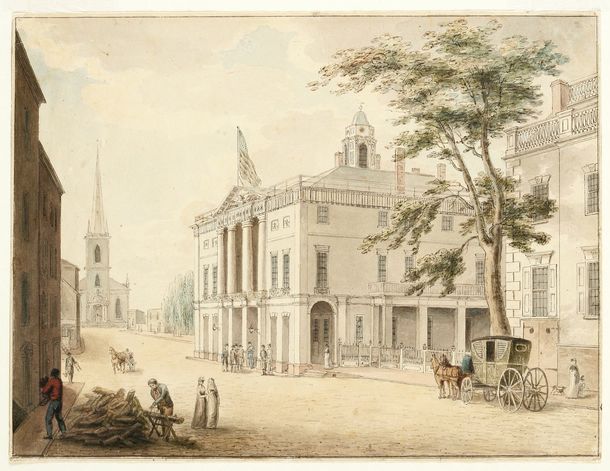
This is an important late 18th-century view of New York’s Federal Hall, showing the style of adjacent buildings. Tiny print on the lower left side explains that this lithograph, published by C. Currier, was based on a drawing by George Holland made in 1797. The process of lithography came into use only several decades later, facilitating the mechanical production of works in color. This one was made by Charles Currier, who, like his more famous brother Nathaniel, was a skilled printer whose work met the public’s appetite for American scenes.
Here, the colors of the print accentuate the contrast between Federal Hall’s refined facade and the more utilitarian mercantile establishments that typified the neighborhood around Wall Street.
It’s worth noting that during the Revolution, the British army had attacked and occupied New York City. Much of the old city was destroyed, and its population shrank. By the time of the Founding, the city had come roaring back. Building boomed, and the population tripled to some 30,000 people. Many of the buildings in this scene were likely rehabbed or new, just like the newly refurbished Federal Hall.
Holland’s drawing captures the modern yet workaday character of the neighborhood where the Congress first convened under the Constitution. Yet, Federal Hall had likely been destroyed by the time Currier’s lithograph appeared. Other features of the scene endure today, notably Trinity Church, whose spire is visible at left.
Artist William Hindley made this interesting architectural rendering of Federal Hall in the 1930s, over a century after the building was demolished in 1812 to make way for the US Custom House of the Port of New York.
Further research on Hindley might clarify whether he was in business for himself or worked for a government entity such as the National Park Service (NPS) or Works Progress Administration (WPA), which employed scores of writers, artists, and photographers to document the physical environment and condition of the country at that time. Whatever the case, Hindley made a handful of drawings aimed at preserving the characteristics of this significant building, which was the sole seat of the federal government during its first year.
It’s prudent to approach such retrospective documents warily. The specifics they present as historical may be spurious and anachronistic, sheer invention making up for a shortage of factual detail. Good artists were scarce in the early national period; the visual record of important people, places, and events then, correspondingly thin.
Here, though, Hindley generally dispels our skepticism. In the lower left legend, he states that his work was extrapolated from the scale of the old city hall, combined with “Hill’s engraving and descriptions,” and Robertson’s drawing. (The latter is a street view of Federal Hall that Archibald Robertson sketched when the building was still extant, around 1798.) In addition, later scholarly analyses of Federal Hall offer other documentary evidence corroborating Hindley.
Hindley’s drawing effectively communicates the subjective significance of L’Enfant’s smooth, symmetrical facade. Highlighted are the columns, pediment, and entablature, a fancy cupola topping off the now three-story building. The focal point of all is the new nation’s seal. The upper right-hand legend tells us that, as reward and payment for his work, the 33-year-old L’Enfant was offered “10 acres of land at Proovost [sic] Lane between E60 and E49 street with a small payment of money but declined it.”
Overstating the case a bit, Hindley avers that L’Enfant was the first architect to solve the problem of how to make a building “characteristically American,” establishing a pattern that other famous public architects of the early national period, such as Bullfinch, Thornton, Hooker, Hadley, Thompson, and Latrobe, merely followed. What can be said with authority, however, is that the stylistic elements L’Enfant combined in Federal Hall were indeed used in government buildings in the US countless times.
Image: from the National Park Service collection of artifacts pertaining to Federal Hall, accessed on 12 December 2012.
Click here to view two other imaginative renderings of Federal Hall that Hindley made.
The afore-mentioned renovation of Federal Hall was complete by the time the First Congress met to certify the results of the first presidential election. This 1790 copperplate engraving depicts George Washington’s swearing in on a crowded balcony, members of Congress looking on. His term began April 30, 1789.
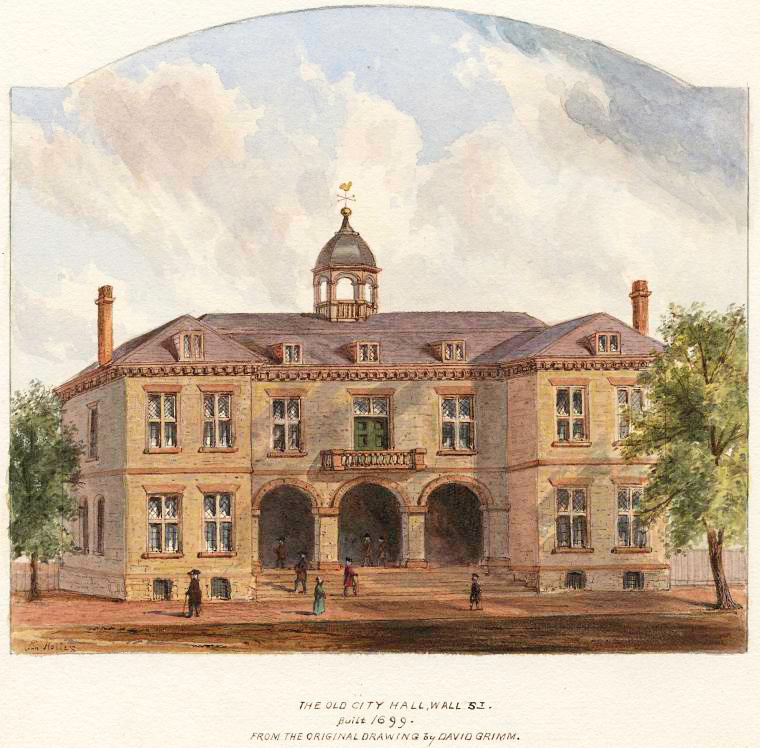
Though the facade was new, the site was familiar to all participants, as the failed Confederation Congress had been meeting in this building, which was New York’s old city hall, for several years. New York City continued as the temporary capital for one more year, until the government moved to Philadelphia, where it would remain for the next decade.
The old city hall is nearly unrecognizable, its scale and structure a canvas for Peter L’Enfant’s showy neoclassical style.
This item is in the collection of the National Park Service, a reminder of that agency’s enormous role in preserving precious artifacts critical to our understanding of the early United States.