Milestones and Thanks

Speed racer Bob Burman, circa 1915 (Courtesy Library of Congress via the Commons on Flickr)

By now, OUR POLITY regularly receives over 1,000 visits a month, a level of readership that suggests it’s firmly established.

My thanks to everyone who is visiting and reading—you’re part of a population that’s global and ever-changing.  I’m deeply grateful for your encouragement, comments, and attention.

Please consider signing up to have OUR POLITY delivered to your inbox using the subscription feature on the sidebar to the right.  Besides the convenience of knowing when new content is published, creating an account enables you to comment on posts.  Only your username (which may be an alias) appears when a comment is published.  No other use of your information is made.

New content typically appears on OUR POLITY every third or fourth day.  Though I occasionally publish more often (as I may this week), I’ve never published more than 15 posts a month.  As with other email subscriptions, you can set your preferences to receive just one weekly digest or be notified of new posts immediately.  Or, feel free to follow me on Twitter; I typically notify followers when I publish something.

If you have any other questions about subscription options, please don’t hesitate to contact me.

Thanks again for visiting my website!  (and don’t forget to vote!)

The picture?
That’s early race-car driver Bob Burman, but his story will have to wait till another day. . .
Click the picture to go to the source.

Excitement Is General

Crowds gathered for the presidential inauguration, 1921 (Courtesy of the Library of Congress)

Excitement is general as we head into the final weeks of the long campaign.  With the presidential race in a dead heat, it’s anyone’s guess who the victor will be.  The candidates receive ever closer scrutiny, waves of analysis rolling in over airwaves and Internet incessantly.  Stalwarts gear up for the final push.

The uncertainty of the race is drawing huge audiences to the presidential debates.  Last night’s debate between President Obama and challenger Mitt Romney is estimated to have drawn some 65 million viewers.  According to Bloomberg, the viewership for the debates has been roughly double what it was for the nominating conventions this summer.

The spontaneity of the response to the debates is unprecedented, too.  Last night during the debate, Twitter recorded over 7 million new tweets, with more than 109,000 recorded during a single minute when the candidates were discussing immigration.  Romney’s peculiar remark about ‘binders full of women’ prompted an immediate outpouring and a new hashtag.  Within minutes, satirical takes on his remarks were available for view on this Tumblr page.

Every age has its own political customs.  The ones we’re using today are making history, too.

Image: Crowds gathered for the presidential inauguration in 1921, from this source.
Click image to enlarge.

Big Bill Haywood

Union leaders Adolf Lessig and Big Bill Haywood (Courtesy Library of Congress via Flickr Commons)

There’s something raw about the history of the 1910s, a period of depression and unrest, when Americans were engaged in an anxious quest for alternatives.  It was a period of activism, when anti-capitalist sentiment and true human suffering allowed organized labor, still in its infancy, to make significant strides.  At the center of these trends were redoubtable labor leaders like Big Bill Haywood (right), shown here in 1913 with his fellow activist Adolph Lessig.

William Dudley Haywood (1869-1928) was one tough customer, a sometime socialist who helped found the radical labor organization known as the International Workers of the World (IWW), or ‘Wobblies.’  Founded in 1905, the IWW was radical in seeking to organize workers of all types and nationalities, even unskilled workers, in contrast to the other, more exclusive, ‘trade’ unions of the day.

Haywood was born in Utah and by age 15 was working in western copper mines.  By 1900, he had an invalid wife and two children and had gotten involved in the labor movement, skyrocketing to the top of the Western Federation of Miners, a militant union that in 1903 pitted itself against the Colorado mining industry and the state’s government in a bitter strike lasting nearly three years.

Aligned for a time with the fledgling Socialist Party, Haywood ultimately fell out with that group over strategy.  By 1910, his chief interest lay in directly mobilizing masses of people in IWW-led strikes and protests, believing this the surest path to structural change.Big Bill Haywood & followers in Paterson, NJ (Courtesy Library of Congress via Flickr Commons)

Haywood was involved, for instance, in the famous 1912 textile strike in Lawrence, Massachusetts, also known as the Bread and Roses strike, whose centennial is now being commemorated.  Lawrence’s textile workers included large numbers of women and teens, and many persons of foreign birth.  Their protests aroused national sympathy, particularly when children of striking parents were sent to New York City for safekeeping.  The strike ended after three months, with workers gaining many concessions to their demands.

The 1912 textile strike in Lawrence (Courtesy of the Library of Congress via Flickr Commons)

Haywood’s star began to set during WWI, when the IWW’s on-going militancy and vision of international solidarity jarred with wartime industrial demands and an accompanying tide of national feeling.  In 1917, Haywood and 100 other IWW officials were arrested on charges of wartime sedition, found guilty, and sentenced to lengthy prison terms.  Freed on bail while appealing conviction, Haywood fled to the Soviet Union, where he entered on an ignominious final chapter and died of alcoholism and diabetes a decade later.

His ashes are interred partly in a wall of the Kremlin, while others were sent back to Chicago to be buried in Waldheim Cemetery near the remains of the Haymarket martyrs.

Images: (top to bottom) Adolph Lessig and Big Bill Haywood, from this source;
Haywood and followers in Paterson, NJ (1913), from this source;
and a scene from
the Lawrence textile strike (1912), from this source.

RELATED ARTICLES:
May Day Meditations, Our Polity.
The Strike That Shook America 100 Years Ago, History.com.

Florence and Margaret Make a Play for Freedom

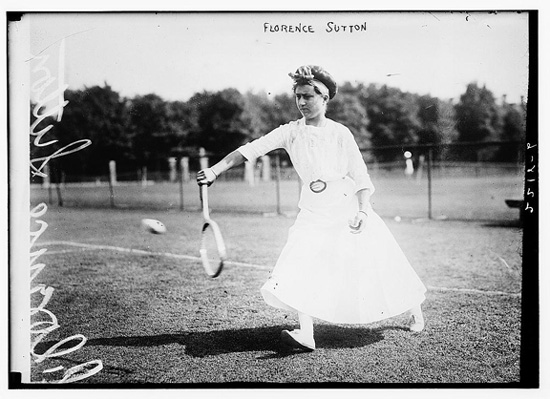
American tennis player Florence Sutton, circa 1910 (Courtesy Library of Congress via the Commons on Flickr)

The athleticism of the women competing in the London Olympics—and their outfits—underscore how dramatically women’s dress and freedom have changed in the century since women like the American tennis great Florence Sutton began trail-blazing.

Sutton’s pioneering sportsmanship—and the achievements of other women in sports like golf and swimming—were striking indications of the liberties that Progressive Era women were intent on claiming.  Circa 1900, it was rare for a respectable woman to do anything but walk, ride, or ski, partly because women were expected to be so heavily clad and partly because they were never supposed to go out unaccompanied.

While poking around for more on Florence and early American sportswomen, I made a surprising discovery.  The first American woman to win an Olympic gold medal was Chicagoan Margaret Ives Abbott (1878-1955).  She won the Olympic competition in women’s golf in Paris in 1900.  Two years later, she became the wife of noted Chicago journalist Finley Peter Dunne.  Margaret was born in India, where her father had been a merchant, but was raised in Chicago, where her mother (also named Margaret Ives Abbott) wrote for the Trib and had a literary salon.

Apparently the Paris Olympics were run in an off-hand fashion, for during her lifetime Margaret was never fully aware of what she had won.  Only after her death did historians realize that her victory in what seemed to be just another golf tournament was actually part of the Olympic competition.  And she received a bowl, not a medal.

Image: Florence Sutton circa 1910, courtesy of the Library of Congress, from this source.

June 25, 2015:
Margaret Abbott’s granddaughter, Miranda Dunne Parry,
has kindly shared this recollection of Margaret, written by her father Philip Dunne
and published in
the August 1984 issue of Golf Digest.  Enjoy!

Related:
Library of Congress photograph
of the US international female tennis players in 1895.

War Dead

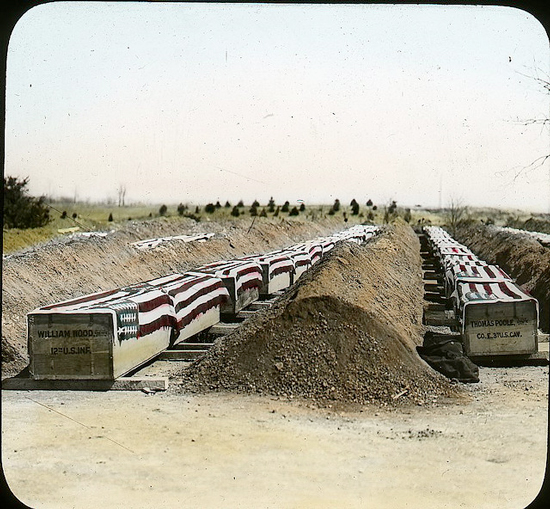
The remains of American soldiers awaiting internment at Arlington National Cemetery (Photograph by E.B. Thompson, courtesy DC Public Library via Flickr Commons)

On April 6, 1899, Washington DC photographer E. B. Thompson rode out to the cemetery at Arlington, where the remains of several hundred officers and soldiers were about to be buried.  The men had died in the late war with Spain, a brief affair that both began and ended the previous year, bringing the US control of Spain’s former island possessions—Guam, Puerto Rico, and the Philippines—and the independence of Cuba.

The coffins represented a fraction of the 3,000 Americans who died, felled not so much by their adversaries as by tropical diseases like malaria and yellow fever.

Now, belatedly, they were to be buried.  The coffins lay suspended over long trenches dug in a new section of the cemetery.  Many of the remains were unidentified, so coffins of the known dead were carefully positioned at the ends of the rows that would be most visible during the ceremony.  Thompson positioned himself near the presidential viewing stand and took this picture.  It is an image as raw as the landscape itself, the kind of grim tribute to the fallen that we hardly ever see.  It was colorized later.

A crowd of some 15,000 people, along with President McKinley and other dignitaries, gathered for the funeral rites.  A newspaper in New Brunswick, Canada, carried a full account of the proceedings.   The work of burying the coffins began after the crowd dissipated, a tough, tedious job that took several days.

Image: E.B. Thompson photograph, “Interment at Arlington National Cemetery,” 1899.
Courtesy DC Public Library Commons, from this source.