Looking In on Lincoln’s Inaugurations

Inauguration of Mr. Lincoln (1861), photograph courtesy of the Library of Congress

How fortunate we are that Lincoln’s presidency came just after the development of photography!  Of course, by the time he first took office in 1861, certain photographic processes, notably daguerreotypes, had been around for decades.  But only around mid-century did photography develop into a versatile, practical, and widely circulating medium.  As a consequence, whereas photographs of Lincoln’s predecessors in the White House are scarce, Lincoln and his political contemporaries had their pictures taken many, many times.  Some even became shrewd retailers of their mechanically reproduced selves.

The result, from the point of view of the present, is an opening-wide of the window onto history.  Whereas details of James Buchanan‘s 1857 inauguration come down to us mainly through artistic and verbal description (there is this one blurry photograph), good photographs documenting both of Lincoln’s inaugurals survive.  From 1861, for instance, there are several fine distant views of Lincoln taking the oath of office, though none of them is close enough for us to make out his great defeated rival, Senator Stephen A Douglas, who, according to historical testimony, is said to have been looking on from a seat nearby.

These photographs remind us of the immature, precarious state of the Union at the time.  The great addition of the new Capitol dome was incomplete, and, even as Lincoln moved to forward to assume his elected office, the elements that made up the nation were breaking apart.  Prior to March 4, 1861, when this picture was taken, seven pro-slavery states had seceded, and afterward, four more southern states would depart.  On April 12th, with the firing on Fort Sumter, the nation would descend into a state of war.

A closer view of Abraham Lincoln's Inauguration in 1861 (Courtesy of the Library of Congress) of Abraham Lincoln in 1865

The crowd gathered for the swearing-in knew that they were witnessing a momentous scene.  The crowd was thick; most had furled their umbrellas; men, straining for the best possible view, mounted light poles and trees.  Motionless, they strained to hear the unamplified proceedings, the camera preserving the style of their hats and clothing.  Two men turn to face the camera, cannily.

The succeeding years saw a widening use of open-air photography, so that we know with some immediacy the Civil War’s corpse-strewn scenes.  Photographers like Alexander Gardner (by then working for Mathew Brady) tirelessly trailed the armies, unflinchingly recording the realities of camps, hospitals, and battle-fields.  By the time of Lincoln’s second inaugural, in 1865, the war was in its final months, slaves had been liberated, and the nation had become accustomed to seeing itself through the lens of photography.

The crowd at Lincoln's Second Inauguration, March 4, 1865 (Courtesy of the Library of Congress)

This wonderful photograph by Gardner captures the look of that later crowd.  Here, the people themselves, not the government nor the army, nor their most powerful representatives, are recognized as camera-worthy, as they gather on an inauguration day that is once again wet and muddy.  Great coats and banners billow in the breeze, as knots of spectators stand about, chatting or strolling as they please.  In time, they part to make way for the inaugural parade, in which Union regiments of both races proudly march.

Alexander Gardner, Stereographic view of the crowd at Lincoln's Second Inauguration, March 4, 1865 (Courtesy of the Library of Congress) Lincoln's Inaugural Parade (1865)

Is it my imagination, or is there a touch of jubilation here, missing from the earlier proceedings?  Though the war had yet to end, the prospects for the Confederacy were dwindling sharply, and Americans who had fought to keep the nation together knew that their victory was sure.

Alexander Gardner photograph of Lincoln delivering his second inaugural address as President of the United States (Courtesy of the Library of Congress)

Bare-headed, Lincoln reads his message of reconciliation to a crowd radiating around him like magnetic filings, the dais overflowing with dignitaries.  A miscellaneous crowd of watchers stands beneath him, studying the crowd while listening.  It is a homely scene with little pageantry, suited to a federal republic that, though riddled with conflict, has endured trials to grow in confidence and power.  Outside the frame, the Capitol dome has been completed, and stands triumphantly capped with the Statue of Freedom.

All images from the collections of the Library of Congress.
Click on the images for more information and larger views.
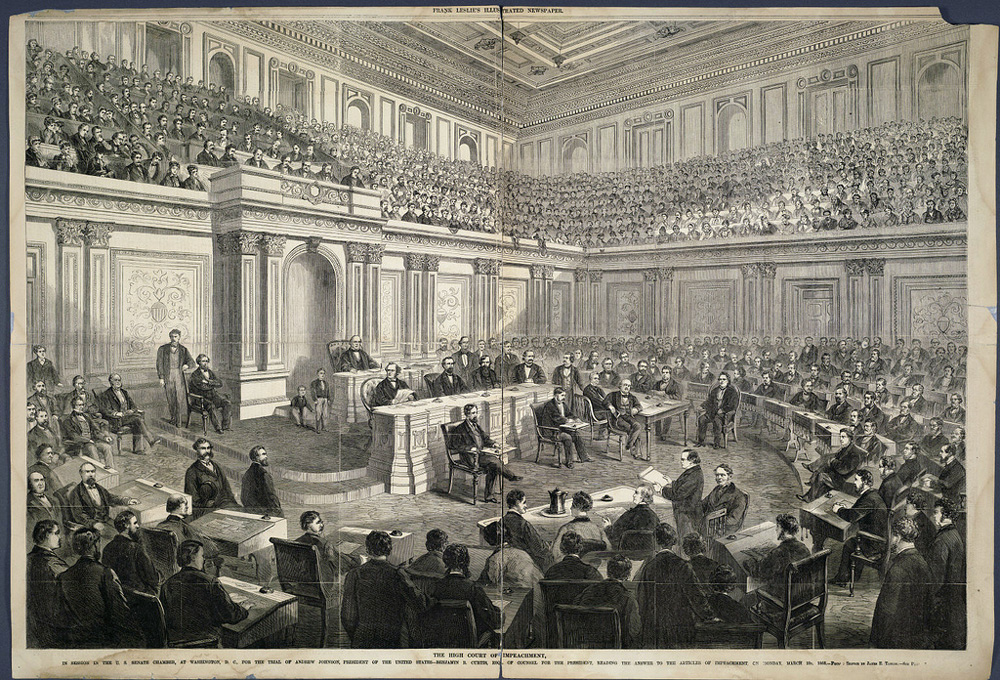
Once Noble Senate

The US senate chamber in 1868 (Courtesy of Cornell University Library via the Commons on Flickr)

I don’t know that what I write here makes me a pundit, but in the wake of the election I have been hit with a strong urge to refrain from punditry—to take a break from it, at least, and let government be.

One of the evils of an excessively long campaign season is that we all develop the habit of opinionating and editorializing.  Our partisan passions, aroused for such a long period, require an effort to quiet, and we forget that there is something larger than the fate of the parties or particular people, namely our collective fate as a nation and economy.  That hangs in the balance now.

The media, even more than our political leaders, bear responsibility for having created a public culture that prizes the work of governing less than politicking.  Competent governing is not praised and celebrated; it is not longed for; it is not revered or nurtured.  No, it is regarded skeptically—poked at and doubted.  Dubious motives are assigned; obstacles exaggerated; worst-case scenarios dreamt up and embroidered.

Would the nation would better or worse off for having a moratorium on loose talk, during which all cable networks, talk shows, and editorial rooms would go dark for a few days?  The talking heads, eager for their fees and salaries, who incessantly press their stale points of view on the rest of us are one of the biggest impediments to redirection and innovation.  They are themselves one of the biggest drags on bipartisanship and governmental resolve.

The hullabaloo surrounding the “fiscal cliff” reminds me that the Senate, in its earliest days, used to meet in private.  That’s right.  From 1789 to 1794, the first senators met privately in chambers in New York and later Philadelphia (Washington DC didn’t exist then) to fulfill their Constitutional duties as they understood them, admitting no spectators, seeking no publicity.  They simply did their work and went away.

This was a perfectly legitimate style of proceeding.  After all, they had been entrusted with large public responsibilities and they knew the nation depended on their behaving in an honorable way.

The senators soon abandoned the custom of meeting in private, however, because they thought that, unless the public could look in on the Senate and begin to understand what it was all about, the body would never develop the authority and prestige that the Founders wanted and expected it to enjoy.   The early Senate was in danger of being eclipsed in importance by the House, which then, as now, was a more unruly and irresponsible body.

The Senate, intended to be the ultimate forum for resolving the nation’s most complex problems, evolved into a highly prestigious and effective body during the long period from the early 1800s until 1986, when the Senate approved live televised coverage of its proceedings.  The reservations that had made senior senators reluctant to embrace such a change were fully vindicated, for the reorientation of the Senate toward this vicarious presence has destroyed the close-knit mutuality that characterized the body, and which rewarded the difficult work of its members with commensurate prestige.

The nation’s chief executive, once the factotum of his party in Congress, has become inflated in importance proportionately.  Today, we look to the president for all things—even for the wisdom that our Founders knew could only be found collectively, in the best minds of the Senate, in its palmiest days.

Image from this source.

Woodrow Wilson Casts His Ballot

Woodrow Wilson Casts His Ballot, 1912 (Courtesy Princeton University Library via Flickr Commons)

I’d been looking for an excuse to write about Woodrow Wilson when Monday’s presidential debate, with its exchange over “horses and bayonets” and the WWI navy, came along especially to encourage me.

An interesting cache of photographs put online by the Woodrow Wilson Library includes this one of Wilson casting his ballot in the presidential election of 1912.  Wilson, then governor of New Jersey and the Democratic candidate for president, won the election in a landslide.

The photograph, with its mesh ballot receptacle, handwritten records, and air of social intimacy, casts doubt on some time-honored political verities.  How free and fair were the elections conducted with this “technology”?  Did our elective process, so often derided as “broken,” really work better in an earlier day?

In 1912, most black Americans were barred or discouraged from voting.  Community norms and party interests inflected how election rules were applied.  Until the ‘Australian’ ballot was universally adopted, casting a vote was a social act, not granted any privacy.  And party loyalty was the grease that kept the machinery running: for much of the nineteenth century, “voting” typically meant nothing more than delivering to the poll a ballot that your party had already completed for you.

Wilson’s ascent coincided with a move toward a more participatory democracy.  In 1912, US senators were still elected, not by the populace, but by the state legislatures.  A Constitutional amendment changing that would be ratified the next year.  The nominating conventions of 1912 were historic, because they were the first to include delegates chosen, not by party operatives, but by popular votes cast in the nation’s first presidential primaries.

*     *     *

A scholar-statesman not unlike Barack Obama, Wilson, a noted professor of political science and former president of Princeton University, spent just two years as New Jersey’s chief executive before catapulting to the presidency.

His path to the White House was more than a little unlikely.  The 1912 election pitted him against three other candidates: the Socialist Eugene Debs, incumbent President William Taft, and former president Theodore Roosevelt, the latter two representing the Conservative and Progressive wings of the Republican Party, respectively.  Only deep divisions within the Republican Party enabled Wilson, the first Southerner to be elected to the White House since Zachary Taylor, to succeed.  Wilson had been a dark horse in the fight for his party’s nomination, triumphing over the favorite, James Beauchamp Clark, a popular House Speaker, in the eleventh hour.

Wilson’s agenda was progressive and sophisticated, but the fractious political environment prevented him from realizing many of his cherished visions, dealing him some notable humiliations instead.  In 1913, John McCutcheon drew this cartoon drubbing Wilson’s first-year performance, yet in the succeeding years Wilson presided over many liberal reforms (e.g. women’s suffrage) and fiscal innovations (e.g. the income tax) that shape our political landscape today.  While Wilson’s approach to the Great War was adroit, he suffered a rebuke heard round the world when a Republican-controlled Senate jettisoned US participation in the new League of Nations and refused to ratify the Treaty of Versailles.  (Unbelievably, Wilson was the first US president to make an official trip abroad when he traveled to Europe to negotiate the Treaty in 1919.)

Image: Wilson voting in New Jersey, from this source.

Stephen Colbert on the recent attacks against the 17th Amendment here.

Excitement Is General

Crowds gathered for the presidential inauguration, 1921 (Courtesy of the Library of Congress)

Excitement is general as we head into the final weeks of the long campaign.  With the presidential race in a dead heat, it’s anyone’s guess who the victor will be.  The candidates receive ever closer scrutiny, waves of analysis rolling in over airwaves and Internet incessantly.  Stalwarts gear up for the final push.

The uncertainty of the race is drawing huge audiences to the presidential debates.  Last night’s debate between President Obama and challenger Mitt Romney is estimated to have drawn some 65 million viewers.  According to Bloomberg, the viewership for the debates has been roughly double what it was for the nominating conventions this summer.

The spontaneity of the response to the debates is unprecedented, too.  Last night during the debate, Twitter recorded over 7 million new tweets, with more than 109,000 recorded during a single minute when the candidates were discussing immigration.  Romney’s peculiar remark about ‘binders full of women’ prompted an immediate outpouring and a new hashtag.  Within minutes, satirical takes on his remarks were available for view on this Tumblr page.

Every age has its own political customs.  The ones we’re using today are making history, too.

Image: Crowds gathered for the presidential inauguration in 1921, from this source.
Click image to enlarge.