The President’s Vision of Progress on Guns

The sociopathic killings in Oregon on October 1 spurred another round of chaotic and frenzied comment. The dialogue began with the president, whose comments on the shootings came out fast, faster than news of the shooting itself.  Whereas some might see the increase in mass gun murders in the US as a cultural, even media-driven, problem, the president understandably sees the Oregon massacre and others like it as having political roots.  In his brief somber statement that day, President Obama argued that this form of criminality has grown out of political choices that ordinary Americans have made.  Make different choices, and sociopathic rampages involving firearms will begin to wane.  Most strikingly, the president appealed to the public for relief from a stale, inconclusive dialogue about gun violence that has become terrifyingly routine.

President Obama’s remarks are worth reading in their entirety. They are notable for what they did and did not say. The president did not call on Americans to back any specific gun-control measure.  Instead, he made three general appeals.

 1.  GET OUT THE FACTS ON GUN-RELATED DEATHS.  The president appealed to the journalistic world to assemble and publish comprehensive data about gun-related deaths in the US.  It’s odd, but authoritative statistics about gun trafficking, gun sales, gun violence, and gun crimes are surprisingly hard to come by.  Several years ago Congress barred the Obama administration from studying this problem or amassing authoritative statistics on public’s behalf.  So, most of the available data is very old, incomplete, or statistically flawed.  Instead, the job of monitoring the extent and nature of gun violence has fallen to a ragtag assemblage of voluntary efforts throughout the country, such as Slate’s effort in the year after Newtown, or the real-time reporting on gun violence that the good people at the Gun Violence Archive carry on.  Accurate information about gun violence and its social costs could reshape the gun debate by silencing false claims and focusing public attention around effective policy aims.

2.  RESPONSIBLE GUN-OWNERS ARE A KEY GROUP IN THE STRUGGLE TO PROMOTE GUN SAFETY.  The millions of Americans who own guns are perhaps the only constituency capable of checking the influence of the National Rifle Association.  The heinous mass murder of children and teachers at the Sandy Hook School in December 2012 effected an attitudinal shift, galvanizing responsible gun-owners in favor of stricter gun laws.  Surveys show that 90 percent of gun owners now favor ‘common-sense’ gun-safety measures, a stance at odds with the unbounded pro-gun rhetoric of the NRA.  In his message, President Obama appealed directly to gun owners, asking them ‘to think about whether your views are properly being represented by the organization that suggests it’s speaking for you.’  Gun-owners are uniquely positioned to speak out in support of prudent public-safety measures that do not impinge upon Second Amendment rights.

3.  VOTERS MUST MAKE PUBLIC SAFETY A PRIORITY: Though many Americans favor tougher gun laws, they do not view this as a key issue when voting.  As a consequence, the gun lobby and pro-gun advocates routinely get their way in Congress and state legislatures.  The president urged voters to care more, and to pay more attention to candidates’ voting records (an issue that has lately vexed Bernie Sanders).  Without legislators willing to vote for gun-control measures, the political struggle to inhibit the reckless use of firearms will go nowhere.

The president’s conviction that the will of the people can transform the gun debate is characteristic of an executive who has taken to heart his role as ‘the people’s sovereign.’  Time and again, the president has placed his faith in a democratic public to generate the “change we can believe in.”  Whether Americans have the determination and wherewithal to fight for a safer civil society remains to be seen.

After the Red Wave: What Democrats Should Do

2014midtermcolorbar
Republican gains in Tuesday’s elections delivered a stunning rebuke to Democrats and their party.  The GOP is resurgent, despite having teetered after the 2012 election on the verge of disintegration and decline.

The Republicans achieved this gain primarily by telling voters that, under President Obama and the Democrats, the nation has fared badly.  Republican candidates attacked both the style and substance of the administration.  They assailed a government that they styled as autocratic, expensive, and ineffective.  They railed against government intrusion, and (in the case of illegal immigration) against governmental laxness, too.  They chafed against laws and constraints they don’t believe in.  Most of all, Republicans succeeded by denigrating what will surely be regarded as this era’s most significant achievements, such as the government’s success at bringing the nation back from the brink of all-out economic collapse and at passing a radical yet tenable and comprehensive health-care reform bill.

Strategically, the GOP also took care to marginalize some of the worst kooks seeking to work their way up in the party’s ranks.  The Republican National Committee under Reince Priebus encouraged and supported more electable candidates whose messages would still resonate with conservatives.  The policy also served the goal of producing a Republican Congress that is more homogeneous and governable.  Anyway, as campaign strategy, it worked.  Even weak candidates like Senator Pat Roberts of Kansas won.

Sadly, the Democrats were afraid to be identified with their party’s strengths.  They also failed to deliver a vision of government, that, if consonant with their recent achievements, was fresh and forward-looking.  As the president’s time in office wanes, Democrats should be thinking about how to catch the next wave.  What should the Democratic Party be about, once heavyweights like Obama and the Clintons are gone?  The Dems are notably short on galvanizing up-and-comers who could breathe new life into what has become a too-staid and centrist political party.

Chiefly, though, the Democrats have failed to accommodate and adapt to legitimate criticisms of Democratic governance and ideology.  In particular, they do not seem attuned to the people’s desire for a government that, if powerful, is deft and efficient.  They have not cared enough about the national mood to break with the president and demand Congressional debate on issues like our open-ended bombing campaign against the Islamic State.*  Nor have Democrats cared enough about the middle and lower classes to attack the glaring issue of corporate responsibility, favoring a rise in the minimum wage, yes, but remaining silent on a host of policies that work against working-class prosperity while benefiting corporations and the interests of global capital unduly.

Renew themselves: in short, this is what the Democrats must do.  Dare to be a more interesting, local, peaceful, green, and economical party.  Dare to think small, and find new ways to promote prosperity that rely less on government spending and more on shrewd uses of information and technology.  Scour the countryside for young, charismatic, ardent, and innovative political thinkers.  Restore pride in American citizenship and civic culture.  And move beyond the paradigm of the social-welfare state in trying to figure out how to give a stagnant, suffering America what it wants and needs.

* The president has since called on Congress to debate and authorize the bombing campaign.

On John Kerry’s eerie resemblance to George Washington

John Kerry 1795, after Gilbert Stuart © 2013 Susan Barsy

Have you noticed that, as John Kerry has aged, he looks a lot like George Washington?

His similarity to the great Founding Father and Commander-in-Chief is unnerving.  It’s as though the ghost of Washington is haunting us, reminding us of his legacy, just in time for Halloween.  When Secretary Kerry appears on television, he unwittingly channels the ghost of Washington.  It’s cautionary.

The ghost prompts the question, “What would George Washington think of our actions overseas?”  Would he have condoned the President’s hawkish determination to punish Syria with military force for its use of chemical weapons against its people?  Would he have applauded the US intelligence forces’ capture of a suspected terrorist in the Libyan capital?  More generally, would George Washington, if alive in our time, be inclined toward intervention, or isolation?

The value of these conjectural questions lies in reminding us of the intimate connection between internal strength and influence abroad.  We need a fixed yardstick against which to measure our global acts and ambitions, which are more over-reaching and morally dubious than they were back in Revolutionary days.  Conscious of enjoying military and technological advantages and relatively ample means, the US frequently intervenes just because it can.  Because it can, our government has been spying on Angela Merkel, of all people.

Alternately, our government follows a schoolyard logic: if Johnny Johnson jumps off a bridge, then so will we.  If our strength relative to other nations continues to supply an irresistible rationale for scatter-shot decisions, soon that strength will be gone; what remains of our moral integrity will vanish, too.

When the United States were weaker, they had little choice but to be savvy about what fights they took on.  In George Washington’s time, a time of global conflict if ever there was one, even the most powerful Americans understood the truly vital importance of focusing on ‘within’ while exercising caution abroad.  While General Washington (1732-1799) was the preeminent ‘hawk’ of his day, he was also a prime founder of the powerful civic institutions that, in their fruition, secured broad national safety and prosperity.

The blessings of that peace were hard-won.  The North America of Washington’s lifetime was shaped by the great global conflict between France and Britain.  As a youth, Washington was one of the earliest participants in the French and Indian War (1754-1763), an expensive multinational conflict waged on the borders of the American colonies that lasted nine years. He then reluctantly led the colonial Revolutionary Army in its War of Independence against the British, a wearisome duty that absorbed him for another eight years’ time (1775-1783).

Given the tortuous path the young nation followed toward establishing a viable government under the US Constitution, George Washington was relatively old by the time he became the nation’s first president.  He governed those eight years with a consciousness of the nation’s fragility, respecting the preciousness of what it had achieved.

Little wonder that, on leaving office, Washington famously warned the nation to avoid the dangers of “foreign entanglements.”  Americans still faced the daunting challenge of growing together as a Union.  The last thing they needed was to become enmeshed in the machinations of world’s great powers.  Violent conflict throughout Europe marked the final years of Washington’s presidency.  Napoleon’s star had begun to rise. The year Washington died, the long Napoleonic Wars (1799-1815) were just beginning.  Protecting ourselves from the debilitating snares of global conflict was an important early contributor to our national growth, our 1812 war with England notwithstanding.

There is much to be said for shaping a foreign policy as creditable to a puny government as to one that’s strong.  Sadly, Kerry’s resemblance to Washington is only skin-deep, and President Obama doesn’t resemble George Washington at all.

© 2013 susanbarsy.com

American Beauty: The Inauguration as Medium and Message

President Obama taking the oath of office as his family looks on (Photograph of PBS coverage)

The American Revolution was a revolt against “kingly power,” that, upon succeeding, evolved into a gamble that ordinary people could rule themselves without a monarch.  The republican government the Framers devised nonetheless featured a novel office—that of chief executive—who, being the choice of the populace, would function as the nation’s symbolic head for four years’ time.  Without some such “people’s sovereign,” the Federalists believed, the new government would have trouble securing the affections and loyalty of the citizenry.  The ritual of the inauguration has taken shape around preoccupations like these.

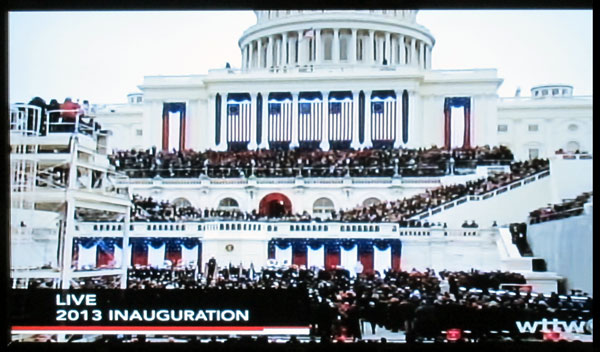
The inaugural was held on the west front of the Capitol (Photograph of PBS coverage)

Relative to the pomp surrounding British monarchical rituals, for instance, American inaugurals are low ceremonies indeed.  Since John Adams’s early disastrous experiments in aping the British monarchy, presidents and their families have avoided ostentatious costumes or trappings offensive to democratic sensibilities.  Officials take the oath of office wearing ordinary street clothes, allowing the “majesty of the people” to take center stage.

The president listening to the inaugural proceedings (Photograph of PBS coverage)

The preference has been strong for an open-air ceremony.  George Washington set the tone in 1789 with his swearing-in on the balcony of Federal Hall (then the seat of Congress) in New York City.  Though harsh weather has sometimes forced inaugurals inside, their location has generally been selected to allow them to be witnessed by largest possible number of people.

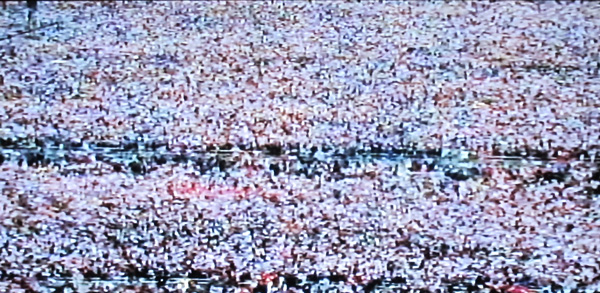
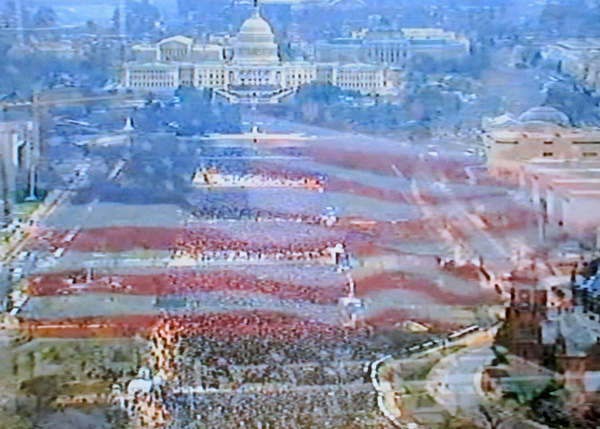
A vast crowd came to the National Mall to take part in the 2013 inauguration (Photograph from PBS television coverage)

Over time, the inaugural has evolved into a full and appropriately expressive ritual, especially through the device of the inauguration poem (a custom begun and carried on mainly by Democratic presidents) and the performance of American song.  In the right hands, the inaugural’s simple components can be coaxed into a whole of considerable beauty and eloquence, as was certainly the case with the inaugural  last Monday.

The ceremony was beautifully orchestrated, planned with an understanding of how its elements could combine.  From invocation to closing prayer, Obama’s second inaugural presented an aesthetic and patriotic vision of the American essence, receiving its purest expression during James Taylor’s simple rendition of ‘America the Beautiful’ on acoustic guitar.  At the same time, several complex political messages were effectively conveyed.

1. Ours is an inclusive, multiracial republic.

The Brooklyn Tabernacle Choir singing the Battle Hymn of the Republic (Photograph of PBS coverage)Visually and verbally, the inaugural moved beyond tokenism to demonstrate the diverse and inclusive character of the US today.  The crowd gathered on the Mall, as well as all those with an official part in the proceedings, showed the fruits of the country’s long struggle to make good on its egalitarian principles and dreams.  The reality of integration and inclusion was embodied in the faces of the military, in the diverse complexion of officialdom, and in all those clergy, singers, poets, musicians, and orators, who were called on to inspire, entertain, instruct, bless, and thrill us that day.

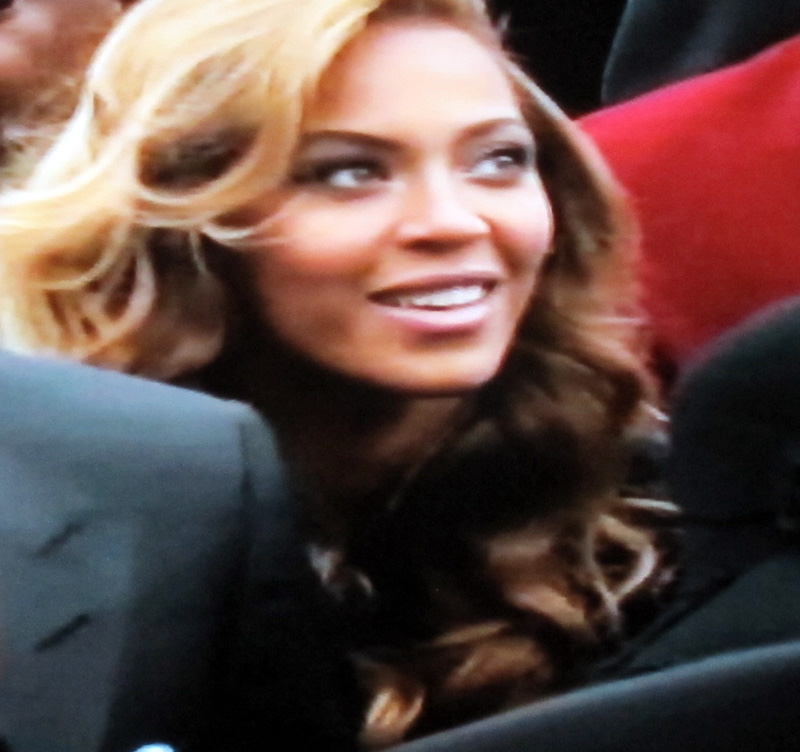
Beyonce leaving the inauguration, where she performed the national anthem (Photograph of PBS coverage)Coinciding with Martin Luther King Day, the inaugural paid homage to the nation’s centuries-long quest for civil equality, encompassing the struggle to end slavery, extend the franchise, welcome the immigrant, and end archaic practices that are discriminatory.  Progress toward these goals, though incomplete and painfully achieved, is evident, and our maturity as a pluralistic country was joyfully ratified on Inauguration Day.

2. Religion is central to American civic life, but not in the way Christian conservatives imagine.

Religious sentiment (of a peculiarly American kind) suffused the inaugural proceedings.  Its historic role in inspiring Americans to preserve and strengthen the Union and to persevere in the face of injustice was humbly acknowledged.  In the ceremony, religion figured as a fountain that Americans must continue to draw on as they seek to discern the right and the true.

Myrlie Evers-Williams somber invocation and Reverend Luis Leon’s benediction extolled the blessings of religion as a unifying and transcendent force, binding together and uplifting the American people.  Driving the point home, the multiracial Brooklyn Tabernacle Choir wowed the crowd with its rendition of the ‘Battle Hymn of the Republic,’ a Civil War-era song about militant righteousness and Union, written by northern white abolitionist Julia Ward Howe.

Was the inaugural satisfying in part because it sketched the spiritual and patriotic dimensions of the Obamas’ own deep personal faith, a faith that opponents have often assailed, belittled, and misrepresented for the sake of political gain?  At the same time, the intense but inclusive spirit of the inaugural seemed a rebuke to the more narrow and divisive Christianity that social conservatives espouse.

3. The condition of the people is the President’s main concern.  Maximize their security, happiness, and well-being, and national  prosperity will follow.

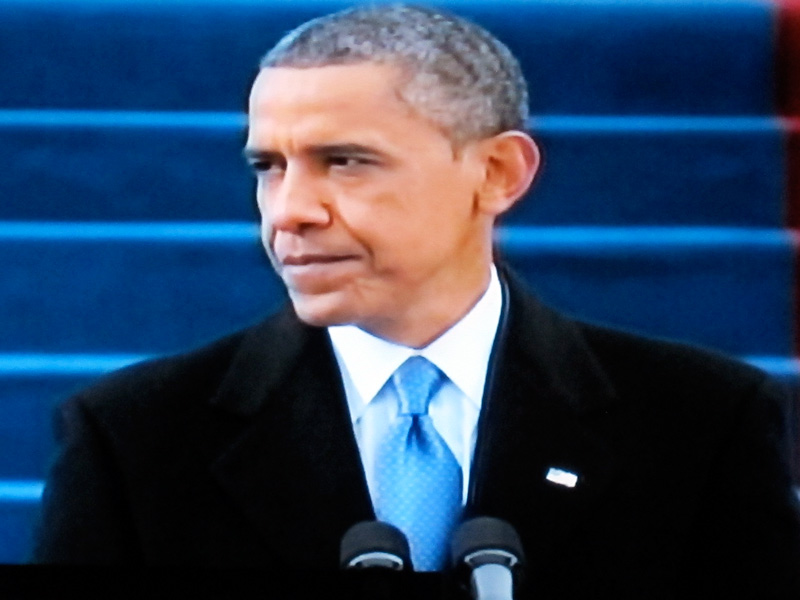
President Obama delivering his inaugural address (Photograph from PBS coverage)Jeffersonian thought has been so marginalized in political discourse that commentators hardly recognize its essence today.  President Obama’s repeated use of phrases and ideas from the Declaration of Independence in his speech signaled his interest in governing in a Jeffersonian vein.  It’s an interesting idea, but what does it mean?  For Jefferson, it meant providing a framework for the individual so that the the individual could flourish.  Jefferson was not anti-government—he was the architect of many enduring and expansive national projects—but he believed chiefly in that government necessary to protect and promote a prosperous and self-realizing citizenry.  When it came to big projects, Jefferson was all about innovation and efficiency.

4. The relationships born of our civic life enjoy a priority over those of corporations or the economy.

The Capitol as seen from the Washington Monument on January 21, 2013 (Photograph of PBS coverage)

Throughout his career, President Obama has sought to reinvigorate the potent role of citizens in political life.  David Brooks, though admiring the inaugural address, regretted the president had not devoted more of it to the budget, the markets, the economy, or free enterprise.  We’ve grown accustomed to thinking that government must be mainly about these.  But are these truly the chief interests of a republican government?  Are these the interests that need protecting?  American business will continue to find a way, whether the Obama administration puts its might behind that project, or not.  The president believes that investment in human capital is the chief requisite to making the economy thrive.  As if to underscore the point, inaugural poet Richard Blanco offered a lyrical, Whitmanesque view of American work in his spare yet impressive poem, One Today.

5. We are all citizens, and, as citizens, must fulfill certain transcendent obligations consonant with the great power reposed in us.

 The best part of the president’s speech was its conclusion.  Pointing to oath-taking as a unifying ritual, the President likened his oath to others we have taken, whether as schoolchildren, government officials, new citizens, or members of the military.  The promises we make to our country bind us together in a way that transcends the claims of self-interest and party.  The president closed with an appeal to each of us to continue to make our voices heard.

The president looks back on the Inaugural crowd (Photograph of PBS coverage)

Election Scenarios; The Spotlight on Silver

Interactive electoral graphic (Screen grab from the NYT; click to visit NYT)

With Election Day 2012 finally in sight, national attention is riveted on the possible electoral outcomes of the presidential vote.  A useful interactive on the New York Times website makes it easier to envision the implications of losses and victories in various swing states.  Click on the image to go to the site, then use the “next” button to take advantage of its interactive features.

*     *     *

Voters pinning their hopes on Mitt Romney’s purported momentum may find that a visit to Nate Silver‘s blog, FiveThirtyEight, puts them in a sour mood.  Silver, a youngish statistician whose 2008 predictions were highly accurate, has consistently assigned President Obama favorable odds of victory.  Even as isolated polls show his challenger pulling even with Obama in several key states, the margin by which Silver’s quantitative model favors Obama has been increasing.  (Silver assigned Obama a 77% chance of winning with 299 electoral votes, as of my site visit earlier in the day.)

Not surprisingly, Silver has come under attack from the right and finds himself the center of eleventh-hour controversy.  The key charges, defenses, and countercharges are contained in the various links below.  The weirdest charge is that of Dean Chambers, who insinuates that Silver is too effeminate to be a competent predictor of the presidential odds.  Also discernible is an anti-intellectual discomfort with hard numbers.

Dylan Byers, Nate Silver: One-Term Celebrity?, Politico.
Brett LoGlurato, People are flipping out over Politico’s attack on Nate Silver, Business Insider.
Ezra Klein, The Nate Silver Backlash, The Washington Post.
Robert Schlesinger, Mitt Romney’s Electoral Problem and the War on Nate SilverUS News and World Report.
Charles P Pierce, The Enemies of Nate Silver, Esquire.