Woodrow Wilson Casts His Ballot

Woodrow Wilson Casts His Ballot, 1912 (Courtesy Princeton University Library via Flickr Commons)

I’d been looking for an excuse to write about Woodrow Wilson when Monday’s presidential debate, with its exchange over “horses and bayonets” and the WWI navy, came along especially to encourage me.

An interesting cache of photographs put online by the Woodrow Wilson Library includes this one of Wilson casting his ballot in the presidential election of 1912.  Wilson, then governor of New Jersey and the Democratic candidate for president, won the election in a landslide.

The photograph, with its mesh ballot receptacle, handwritten records, and air of social intimacy, casts doubt on some time-honored political verities.  How free and fair were the elections conducted with this “technology”?  Did our elective process, so often derided as “broken,” really work better in an earlier day?

In 1912, most black Americans were barred or discouraged from voting.  Community norms and party interests inflected how election rules were applied.  Until the ‘Australian’ ballot was universally adopted, casting a vote was a social act, not granted any privacy.  And party loyalty was the grease that kept the machinery running: for much of the nineteenth century, “voting” typically meant nothing more than delivering to the poll a ballot that your party had already completed for you.

Wilson’s ascent coincided with a move toward a more participatory democracy.  In 1912, US senators were still elected, not by the populace, but by the state legislatures.  A Constitutional amendment changing that would be ratified the next year.  The nominating conventions of 1912 were historic, because they were the first to include delegates chosen, not by party operatives, but by popular votes cast in the nation’s first presidential primaries.

*     *     *

A scholar-statesman not unlike Barack Obama, Wilson, a noted professor of political science and former president of Princeton University, spent just two years as New Jersey’s chief executive before catapulting to the presidency.

His path to the White House was more than a little unlikely.  The 1912 election pitted him against three other candidates: the Socialist Eugene Debs, incumbent President William Taft, and former president Theodore Roosevelt, the latter two representing the Conservative and Progressive wings of the Republican Party, respectively.  Only deep divisions within the Republican Party enabled Wilson, the first Southerner to be elected to the White House since Zachary Taylor, to succeed.  Wilson had been a dark horse in the fight for his party’s nomination, triumphing over the favorite, James Beauchamp Clark, a popular House Speaker, in the eleventh hour.

Wilson’s agenda was progressive and sophisticated, but the fractious political environment prevented him from realizing many of his cherished visions, dealing him some notable humiliations instead.  In 1913, John McCutcheon drew this cartoon drubbing Wilson’s first-year performance, yet in the succeeding years Wilson presided over many liberal reforms (e.g. women’s suffrage) and fiscal innovations (e.g. the income tax) that shape our political landscape today.  While Wilson’s approach to the Great War was adroit, he suffered a rebuke heard round the world when a Republican-controlled Senate jettisoned US participation in the new League of Nations and refused to ratify the Treaty of Versailles.  (Unbelievably, Wilson was the first US president to make an official trip abroad when he traveled to Europe to negotiate the Treaty in 1919.)

Image: Wilson voting in New Jersey, from this source.

Stephen Colbert on the recent attacks against the 17th Amendment here.

Excitement Is General

Crowds gathered for the presidential inauguration, 1921 (Courtesy of the Library of Congress)

Excitement is general as we head into the final weeks of the long campaign.  With the presidential race in a dead heat, it’s anyone’s guess who the victor will be.  The candidates receive ever closer scrutiny, waves of analysis rolling in over airwaves and Internet incessantly.  Stalwarts gear up for the final push.

The uncertainty of the race is drawing huge audiences to the presidential debates.  Last night’s debate between President Obama and challenger Mitt Romney is estimated to have drawn some 65 million viewers.  According to Bloomberg, the viewership for the debates has been roughly double what it was for the nominating conventions this summer.

The spontaneity of the response to the debates is unprecedented, too.  Last night during the debate, Twitter recorded over 7 million new tweets, with more than 109,000 recorded during a single minute when the candidates were discussing immigration.  Romney’s peculiar remark about ‘binders full of women’ prompted an immediate outpouring and a new hashtag.  Within minutes, satirical takes on his remarks were available for view on this Tumblr page.

Every age has its own political customs.  The ones we’re using today are making history, too.

Image: Crowds gathered for the presidential inauguration in 1921, from this source.
Click image to enlarge.

A Prisoner of the Bully Pulpit Breaks Free

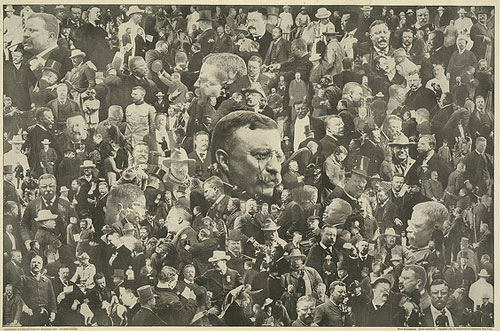
Photomontage of Theodore Roosevelt (Courtesy of Cornell University Library via Flickr Commons)

♦ A HISTORICAL ANALYSIS OF PRESIDENT OBAMA’S ACCEPTANCE SPEECH ♦

Theodore Roosevelt, though a fine president in many ways, left behind one baleful legacy: the idea of the presidency as a ‘bully pulpit,’ by which he meant a superb vantage from which to preach to others about how the nation should be.  When you hear presidential candidates speaking confidently of the miraculous feats that will follow from their being elected, it’s the misleading cadences of a bully-pulpit preacher you’re hearing.

THEODORE ROOSEVELT RESHAPES THE PRESIDENCY

To an extent difficult for us to appreciate today, Roosevelt’s conception of the president as an active visionary was revolutionary, departing in significant ways from the executive role the Constitution laid out.  Our scheme of government assigns the president a few plain duties, which, given the size and scope of the government and its role in the world, constitute a staggering burden.  In addition to serving as the symbolic and ceremonial head of the nation, the president executes the laws, conducts foreign policy, commands the armed forces.  Presidents often function as party leaders, but their constitutional function is essentially one of interdependence, for a president cannot make a law, placing every president in that regard very much at the mercy of Congress.

THE CHANCE TO BECOME A SCINTILLATING STAR

During the first century of the nation’s life, presidents grappled with this limitation in various ways, but Teddy was the first to dare to act as though it didn’t exist.  He was determined to make the president the determining force in all things.  Like Satan—the most powerful angel in Milton’s celestial firmament—, he chafed at playing second fiddle; he longed to be God.  Suiting actions to words, Roosevelt broke the mold, becoming a media-oriented president intent on using his considerable intellect and celebrity to reshape the nation and govern Congress.  Initiative pulsated from the White House.  It was all very thrilling.  Moreover, it kept Roosevelt constantly in the spotlight, which was something he liked.

WHICH BULLY PULPIT PREACHERS PLEASE US MORE

Since then, Roosevelt’s conception of the presidency has become our conception, too.  In what is a sad distortion of the Founders’ vision, we expect the president—a single person—to do the work that Congress should be doing.  This, in turn, leads to a confusion about where responsibility lies.  The American people spend more and more time agonizing over presidential choice, more and more time trying to decide which campaign promises and bold visions please them more.

A PRESIDENT IN THE ROOSEVELTIAN VEIN

It was clear from the start that Barack Obama sought to be an activist president in the Rooseveltian vein.  His entire campaign the first time around was based on the premise that he could “change Washington,” reorganize the business of politics, and define a new political epoch singlehandedly.  For much of his first term, he seemed at odds with the presidential role, chafing at its limitations and behaving as though his ability to extract specific laws from Congress was the sole yardstick later generations would measure him by.

Influencing Congress became his preoccupation.  Whether the issue was health care or the debt ceiling, President Obama spent much of his first term lecturing Congress and the public—chiding and exhorting the nation to embrace his vision for us.  His love of showing his mettle prompted him to become over-involved in fruitless wrangles whose results were properly the responsibility of a weak and recalcitrant Congress.  The “victories” so gained were costly indeed: witness a health-care bill ahead of its time that, regardless of its merits, heightened partisan rancor and left much of the nation resentful and unpersuaded.

THE BULLY PULPIT’S NOT ALL IT’S CRACKED UP TO BE

As recently as January, the president’s bully-pulpit predilections were on full display, when he chose to use the State of the Union address to tell Congress its business rather than report candidly on governmental progress.  Yet, between then and now, Obama has seen the light about an activist presidency, about what a dead-end it is, how it takes a certain set of conditions to achieve.  In the meantime, he has racked up a steady tally of gains, showing himself to be very able in directing foreign affairs and the military.  And he retains the support of a large part of the electorate, who value his honesty and intelligence and see him as persistent, prudent, and humane.

FOUR YEARS OUT

Which brings us to the president’s recent acceptance speech.  Some listeners were disappointed; others found the speech a bit desperate or weak.  We all noticed a difference.  The bully-pulpit fervor we’ve grown so accustomed to was missing.

Instead, the President re-articulated his fundamental role as ‘the people’s sovereign’—the keeper of the people’s interest, uniquely entrusted to embody and articulate their general sentiments and needs.  This emphasis on the president’s traditional role as the national symbol of the people’s rule enabled the President to remind his listeners of their primary role as citizens, in a system in which his power is ‘from the people.’

A JUSTER RECOGNITION OF PRESIDENTIAL DUTY

Lacking the glitz and razzmatazz of his earlier speeches, the president’s speech that night was pitched in a lower key.  Its high points were not remarkable for policy specifics, but for their embrace of a more constitutionally sound notion of the presidency, one focused on executing the will of the people and the astute exercise of presidential duty.  The speech’s most important moment came when Obama said, “I’m not a just candidate for the presidency.  I am the president,” a simple declaration that eloquently accounted for his changed tone.

For a sitting president who a year ago styled himself an underdog, this embrace of experience and authority marked a great leap toward political maturity.  Scaling back the high-flown rhetoric and grand visions of which he has been so fond, the president has raised his ambitions in another way: making a bid for greatness by renouncing a view of office that offers self-gratification now.

Regardless of the continuing deep divisions in Congress, the nation can repose confidence in the seasoned president we have now.  All in all, it was a moment I rejoiced to see: a prisoner of the bully pulpit breaking free.

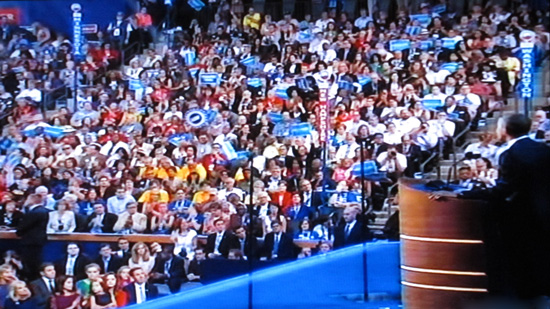
President Obama delivering his acceptance speech before the Democratic National Convention, Sept 6, 2012 (Screen shot courtesy of WTTW Channel 11 Chicago)

Top image: “Five hundred different views of Theodore Roosevelt,” from this source.
Bottom image: Screen capture of PBS Newshour coverage of the Democratic National Convention.

A Great White Nation of Self-Made Men

The Republican National Convention created a strange impression, painting a peculiar picture of the US economy and its citizens’ woes.  Not only the present was distorted, but history, too.  I listened carefully to what the speakers and party-sponsored commercials praised, and compared it to the nation and the realities I knew.   There was a huge gap between the two.

America is at a cross-roads for many reasons, among them the fact that several enormous historical advantages we’ve enjoyed are waning.  The nation that once enjoyed an immense over-supply of land and relative scarcity of labor has matured into a nation where resources are becoming more precious and the population is more and more exposed to underemployment and fierce competition.  Global change is reinforcing the trend.  Yet rather than acknowledge or adjust to the change, Republicans have decided to dismiss it and argue that a flawed president is to blame.  Only bad people stand between us and the restoration of the nation’s former glory.

No credit was allowed to the great federal structure that allowed us to flourish in the first place, nor to the amazing natural inheritance that sustains the US—superior natural resources that should be husbanded rather than squandered or spoiled.

The vast historic role of the state in nation-building went unacknowledged—was belittled, even.  Rand Paul jeered at the idea that infrastructure investment creates prosperity, insisting the opposite was somehow the case.  Try telling that to the great 19th-century railway magnates, who depended entirely on land grants and laws enacted by Congress to create their lines.  Or to the era’s land-speculators, who knew that towns would grow mainly where railroads were placed.  Or to the first telegraph companies, whose networks piggybacked on the railroad rights-of-way that federal legislation had so thoughtfully made.  Without the federal government, states would have built useless networks of dead-end roads.

Even America’s private enterprises might have remained small had it not been for the protection that early Supreme Court decisions gave them.  Without such protection, all corporate entities would have been stymied, including those that built the nation’s first roads, bridges, and schools.

The Republicans committed other disturbing elisions.  I listened to the praise for families; I admired the attractiveness of Jenna Ryan and Ann Romney; their picture-perfect children were impressive, too.  The world of the 2012 Republicans is a world of stay-at-home mothers who don’t need to worry about limiting their family size or figuring out how to feed an additional mouth.  It’s a world where there’s plenty of time for charity, because the fortunate people in it somehow have plenty to spare.  And that’s good, because in this Republican world, government help is bad.  All we want, Paul Ryan tells us, is to be left alone.

Absent was any acknowledgment of the demographic trends of the last several decades, which have seen the rise of delayed child-bearing, increased family limitation and planning, and the rise of two-career couples working outside the home.  The party celebrated its female members—but these women apparently never needed a student loan, never needed protection from workplace bias, never needed family planning or contraception while single.  One must suppose this, because the Republicans have been active in opposing, attacking, and weakening the structure of support that has enabled more American women to gain education, control reproduction, contribute more to the family economy, and earn decent livings.

Without such support, how are young women supposed to take care of themselves and their families?  Implicit in the worldview paraded at the convention is that marriage in itself provides wives and mothers with adequate financial protection.  Yet the number of women living the dream that the beautiful Republican spouses embody is painfully few.

The Republican convention’s treatment of race was perhaps most astonishing.  The party sought to promote itself as a “brand” friendly to minorities, despite the fact that it has been working hard in states such as Texas, Ohio, and Pennsylvania to raise voting requirements, restrict early voting, and redraw districts in a way that make it harder for minorities to vote or gain representation.

I was agog at efforts to depict President Obama as a lazy, do-nothing character who did not understand struggle, success, or hard work.  It was a “dog-whistle” portrayal of a super-high-achieving guy that played off of deeply engrained racial stereotypes.  The topper came when Clint Eastwood re-imagined the president as someone who was anti-social and vulgar, enacting a racist fantasy (perhaps unwittingly) at the close of his imaginary dialogue with the president by encouraging the crowd to chant “Make My Day.”  We all know what happens to low-lifes who dare to mess with Dirty Harry.

It was a shameful spectacle spelling a new nadir for the G. O. P.

RELATED:
The Map of Federal Benefits, Our Polity.

Be Our President, Please

Forget the polls: I woke up yesterday with the cold hard conviction that Obama will lose the presidency.  It was a moment when wishes dropped away, exposing a bleak vista shaped by the President’s own choices and style of proceeding.

If only he thought of his office differently, Obama would be far more popular than he is, and his reelection would be a certainty.  From the start, he has styled himself as an activist president rather than an executive duty-bound to stand as a symbol of the whole country and its legislatively expressed will.  His would not be a role secondary to the other leaders of his party.  No, from the outset Obama has positioned himself as one who, separate from all others, would push to redirect established institutions of power.  From the vantage of the White House, he would elevate the nation to a state that had previously eluded the whole governing community and other members of his party.

This vision has given free rein to the narcissism and paternalism that are aspects of Obama’s personality.  After a point, it doesn’t matter whether the president has a good heart or an intelligent grasp of policy: what matters is that, in his zeal to do more and be better than others, he is subverting the collaboration and interdependence on which the government is premised.

When Obama was first running in 2008, I was reluctant to believe Chicago friends who told me that he was famous for throwing fellow-Democrats under the bus.   Four years later, after watching Obama tirelessly lecture and upstage everyone else in his party, I’m ready to believe.  The latest instance was on Friday, when the president couldn’t wait to strike out in a new direction on immigration policy—a complex and divisive issue whose resolution warrants the whole voice and weight of Congressional authority.

Sadly, in arrogating to himself matters more appropriately left to Congress, Obama has foregone the chance to be a different kind of executive—one who embodies the authority of the government and symbolically represents the people as a whole.  By aiming to do less, Obama could do more to uplift and unite a beleaguered country.

RELATED:
Political Affections