The Closed-Door Campaign

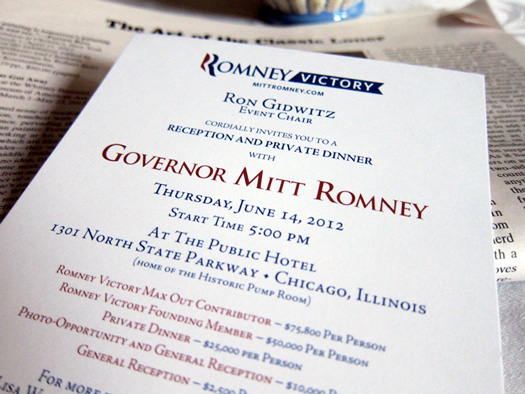
Photograph of an invitation to a Romney fund-raising event (Credit: Susan Barsy)

A piece of high-end junk mail appeared in my P.O. box the other day.  An invitation to an upcoming Romney fundraiser, it is a perfect souvenir of this campaign season.  For just $75,800, I can become a “Romney Victory Max Out Contributor,” and perhaps sit next to someone powerful in the old Pump Room.

Now that the suspense has gone out of the primaries, a superficial calm has fallen over the presidential campaign.  Tune out the perfunctory stump speeches and ramped-up media campaigns, and you will hear the ching-ching! of aggressive fund-raising, as both Romney and the president crisscross the country desperately scrounging up cash, now taken as a proxy for popular support.

Have you been reading about the changing style of presidential fundraising?  Whereas in 2008 Obama made securing small contributions a priority, his style of fund-raising is now virtually indistinguishable from that of Mitt Romney.  Both rely mainly on high-end fundraisers, hosted by celebrities or other ultra-wealthy Americans and typically kept at a distance from the public eye.  “Few Witnesses to Obama, Romney, As They Raise $1.5 Billion,” read a recent Bloomberg headline.

In many ways, this cozy relationship between leading politicians and the wealthy merely mirrors the relationship the two groups have enjoyed historically.  Go back to the Revolutionary Era or the early republic, and you will find that wealthy Americans led the colonies and states, wrote the Constitution, and dominated high office.  All throughout the nineteenth century, the line between public interest and private remained  suspiciously murky.  In fact, that a politician represented his own financial interest and that of his friends was taken more or less for granted; it was rarely viewed as criminal, certainly.

At present, however, the candidates’ attentiveness to wealth smacks of a politics of avoidance that is gripping the country.  For the people, indeed.  The candidates offer platitudes to a populace who are suffering, disillusioned, and angry, but it’s probably more fun to dine with the wealthy and promise to supply the things that they need.  Yet as long as the nation’s leading classes remain locked in this romantic tango, behind closed doors, a true economic recovery is unlikely to occur.

RELATED:
Susan Barsy, Mitt Romney as Exhibit A, Our Polity.
Julie Pace, What $40,000 Gets You in Presidential Fundraising, Yahoo/AP.

Democrats: Shake It Up

CAN THE DEMOCRATIC PARTY change from within?  Probably not, because most very active Democrats see no need to.  The party has its entrenched blocs of support, just as the Republican Party does.  The Democratic Party’s need to retain its base, which it counts on to win in national elections, enforces its own tendency to be conservative.  Sadly, the party is unlikely to give up or disregard interests already in its column, even if doing so would bring it a base of support that’s broader, stronger, and more fervent.

It’s an unfortunate situation for several reasons.  1.) The Democratic Party is at risk of losing control of the Senate to an observably weaker party that’s on the verge of disintegrating.  Yet rather than boost its popularity by advancing a constellation of smart new ideas, the Democratic Party is coasting along defensively, its identity defined by its historical positions and the reactive posture it habitually assumes vis-à-vis the Republican Party.  What the Republicans attack, the Democrats defend.

2.) The Democrats’ patchy ideological vision leaves the country vulnerable to a rightward lurch: the staleness that might seem a parochial problem is a problem for the country, too.  The party’s failure to take up feasible positions on matters like fiscal reform or entitlements, for instance, leaves us with a defeated, going-nowhere feeling.  (Did you know that many Democrats, including my own representative Jan Schakowsky, voted against the bill to increase the debt ceiling?  Their numbers equaled the number of Republicans who voted no.)  Democrats’ inability to change with the times is creating an ideological vacuum that other ideas—other candidates—other factions are filling.

3.) In the meantime, large blocs of disaffected or simply bored voters have been left without partisan representation.  Such voters now comprise a plurality of the electorate, as the percentage of Americans affiliated with either party has continued to decline.  If the Democrats wish to remain relevant, they as a group must fashion an ideology that appeals to a greater number of these voters, and that’s compelling enough to induce them to identify with the party.

It’s not enough for a few leading Democrats (e.g., the President) to espouse new ideas.  The Democrats collectively must shift to new ground.  It’s not enough for a few Democrats reach out to young voters, or to green voters, say, because, in themselves, such gestures have no efficacy.  Without the power of a whole party behind them, the proposals of a few men or women mean nothing.

Until the Party modifies its identity, its would-be adherents will know the party is not really about them.  They won’t be able to rely on it as a vehicle of their values and concerns.  This is why enthusiasm for voting and the parties is waning.  This is why so many Americans are dissatisfied with the work their political leaders are doing.  The parties do not faithfully mirror modern Americans and their world; the mirrors they hold up are cloudy with the treacly cliches of decades.  They’re distorted with age.

Democrats must give up their comfortable mantras and embrace efficiency.  They must become champions of small, smart government, because this is the only kind that we can sustain.  There’s no reason why Democrats can’t continue to champion a constructive federalism (that’s only sensible), but they must work to rid government of its bloated, statist qualities.  Democrats must work toward a sort of state that maximizes individual freedom, which paradoxically might include becoming more protective of our economy, our skills & labor, and our resources and environment.

Democrats should identify themselves with the project of restoring civic integrity to the country, whether through increased emphasis on civics education in schools, through clearer paths to citizenship, or through the embrace of a party-wide pledge to renounce things like super-PAC money.  Democrats should acknowledge that entitlements must be reformed and take the lead in proposing changes that are practical and humane.

There are glimmers of hope within the Democratic Party.  I find it hopeful that the president and the Clintons are working together more closely.  Though none are ideologues, each has personified a pragmatic liberalism that could help catalyze a new outlook party-wide.  If aided by an echelon of leading Democrats, their inclinations could form the nucleus of an all-out movement.

Meanwhile, closer to home, a progressive version of Democracy is very much on display, with Illinoisans like Rahm Emanuel, Toni Preckwinkle, and now even Governor Quinn pushing against the party’s traditional constituencies in a quest for more efficient government that reins in spending.

Can the Democrats shake it up and become a new party?  Though it seems up to them, perhaps the answer’s with you.

RELATED:
New Democrats
Why Democrats Should Embrace Simpson-Bowles

Know someone who would like this article?  Feel free to share it using the buttons below.
New Democrats

One of the strange things about the Democratic Party is that it’s only had two major ideological phases in its very long life.  In the first phase of its life—from 1828 to 1932—it was the party of less government, states’ rights, and laissez-faire.  In the second phase—dating from 1932 to the present—it’s been the party of big government, activist government, and more dedicated than the Republicans to the rights of the people.

Even though the Democratic Party is full of good people who believe they have right on their side, it’s hard to escape the conclusion that the Republican Party is more vinegary, more organized and interesting.  Perhaps because long ago the Democratic Party believed in “letting everyone be,” its members (and I’m talking now about its ordinary members, not about leading Democrats) tend to let the Republicans hog the spotlight and get away with all kinds of outrageous things.  The Democratic Party plays defense, but as a whole its members are not organized and energized to PREVAIL in defining the character of our political life.  This is why we are always focused on the Republican Party, with its weird leaders, its mama grizzlys, its Bible thumpers, its dark strategists like Dick Cheney and Karl Rove.

This is a shame, because it’s obvious that there is a lot of work the Democratic party, root and branch, could be doing.  If Democrats thought like Republicans, they would be out there in the vast “red” districts of the South and West, working to strengthen their base by reminding voters of the true civic traditions of this country.  They would be active in school districts, where the Republicans are rewriting history with misleading textbooks and charter schools.  If Democrats thought like Republicans, they would be busy trying to capitalize on Obama’s considerable star-power by tossing out their old ideas and fashioning a new ideological message, around which a vast army of moderates and independents could rally.

Instead, despite the palpably weak condition of the Republican Party, most Democrats are sitting on the sidelines, just laying bets on whether or not Obama will manage to squeak through and resigned to the prospect of losing more seats in Congress.  Yet this is a time when the Democrats (given a more can-do mentality) could have been on the offense, mobilizing to make substantial gains in both Congress and state governments.

It’s funny, because you can see Obama trying to articulate some of the elements of a New Democratic ideology.  But, as I’ve written elsewhere, this is a task that “takes a village”: reshaping a party’s message is too big a job for any one person.  You can see big Bill off on the side, like the party’s guardian angel, doing his “smart government” thing.  It may be a little more retro than I’d like, but he, too, is trying to get the Dems to move to new ground.

The Democrats may be approaching a tipping point, where they flip a switch—choose to leap into the present—and articulate a crystal-clear “New Democrat” ideology.  If I had my way, that ideology would embrace not just the green, but the local.  It would emphasize smart, rather than big.  It would pioneer a decentralization of the federal government.  And it would tout an economy based not on continued global expansion, but on the shrewd husbandry of our own great national and human capital.  It would be far more protective, more civic, and more inward looking.

This is just one vision, and there’ve gotta be many.  So, to all you New Democrats out there, I say: Get talking.

Why Democrats Should Embrace Simpson-Bowles

After writing about the federal budget the other day, I experienced what can only be called “a tea-party moment.”  By which I mean, a momentary but passionate longing for an end to deficit spending.  It doesn’t have to happen tomorrow, and it couldn’t have happened yesterday, but we have to have a plan for getting the federal budget back on a sustainable footing.  Democrats—all Democrats, as a party—need to embrace this goal.  If they can lead on this issue and bring the electorate to see how deficit reduction can be accomplished responsibly, they’ll find themselves enjoying renewed dominance nationally.  Endorsing the widely respected bipartisan recommendations of the Simpson-Bowles commission is the best way.

What’s clear from the budget graphic I wrote about last week is that the entitlements—Medicare, Medicaid, and Social Security—, are growing at annual rates that will continue to put the squeeze on the discretionary spending that Congress determines.  That’s why deficit spending will continue, and probably at a rate much higher than the $900 billion that President Obama has been proposing.  As the mandated portions of federal spending increase, there will be less and less scope for spending that addresses topical but often urgent contemporary needs.

To the extent that Democrats in the House and Senate have cast themselves as defenders of the status quo when it comes to entitlements, they have taken up an untenable, self-immolating position that will weaken them as a party.  Most Americans understand that the structure of entitlements will have to change, and, if they don’t already, they can be made to.  Today’s entitlements are simply too good to be true.  Originally intended to aid the ill and elderly who would otherwise be destitute or cut off from care, entitlements must be preserved to fulfill their original function of assisting the most needy.  But these programs must be modified in light of experience and changing social and economic conditions.  Social welfare is an important principle that we can best honor by re-tailoring these programs to fit the 21st century.  Simpson-Bowles, which calls for substantial but gradual changes to these programs, shows us the way.  It may not be the perfect plan, but you know what?  Its huge merit is that it was arrived at, and has already been vetted in, a bipartisan way.  With its provisions for thorough-going tax reform and modifications to the sacred cow of Social Security, it represents the deep sort of compromise that can be liberating.

The approach of the Democratic convention and the November election provide Democrats with a golden opportunity.  Look at the Republican primary contest and ask yourself, what’s holding together the Republican Party?  The alarming strength of candidates like Rick Santorum, Newt Gingrich, and before them Rick Perry attests to the party’s troubling divisions.  Were I a moderate Republican, I would be desperately seeking an alternative to a party whose constituents are proving themselves to be so provincial, chauvinistic, and bigoted.  Now is the time for Democrats to take the lead.  Democrats need to become champions of efficient, compassionate government—not the backward-looking defenders of a lost society that they often seem.  Making deficit reduction and tax reform their rallying cries would leave Republicans without productive ground to occupy.  The Democrats would win many converts among disaffected Republicans and the unaligned.  Democrats cannot continue to defend government spending simply because that’s what they’re comfortable doing.

The Times this week published an amazingly convoluted analysis arguing that it has been politically necessary for President Obama to avoid acknowledging any allegiance to the deficit-reduction plan that Bowles-Simpson produced—even though his current ideas about deficit reduction mirror theirs.  The fact is: the burden of deficit reduction isn’t the President’s.  The deficit problem belongs to Congress, and Congress alone.  That’s why it’s so important that the Democratic Party as a whole take responsibility.  Take the lead.  Admit that recent economic trends give us the breathing room to tackle the deficit issue, and take up a position in the center field.  It’s not just good politics.  At bottom, it’s what’s prudent and responsible: a balanced budget—or a nearly balanced one—is what the country needs.

Help Understanding the Budget

I have trouble thinking about the federal budget.  The numbers are too big.  I have pretty good math ability, so if I have trouble with it, I suspect a lot of other people do, too.  Maybe even many of our legislators in Congress!  (I would not want to be on the budget committee.)

So I was really glad to find this cool interactive graphic on the New York Times website showing President Obama’s proposed budget for 2013.  The graphic shows all the huge and tiny (relatively tiny that is–even a tiny part of the budget can have $1 billion in funding) expenditures the government makes yearly.  The colors of the bubbles show the cuts and increases that are proposed.  There’s also an empty circle representing the size of the deficit we’re running, so you can see it in relation to the budget as a whole.

If you click on the buttons above the graph, the bubbles regroup to show the parts of spending that the budget can’t control.  Looking at the graph makes you realize that nearly 70 percent of our budget obligations are mandated, while 30 percent are discretionary.  It’s interesting to see that President Obama is asking that many discretionary parts of the budget be increased, instead of being frozen.  According to this article from US News, Congress has already established that it may run a deficit of up to $1.047 trillion in 2013.

I’m far from being a budget radical, but I can understand why people are in revolt about the size and complexity of the government’s activities.  When you move the cursor over this picture of the government and look at the different obscure programs and how much they cost, you do start to wonder whether they are all necessary.

Click here for the graphic discussed: Four Ways to Slice President Obama’s 2013 budget.