The GOP’s marriage of convenience turns sour

Back in the spring of 2012, I wrote a post, Is the Republican Party Dying?, in which I surmised that the GOP, despite its already apparent fissures, was unlikely to collapse any time soon, because of the broad popularity it continued to enjoy at the state level in many parts of the country.  Now, in the wake of last week’s House vote on a bill to reopen the government, we have fresh evidence with which to assess the current condition of the party.

The GOP’s troubles appear to be growing, for, with the House vote that ended the government shutdown, the relative strength of the GOP’s intransigent right wing is clear to see.

Here is the vote count and its geographic distribution as depicted in a New York Times interactive graphic on October 17.  The yes vote (totaling 235 votes) was composed of 198 Democrats and 87 Republicans.  The no vote (totaling 144 votes) was composed entirely of Republicans unwilling to compromise, or to adhere to the advice of the moderate leadership of the party, as embodied in the House Speaker, John Boehner.

The size of the “no vote” is significant and startling, establishing that the more radical “Tea Party” element in the GOP, far from being a minority tendency as often depicted, comprises a MAJORITY of all House Republicans.  Far from being a “tail” that is “wagging the dog,” the Tea Partiers have morphed into the dog itself.  The only wonder is that they have not yet used their power to depose John Boehner–a miracle that has probably astonished the Speaker himself.

Regarding the “upcountry” character of these more radical Republican characters, the NYT map illuminates how difficult it will be to dislodge them, and why this faction so consistently overestimates its prospects for influencing the mass of the American population.  In many states where the suicide caucus lives, it enjoys a virtual monopoly.  In 12 states—including Georgia, South Carolina, Tennessee, Missouri, Texas, and Arizona—all the Republican representatives are of the intransigent kind.

These blinkered souls believe, despite the mounting evidence of public opinion polls, that their views command the assent of the American mainstream, and they are confidently planning to extend their geographical sweep into more moderate Republican territory.  In the meantime, moderates, alarmed at the immoderation of their right wing, have begun planning to challenge them in the primaries.  The battle for control of the GOP will be hard-fought.

But for now, the rest of us have seen how dangerous and desperate political actors can be when trying to hold together a party that’s imploding.  Should we condemn John Boehner for accommodating the radicals, or be relieved that no more radical obstructionist is replacing him?  The GOP truly is a grand old party, and should its literally elephantine organization collapse, the attendant damage would be catastrophic, not just for the party, but, as we have seen, for the nation too.

Looking back on this period, historians will puzzle over the decision of the GOP to welcome this radical fringe into their party.  Even now, the traditional Republicans could recover their dominance by unceremoniously cutting the Tea Party loose.  Without the GOP’s support and legitimation, the radicals’ spell would be broken, and their national influence would evaporate overnight.

Moderate Republicans who believe that such destructive zealots are necessary to their party have forgotten about the massive bloc of disaffected voters in the center of the political spectrum, waiting for forward-looking parties and personalities to appeal to them.

The GOP obstructionists

Who are the obstructionists intent on defunding Obamacare and delaying its implementation?

I appended to Monday’s post on Republican Fire-Eaters this list, compiled by fellow blogger Eric Prileson, giving the names and phone numbers of the 228 Republicans and 2 Democrats who passed a House spending bill to this effect on September 20.

The determination of the House to “hold up” the government until the Affordable Care Act is modified to its liking solidified when House Speaker Boehner and other G.O.P. moderates decided, once again, to cave in to the far-right members of their party.  The 80 radical Republicans leading the charge have been nicknamed the “suicide caucus”–an apt coinage highlighting their resemblance to a terrorist group.

As Thomas L Friedman and others have noted, this group is a minority with some striking geographical and sociological peculiarities.  I encourage you to read Ryan Lizza’s geographical analysis of the suicide caucus, recently published on the New Yorker website.  Accompanying it is a dandy map, based on data from The Cook Political Report, showing the “upcountry” character of the caucus’s constituency. Click on the map to go to its source.

congressdistricts_final-01.png

Lizza:

The geography of the suicide caucus shows . . . [that] half of these districts are concentrated in the South, and a quarter of them are in the Midwest, while there’s a smattering of thirteen in the rural West and four in rural Pennsylvania (outside the population centers of Philadelphia and Pittsburgh) . . . . there are no members from New England, the megalopolis corridor from Washington to Boston, or [from] along the Pacific coastline.

These eighty members represent just eighteen per cent of the House and just a third of the two hundred and thirty-three House Republicans. They were elected with fourteen and a half million of the hundred and eighteen million votes cast in House elections last November, or twelve per cent of the total.

The districts represented are also whiter than the nation as a whole.

The South, where many of the obstructionists live, is home to some of the nation’s unhealthiest populations.  Most Southern states, under Republican control, have decided against implementing the ACA-funded expansion of Medicare that might have benefited their neediest citizens.  This interactive map, published in today’s New York Times, shows the millions of people who will be affected by their choice.

*     *     *

Minorities, if sufficiently intransigent, can cause great harm if the majority fails to neutralize or contain them, leading to a frightful dynamic that President Lincoln, long ago, most eloquently described.

Republican Fire-Eaters

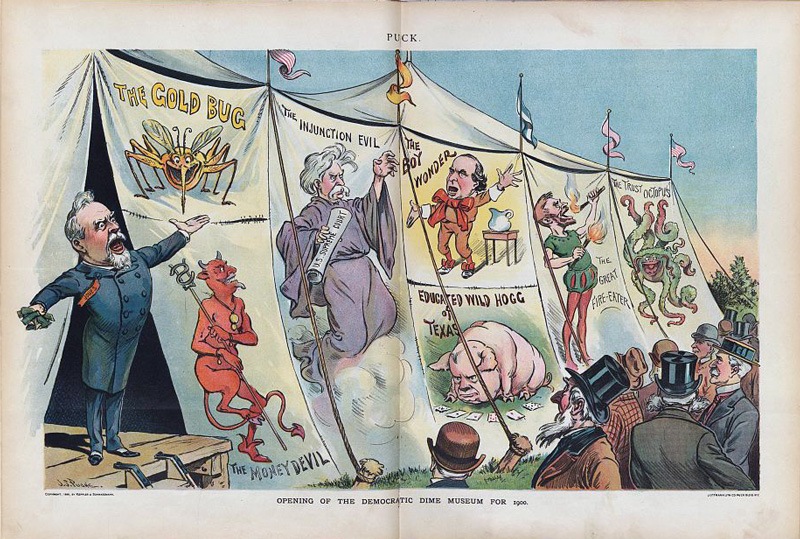
Political cartoon from Puck, showing various political types, including the "fire-eater" (Courtesy Library of Congress)

In politics, as in the circus world, a fire-eater is a performer who will swallow fire to attract a crowd and earn a living.  This aptly describes the tawdry crowd of grand-standing Republicans threatening to shut down the federal government today.

Their behavior resembles nothing so strongly as that of radical pro-slavery men, who, before the Civil War, threatened angrily to secede from the Union whenever the federal government wasn’t going their way.  Antebellum fire-eaters pretended to be great patriots and high-minded constitutionalists while actually serving the retrograde interests of a minority.

So it is with today’s right-wing Republicans, whose aversion to President Obama and health-care reform is so intense as to drive them along a reckless and self-defeating course.  Ted Cruz is, if anything, more self-serving and sophomoric than leading pro-slavery apologists–men such as William Lowndes Yancey of Alabama or Robert Barnwell Rhett of South Carolina–whose parochial defense of slave-holding and states’ rights marred careers as distinguished as any in their day.  In the end, these men could not love the United States more than they loved holding slaves, leading them to sacrifice true patriotism to an ignoble cause.

By now it has dawned on many Americans that those in Congress intent on derailing Obamacare at all costs are more like demagogues than patriots.  In their stubborn attempt to thwart the inclinations of a national majority, stand in the way of progress, and sabotage the federal government, Cruz and his ilk recall the secessionists whose noblest vision was to arouse local populations to follow them.  Intent on justifying their contempt of the federal government with high-toned ideas, the first fire-eaters used every conceivable means they could to oppose the federal government and the will of the majority, ultimately succeeding in persuading their fellow-citizens to withdraw from the Union and take up arms.

So it is with the current Republican spoilers, laboring unceasingly to deprive Americans of access to the new ACA-mandated health-insurance plans.  Don’t they realize that most Americans are tired of extremism, tired of factions intent only on undoing?  Republican fire-eaters would be better off quitting the circus and getting down to the sober, un-sensational business of governing.

Image: A 1900 political cartoon from Puck showing various American political types, including the fire-eater at right, courtesy of the Library of Congress.

Want to tell the fire-eaters what you think of their actions?
FOR A HANDY LIST OF THEIR TELEPHONE NUMBERS, COMPILED BY FELLOW BLOGGER ERIC PRILESON,
CLICK HERE

The Incredible Shrinking GOP

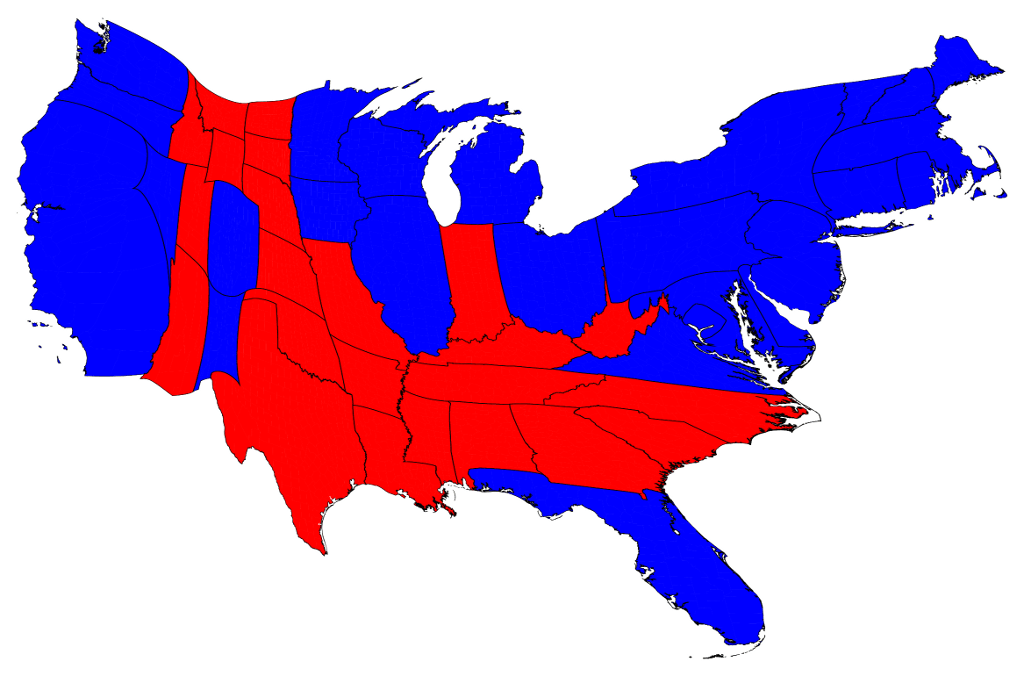
Cartagram by Mark Newman showing the relative strength of the Democratic and Republican vote.

The results of Tuesday’s election, in which Republicans failed of their two principal goals, and indeed lost ground even in the House, indicate that the GOP is in danger of becoming a minority party.

The cartogram above, one of a series of maps created by Mark Newman of the University of Michigan to show the real strength and distribution of the popular vote, depicts the limits of the GOP’s popular appeal.

While the Republican party continues to command the allegiance of bands of Americans in southern and land-locked western states, these states are not particularly populous.  In the more heavily populated and cosmopolitan areas of the United States, the Democratic Party under Barack Obama is consolidating its hold.

Voting strength of Democrats and Republicans by county, with purple showing county-level mix

Moreover, many of the counties that the Republicans managed to win Tuesday are actually divided and could readily swing back the other way.  In the county-level map above, only the streaks that are pure red and reddish can be regarded as Republican strongholds.

The Republicans in denial

Interestingly, the Republican leadership seems incapable of grasping the fact that its positions and values are increasingly out of step with those of the nation.  John Dickerson of Slate, appearing on Washington Week on Friday, described the Romney-Ryan campaign’s illusory anticipation of victory: it simply couldn’t imagine there being enough Americans to support the President, though numerous polls had shown that support for him was holding and building.  A contempt for the whole of the electorate, and an inability to embrace its diversity, spelled doom for Republicans in the 2012 campaign.

Look for Republicans to continue to grasp at procedural, legal, monetized, and PR-based tactics to sustain the illusion that they remain a formidable party.  In fact, unless the Republican Party dramatically transforms itself, renounces extremism, and embraces diversity and moderation, its showing will be even weaker next time.

Click here to view all of Mark Newman’s maps and learn more about what they mean.

MORE ON MY TAKE ON THE GOP:
What If They Can’t Take the Capital? September 2012.
A Great White Nation of Self-Made Men, September 2012.
Moment of Truth for the GOP’s Conservative Wing, August 2012.
Should Leaders Who Can’t Govern Their Party Govern the Country? June 2012.
Is the Republican Party Dying? March 2012.
2008: The Critical Election That Wasn’t (Part II), January 2012.
Parties Made New: Our Critical Elections February 2012.