
THE BICYCLE possessed some kind of magic, its mute presence transforming American society. Originally known as a velocipede, the bicycle had been around since the early nineteenth century, but only after 1890 did the contraption become safer and gain popularity throughout the States as something associated with freedom and pleasure. Continue reading
Tag Archives: sports
Football: A Romance in Pictures
 On Super Bowl Sunday, over 110-million Americans tune in to watch football’s grand championship game. Fans cheer and grimace, drink and eat chili, spellbound by the contest for the sport’s supreme prize.

Enthusiasm envelops all of society, even presidents, plutocrats, and Paul McCartney. Few can resist the drama of the grand finale.

Only a fortunate few can afford to go to the game.

That doesn’t stop all America from watching.

Even a crack in the fence can seem pretty wide.

For few things are as thrilling as a really good game.

The agony of suspense is deeply satisfying . . .

the rapt suspense that grips and unites a vast company.

Why do we love football so, anyway?

Is it that football players channel our aspirations, reminding us of the days when we, too, played?


Does it bring back the happiness of childhood games?

Or remind us of our first date in some way?

The acrobatics, the shenanigans, the mock-murderous conflicts:

To society, they bring much-needed cartharsis.

The players, the fans, they all have their reasons.

Maybe we’ll figure out what it all means next season.
All images courtesy of the Library of Congress.
For further information, click the links below.
1, 2, 3, 4, 5, 6, 7, 8, 9, 10, 11, 12, 13, 14, 15, 16, 17, 18.
Thanks to ice-skating, ladies’ skirts rise

The ice-skating craze that swept the northern US in the 1850s cracked the shell of stiff propriety imprisoning respectable women then. Normally, women were obliged to swaddle themselves in yards and yards of fabric, to garb themselves in full-length dresses and hoop-skirts completely concealing their lower bodies. Even equestrianism, which offered upper-class women a welcome chance to get some exercise, entailed riding side-saddle in a skirt that was abnormally long.
When Cole Porter penned the line, “In olden days a glimpse of stocking was looked on as something shocking,” he summed up the 1850s economically.
Ice-skating changed that in a snap—as long as ladies and gentlemen were on the ice. To step onto a frozen pond was to sail into a world where the rules of genteel behavior were relaxed, strangers mingled, and even women could get a little bit wild.
This opening for women was symbolized in the creation of a special petticoat, designed to be worn as activewear under their skirts. The Balmoral petticoat, as it was called, was associated with Queen Victoria and the outdoor pastimes—such as skating, hiking, hunting, and riding—that she and her family were known to pursue on their country estate in Balmoral in the Scottish Highlands.

Fashion plates, like this one, and this one, showing skaters in balmoral petticoats, underscore the connection between this article of dress and an active outdoor life. Women donned such petticoats to skate or, in warmer months, to play croquet.
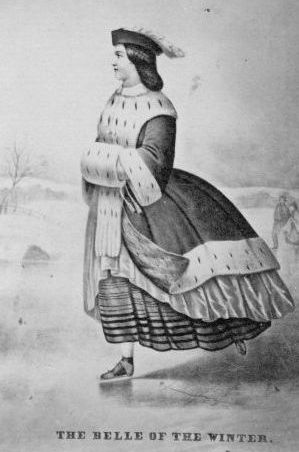

According to Leimomi Oakes, who writes about historical fashion at dreamstress.com, the balmoral petticoat typically had broad stripes at the bottom. Sometimes it was made of a colorful plaid. The petticoat was made to show off, furnishing a flash of color under drawn-up skirts. While full enough to be worn over a hoop, when it was not, it showed off the wearer’s ankles and legs. The full effect could be startlingly bold, as in the cover illustration for the song, “The Gal with the Balmoral” (1861).
Women began wearing these shortened skirts as soon as they began learning to skate. The petticoat was in vogue by 1859, as this print shows.
So, for a brief time in the 1850s and 60s, ice-skating offered a taste of sweet liberation, when women could pin up their skirts and have fun outside.
 Sheet music cover, circa 1868
Images: Courtesy of the Library of Congress.
For further information click here and here.
This is the sixth in an occasional series on ice-skating. Click here to read from the beginning.
Boy-powered ice-sweepers

For the most part, boys who wanted to skate had to clear the ice themselves.
Ice rinks, though not unheard of, were far fewer in number and far less interesting than frozen waterways, whether rivers or ponds; and, for the better part of a century, most American skaters enjoyed their sport in such natural settings.
Here, boys of various ages pose with their shovels while clearing the ice in Washington DC. Half-pose for the camera, I should say, for, while cooperating, still they couldn’t quite stifle their pure excitement and joy, their clowning and jostling frozen forever, along with their readiness to have a good time.
Despite differences in headgear, the skaters’ dress is fairly uniform: their knee-length trousers terminating above long wool stockings and lace-up skates. Most wear jackets rather than long overcoats, and a few wear ties! In the vanguard, an earnest-looking boy wears a serious woolen hat, its folds covering his ears, neck, and chin in a heavy cowl.
The knee-length pants were known as knickers. Their uniform usage in this photograph suggests that it was taken in the nineteen-teens.
Image: from this source
Click image to enlarge.
This is the fifth in an occasional series on ice-skating. Click here to read from the beginning.
Ice skates circa 1850

This pair of American-made ice skates, dating from 1840-1859, is part of the collection of the Costume Institute at the Metropolitan Museum of Art. The ice skaters I’ve been writing about lately would have been wearing skates similar to these.
While these skates were of a style that had been used for centuries, skate design was on the cusp of dramatic change. The 1850s saw many innovations, as ice-skating boomed in popularity. Many different styles of clip-on and strap-on skates were being brought to market, as makers vied to make skates stronger, faster, and more stable. The toe pick and the elongated blade extending beyond the back of the skate, both features of modern figure skates, hadn’t yet been thought of. Stopping or turning in these old skates could be tricky! Note the nail sticking up from the platform of the skate, which embedded itself in the heel of the wearer’s shoe, as a means of making the skate more stable.

Skating ahead of the Curve documents the newfangled skates being made at the time. These skates, dating from 1840-60, have taken a leap forward in material and design. Made mainly of metal, including cast steel, they feature a heel cup and thick leather straps that would have attached firmly to a boot or shoe.

The heel cup is decorated with a skating scene.
For more on 19th-century skates and skating,
see “Ice Skating in the 1860s: A Fashion and a Passion,”
a wonderful article by Betty Hughes.
see “Ice Skating in the 1860s: A Fashion and a Passion,”
a wonderful article by Betty Hughes.
This is the fourth in an occasional series on ice-skating. Click here to read from the beginning.