Who Will Climb to the Top of the GOP Heap?

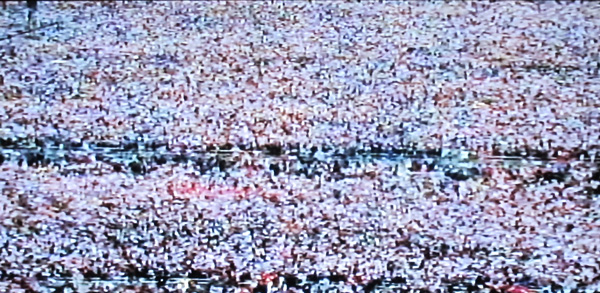
The GOP heap (photomontage), © 2015 Susan Barsy
My take on the declared Republican presidential candidates.  They are listed in reverse order, from least to most likely to rise to the top of the heap.  Those in red I consider to have no chance of winning.

16. Ben Carson  Lacks government experience.  Our nation and its foreign affairs are too complex to hand over to a novice.

15. Carly Fiorina  Her record as a business executive is too mixed to warrant considering her as a candidate for the nation’s chief executive.  She failed to gain the confidence of California voters in a run for the Senate, a proof of her unelectability.

14. George Pataki  Who?  To say that he’s missed his moment is an understatement.

13. Donald Trump  In his previous run, he proved himself a wash-out, using his candidacy to cast groundless aspersions against President Obama’s Americanness.  He’s followed this up with offensive remarks about Mexicans.  Basically a nativist, Trump shows an utter disregard for popular sentiment in putting himself forward again.

12. Ted Cruz  Smart, but too unlikable to be a viable candidate. He believes he needs no one else, a red flag given that our political system is based on interdependency.  Cruz has recklessly pitted himself against others, including wiser members of his own party, revealing a narcissism that’s pretty scary.

11. Mike Huckabee  He washed out in the previous presidential election cycle as soon as he faced primaries in the large urbanized states; what has changed?

10. Rick Santorum  Similarly, this guy has a problem tolerating diversity.  He fizzled out last time and hasn’t scored any big accomplishment to improve voters’ negative perceptions of him.   

9. Chris Christie  An east-coast media darling.  Someone who disavows responsibility for his underlings in the tiny state of New Jersey shouldn’t be put in charge of a vast federal bureaucracy.

8. Scott Walker  He’s far too provincial and inexperienced to be put in charge of America’s foreign affairs.  I’m not sure he could pass a course in geography.  Remember Rick Perry?  Walker is unlikely to fare well with a population that’s far more ethnically and racially diverse than that of Wisconsin.  Charges of corruption have already begun dogging him.

7. Marco Rubio  He’s smart; he’s likeable; but he isn’t ready.  While he’s shown his ability to ‘talk the talk’ with Florida’s diverse voters, I doubt that struggling Americans will find much to identify with in him.  He’s more of a wunderkind, a Latino JFK.

6. Bobby Jindal  Smarter and more nuanced than Scott Walker, Jindal is a talent with significant liabilities.  Though I wrote him off a long time ago after his abysmal 2009 State of the Union Response, he conveys more sophistication and sincerity when speaking off the cuff.  As a man of color, a Southerner (not a Floridian—big difference), and a child of immigrants, he speaks effectively about the need for cultural unity, a major underlying worry that American leaders seldom constructively address.  This guy doesn’t play identity politics—hooray!   He needs to get onto the national stage, but is running for president this time around really the best way?

5. Rick Perry  Like it or not, we have to pay attention to him, because he’s governing one of the largest of the states and by some measures it’s thriving.  He’s still going to have problems persuading anyone that he’s competent to conduct the nation’s foreign affairs, but his no-holds-barred pro-corporate approach to the economy is going to win him a lot of powerful backing.  He’s going to emerge as the leading pro-business anti-regulation candidate (unless he fails to beat those felony charges).

4. Lindsey Graham  An interesting candidate who’s got some name recognition and might be an effective president, given his extensive experience of Washington and the Senate.  He’s got foreign-policy chops, coupled with what pass for socially moderate views, but is probably too much of a hawk to prevail, given that main-street Americans wants to do less overseas.  He might do better than expected if he succeeds in mobilizing the southern and mid-Atlantic base of the GOP outside Florida.  On the other hand, he might suffer from “Senator-speak,” Christopher Dodd’s problem.

3. John Kasich  You haven’t been hearing much about him because he’s been too busy running Ohio.  Besides, this guy will never be much of a media darling.  Of all the truly conservative candidates, however, this one is the most formidable, because he is from a large industrial state, and is the most experienced of all candidates in addressing the nation’s profound economic pain on the front line.  I believe that as many of the less viable conservative candidates drop out, conservative voters will gravitate toward Kasich.

2. Jeb Bush  He will remain near the top because he is the safest choice.  Choosing the “Bush brand’ means getting all the human capital arrayed around the Bushes in their individuality—a factor positively associated with continuity in these changing and uncertain times.  Wigged out by all the unknown qualities of all the other candidates, many moderate and benighted GOP voters will pull the lever for Bush.  The candidate himself has yet to show that he has a ‘fire in his belly,’ making him vulnerable to more ardent rivals, like Rand Paul.

1. Rand Paul  This guy remains formidable because he’s one of the few candidates who could draw in a lot of voters who don’t normally swing Republican and beat Hillary Clinton.  Moreover, with his off-beat combination of libertarian and unorthodox views, Paul is one of the few Republican candidates who could actually catalyze the Republican Party and configure it into something new.   He’s won a lot of respect because of his willingness to assert his convictions without doing so (as Cruz has) at the expense of his party.  His opposition to the growing surveillance state and his occasional willingness to cross the aisle to support positions similar to those of President Obama mark him as a maverick and a game-changer within the GOP.  It would be cool if he could redefine the voting blocks that make up the GOP, something that hasn’t been done since the Reagan Revolution of 1980.

American Beauty: The Inauguration as Medium and Message

President Obama taking the oath of office as his family looks on (Photograph of PBS coverage)

The American Revolution was a revolt against “kingly power,” that, upon succeeding, evolved into a gamble that ordinary people could rule themselves without a monarch.  The republican government the Framers devised nonetheless featured a novel office—that of chief executive—who, being the choice of the populace, would function as the nation’s symbolic head for four years’ time.  Without some such “people’s sovereign,” the Federalists believed, the new government would have trouble securing the affections and loyalty of the citizenry.  The ritual of the inauguration has taken shape around preoccupations like these.

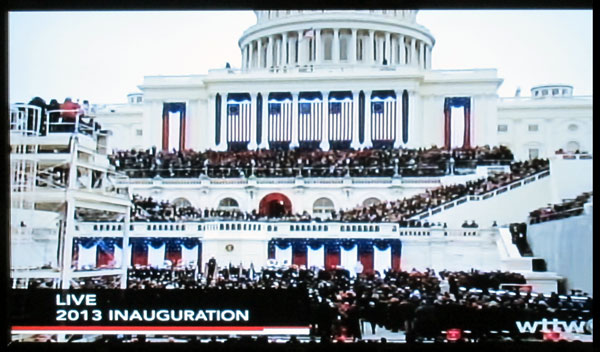
The inaugural was held on the west front of the Capitol (Photograph of PBS coverage)

Relative to the pomp surrounding British monarchical rituals, for instance, American inaugurals are low ceremonies indeed.  Since John Adams’s early disastrous experiments in aping the British monarchy, presidents and their families have avoided ostentatious costumes or trappings offensive to democratic sensibilities.  Officials take the oath of office wearing ordinary street clothes, allowing the “majesty of the people” to take center stage.

The president listening to the inaugural proceedings (Photograph of PBS coverage)

The preference has been strong for an open-air ceremony.  George Washington set the tone in 1789 with his swearing-in on the balcony of Federal Hall (then the seat of Congress) in New York City.  Though harsh weather has sometimes forced inaugurals inside, their location has generally been selected to allow them to be witnessed by largest possible number of people.

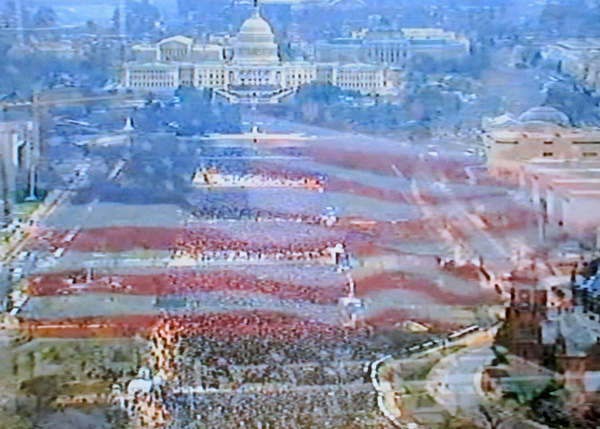
A vast crowd came to the National Mall to take part in the 2013 inauguration (Photograph from PBS television coverage)

Over time, the inaugural has evolved into a full and appropriately expressive ritual, especially through the device of the inauguration poem (a custom begun and carried on mainly by Democratic presidents) and the performance of American song.  In the right hands, the inaugural’s simple components can be coaxed into a whole of considerable beauty and eloquence, as was certainly the case with the inaugural  last Monday.

The ceremony was beautifully orchestrated, planned with an understanding of how its elements could combine.  From invocation to closing prayer, Obama’s second inaugural presented an aesthetic and patriotic vision of the American essence, receiving its purest expression during James Taylor’s simple rendition of ‘America the Beautiful’ on acoustic guitar.  At the same time, several complex political messages were effectively conveyed.

1. Ours is an inclusive, multiracial republic.

The Brooklyn Tabernacle Choir singing the Battle Hymn of the Republic (Photograph of PBS coverage)Visually and verbally, the inaugural moved beyond tokenism to demonstrate the diverse and inclusive character of the US today.  The crowd gathered on the Mall, as well as all those with an official part in the proceedings, showed the fruits of the country’s long struggle to make good on its egalitarian principles and dreams.  The reality of integration and inclusion was embodied in the faces of the military, in the diverse complexion of officialdom, and in all those clergy, singers, poets, musicians, and orators, who were called on to inspire, entertain, instruct, bless, and thrill us that day.

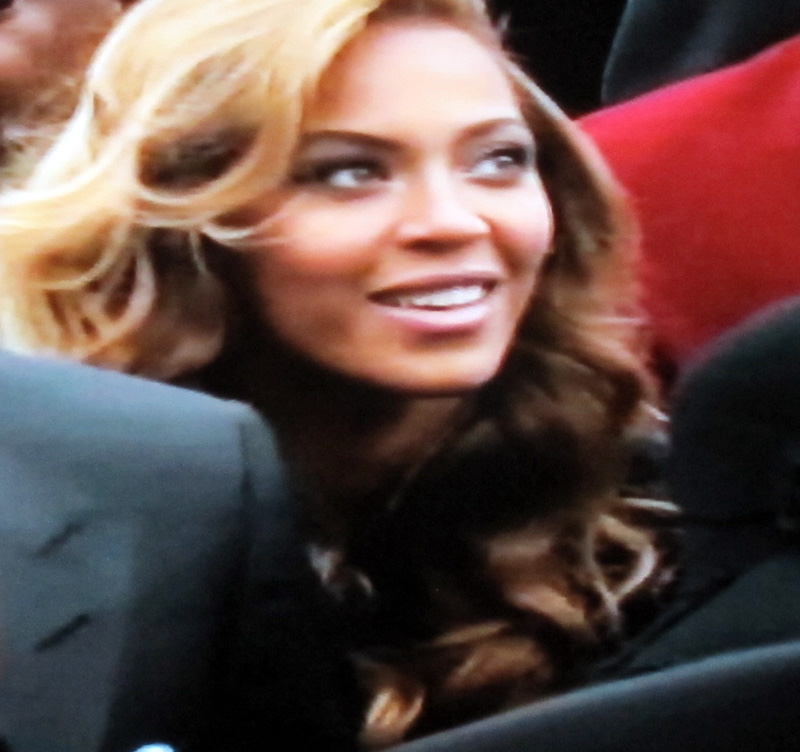
Beyonce leaving the inauguration, where she performed the national anthem (Photograph of PBS coverage)Coinciding with Martin Luther King Day, the inaugural paid homage to the nation’s centuries-long quest for civil equality, encompassing the struggle to end slavery, extend the franchise, welcome the immigrant, and end archaic practices that are discriminatory.  Progress toward these goals, though incomplete and painfully achieved, is evident, and our maturity as a pluralistic country was joyfully ratified on Inauguration Day.

2. Religion is central to American civic life, but not in the way Christian conservatives imagine.

Religious sentiment (of a peculiarly American kind) suffused the inaugural proceedings.  Its historic role in inspiring Americans to preserve and strengthen the Union and to persevere in the face of injustice was humbly acknowledged.  In the ceremony, religion figured as a fountain that Americans must continue to draw on as they seek to discern the right and the true.

Myrlie Evers-Williams somber invocation and Reverend Luis Leon’s benediction extolled the blessings of religion as a unifying and transcendent force, binding together and uplifting the American people.  Driving the point home, the multiracial Brooklyn Tabernacle Choir wowed the crowd with its rendition of the ‘Battle Hymn of the Republic,’ a Civil War-era song about militant righteousness and Union, written by northern white abolitionist Julia Ward Howe.

Was the inaugural satisfying in part because it sketched the spiritual and patriotic dimensions of the Obamas’ own deep personal faith, a faith that opponents have often assailed, belittled, and misrepresented for the sake of political gain?  At the same time, the intense but inclusive spirit of the inaugural seemed a rebuke to the more narrow and divisive Christianity that social conservatives espouse.

3. The condition of the people is the President’s main concern.  Maximize their security, happiness, and well-being, and national  prosperity will follow.

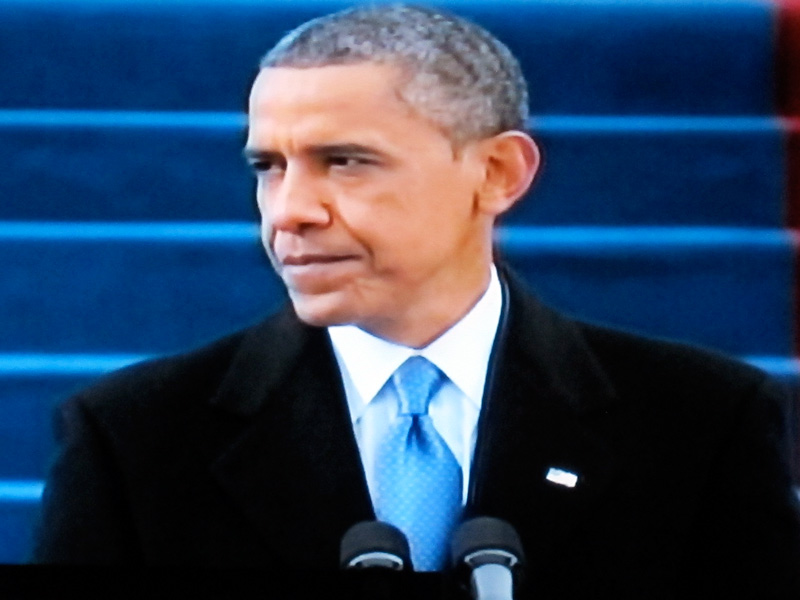
President Obama delivering his inaugural address (Photograph from PBS coverage)Jeffersonian thought has been so marginalized in political discourse that commentators hardly recognize its essence today.  President Obama’s repeated use of phrases and ideas from the Declaration of Independence in his speech signaled his interest in governing in a Jeffersonian vein.  It’s an interesting idea, but what does it mean?  For Jefferson, it meant providing a framework for the individual so that the the individual could flourish.  Jefferson was not anti-government—he was the architect of many enduring and expansive national projects—but he believed chiefly in that government necessary to protect and promote a prosperous and self-realizing citizenry.  When it came to big projects, Jefferson was all about innovation and efficiency.

4. The relationships born of our civic life enjoy a priority over those of corporations or the economy.

The Capitol as seen from the Washington Monument on January 21, 2013 (Photograph of PBS coverage)

Throughout his career, President Obama has sought to reinvigorate the potent role of citizens in political life.  David Brooks, though admiring the inaugural address, regretted the president had not devoted more of it to the budget, the markets, the economy, or free enterprise.  We’ve grown accustomed to thinking that government must be mainly about these.  But are these truly the chief interests of a republican government?  Are these the interests that need protecting?  American business will continue to find a way, whether the Obama administration puts its might behind that project, or not.  The president believes that investment in human capital is the chief requisite to making the economy thrive.  As if to underscore the point, inaugural poet Richard Blanco offered a lyrical, Whitmanesque view of American work in his spare yet impressive poem, One Today.

5. We are all citizens, and, as citizens, must fulfill certain transcendent obligations consonant with the great power reposed in us.

 The best part of the president’s speech was its conclusion.  Pointing to oath-taking as a unifying ritual, the President likened his oath to others we have taken, whether as schoolchildren, government officials, new citizens, or members of the military.  The promises we make to our country bind us together in a way that transcends the claims of self-interest and party.  The president closed with an appeal to each of us to continue to make our voices heard.

The president looks back on the Inaugural crowd (Photograph of PBS coverage)

Obamacratic Gossip

Michelle Obama during Monday's Inaugural Ceremony (Image taken from PBS Newshour coverage)

I heard it first from the security guard in my office building.  We were chatting about the inauguration, when he grew animated.  “What’s going to happen after this?” he abruptly asked me.  “The Democrats don’t have anyone to come after Obama.  They only have one person.  You know who it is?”  It astonished me to realize he meant the First Lady.

“If that happens, I’ll tell everyone I heard it here first,” I replied, taking his words as a measure of the fervid loyalty the First Family enjoys in some camps.  Whether Mrs. Obama, who has never held public office and was a reluctant first lady, would ever contemplate a presidential run seems doubtful to me.  She’s an entirely different sort than Hillary Clinton, who, since her school days, has been a political animal through and through.

Imagine my astonishment, then, when I ran across this image on a heavily visited website (The Obamacrat) that assumed the same thing: that a Michelle Obama candidacy would be viable in 2016.  If nothing else, this incipient “draft MO” movement suggests how ready citizens of perhaps any nation are to place their trust in established political families, fueling a dynastic element that has been an unmistakeable and constant feature of American politics, as evident during the Federalist era as it is today.

Photograph of Mrs Obama
made from PBS Newshour coverage of Monday’s presidential inauguration.

RELATED:
What will Michelle Obama do with four more years? Yahoo.com

A President Ventures Abroad

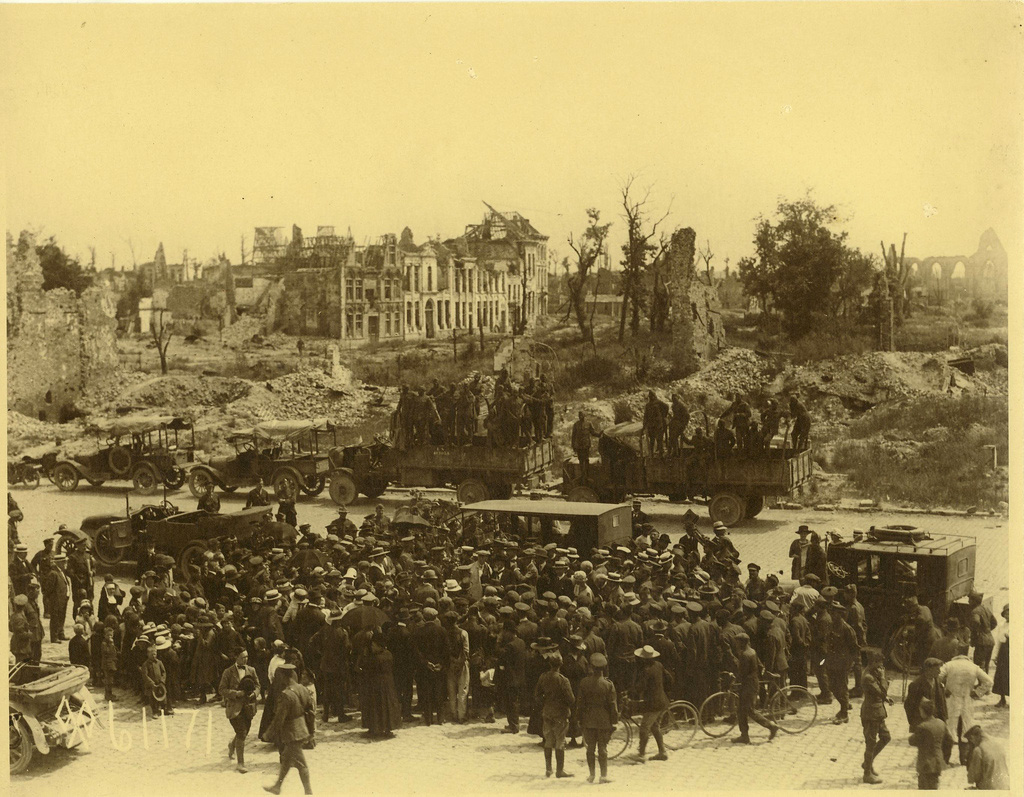
President Wilson and the King and Queen of Belgium at Ypres, 1919 (Courtesy: Woodrow Wilson Presidential Library via the Commons on Flickr)

Given the international status of the United States today, the home-bound nature of the presidency during the first century-plus of the nation’s existence is hard to imagine.  The first president to venture beyond the western hemisphere was Woodrow Wilson, who in 1919 traveled to Europe at the conclusion of the First World War to participate in the negotiations that produced the Treaty of Versailles.

During his trip, Wilson and his entourage visited Belgium, touring Ypres and other areas that had been devastated by the fighting.  An anonymous photographer attached to the US Signal Corps documented the president’s tour of the war-torn landscape.  The resulting deep-focus sepia prints preserve the occasion on which Wilson first saw something of late war in which he and the rest of the nation had been engaged.

Image: from this source.
Click image to enlarge.

Once Noble Senate

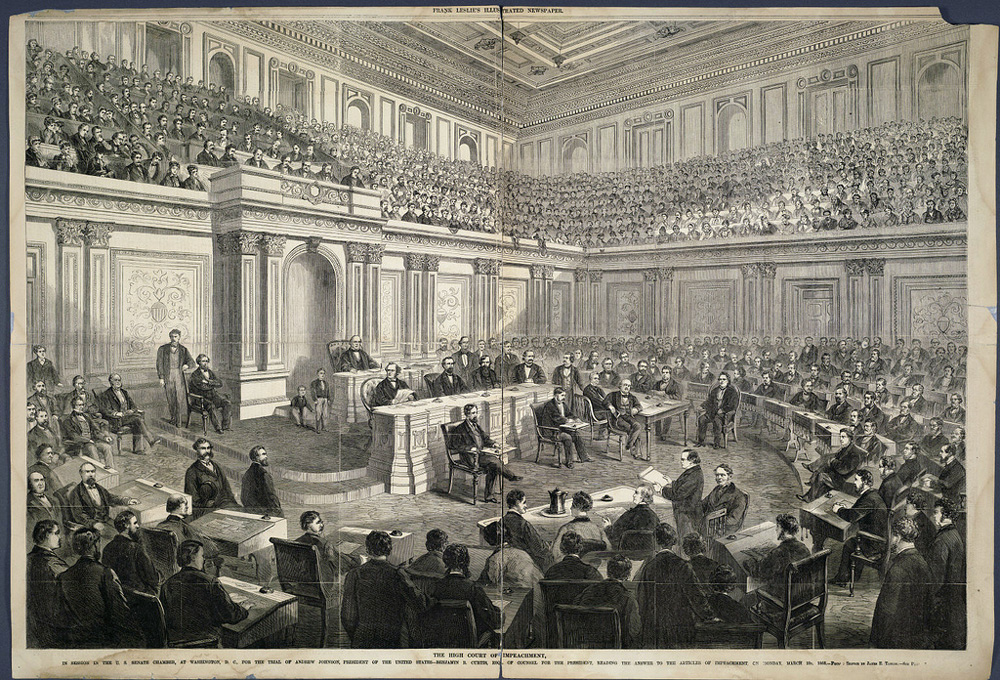
The US senate chamber in 1868 (Courtesy of Cornell University Library via the Commons on Flickr)

I don’t know that what I write here makes me a pundit, but in the wake of the election I have been hit with a strong urge to refrain from punditry—to take a break from it, at least, and let government be.

One of the evils of an excessively long campaign season is that we all develop the habit of opinionating and editorializing.  Our partisan passions, aroused for such a long period, require an effort to quiet, and we forget that there is something larger than the fate of the parties or particular people, namely our collective fate as a nation and economy.  That hangs in the balance now.

The media, even more than our political leaders, bear responsibility for having created a public culture that prizes the work of governing less than politicking.  Competent governing is not praised and celebrated; it is not longed for; it is not revered or nurtured.  No, it is regarded skeptically—poked at and doubted.  Dubious motives are assigned; obstacles exaggerated; worst-case scenarios dreamt up and embroidered.

Would the nation would better or worse off for having a moratorium on loose talk, during which all cable networks, talk shows, and editorial rooms would go dark for a few days?  The talking heads, eager for their fees and salaries, who incessantly press their stale points of view on the rest of us are one of the biggest impediments to redirection and innovation.  They are themselves one of the biggest drags on bipartisanship and governmental resolve.

The hullabaloo surrounding the “fiscal cliff” reminds me that the Senate, in its earliest days, used to meet in private.  That’s right.  From 1789 to 1794, the first senators met privately in chambers in New York and later Philadelphia (Washington DC didn’t exist then) to fulfill their Constitutional duties as they understood them, admitting no spectators, seeking no publicity.  They simply did their work and went away.

This was a perfectly legitimate style of proceeding.  After all, they had been entrusted with large public responsibilities and they knew the nation depended on their behaving in an honorable way.

The senators soon abandoned the custom of meeting in private, however, because they thought that, unless the public could look in on the Senate and begin to understand what it was all about, the body would never develop the authority and prestige that the Founders wanted and expected it to enjoy.   The early Senate was in danger of being eclipsed in importance by the House, which then, as now, was a more unruly and irresponsible body.

The Senate, intended to be the ultimate forum for resolving the nation’s most complex problems, evolved into a highly prestigious and effective body during the long period from the early 1800s until 1986, when the Senate approved live televised coverage of its proceedings.  The reservations that had made senior senators reluctant to embrace such a change were fully vindicated, for the reorientation of the Senate toward this vicarious presence has destroyed the close-knit mutuality that characterized the body, and which rewarded the difficult work of its members with commensurate prestige.

The nation’s chief executive, once the factotum of his party in Congress, has become inflated in importance proportionately.  Today, we look to the president for all things—even for the wisdom that our Founders knew could only be found collectively, in the best minds of the Senate, in its palmiest days.

Image from this source.