The Incredible Shrinking GOP

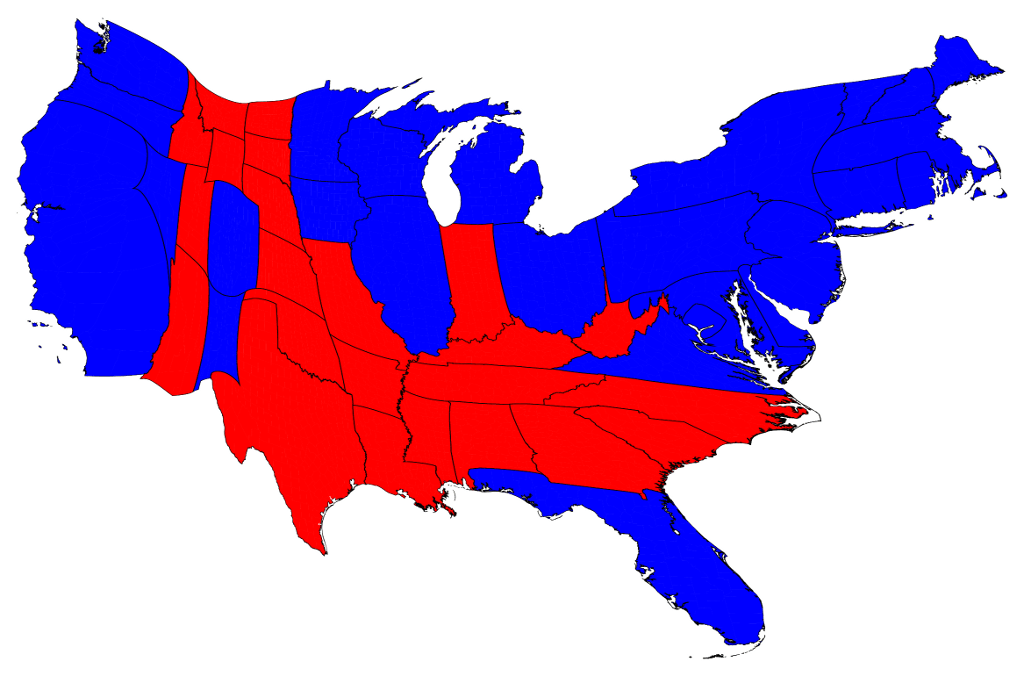
Cartagram by Mark Newman showing the relative strength of the Democratic and Republican vote.

The results of Tuesday’s election, in which Republicans failed of their two principal goals, and indeed lost ground even in the House, indicate that the GOP is in danger of becoming a minority party.

The cartogram above, one of a series of maps created by Mark Newman of the University of Michigan to show the real strength and distribution of the popular vote, depicts the limits of the GOP’s popular appeal.

While the Republican party continues to command the allegiance of bands of Americans in southern and land-locked western states, these states are not particularly populous.  In the more heavily populated and cosmopolitan areas of the United States, the Democratic Party under Barack Obama is consolidating its hold.

Voting strength of Democrats and Republicans by county, with purple showing county-level mix

Moreover, many of the counties that the Republicans managed to win Tuesday are actually divided and could readily swing back the other way.  In the county-level map above, only the streaks that are pure red and reddish can be regarded as Republican strongholds.

The Republicans in denial

Interestingly, the Republican leadership seems incapable of grasping the fact that its positions and values are increasingly out of step with those of the nation.  John Dickerson of Slate, appearing on Washington Week on Friday, described the Romney-Ryan campaign’s illusory anticipation of victory: it simply couldn’t imagine there being enough Americans to support the President, though numerous polls had shown that support for him was holding and building.  A contempt for the whole of the electorate, and an inability to embrace its diversity, spelled doom for Republicans in the 2012 campaign.

Look for Republicans to continue to grasp at procedural, legal, monetized, and PR-based tactics to sustain the illusion that they remain a formidable party.  In fact, unless the Republican Party dramatically transforms itself, renounces extremism, and embraces diversity and moderation, its showing will be even weaker next time.

Click here to view all of Mark Newman’s maps and learn more about what they mean.

MORE ON MY TAKE ON THE GOP:
What If They Can’t Take the Capital? September 2012.
A Great White Nation of Self-Made Men, September 2012.
Moment of Truth for the GOP’s Conservative Wing, August 2012.
Should Leaders Who Can’t Govern Their Party Govern the Country? June 2012.
Is the Republican Party Dying? March 2012.
2008: The Critical Election That Wasn’t (Part II), January 2012.
Parties Made New: Our Critical Elections February 2012.
The Good News? A Dollar Can’t Vote

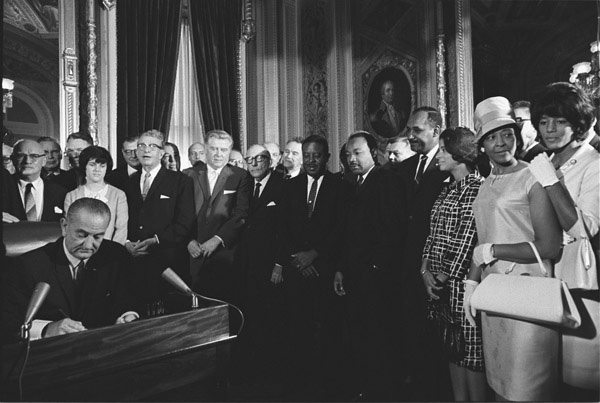
LBJ signing the 1965 Voting Rights Act as Martin Luther King Jr and others look on (Courtesy of the Library of Congress via the Commons on Flickr)

As Election Day dawns, final tallies of money spent on the 2012 campaign are appearing.  In a country where a dollar is sometimes taken as a measure of all things, it’s worth remembering that these billions have been expended in the hope of bending the great will that collectively lies with the American people.

That’s right, fellow citizens: at the end of the campaign, it all comes down to you.  The special interests, the media, the national parties, the consultants: in the end they’re all equally powerless.  It’s up to you to get out and vote today.  Ignore the cynics: your action—no matter where you live—is an expression of power that remains awesome and singular.  No matter who has the money or how it’s spent, the voter’s mind and heart are where power lives.

So get out and exercise your power today: vote for the best men and women, and may the best of them win!

Image: Lyndon Johnson signing the 1965 Voting Rights Act as Martin Luther King Jr. and others look on, from this source.

Election Scenarios; The Spotlight on Silver

Interactive electoral graphic (Screen grab from the NYT; click to visit NYT)

With Election Day 2012 finally in sight, national attention is riveted on the possible electoral outcomes of the presidential vote.  A useful interactive on the New York Times website makes it easier to envision the implications of losses and victories in various swing states.  Click on the image to go to the site, then use the “next” button to take advantage of its interactive features.

*     *     *

Voters pinning their hopes on Mitt Romney’s purported momentum may find that a visit to Nate Silver‘s blog, FiveThirtyEight, puts them in a sour mood.  Silver, a youngish statistician whose 2008 predictions were highly accurate, has consistently assigned President Obama favorable odds of victory.  Even as isolated polls show his challenger pulling even with Obama in several key states, the margin by which Silver’s quantitative model favors Obama has been increasing.  (Silver assigned Obama a 77% chance of winning with 299 electoral votes, as of my site visit earlier in the day.)

Not surprisingly, Silver has come under attack from the right and finds himself the center of eleventh-hour controversy.  The key charges, defenses, and countercharges are contained in the various links below.  The weirdest charge is that of Dean Chambers, who insinuates that Silver is too effeminate to be a competent predictor of the presidential odds.  Also discernible is an anti-intellectual discomfort with hard numbers.

Dylan Byers, Nate Silver: One-Term Celebrity?, Politico.
Brett LoGlurato, People are flipping out over Politico’s attack on Nate Silver, Business Insider.
Ezra Klein, The Nate Silver Backlash, The Washington Post.
Robert Schlesinger, Mitt Romney’s Electoral Problem and the War on Nate SilverUS News and World Report.
Charles P Pierce, The Enemies of Nate Silver, Esquire.

Excitement Is General

Crowds gathered for the presidential inauguration, 1921 (Courtesy of the Library of Congress)

Excitement is general as we head into the final weeks of the long campaign.  With the presidential race in a dead heat, it’s anyone’s guess who the victor will be.  The candidates receive ever closer scrutiny, waves of analysis rolling in over airwaves and Internet incessantly.  Stalwarts gear up for the final push.

The uncertainty of the race is drawing huge audiences to the presidential debates.  Last night’s debate between President Obama and challenger Mitt Romney is estimated to have drawn some 65 million viewers.  According to Bloomberg, the viewership for the debates has been roughly double what it was for the nominating conventions this summer.

The spontaneity of the response to the debates is unprecedented, too.  Last night during the debate, Twitter recorded over 7 million new tweets, with more than 109,000 recorded during a single minute when the candidates were discussing immigration.  Romney’s peculiar remark about ‘binders full of women’ prompted an immediate outpouring and a new hashtag.  Within minutes, satirical takes on his remarks were available for view on this Tumblr page.

Every age has its own political customs.  The ones we’re using today are making history, too.

Image: Crowds gathered for the presidential inauguration in 1921, from this source.
Click image to enlarge.

Presidential Selection

Washington Death Mask

Halloween is just around the corner, when, by tradition, all souls departed return to their earthly haunts for a night.

Were the spirits of our Founding Fathers to be among them, I wager that no change in our political system would astonish them more than the monstrous process we rely on to fill the presidency.

Certainly, the bitter and protracted process we have today bears little resemblance to the simple one that twice elevated our first executive, George Washington, to the post.  Washington, whose spotless reputation helped reassure Americans that the novel office of a civilian executive could be filled responsibly, was the near-unanimous choice of the small group of electors, appointed by the state legislatures, who gathered to settle the issue in 1789 and again in 1792.  He did not campaign for the office, and no promises were made.

Washington, as famous for his ardent federalism as for his total abhorrence of political parties, would be horrified at the prevailing partisan strife and competition.  He would find appalling the careerism that prompts unfit and unlikely candidates to vie for eminence.  He would be chagrined to learn that our national energies, which should be devoted to the arduous work of governing, are instead being diverted into a vitiating quest for party supremacy, which dominates a greater part of the calendar with each election cycle.

Above all, Washington would revile the self-aggrandizing impulse that, as it continues unchecked, erodes the vitality of a great government whose genius rests on interdependency.

Image: Life mask of George Washington, from this source.