What If They Can’t Take The Capital?

H. H. Green, "Bird's Eye View of Washington, DC," 1916 (Courtesy of the Library of Congress)

We may not have reached the turning point in the 2012 campaign, but Mitt Romney‘s impolitic behavior has got me thinking about what it might mean for the Republican Party if it fails to take the presidency this time around.

The party wars raging these days are much like real wars in which a few goals are recognized as being of overwhelming importance.  In military conflict, taking or holding a capital is often paramount to victory. The force that fights to take a capital but never succeeds condemns itself to a war without end.  It never gains sway.

The outlook for the GOP

Despite the Republicans’ emphasis on unity, theirs is a badly divided party, composed of two parts, ideologically riven, and in real danger of breaking apart.  Throughout the campaign, moderates within the party have been hoping that its two wings can be welded together sufficiently to secure a presidential victory.  Should the Republican party fail of this goal, it will have difficulty convincing us that it remains a dominant political force.

The Republican Party still has vast resources and an impressive organization; it has some intelligent personnel and many, many backers and devotees.  Despite all this, it could go into decline, if the presidential contest suggests that it is no longer organized around ideas and policies that have national appeal, that can command the assent of a voting majority.

A party shy of the presidency

Is winning the presidency all that important to the life of a party?  It is when the party has been struggling for several presidential election cycles to demonstrate that its candidates truly represent the will of the people.  Historically, when a party cannot win the White House, that party fades.  It happened with the Federalist party to which the Founders belonged.  It happened to the Whig Party in the 1850s.  It happens when a perfectly good party lack leaders capable of reshaping the party’s ideology for changing times.

A party that cannot win the presidency risks the loss of its adherents and its leadership, too.  Without the presidency, a party cannot initiate and bring legislation to fruition without cooperation from the other side.  The Republican Party has set itself in opposition to the Democratic Party.  Instead of building the goodwill that has historically proved the salvation of a minority party, it has shown open and increasing enmity toward the other side.

Emphasis on controlling the electoral process

Anxiety pervades the Republican Party, which since the year 2000 has concentrated more and more, not on recasting itself ideologically, but on controlling the electoral process in hope of achieving a favorable return.  Ever since George W. Bush’s contested win that year, which came down to interpreting a bunch of chads clinging to physical ballots in Florida, the Republicans have become obsessed with state-level control of the election rolls.

G. W. Bush’s re-election in 2004 occurred amid controversies over voter suppression in states like Ohio, where Republicans had succeeded in removing voters from the rolls through aggressive challenges.  In the current election cycle, we have seen concerted efforts in several Republican-controlled states to tighten up voting requirements and to make it more difficult for certain classes of voters to gain representation or vote early.

Only respect for the electorate can save the GOP

It’s a shame, because intelligent leadership and constructive ideas are what the GOP needs.  In the end, only better ideas and a genuine respect of the electorate can save the Republican Party from the minority status that threatens it now.

Image: H. H. Green, “Bird’s eye view of Washington, DC” (1916), from this source.
Other wonderful old maps and views of the nation’s capital are here.

RELATED ARTICLES:
Voter Harassment, Circa 2012, New York Times.
Is the Republican Party Dying?, Our Polity.
A Great White Nation of Self-Made Men, Our Polity.
Democrats: Shake It Up, Our Polity.
2008: The Critical Election That Wasn’t (Part II), Our Polity.
A Prisoner of the Bully Pulpit Breaks Free

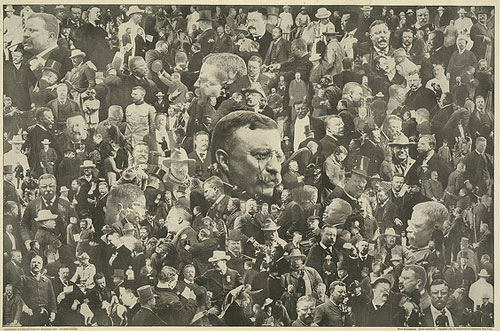
Photomontage of Theodore Roosevelt (Courtesy of Cornell University Library via Flickr Commons)

♦ A HISTORICAL ANALYSIS OF PRESIDENT OBAMA’S ACCEPTANCE SPEECH ♦

Theodore Roosevelt, though a fine president in many ways, left behind one baleful legacy: the idea of the presidency as a ‘bully pulpit,’ by which he meant a superb vantage from which to preach to others about how the nation should be.  When you hear presidential candidates speaking confidently of the miraculous feats that will follow from their being elected, it’s the misleading cadences of a bully-pulpit preacher you’re hearing.

THEODORE ROOSEVELT RESHAPES THE PRESIDENCY

To an extent difficult for us to appreciate today, Roosevelt’s conception of the president as an active visionary was revolutionary, departing in significant ways from the executive role the Constitution laid out.  Our scheme of government assigns the president a few plain duties, which, given the size and scope of the government and its role in the world, constitute a staggering burden.  In addition to serving as the symbolic and ceremonial head of the nation, the president executes the laws, conducts foreign policy, commands the armed forces.  Presidents often function as party leaders, but their constitutional function is essentially one of interdependence, for a president cannot make a law, placing every president in that regard very much at the mercy of Congress.

THE CHANCE TO BECOME A SCINTILLATING STAR

During the first century of the nation’s life, presidents grappled with this limitation in various ways, but Teddy was the first to dare to act as though it didn’t exist.  He was determined to make the president the determining force in all things.  Like Satan—the most powerful angel in Milton’s celestial firmament—, he chafed at playing second fiddle; he longed to be God.  Suiting actions to words, Roosevelt broke the mold, becoming a media-oriented president intent on using his considerable intellect and celebrity to reshape the nation and govern Congress.  Initiative pulsated from the White House.  It was all very thrilling.  Moreover, it kept Roosevelt constantly in the spotlight, which was something he liked.

WHICH BULLY PULPIT PREACHERS PLEASE US MORE

Since then, Roosevelt’s conception of the presidency has become our conception, too.  In what is a sad distortion of the Founders’ vision, we expect the president—a single person—to do the work that Congress should be doing.  This, in turn, leads to a confusion about where responsibility lies.  The American people spend more and more time agonizing over presidential choice, more and more time trying to decide which campaign promises and bold visions please them more.

A PRESIDENT IN THE ROOSEVELTIAN VEIN

It was clear from the start that Barack Obama sought to be an activist president in the Rooseveltian vein.  His entire campaign the first time around was based on the premise that he could “change Washington,” reorganize the business of politics, and define a new political epoch singlehandedly.  For much of his first term, he seemed at odds with the presidential role, chafing at its limitations and behaving as though his ability to extract specific laws from Congress was the sole yardstick later generations would measure him by.

Influencing Congress became his preoccupation.  Whether the issue was health care or the debt ceiling, President Obama spent much of his first term lecturing Congress and the public—chiding and exhorting the nation to embrace his vision for us.  His love of showing his mettle prompted him to become over-involved in fruitless wrangles whose results were properly the responsibility of a weak and recalcitrant Congress.  The “victories” so gained were costly indeed: witness a health-care bill ahead of its time that, regardless of its merits, heightened partisan rancor and left much of the nation resentful and unpersuaded.

THE BULLY PULPIT’S NOT ALL IT’S CRACKED UP TO BE

As recently as January, the president’s bully-pulpit predilections were on full display, when he chose to use the State of the Union address to tell Congress its business rather than report candidly on governmental progress.  Yet, between then and now, Obama has seen the light about an activist presidency, about what a dead-end it is, how it takes a certain set of conditions to achieve.  In the meantime, he has racked up a steady tally of gains, showing himself to be very able in directing foreign affairs and the military.  And he retains the support of a large part of the electorate, who value his honesty and intelligence and see him as persistent, prudent, and humane.

FOUR YEARS OUT

Which brings us to the president’s recent acceptance speech.  Some listeners were disappointed; others found the speech a bit desperate or weak.  We all noticed a difference.  The bully-pulpit fervor we’ve grown so accustomed to was missing.

Instead, the President re-articulated his fundamental role as ‘the people’s sovereign’—the keeper of the people’s interest, uniquely entrusted to embody and articulate their general sentiments and needs.  This emphasis on the president’s traditional role as the national symbol of the people’s rule enabled the President to remind his listeners of their primary role as citizens, in a system in which his power is ‘from the people.’

A JUSTER RECOGNITION OF PRESIDENTIAL DUTY

Lacking the glitz and razzmatazz of his earlier speeches, the president’s speech that night was pitched in a lower key.  Its high points were not remarkable for policy specifics, but for their embrace of a more constitutionally sound notion of the presidency, one focused on executing the will of the people and the astute exercise of presidential duty.  The speech’s most important moment came when Obama said, “I’m not a just candidate for the presidency.  I am the president,” a simple declaration that eloquently accounted for his changed tone.

For a sitting president who a year ago styled himself an underdog, this embrace of experience and authority marked a great leap toward political maturity.  Scaling back the high-flown rhetoric and grand visions of which he has been so fond, the president has raised his ambitions in another way: making a bid for greatness by renouncing a view of office that offers self-gratification now.

Regardless of the continuing deep divisions in Congress, the nation can repose confidence in the seasoned president we have now.  All in all, it was a moment I rejoiced to see: a prisoner of the bully pulpit breaking free.

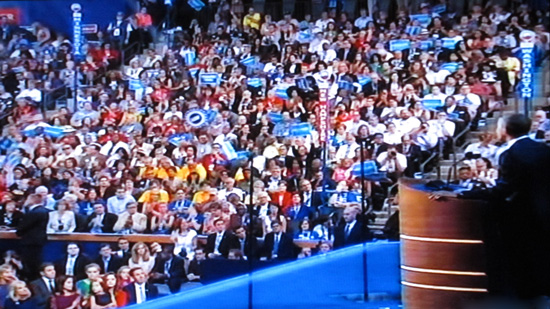
President Obama delivering his acceptance speech before the Democratic National Convention, Sept 6, 2012 (Screen shot courtesy of WTTW Channel 11 Chicago)

Top image: “Five hundred different views of Theodore Roosevelt,” from this source.
Bottom image: Screen capture of PBS Newshour coverage of the Democratic National Convention.

‘Deep Throat’: What Secret?

Official seal of the US Federal Bureau of Investigation (Courtesy Wikimedia Commons)

Enemies, Tim Weiner’s new book on the FBI, contains at least one fascinating revelation.  While the most of America had to wait some 30 years to learn the identity of ‘Deep Throat,’ the mysterious informant whose leaks to reporters Carl Bernstein and Bob Woodward helped topple Nixon in the Watergate scandal, Nixon knew of his identity within just ten days.

‘Deep Throat’ was Mark Felt, the number 2 man at the FBI.  It turns out that he and others within the Bureau were disaffected because Nixon passed over Felt for the directorship of the FBI after J Edgar Hoover‘s sudden death of a heart attack in 1972.  Felt had been Hoover’s chosen successor.  Nixon instead chose L. Patrick Gray, a man with no intelligence experience.

Nixon’s selection of a man some regarded as a clueless hack may have been deliberate; small wonder, then, that Felt’s loyalists were enraged.  They felt the selection demeaned the Bureau.  Thus, a disgruntled faction loyal to Felt became inordinately interested in the doings of Richard Nixon and formed a determination to bring him down.  Far from wanting to serve the president, they began to regard him as a ‘person of interest.’

This configuration of forces resulted in a comical double game.  As Russell Baker, reviewing Weiner’s book for the New York Review, put it:

While Felt was leaking to the press about the president’s Watergate involvement, someone else, perhaps another FBI agent, was leaking to the White House about Felt’s leaking to the press.  Such was life in the world of top secrecy.

Knowing who was responsible for the leaks didn’t help Nixon much. Again Baker:

Why didn’t Nixon fire Felt immediately?  The answer is preserved in the Nixon White House tapes, with Bob Haldeman, Nixon’s chief of staff, saying, “If we move on him, then he’ll go out and unload everything.  He knows everything that’s to be known in the FBI. . . . He has access to absolutely everything. . . . Gray’s scared to death.  We’ve got to give him warning. . . .”

Then Nixon: “What would you do with Felt? . . . Christ!  You know what I’d do with him?  Bastard!”

Judging from Baker’s review, Weiner’s book is a meaty read, casting light on the workings of an agency whose role in our history has been shadowy indeed.

Be Our President, Please

Forget the polls: I woke up yesterday with the cold hard conviction that Obama will lose the presidency.  It was a moment when wishes dropped away, exposing a bleak vista shaped by the President’s own choices and style of proceeding.

If only he thought of his office differently, Obama would be far more popular than he is, and his reelection would be a certainty.  From the start, he has styled himself as an activist president rather than an executive duty-bound to stand as a symbol of the whole country and its legislatively expressed will.  His would not be a role secondary to the other leaders of his party.  No, from the outset Obama has positioned himself as one who, separate from all others, would push to redirect established institutions of power.  From the vantage of the White House, he would elevate the nation to a state that had previously eluded the whole governing community and other members of his party.

This vision has given free rein to the narcissism and paternalism that are aspects of Obama’s personality.  After a point, it doesn’t matter whether the president has a good heart or an intelligent grasp of policy: what matters is that, in his zeal to do more and be better than others, he is subverting the collaboration and interdependence on which the government is premised.

When Obama was first running in 2008, I was reluctant to believe Chicago friends who told me that he was famous for throwing fellow-Democrats under the bus.   Four years later, after watching Obama tirelessly lecture and upstage everyone else in his party, I’m ready to believe.  The latest instance was on Friday, when the president couldn’t wait to strike out in a new direction on immigration policy—a complex and divisive issue whose resolution warrants the whole voice and weight of Congressional authority.

Sadly, in arrogating to himself matters more appropriately left to Congress, Obama has foregone the chance to be a different kind of executive—one who embodies the authority of the government and symbolically represents the people as a whole.  By aiming to do less, Obama could do more to uplift and unite a beleaguered country.

RELATED:
Political Affections

Political Affections

Robert Cruikshank watercolor of crowds attending Andrew Jackson's inaugural reception in 1829 (Courtesy of the Library of Congress).

Amid the strife wracking US politics, a soul can grow weary.  Why do we care?  Why do we bother—why not lay down the burden of republican citizenship and turn away?

In our hearts, most of us have a vision of a more just, peaceful, and prosperous nation.  With concerted effort and good will, we can attain a condition better than what we’ve experienced lately.  I suppose I became a historian and took the unlikely step of writing about politics because I want to make citizenship a large, evident part of my identity.  Whatever else I do, being a citizen is something that I want to achieve.

Patriotism is out of fashion with the sophisticated.  We think about “going into politics” as a sort of careerism; and, if we don’t do that, it’s pretty much understood that we are on the sidelines.  It would be difficult for us to make sense of the 19th-century statesman who, on his death, was eulogized as a “pure patriot. . . whose brain and heart and means and energies were all at the service of his country.” We can understand the part about the brain and the heart—but to commit all one’s means and energies to the country?  That’s alien.

Yet the many-sided commitment of self to public life was once a commonly held American ideal, which individuals pursued in the hope of gaining a special kind of honor and esteem.  Conversely, the wholehearted identification of one’s personal destiny with that of the nation was a crucial element on which the future of the republic was thought to depend.

Queen Elizabeth’s Diamond Jubilee last week stirred up many warm feelings, underscoring the important role of human affection in maintaining a government and a country.  Having a queen may seem useless from a functional standpoint, but symbolically Elizabeth represents the nation in her person.  To love Elizabeth is to love Britain, which isn’t too hard, especially when she is looking so darned benign and motherly.

Photograph of Queen Elizabeth II wearing a hat adorned with flowers

Yet the sentiment the Queen evokes isn’t particularly cozy.  Often she evokes awe, especially when projecting loftiness, magnificence, or a tireless duty.  All the qualities associated with the Queen serve to bridge a gulf that might otherwise exist between her subjects and that abstraction that is their nation.  It’s precisely because Elizabeth is a person—rather than a building, say, or a flag—that she can embody so many varying qualities that, taken all together, help maintain something distinctive in Brits’ feeling for their country.

In the words of the 19th-century Englishman Walter Bagehot, the queen “excites and preserves the reverence of the population,” thereby helping to bind their sentiments to the state.

Besides her gobs of jewels, her surreally one-of-a-kind existence, and her heavily photographed family, what I like most about the queen is the way she styled herself as a sort of sacrificial über-citizen, beginning on the very first day of her reign.  On the evening of her Coronation in 1952, the young queen made this declaration to the people of her country.

I have in sincerity pledged myself to your service, as so many of you are pledged to mine. Throughout all my life and with all my heart I shall strive to be worthy of your trust.

Thus began sixty fairly unsensational years of color-coordinated dressing and the performance of millions upon millions of prescribed and customary royal duties.  At the end of the day, it’s hard not to admire Elizabeth’s dogged commitment to all the formalities and tedious conventionalities that are part and parcel of her country’s monarchical tradition.

When it came time to draw up our own Constitution in the 1780s, the Revolutionary generation was conscious that, in rejecting monarchical government, they had given up something that, in good times, helped secure citizens’ attachment and loyalty.  What, in a republic, could substitute for monarchy’s appealing glitter, pomp, and ceremony?  What could the framers devise to cultivate the people’s respect and embody the fledgling nation’s character and authority?

Ironically, the answer they came up with is the presidency.  The framers hoped that the occupant of this new-fangled office would function as “the people’s sovereign.”  Federalists like John Adams hoped that the style presidents adopted would be sufficiently “splendid and majestic” to instill a sense of the dignity and authority of the nation in the public mind.  In addition, members of the federal government took care to develop a set of forms and customs for capital life that might earn the republic respect, both at home and abroad.

Still, it would be hard to claim that the Founders solved the problem satisfactorily.  In the years before the Civil War, observers recognized that the federal government exercised only a weak, secondary claim on many Americans’ loyalties—secondary to their homes and to the states where they were raised.

As we contemplate the narcissism and partisanship permeating the competition for the presidency, we may be justified in doubting whether the work of securing the affection and loyalty of the people remains a priority today.

Image: Robert Cruikshank’s watercolor,
“President’s Levee, or all Creation going to the White House”
(published 1841), from this source.