The Closed-Door Campaign

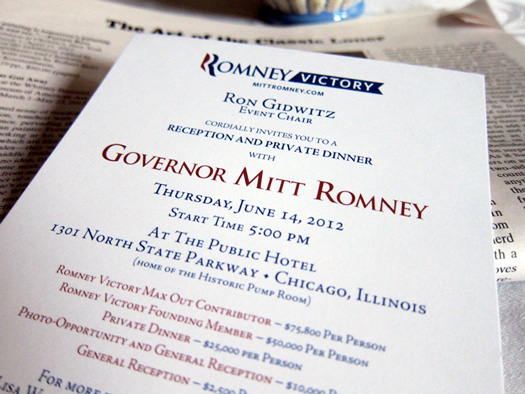
Photograph of an invitation to a Romney fund-raising event (Credit: Susan Barsy)

A piece of high-end junk mail appeared in my P.O. box the other day.  An invitation to an upcoming Romney fundraiser, it is a perfect souvenir of this campaign season.  For just $75,800, I can become a “Romney Victory Max Out Contributor,” and perhaps sit next to someone powerful in the old Pump Room.

Now that the suspense has gone out of the primaries, a superficial calm has fallen over the presidential campaign.  Tune out the perfunctory stump speeches and ramped-up media campaigns, and you will hear the ching-ching! of aggressive fund-raising, as both Romney and the president crisscross the country desperately scrounging up cash, now taken as a proxy for popular support.

Have you been reading about the changing style of presidential fundraising?  Whereas in 2008 Obama made securing small contributions a priority, his style of fund-raising is now virtually indistinguishable from that of Mitt Romney.  Both rely mainly on high-end fundraisers, hosted by celebrities or other ultra-wealthy Americans and typically kept at a distance from the public eye.  “Few Witnesses to Obama, Romney, As They Raise $1.5 Billion,” read a recent Bloomberg headline.

In many ways, this cozy relationship between leading politicians and the wealthy merely mirrors the relationship the two groups have enjoyed historically.  Go back to the Revolutionary Era or the early republic, and you will find that wealthy Americans led the colonies and states, wrote the Constitution, and dominated high office.  All throughout the nineteenth century, the line between public interest and private remained  suspiciously murky.  In fact, that a politician represented his own financial interest and that of his friends was taken more or less for granted; it was rarely viewed as criminal, certainly.

At present, however, the candidates’ attentiveness to wealth smacks of a politics of avoidance that is gripping the country.  For the people, indeed.  The candidates offer platitudes to a populace who are suffering, disillusioned, and angry, but it’s probably more fun to dine with the wealthy and promise to supply the things that they need.  Yet as long as the nation’s leading classes remain locked in this romantic tango, behind closed doors, a true economic recovery is unlikely to occur.

RELATED:
Susan Barsy, Mitt Romney as Exhibit A, Our Polity.
Julie Pace, What $40,000 Gets You in Presidential Fundraising, Yahoo/AP.

The Political Animal at Rest #2

The other day I watched Frost/Nixon, the 2008 film adapted from the 2006 play adapted from, well, the 1977 bit of history.  Michael Sheen and Frank Langella reprise their Broadway performances as David Frost and Richard Nixon, respectively, working out their divergent fates in the series of on-camera interviews that the British television personality set up with Nixon three years after he resigned from the presidency.

I wasn’t too blown away by the movie but think it’s worth seeing for several reasons.  First, I’m in favor of anything that gets a person thinking about an important historical event or personality.  This, the movie does.  It suggests the complex emotional currents swirling around in the aftermath of Watergate, as a chain of ridiculous and unnecessary crimes brought down the entire inner circle of the White House and prompted the most powerful man in the nation to flee ignominiously rather than face impeachment or say what had happened—what he had done—while he was in office.

Yes, the ignominy of Richard Nixon’s end was astonishing.  More to the point, his furtive escape from the machinery of justice left the American people full of frustration, disappointment, and hostility.  They were entitled to something more and better from their leader.  Nixon’s violation of their contract left them degraded and cheated.  They watched powerlessly as Nixon climbed into his presidential helicopter (which belonged to them, by the way) and flew away from blame.  The film doesn’t really do justice to these precipitating events and their effects on the public, but it channels enough of the flavor of this peculiar historical moment to give viewers the idea.

Second, Michael Sheen is brilliant as David Frost, depicted here as a benign, happy-go-lucky risk-taker.  Now something of a British national treasure (the Australian-born Frost was knighted and is still working at age 73), he was then at risk (we are to believe) of becoming a nobody.  Adrift professionally, Frost latches on to the desperate and expensive scheme of interviewing Nixon as a way to save himself from oblivion and irrelevance.  Bleak prospects and a yen for respectability drive both characters into a wary relationship and a mediated struggle for supremacy.  Will the seemingly careless Frost manage to wrest anything valuable from his cagey and formidable adversary?  Frost’s success in doubling down at a critical juncture and exacting admissions from Nixon that ostensibly relieve a troubled nation makes this the ultimate Brit feel-good movie.

Frank Langella’s Nixon is evocative enough to send you off on a quest for vestiges of the real man, and this is the final reason the film is worth viewing.  The question of Nixon’s role in history is essentially a question of personality, a topic this film treats inconclusively.  Yet even its cursory sketch of Nixon’s discordant makeup raises questions that Americans will be debating for years to come.  Curiosity sent me to YouTube, where, for a time, footage from the original interviews was on view.  The memory of Nixon assessing his own failings will stay with me a long time.  It’s compelling stuff.

RELATED:
The Political Animal at Rest #1 (on the 1942 Capra film Meet John Doe)

New ‘Critical Elections’ Page

Presidents Jefferson, Lincoln, Jackson, McKinley, FDR, & Reagan

So many readers come to my site looking for “Parties Made New: Our Critical Elections” that I have moved this essay to its own new page, where it’s easier to read in its entirety.  It can be accessed by clicking on the permanent new “Critical Elections” link on the main menu, above; or click here.

On the new page, the recap of our six critical elections has been combined with an analysis of the 2008 election to form a single piece, as originally intended.

Thanks to everyone who has visited the site–I enjoy writing for you.

Bring Back The Platform!

Political textile advertising the Republican ticket of McKinley & Hobart (1896)
1896 textile proclaiming the principles and candidates of the Republican Party.
Courtesy Cornell University Library via Flickr Commons.

I get tired of the politics of personality, and when that happens I find myself wishing that the party platform was still an important part of American politicking.  Back in the day, the platform was a formally arrived-at set of principles that all the party’s candidates “stood upon.”  Platforms had “planks”, and these were “hammered out” at the same conventions where party delegates settled on a presidential nominee.  Being on the platform committee was a big deal, and sometimes battles over planks were as suspenseful and heated as the question of who the party’s nominee would be.  The platform was important, because it was binding and because it charted a course for the party.  During the long period in our history when most Americans never so much as glimpsed the people they were electing, platforms gave citizens another, perhaps more reliable, way to identify not so much with a candidate, as with a party.

Buttons advertising the 1896 Democratic ticket
Campaign buttons advertising the stands of the 1896 Democratic Party.  Nominee William Jennings Bryan ran on a platform of reform and a silver-backed currency.  So-called “silver bugs” hoped to triumph over the “gold bugs” of Wall Street.
Image courtesy of Cornell University Library via Flickr Commons.

The parties still have platforms, but they’re unimportant today.  At least as far back as Eisenhower, parties began fudging on their platforms, in the belief that bland compromises would maximize the votes their candidates could snag.  The platform received another blow in the television age.  When the networks began live coverage of the conventions, they decided that the platform was boring.  Why give air time to such a tedious process?  As for the parties, they worried that strife over the platform would embarrass them and make them look iffy.  So the platform was eventually removed from the stage.

Too bad, because platforms efficiently accomplished many important ends, and, today, increased reliance on them could carry many advantages.  For instance:

1. Platforms make best use of the ideas floating around within a party.  To create a compelling platform, party members must consider what interlocking set of ideas will best serve their larger interests and aims.  In what amounts to an exercise in “wholesale politics,” pols pause to consider how to make their stands palatable to the voting majority.  In such an exercise, Democrats might be forced to consider, for example, how their desire for greater equality and opportunity could be made to gibe with the smaller, more efficient, government Americans crave.

2. Platforms differentiate between dominant and minority views.  This sort of clarity is badly needed in the Republican party, where extreme views, whether social or fiscal, are in danger of tearing the party in two.  Platform debates create an opportunity to air and resolve some potential sources of strife before party members take office, and provide a definitive gauge of when a minority view has gained enough traction that all members of a party accept and endorse it.  Does the GOP as a whole really want to embrace the balanced-budget pledge that some members have signed?  Does it really want to repeal universal health care?  Oppose same-sex marriage?  If so, put it in the platform.  If not:

3. Political minorities know who they are.  By establishing which are minority views, platforms enhance party discipline and make it clear when individual politicians are deviating–not just on the stump but when governing.  Rather than allowing political minorities undue influence, as we do today, we should be encouraging them to form their own distinct parties, thus forcing them to confront the weakness of their position vis-à-vis the voting majority.  The Republican Party has made a terrible mistake in allowing its conservative wing so much influence, when it has been clear since at least 2008 that American voters as a whole abhor ultra-conservative views such as those that Rick Santorum has been articulating.

4. Platforms constrain the executive, while making the job of president easier.   Historically, the president has been styled as the “standard-bearer” of a party.  Up until the time of Teddy Roosevelt, it was understood that the president was a party figurehead, who, besides carrying out his constitutional duties, would faithfully adhere to a course of action that his party had already articulated and communally endorsed.  The presidency requires independent judgment and action, of course, but, as we have seen in the Obama administration, chaos results when the president gets too much ahead of his party and insists on acting as an engine of change.  Party platforms promote smooth governance because, through them, the president and his party’s representatives in Congress are bound to a mutually agreed-upon set of ideas and to what are judged to be attainable goals.

Overall, an emphasis on shared ideas could mitigate our increasing preoccupation with individual actors and their opinions.  Our political system demands that majorities organize themselves and act harmoniously, and it requires leaders in the legislative and executive branches who can acknowledge and embrace their interdependence.  Platforms, by emphasizing what is mainstream and attainable, contribute to the achievement of these aims.

McKinley Campaign Poster
1896 poster envisioning the consequences of the Republican Party’s protectionist platform vs. that of the Democrats, which called for free trade.  Note how nominees are depicted as flag-bearers who will advance what a whole party believes.
Courtesy of Cornell University Library via Flickr Commons.