Jamaica Pond ice-skaters, 1859

A crowd of men, women, and children skate under a cloudy sky.

In the 1850s, a rage for dancing and ice-skating swept America.  Both the ball room and the surface of an icy pond offered antebellum northerners a way to escape the stiff conventionality of everyday society and discover different ways of moving and being.

This beautiful old print, a 1859 view of skaters on Jamaica Pond outside Boston, captures this well.  Look closely and you may see a lady with a hockey stick.

The hazards of the ice justified the suspension of some proprieties.  Top hats flew as gentlemen lost their dignity.  Beneath the ladies’ long, voluminous skirts, their calves and ankles were plainly showing.  Shocking!

While some women in the picture are wearing the floor-length skirts typical of the time, others are wearing shorter skating skirts which were more novel, freer and more daring.

Image: from this source.  Click to enlarge.

This is the first in an occasional series on ice skating.  Click forward to see the others.

The real stuff of history

Woman's shoes circa 1845 from the blog "In the Swan's Shadow"

Woman’s shoes, circa 1845, featured on “In the Swan’s Shadow.

As a result of the internet revolution, the historian (whether armchair or professional) has better materials to work with than ever before.  Museums, libraries, antique dealers, auction houses, even private collectors are increasingly sharing images of their holdings online, giving the material culture of the past a prominence and visibility that it lacked formerly.  Hidden away for centuries in cellars and attics, History’s shoes and dresses, waistcoats and wallpapers, jewelry, love letters, paintings, and furnishings are suddenly everywhere, courtesy of digital photography.

The impact of these items can be surprisingly revolutionary, correcting and revitalizing the past that has come down to us through historical writing.  Architecture, photography, and other vestiges of material culture together impart a more accurate and sophisticated view of earlier cultures.  Rather than growing dimmer, views of nineteenth-century America, for instance, are growing more vivid each day.

Dipping into that past is the business of “In The Swan’s Shadow,” a blog that’s been around for about 5 years.  The unidentified blogger who puts it out is amazingly dedicated and prolific, posting 1,560 items in 2013.

The site is a trove of images of items surviving from the era of the American Civil War, documenting the lives of women (and children) in particular.  There are laces and shawls, bonnets and gloves, cameos, fancy dresses, portraits big and small, genre paintings, fashion illustrations, Victorian earrings and bracelets made of jet and turquoise, old photographs of women, hair-do designs, crinolines—you name it.  I love the items the “ebon swan” features.

Popular interest in the Civil War period, about what women wore and how they looked, has been stoked by historical re-enactment and its sister art, historical costuming, both of which are the focus of innumerable blogs.  A desire to re-create and re-inhabit the past, however briefly, has proved a powerful motive for taking history apart at the seams.

Fashion plate from the 1850s

1859 fashion plate featured in a post on “In the Swan’s Shadow

Thanks to an unsung army of hobbyists, curators, shopkeepers, and bloggers, two great gains for history are being achieved.  First, the scrim of drab sentimentalism that formerly enveloped the antebellum and war period is being torn away. The era’s clothes, jewelry, and pictures bring back a culture that was sumptuous, passionate, colorful, and edgy.  The heavy clothes that, in fashion plates, look only imprisoning can now also be appreciated as opulent expressions of female power and dignity.

Antebellum dress with black buttons.

Dress with black buttons in the Kentucky Historical Society‘s collection. Featured in a post on “In the Swan’s Shadow.”

Second, nineteenth-century America’s participation in a trans-Atlantic culture has never been more plain.  Many Americans lived in primitive conditions in the early national and pre-Civil War periods, but others had access to goods that were dazzling.  Lacking a fully developed sensibility, upper-class Americans continued to rely on Europe for luxury goods and ideas—for the glamour distilled in a fine silk damask, or in the light flutter of a lady’s fan.

Ladies fan in the collections of the Museum of Fine Arts, Boston.  Click to go to the source.

Feathered fan in the collections of the Museum of Fine Arts, Boston, featured on “In the Swan’s Shadow.”  Click here to go to the MFA site.

Yes, the real stuff of history is piling up at a crucial intersection of proof and inspiration, offering its mute truths as a feast to our vision.

1913: A Beginning More Modern Than Intended

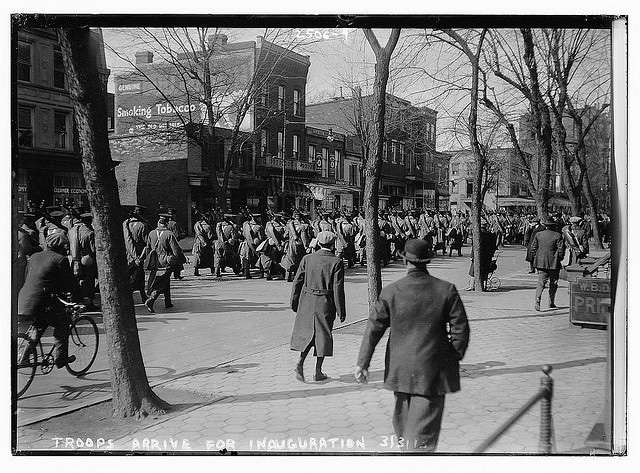
Troops marching into Washington for Wilson's inauguration (Courtesy Library of Congress)
A hundred years ago today, excitement gripped Washington, as crowds flooded the capital in anticipation of Woodrow Wilson’s inauguration the next day.

Wilson’s swearing-in marked an unlooked-for turn in American politics.  As an intellectual, a Democrat, and a Southerner, he promised to introduce a national tone quite different than what the US had been used to under his Republican predecessor, William Taft.  Wilson’s election was a heady coup for the Democrats, whose victory owed much to divisions within the Republican Party, which had split apart into conservative and progressive wings, aligned around Taft and Theodore Roosevelt respectively.

1913preparations

Wilson, who strove to present himself as a reformer and people’s champion, understood the value of publicity.  Preparations for his inaugural were elaborate and included a kind of triumphal procession toward Washington beginning from his birthplace in Staunton, Virginia.  Every aspect of the undertaking was heavily publicized, including the stringing of electric lights along Pennsylvania Avenue, which was breathtakingly modern at the time.

Pennsylvania Avenue strung with lights for Wilson's inauguration (Courtesy Library of Congress)

1913inauglights-level

There was just one complication Wilson hadn’t given much thought to.  His idea of political progress didn’t include the ladies, who he believed shouldn’t vote, lest they become “unsexed” and manly.  So, for months, mainly beyond his consciousness, a feminine maelstrom of discontent had been brewing.

Captains of the women's suffrage parade (Courtesy Library of Congress via the Commons on Flickr))

A young college graduate named Alice Paul and her fellow activists were intent on organizing a vast suffrage parade, to take place in the capital on March 3, the day before Wilson’s inauguration, stealing his thunder and symbolically following the same route to power as he.

After three months of frantic planning, Paul and her committee had raised $14,908.06 in funds (at a time when the average yearly wage was $621), mobilized thousands of like-minded women all over the country, and laid the groundwork for a parade with floats, delegations, and an allegorical pageant to be performed on the steps of the Treasury Building.

Women en route to the suffrage parade (Courtesy Library of Congress)

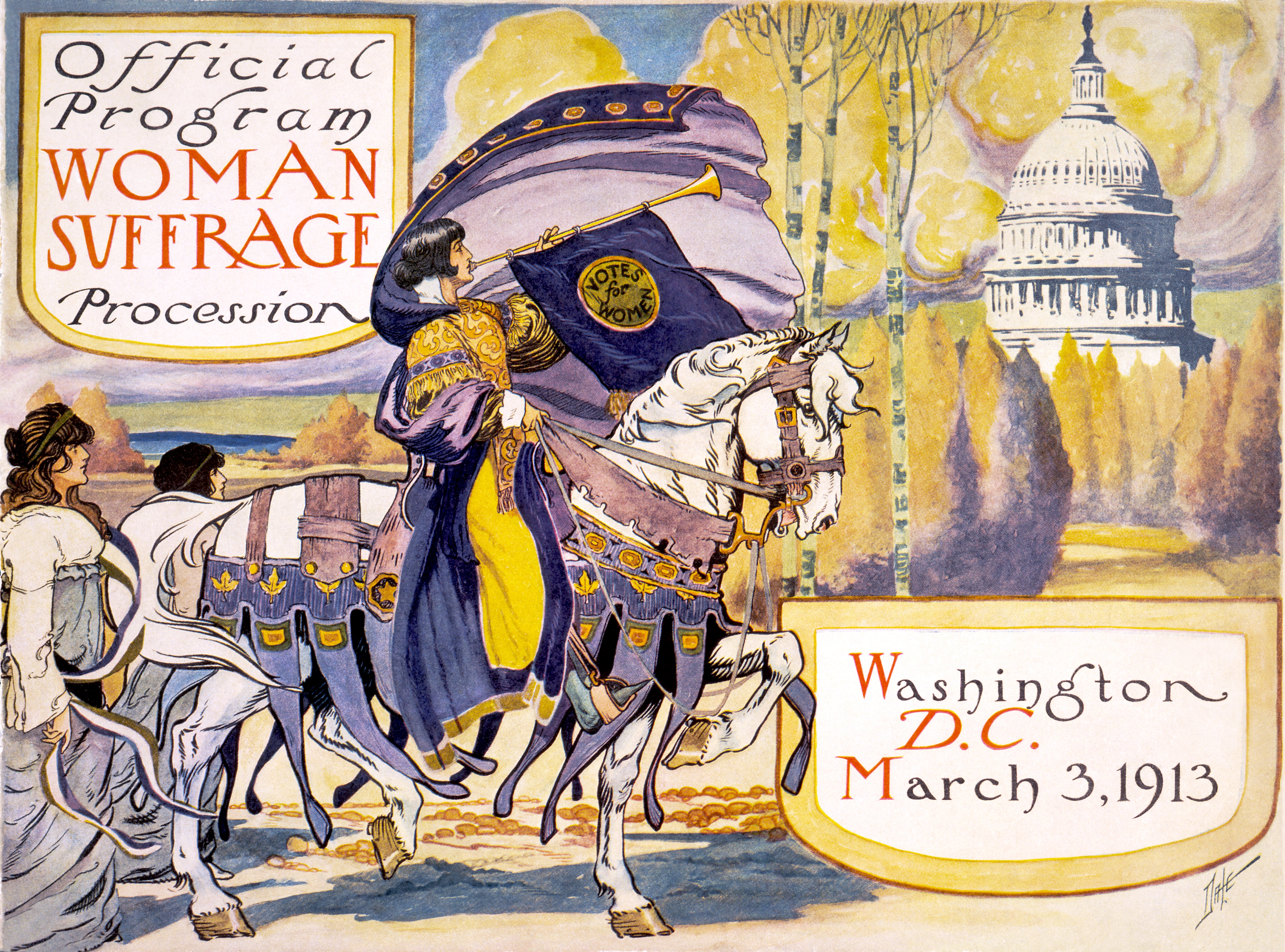
Women from all over donned protest garb and walked, rode, and sailed to take part in the great Woman Suffrage Parade.  There were delegations from Europe, marchers from places like Chicago, Oklahoma, New York, and Ohio, and women from all walks of life.  They bore colorful banners and distributed lavishly expensive programs trumpeting the day’s official proceedings.

suffrageprogram

In the hours before the commencement of the parade, the capital’s streets became choked with people, as skeptical men and more than 5,000 female demonstrators and their allies arrived.

Police were unprepared to deal with the dense masses of spectators and protestors.  Authorities viewed the effort dismissively.  They had not planned to clear the streets, imagining that the sidewalks would suffice for a ladies’ parade.  The streetcars were still running, as pandemonium brewed.

Pandemonium before the suffrage parade

Finally, the streets were cleared and the parade began.  The suffragettes marched several blocks unimpeded, but gradually men began surging into the street, making it almost impossible for the women to pass.  The mood turned ugly and openly insulting.  Marchers struggled to get past the hecklers, their path reduced to a single file.  The men were emboldened by the police, who refused to protect the marchers and instead joined in their humiliation.  Helen Keller, who was among the marchers, found the experience profoundly enervating and exhausting.  Nearly 100 of the marchers were hospitalized.

The chief of police, realizing too late how he had miscalculated, called on Secretary of War Harold Stimson to send out an infantry regiment to restore order and control the crowd.  In the wake of the Congressional inquiries that followed, that police chief would lose his job.

Wilson’s arrival in town was barely noticed that day.  His inauguration, though orderly, was eclipsed by the more truly electrifying Suffrage Parade.  The bold strategies of Alice Paul and her sisters succeeded brilliantly, breathing new life into women’s quest for the vote, a goal they would finally achieve in 1920.

Images courtesy of the Library of Congress.

All About a Ball

Preparing the US National Museum for Garfield's Inaugural Ball (Courtesy the Smithsonian Institution via the Commons on Flickr)

As the day for James A. Garfield‘s inauguration rolled around, the decision was made to hold his inaugural ball in the newly constructed United States National Museum, which had not yet opened to the public.

The massive building, with its grand halls and balconies, seemed tailor-made to soothe a vexation the planning committee faced every four years: finding a venue large enough to accommodate five to ten thousand people.  The nation’s past was strewn with disastrous stories of inaugural parties gone awry: rampaging crowds, looted furnishings, overcrowded chambers, guests forced to dance in their overcoats in unheated temporary buildings.

The National Museum decorated for the 1881 inaugural ball (Courtesy of the Smithsonian via the Commons on Flickr)

The planning committee went wild preparing the still-vacant museum for the president’s gala.  They ordered up three-thousand gas lights, a temporary wooden floor, illuminated garlands, patriotic bunting, placards sporting the monograms of the new president and vice president, and a vast “Lady America” statue to transform the building.  (Wooden chairs in the photographs give an idea of the interior’s scale.)  Vast quantities of refreshments, including 15,000 “assorted cakes,” awaited the inevitable hour when dancers got hungry.

Yet, in the end, these lifeless photographs scarcely satisfy our curiosity.  For what about the ball itself?   Specifically, what about the ladies?  What were they wearing?  Here we run smack up against the bouncers of photography’s limitations, Gilded Age customs, and social mores.

Sadly, Americans couldn’t snap candids of themselves as they stepped out for the ball on that historic night.  The Brownie camera that would make amateur photography possible was twenty years in the offing.  Only by going to a studio photographer arrayed in her ball dress could a woman who went to the ball retain a souvenir of what she looked like that night.  Few such photographs are likely to exist (but let me know if they do!).

♦     ♦     ♦

1880 corset

Thank heaven for the internet, which helps dress up a scene so otherwise naked!  The foundation of every Gilded Age look was the corset, which molded women’s bodies into an idealized form.  It created the hour-glass shape, the essential female silhouette in those days.  Ladies attending Garfield’s ball wore either a corset or an evening dress reinforced inside with whalebone stays.

Dresses donned over the corset were complicated.  This evening dress was characteristic, with its curvacious form-fitting bodice, cinched-in waist, and eye-catching skirt culminating in a bustle and train.  While rigidly sculpted and richly decorated, dresses were relentlessly columnar, emphasizing the figure’s verticality.  The torso of the dress was elongated, thanks to a cut of bodice called the Cuirass, which (echoing the corset) extended smoothly beyond the waist and over the hips.  Keyhole and “V” necklines were popular then.

Even day-time skirts dripped with pleats, folds, and elaborate drapery, accentuating the hips and creating a coveted multi-layer look.  “Tie-back skirts,” though considered scandalous, were all the rage, the skirt being pulled back across the front of the body, supposedly accentuating a woman’s legs.

Evening dresses were made of silk, sometimes heavily textured, and covered with beadwork and ribbon to make them shine.  Textile makers produced vibrant colors with the help of synthetic dyes.  The surface of the dress was further built up with lace, ruffles, and ruching.  Some dresses had heavy tassels of the kind now seen only on fancy furniture and curtains.  The backs of dresses, too, were elaborate and bulky.  To see how these elements could combine, check out this gorgeous cream silk gown, designed by Frederick Worth, the leading couturier of the time.

♦     ♦     ♦

"The Inauguration of President Garfield - The Opening of the Grand Inaugural Ball" (from Leslie's Illustrated of March 19, 1881)

Such are the fashions depicted in the most lifelike extant depiction of Garfield’s ball, created when Frank Leslie’s Illustrated magazine dispatched several “special artists” to capture the scene on the night of March 4, 1881.

The resulting composite illustration includes recognizable portraits of many public figures, with the bearded president, at center, flanked by his son and daughter, and Lucretia Garfield, the new First Lady, hanging on an ambassador’s arm.  (Elsewhere, politicians and military men like Carl Schurz, William T. Sherman, John Logan, James G Blaine, and Roscoe Conkling pepper the crowd.)

Five or six ladies appear at the forefront, the artists painstakingly rendering their dresses, hair-styles, fans, jewelry, and bouquets.  We see Lucretia Garfield in her high-necked pale lavender gown, for instance, while the younger women wear dresses that are more revealing, with low-cut necklines and negligible sleeves.  Yet what joy could they have had in dancing, in such long heavy dresses, and such tight strict corsets?

Looking at this drawing, I am most struck with its subjects’ unknowing.  Little could they know that in just a few months, Garfield’s life would be taken, or that in a few decades, the constraints on women’s fashions and movements would be melting away.  That soon a woman could vote for the president, or against him, as may be, or pick up a Brownie camera and take a picture of her day.

Images: Photographs of US National Museum courtesy of the Smithsonian Institution via the Commons on Flickr; corset from this source; engraving courtesy of the Library of Congress.

RELATED ARTICLES:
Inaugural Day in Washington, The Old Print Gallery.com.