
THE BICYCLE possessed some kind of magic, its mute presence transforming American society. Originally known as a velocipede, the bicycle had been around since the early nineteenth century, but only after 1890 did the contraption become safer and gain popularity throughout the States as something associated with freedom and pleasure. Continue reading
Tag Archives: women
Sisterhood on ice

As ice-skating became a leading pastime in the 1860s, pictures of ice-skating and ice-skaters proliferated in the popular press, recording its impact on society. Looking at such pictures, it’s hard to escape the conclusion that skating represented something special in the lives of women, while also violating existing norms. If skating let women escape a certain social confinement, it rendered them more vulnerable, too. Ice-skating, though fun and bold, exposed women to certain perils, among them a mixing of classes and sexes that nineteenth-century society was set up to avoid.
This print by Winslow Homer (1836-1910) encapsulates such strains. Continue reading
Thanks to ice-skating, ladies’ skirts rise

The ice-skating craze that swept the northern US in the 1850s cracked the shell of stiff propriety imprisoning respectable women then. Normally, women were obliged to swaddle themselves in yards and yards of fabric, to garb themselves in full-length dresses and hoop-skirts completely concealing their lower bodies. Even equestrianism, which offered upper-class women a welcome chance to get some exercise, entailed riding side-saddle in a skirt that was abnormally long.
When Cole Porter penned the line, “In olden days a glimpse of stocking was looked on as something shocking,” he summed up the 1850s economically.
Ice-skating changed that in a snap—as long as ladies and gentlemen were on the ice. To step onto a frozen pond was to sail into a world where the rules of genteel behavior were relaxed, strangers mingled, and even women could get a little bit wild.
This opening for women was symbolized in the creation of a special petticoat, designed to be worn as activewear under their skirts. The Balmoral petticoat, as it was called, was associated with Queen Victoria and the outdoor pastimes—such as skating, hiking, hunting, and riding—that she and her family were known to pursue on their country estate in Balmoral in the Scottish Highlands.

Fashion plates, like this one, and this one, showing skaters in balmoral petticoats, underscore the connection between this article of dress and an active outdoor life. Women donned such petticoats to skate or, in warmer months, to play croquet.
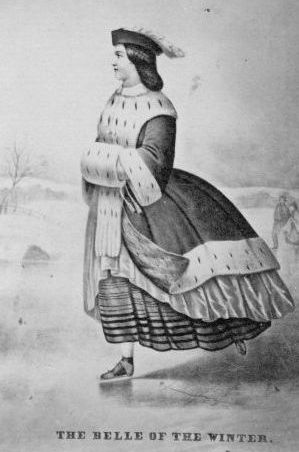

According to Leimomi Oakes, who writes about historical fashion at dreamstress.com, the balmoral petticoat typically had broad stripes at the bottom. Sometimes it was made of a colorful plaid. The petticoat was made to show off, furnishing a flash of color under drawn-up skirts. While full enough to be worn over a hoop, when it was not, it showed off the wearer’s ankles and legs. The full effect could be startlingly bold, as in the cover illustration for the song, “The Gal with the Balmoral” (1861).
Women began wearing these shortened skirts as soon as they began learning to skate. The petticoat was in vogue by 1859, as this print shows.
So, for a brief time in the 1850s and 60s, ice-skating offered a taste of sweet liberation, when women could pin up their skirts and have fun outside.
 Sheet music cover, circa 1868
Images: Courtesy of the Library of Congress.
For further information click here and here.
This is the sixth in an occasional series on ice-skating. Click here to read from the beginning.
Philadelphia on ice

The winter of 1856 was one of the coldest in the nineteenth century. It was so cold that the Ohio River froze solid from bank to bank, creating a path for southern slaves to escape, just as Harriet Beecher Stove had envisioned in Uncle Tom’s Cabin two years before. Elsewhere, the long stretches of cold weather created favorable conditions for Americans’ new favorite pastime, ice-skating, then enjoying great burst of popularity.
This scene, of city-dwellers crowding the ice on the Delaware River in Philadelphia, furnishes a gauge of the strength of the trend. For though ice skating had been practiced for centuries, until 1850, skate blades were crafted only of wood or bone. A Philadelphia businessman, Edward W Bushnell, is credited with revolutionizing the sport of skating, by being the first to manufacture a blade of steel. Strapped and clamped to the bottoms of shoes, the sharp metal blades gave skaters unprecedented speed and control.
The excitement was considerable as the innovation took hold. The Quakers of Philadelphia had always carried on their hereditary skating traditions, but steel skates led to many novelties. By the time lithographer James Fuller Queen captured this scene, many men and boys had paid up for the new skates, which were very expensive at $30 a pair. Most of the ladies and townspeople pictured are spectators only, standing still as bold skaters thread their way through the crowd.
According to John Frederick Lewis, author of Skating and the Philadelphia Skating Club (1895), a Miss Van Dyke, daughter of James C Van Dyke, US attorney for Philadelphia, was the first woman in Philadelphia to appear on skates; she “rapidly became skillful and expert” in 1854. Other ladies followed her lead, making skating fashionable, once concerns about safety and possible harassment from ruffians had been cleared away.
Image: from this source.
Click on the image for a much larger view.
This is the third in an occasional series on ice-skating. Click here to go to the first post.
Cool girls with skates

Four girls with ice skates walk down a street in New York’s Chinatown. It’s 1965, Mott Street, a sunny day—and late April, which heightens the incongruity of what we’re seeing. While the setting grounds them to their roots and history, the girls are American and of the moment, with loose hair styles, jackets, and dungarees. The photographer, Ed Ford of the New York World Telegram & Sun, captured a carefree, top-of-the-world moment effectively.
Since ice skating originated in Northern Europe and developed as a result of American and European innovations, the ice skates are a token of westernization (as well as a capacity to have fun).
Image: from this source.
This is the second in an occasional series on ice-skating.
Click back and forward to see the others.