How the Fed Makes Us Lazy—and What We Can Do

http://upload.wikimedia.org/wikipedia/commons/thumb/3/3f/Ben_Bernanke_official_portrait.jpg/512px-Ben_Bernanke_official_portrait.jpg
This is not a post about hating the Fed and how we should get rid of it.  This is a post about the rest of us and how convenient it is to have the Fed to complain of.

I was tempted to title this post, “The rabble are out to crucify Ben—there’s even a Judas” (now that Paul Krugman, the Fed chief’s former Princeton colleague, has taken to assailing Benanke’s performance in print).  But that would have been just one more example of the phenomenon I’m out to criticize: finger-pointing.

It would be tough to judge a finger-pointing contest these days.  As the economy flails in the long wake of the financial crisis, everyone in every party seems to be training to become a finger-pointing champion.  What interests me about the attacks on the Fed, however, is that even anti-government types now seem caught up in thinking that tinkering with the government is the key to solving problems that—let’s face it—the American private sector created.

The federal government is powerful, but more powerful still are the aggregated interests that pump out more than $15 trillion worth of goods and services a year.  That was our GDP in 2011, a CIA Factbook figure.  If you hold a job, work in a profession, run a multinational, or own a small business, you are part of that great engine.  Simply put: we are the economy.  The mess is ours.

Perhaps this is why we feel such scorn for Ben Bernanke, a man so sincere and conscientious it’s irritating.  Love him or hate him, it’s hard to claim he isn’t doing his utmost to fulfill the Federal Reserve’s dual mandate, which is to stabilize prices AND move the country toward full employment.

That’s right: one soul at the helm of the Federal Reserve, believes that, by controlling the amount of money in circulation, he can sufficiently influence the sort of corporate decision-making needed to end joblessness.  He hopes that, by tweaking our monetary policy, he can prompt our American brothers to give another American brother a job, until every brother and sister in our economy is once again working.

This is why, in Mr Bernanke’s increasingly frequent public appearances and statements, he can be heard fretting about, say, whether long-term unemployment could lead to a permanent loss of human capital in the economy.  He truly believes that getting all of America back to work is his responsibility.

He may be the only American who feels that, unfortunately.  This is why hating the Fed is so misguided and self-deceiving.  Hating the Fed is a cop-out, a lazy habit that absolves the rest of us from looking around us and asking who else might bear some responsibility.  Our national preoccupation with monetary policy is a convenient dodge, diverting us from the fact that we ourselves could do something.

We are the economy.  Regardless of the shortcomings of the Fed and Mr Bernanke, we owe it to the jobless to recognize their lot as a social, civic, and humanitarian problem, one that’s in our power as a society to remedy.

Should we destroy the one thing that’s working?
Obviously not.  The Fed would matter a lot less if we could manage to get some other things working as well as it does.  If we didn’t have institutions like the Fed, it would be up to Americans in their respective states and communities to figure out how to alleviate joblessness and destitution and restore prosperity.

This was our lot earlier in our history, when Americans operated with a mere fraction of what now passes for economic understanding.  In those times, punishing downturns such as those occurring in 1837, 1873, and 1893, led not only to protracted suffering but also to constructive cultural and social ferment, an outpouring of philanthropic zeal, and more than a little genuine soul-searching.

The Panic of 1837, for instance, prompted the formation of some of our earliest urban relief organizations, while the banking crisis of 1856 gave way to a religious reawakening in 1857 known as “the Businessmen’s Revival.”  Chief among the converts were Manhattanites who concluded their own godlessness and greed were to blame for the economic adversity they were suffering.  Such heartfelt contrition and public avowal of responsibility, even in secular form, have been all but missing from our present-day financial crisis.

We can’t hope to lessen joblessness if we don’t recognize our obligations to one another.  We can’t hope for national prosperity when so many of our fellow Americans are jobless and poor.  The common-sense idea that we must care for one another, even if only for selfish reasons, is crucial if we are to re-energize our economy.  It might not be an idea Ben Bernanke can teach us, but it sure is one that we can use.

Want help  •  Foreswear laissez-faire  •  Use all the tools
Hire a fellow American  •  Talk to the rich guy

RELATED:
Susan Barsy, Fiscal Policy is not Economic Policy, Our Polity.
Dean Baker and Kevin Hassett, The Human Disaster of Unemployment, New York Times.
Rick Newman, To Fix the Federal Reserve, Fix Congress First, US News.
George F. Will, The Trap of the Federal Reserve’s Dual Mandate, Washington Post.
Ken McLean, The Fed’s Dual Mandate Dates to a 1946 Act, Washington Post.

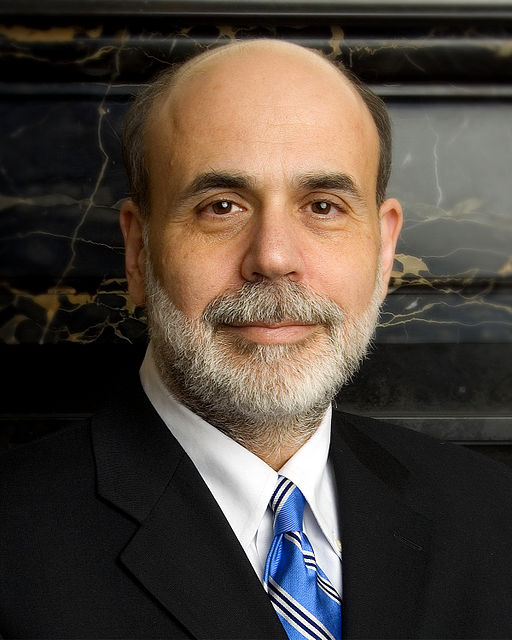
Image: Official portrait of Federal Reserve chair Ben Bernanke, from this source.

Before There Were Income Taxes

Drinking glass with McKinley's image and the motto "Protection and Plenty" (courtesy Cornell University Library via Flickr Commons)

Do you ever get the sense that there are forbidden topics in American politics?  If there are, I think one is the tariff and the costs of “free trade.”  (Another is the price of food, but I’m not going to write about that today.  Nor am I going to write about the relation between rising domestic gas prices and the export of our own oil and gas, which has recently reached an alltime high.)

No, my only topic today will be the tariff, not because it’s timely or explosive or even the slightest bit sexy, but because it’s been tugging at the edges of my attention lately.  And I’m going to indulge myself by writing about the tariff nostalgically, in my capacity as a citizen and an historian, not as a trade expert or an economist—because of course I’m neither of those things.  (If you’re fuzzy on what a tariff is, you may wish to read this.)

Recalling the tariff is important, because it was once a central element of US fiscal and trade policy.  Thinking about this now-forgotten source of federal revenue may free us to grapple with the budget woes confronting us more creatively.  But first, let me back up and locate my nostalgia in a specific situation—several situations, really, existing concurrently.

1. The Tax Man Cometh

Last month, the nice man who does our income taxes paid us a visit.  We had a nice lunch, then Bob and I handed off all the forms and papers he needed to take away.  It was a nice modern ritual.  It couldn’t have happened in the 19th century (except for a brief period in the 1860s—and there were no professional accountants then—), because the federal income tax was established permanently only in 1913.  Ever wonder how the federal government was funded before then?  By 1913, the US was 124 years old.

Tariffs are a big part of the answer.  From the nation’s founding until 1913, tariffs on goods imported into the US typically accounted for the bulk  (sometimes more than 90 percent) of the government’s revenue stream.  The remainder of its needs were met through excise taxes on goods such as whiskey.

2. Red-Ink Ricochet and the Mood of 2011

We live in a time of red ink, a condition that’s occasioned conflict and a fit of soul-searching.  The mood of 2011 was angry and irritated.  Occupy Wall Street, the strident clamor of the Tea Party, protracted and still unresolved quarrels in Congress over tax cuts and the debt ceiling: these events showed a nation under strain and increasingly divided along party and class lines.  At the heart of the buzz is a widespread conviction: we cannot continue on the same path we’ve been treading.  Our current fiscal policies cannot be sustained, we cannot continue along with more of the same.  As the federal deficit has spiraled, balancing the budget has come to seem an impossibility, the how of it becoming a vexatious topic to a population afflicted with high long-term unemployment and rising income inequality.

Given that the government lacks the will to cut spending, how do we come up with more black ink?  The red stuff is as pesky as the pink snow in The Cat in the Hat story.  We may shift our tax burdens around endlessly, but we’re not due for relief, at least not as long as internal taxation constitutes the US government’s principal revenue stream.

The tariff is germane to these meditations, because the mechanism of the tariff was used in the past to address a constellation of problems similar to those we confront today.

When the country was first founded, it occupied an inferior and economically vulnerable position.  The government was saddled with enormous debts accrued from fighting the Revolution.  Our fledgling economy, based primarily on agriculture and trade, was heavily dependent on more mature economies who actually made things.  Globally, industrial manufacturing was in its infancy, but a technology gap and America’s relative labor scarcity hampered our efforts to compete with Europe’s more rapidly industrializing powers, notably England.  Finally, to say that our population was averse to internal taxation was putting it mildly.  For all these reasons, the tariff became the backbone of government financing, a development that also created conditions under which a diversified economy could grow.

The government’s needs then were far more modest.  Yet, throughout the nineteenth century, protective tariffs were more than a great source of federal revenue.  They protected domestic manufacturing, fueling the development of a broad industrial base and abundant labor opportunities.  Indirectly, the tariff promoted conditions in which American laborers could mobilize politically and successfully push for fair wages and other labor standards that gradually improved their quality of life.

Which is not to say the tariff was without political controversy.  For every statesman like Henry Clay, who tirelessly championed tariffs and “home industry,” there was another like John Calhoun, who, when confronted with the Tariff of 1828 (the so-called “Tariff of Abominations“), argued that his state would be justified in striving to nullify and defy the federal law.  Tariffs benefited the more mercantile and industrial parts of the country, while imposing negative effects on those engaged in agriculture.  Each new tariff measure spurred hot debate; countless hours were spent arguing over tariff rates and the specific goods on which tariffs would be imposed.  Yet, despite these drawbacks, tariffs served the national interests of the United States admirably.  Above all, the tariff proved popular politically.

3: Handkerchiefs Spoke To Me

Evidence for this last point came to hand recently, in the form of political handkerchiefs made in the late nineteenth and early twentieth centuries.  That’s right: political handkerchiefs.  They spoke to me.  And they might speak to you, too.

Textile touting the presidential candidacy of Benjamin Harrison (Courtesy Cornell University via Flickr Commons)

While trolling the internet for images to illustrate this post on party platforms, I stumbled on a trove of old political handkerchiefs preserved at Cornell University Library.  Dating mainly from the 1880s through the 1910s, these textiles bespeak the wild popularity of tariffs and “home industry.”

Political handkerchief from the 1888 Republican presidential campaign

Adorned with patriotic symbols and images of prosperity, woven on homespun in American mills, the artifacts suggest a dovetailing of political and economic interests that we think of as inevitably antagonistic.  Indeed, the protective tariff was a powerful political bond mitigating the conflicting interests of American labor and the captains of industry.

1888 Political handkerchief with flags and the words "Protection--Home Industries"

Interestingly, the Republican party was the champion of protectionism in those days.  The question for Republicans in the late 1800s was not whether there should be a tariff, but how high it should be.  In the election of 1888, the budgetary surplus resulting from tariff revenues had grown to be so large that it was something of an embarrassment for the party.  A theme of the election was whether to lower the tariff so that the government would not end up with funds it didn’t need.

Political textile with the slogan "True Blue Republican--Protection--Home Industries"

Despite some modification, the tariff remained a popular element of Republican ideology for at least two more decades.  Industrialists, workers, and politicians shared an interest in maintaining the tariff system, which imposed tax burdens on “the other guy”: those who wanted access to our markets, manufacturers and purveyors of goods from overseas.

Pro-protection handkerchief from Theodore Roosevelt's 1904 campaign (Courtesy Cornell University Library via Flickr Commons)

4. The limits of nostalgia

Back to the present: we live in an era of free trade.  By 1900, our economy had become vastly more productive.  We needed larger markets for the goods we made, the natural resources we harvested, and the crops we grew.  Gaining access to foreign markets has been America’s goal for a century, one integral to the global dominance that we’ve enjoyed.  Achieving this has entailed opening our own market to foreign goods and nearly eliminating the tariff protections American industry once knew.  The US is now party to many reciprocal and multilateral trade agreements, and our capacity to change the terms under which we trade is modulated by our participation in the World Trade Organization (WTO).  The tariff is a mere relic of the nineteenth century, and to write about it is to go against the grain of what we’ve become.

Yet, in the current climate of economic and political unease, Americans are re-examining the role of government and how its fiscal policies can be made a more perfect mirror of the people’s needs.  At such a moment, it may be fruitful to ponder the constructive role of the tariff and all that this alternative system of taxation enabled us to become.

All images in this post are courtesy of the
Susan H. Douglas Collection of Political Americana
at Cornell University Library.
You can visit its photostream here.

RELATED:
Susan Barsy, Bring Back The Platform!, Our Polity.
Ron Grossman, “Globalism and Its Discontents,” Chicago Tribune.
“The Rise of the Income Tax,” a succinct time-line by TurboTax, on view here.

Fiscal Policy is Not Economic Policy

One of the strange features of the period we are living in is that discussions of fiscal and monetary policy have pretty much preempted a more direct examination of structural problems in the American economy.  These topics have become our obsession, precluding direct debate about what sort of economy we want to be.

Perhaps because Americans are phobic about the idea of having a larger economic vision, we do not talk about how we would like the various parts of our economy to function together for our greatest well-being.  Instead, we talk about monetary policy (the Fed and the money supply) and fiscal policy (the role of government as a taxing and spending agent), as though getting these two parts of the equation right will, in themselves, produce a national economy that is prosperous and serves the various needs of the citizenry.

Perhaps it’s inevitable, because these are the two parts of our vast economic system over which officialdom can hope to exert control.  Almost occluded is the whole world of work—the whole world of enterprise—, the aggregate shape of which should always be our main point of reference.  Anti-statists though we are, we focus on government action more than on what American workers and companies are actually doing, or on the cultural and practical developments that could help them continue more happily, successfully, and harmoniously.

Instead, all roads lead back to the government, the federal government, which, as the economy has grown, so too has it, grown to be a huge economic agent, one so huge and complex that citizens can scarcely apprehend its many functions.  The government’s role as an employer—as a regulator—as a consumer—is massive.

Readers of this website have noted already that, while public discussion of government spending often focuses on social benefits distributed to the ill, the poor, and elderly, the government gives mightily to other economic actors, whether in the form of tax breaks, farm subsidies, employment, military spending, or other government contracts, forming a great gift-cycle that is myriad and so circular!  Because, of course, we pay our part for all of these things.  It’s all so different from the days, long long ago, when there were no income taxes, and the government’s main functions were running the P.O. and sending farmers experimental seeds!

Notwithstanding the benefits that might follow from keeping our sights trained on creating opportunities for American labor and improving the character of our own economic activities, we are entering a period when fiscal policy will remain at the center of public consciousness, where more and more attention will be trained on issues of taxation, and on tax reform itself, of all things.

Federal Revenues & Expenses as a Percent of GDP, 1981-2012

Image: from this source

RELATED:
The Map of Federal Benefits
Help Understanding the Federal Budget
Eduardo Porter, “A Nation With Too Many Tax Breaks,” New York Times, 14 March 2012.
GRAPHIC: “Who Gets the Breaks and Benefits,” New York Times, 14 March 2012.
Tracy Gordon, “What States Can, And Can’t, Teach the Federal Government About Budgets,” Brookings, March 2012.
GRAPHIC: “Government Spending by Level, as a Percentage of GDP,” Brookings.

The Map of Federal Benefits

I stumbled on this fascinating map published yesterday on the New York Times website.  It’s a national map showing the distribution of all federal benefits to individuals–including Social Security, Medicare, Medicaid, veterans benefits, and so on–by county, so that you can see which counties are most reliant on federal social spending.

What’s fascinating is that the highest levels of federal benefits are not where you might expect them to be.  They are not in cities.  In many cases, they are in “red” parts of the country.

The only way this map could be better is if it included farm subsidies.  I imagine they were excluded because they often go to corporate entities, and this is a map of benefits to individuals.  But because many prosperous commercial farmers in America benefit from this form of government support, it might be included to round out this picture of geographical reliance on federal aid.

Food for thought.