Ferris: His Wonderland

The First Ferris Wheel, Chicago, 1893; photograph by Starks W. Lewis (Courtesy Brooklyn Museum via the Commons on Flickr)

Around this time of year in 1893, millions of people were flocking to Chicago to see the great world’s fair the city was hosting.  Formally known as the World’s Columbian Exposition, the fair belatedly commemorated the 400th anniversary of Columbus’s “discovery” of the New World.

In a bid for national and international celebrity, Chicagoans (whose young city had burned to the ground 22 years earlier) went all out in constructing the fair’s great White City: acres and acres of magnificent pavilions, illuminated at night by millions of dazzling electrical lights, and all organized around a network of waterways.

To make it even more special, the organizing committee hired a young engineer named George Washington Gale Ferris, Jr., to dream up something similar to the amazing tower that George Eiffel had designed for the world’s fair in Paris in 1889.  Similar to that tower, but better.  Yet at first the organizers of Chicago’s fair were doubtful about the idea that Ferris came up with.

Ferris, 34 years old (and destined to die of typhoid fever just three years later), had already gained an impressive reputation as an engineer and bridge-builder, a reputation that sprang from his understanding of steel.  The design that he proposed to the fair’s organizers was for a gargantuan wheel, that, if built, would tower above everything and lift passengers effortlessly, treating them to aerial views from astonishing heights.

Starks W. Lewis, an amateur photographer who managed to get his camera (it would have been pretty bulky) set up on the wheel, captured the wonder of it all.  From his vantage, the intricate workmanship of the wheel itself, as well as size and design of the passenger cars, each of which was designed to hold 60 people, is clearly revealed.

Despite organizers’ fears, Ferris’s daring contraption worked perfectly.  Rising to a height of 264 feet and measuring 825 feet around, the Wheel weighed more than 2.6 million pounds.  It was powered by two 1,000-horsepower steam engines and operated reliably, unimpaired by lightning and gale-force winds.  According to Judith Adams-Volpe, writing about Ferris in the American National Biography, the wheel became the Fair’s leading attraction, the first instance of “technology being harnessed purely as a pleasure machine.”

View of the Fair from the Ferris Wheel, 1893 photograph by Starks Lewis (Courtesy of the Brooklyn Museum via Flickr Commons)

What steel gave society was the capacity to rise above the earth and gain an entirely new perspective on itself.  The people who visited the Fair from all over the US could see their world as they had never seen it, from a perspective previously offered only by mountains or the occasional steeple.  In the wondrous aerial vision Ferris gave the world came a hint of the built marvels that were still to come.

Images: Photographs of and from the first Ferris Wheel
by Starks W. Lewis, 1893, courtesy of the Brooklyn Museum, from this source.
Lorimer

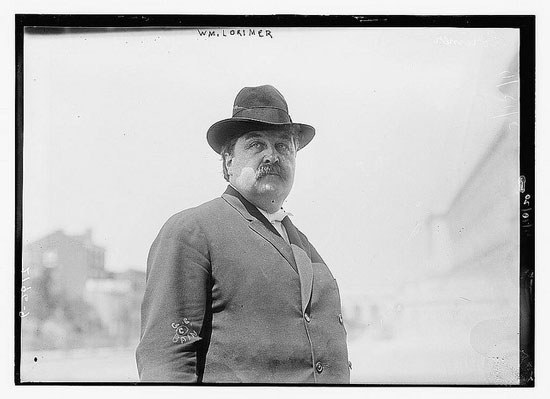
William Lorimer circa 1911 (Courtesy Library of Congress via The Commons on Flickr)

William Lorimer (1861-1934), was a rare bird indeed: a Chicago political boss who was Republican.  By the time he paused to have this photograph taken, he’d risen to a seat in US Senate, but under circumstances that steeled reformers’ determination to amend the Constitution, so that nothing of the kind would ever happen again.

Lorimer had the bored, jaded look of a man who’d been around the corner and back again.  Known as the “the Blond Boss,” Lorimer, who’d been born in Manchester, England, had risen to wealth from poverty, the son of a Scotch-Presbyterian minister who died early, leaving his family to negotiate the late nineteenth-century Chicago immortalized in works like Sister Carrie.  From the age of ten, Lorimer worked various jobs, including in the stockyards; he received negligible education.

In his early 20s, he became a street-car driver, married a woman who was Irish Catholic, and converted to her religion.  Known as a clean liver who did not drink, smoke, or attend the theater, he fathered 8 or 9 daughters, many of whom later worked for the city.

Lorimer’s determination to enter politics on the Republican side is said to have dated from 1884, when a Chicago polling place could not provide him with a Republican ballot to cast for James G. Blaine.  Lorimer became the political favorite of ethnic voters on the city’s west side, including many Russian Jews, Bohemians, and Irish who had previously voted Democratic.  Lorimer was not a reformer; he believed in competition.

He thrived by delivering on promises to supporters and friends, and by wedging himself between the Democrats and the reform wing of his own party.  Exploiting these divisions, he managed in 1908 to defeat a rival Republican for the US Senate, at a time when all Senators were chosen by state legislatures.  A year later, one Illinois state assemblyman claimed to have been paid $1,000 for his vote.  Several others joined him, claiming to have received payments from a jackpot fund set up to influence decisions in the Illinois assembly.

The allegations were investigated over the next several years by state and federal legislative committees, which could not find evidence of Lorimer’s personal wrong-doing.  But the winds of change had been blowing strongly, and eventually grew strong enough to blow Lorimer away.  Ignoring the detailed conclusions of the committees, the Senate voted to expel Lorimer in 1911.  Two years later, the nation ratified the 17th Amendment, which empowered voters to elect US senators directly.

Though Lorimer dropped dead in a Chicago train station decades ago, something of his spirit still haunts Chicago.

Image courtesy of the Library of Congress, from this source.

YOU MAY ENJOY:
Boss Lorimer and the Illinois Bribery Scandal,” New York Times, 1909.

Was American Greatness Built on Fiscal Folly?

The US Capitol in the 1830s (Courtesy Cornell University Library via The Commons on Flickr)

Is American greatness based on extravagant decisions that make no economic sense?  I’m pretty sure the answer is yes.

Our history is littered with “go-for-broke” projects that were hailed as sure-fire disasters at the time.  They would never have had a chance if our ancestors had had to defend themselves against the hand-wringers and economic rationalists who control American decision-making today.

Here is a short list of things that would never have happened because they entailed excessive risk, uncertain returns, irrevocable loss, or extravagant outlays.  In some cases, the day of exoneration for these decisions didn’t arrive for decades.  In the meantime, the country and its leaders endured ridicule as well as some terrifying liabilities.

1.  The Revolution.  It should have been a doomed undertaking.  The rebellion was impulsive and deepened into a pitched struggle that lasted eight years.  During that time, the colonies held it together with a more or less powerless committee that they tried to dignify with the name of the Continental Congress.   The war was fueled largely by reckless borrowing and the issuing of funny money.  The country organized under the Constitution largely because the new structure promised impecunious states debt relief.  Burdened from the outset with staggering debts, we became the US because there was no other way.

2.  The Louisiana Purchase.  Jefferson’s famous 1803 purchase was another patent error we wouldn’t think of committing today.  True, he acquired all that land west of the Mississippi, out of which 14 or 15 perfectly good states were made, —but he agreed to pay France an amount of money that was two times our entire federal budget at that time.  How could that be wise?

3.  The founding of Washington, DC.  Another ghastly boo-boo.  Instead of putting the capital near one of the existing states or cities, our frivolous forefathers insisted on mapping out a whole new city, and on a ridiculously grandiose scale, too.  Ignoring the fiscal realities, they threw away dollar after dollar building up an unduly magnificent city—it was all too European.  Yet, lo and behold, the iconic city they built is a global symbol, anchoring a metropolitan region of some 5 million people that is one of the most dynamic in the US today.

4. Seward’s Folly.  The Alaskan Purchase.  Another instance of classic fiscal adventurism.  Another expenditure the US didn’t need, especially not in 1867, when the government was laden with debt from the Civil War.  Critics argued that Alaska was inconvenient, and unnecessary; its only asset was a population of fur-bearing animals, whose value was declining.  That was before the gold was discovered, or the oil.  Purchased for 7.2 million dollars, Alaska today has a $49-billion GDP.

5. Ending slavery.  This, surely, was the most economically reckless action in American history.  For in putting an end to slavery, the US deprived one class of white Americans of millions of dollars of “property” and put an end to a convenient labor system they were accustomed to.  The gradual recognition that the slaves in our midst had a moral and political claim to be treated differently—that, in fact, Americans of all races are entitled to full civil and political equality—is one of the costliest convictions at which we’ve ever arrived.   Yet like many of our other decisions that “made no sense,” this one was essential to our national integrity.  And it highlights, in a way that the other items on my list do not, why economic rationality alone has never been, and should never be, the transcendent value in a republic like ours.

So, to my contemporaries I say—yes, cut away the waste and the unnecessary—but never disavow that go-for-broke mentality.  It’s part of the folly that made us great.

Image: The U.S. Capitol in 1830s Washington, D.C.
from this source.
  For a photograph of the Capitol from this period, click here.

War Dead

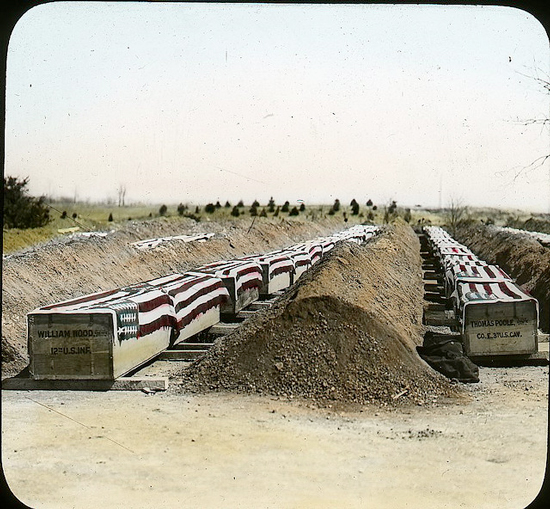
The remains of American soldiers awaiting internment at Arlington National Cemetery (Photograph by E.B. Thompson, courtesy DC Public Library via Flickr Commons)

On April 6, 1899, Washington DC photographer E. B. Thompson rode out to the cemetery at Arlington, where the remains of several hundred officers and soldiers were about to be buried.  The men had died in the late war with Spain, a brief affair that both began and ended the previous year, bringing the US control of Spain’s former island possessions—Guam, Puerto Rico, and the Philippines—and the independence of Cuba.

The coffins represented a fraction of the 3,000 Americans who died, felled not so much by their adversaries as by tropical diseases like malaria and yellow fever.

Now, belatedly, they were to be buried.  The coffins lay suspended over long trenches dug in a new section of the cemetery.  Many of the remains were unidentified, so coffins of the known dead were carefully positioned at the ends of the rows that would be most visible during the ceremony.  Thompson positioned himself near the presidential viewing stand and took this picture.  It is an image as raw as the landscape itself, the kind of grim tribute to the fallen that we hardly ever see.  It was colorized later.

A crowd of some 15,000 people, along with President McKinley and other dignitaries, gathered for the funeral rites.  A newspaper in New Brunswick, Canada, carried a full account of the proceedings.   The work of burying the coffins began after the crowd dissipated, a tough, tedious job that took several days.

Image: E.B. Thompson photograph, “Interment at Arlington National Cemetery,” 1899.
Courtesy DC Public Library Commons, from this source.