After the Red Wave: What Democrats Should Do

2014midtermcolorbar
Republican gains in Tuesday’s elections delivered a stunning rebuke to Democrats and their party.  The GOP is resurgent, despite having teetered after the 2012 election on the verge of disintegration and decline.

The Republicans achieved this gain primarily by telling voters that, under President Obama and the Democrats, the nation has fared badly.  Republican candidates attacked both the style and substance of the administration.  They assailed a government that they styled as autocratic, expensive, and ineffective.  They railed against government intrusion, and (in the case of illegal immigration) against governmental laxness, too.  They chafed against laws and constraints they don’t believe in.  Most of all, Republicans succeeded by denigrating what will surely be regarded as this era’s most significant achievements, such as the government’s success at bringing the nation back from the brink of all-out economic collapse and at passing a radical yet tenable and comprehensive health-care reform bill.

Strategically, the GOP also took care to marginalize some of the worst kooks seeking to work their way up in the party’s ranks.  The Republican National Committee under Reince Priebus encouraged and supported more electable candidates whose messages would still resonate with conservatives.  The policy also served the goal of producing a Republican Congress that is more homogeneous and governable.  Anyway, as campaign strategy, it worked.  Even weak candidates like Senator Pat Roberts of Kansas won.

Sadly, the Democrats were afraid to be identified with their party’s strengths.  They also failed to deliver a vision of government, that, if consonant with their recent achievements, was fresh and forward-looking.  As the president’s time in office wanes, Democrats should be thinking about how to catch the next wave.  What should the Democratic Party be about, once heavyweights like Obama and the Clintons are gone?  The Dems are notably short on galvanizing up-and-comers who could breathe new life into what has become a too-staid and centrist political party.

Chiefly, though, the Democrats have failed to accommodate and adapt to legitimate criticisms of Democratic governance and ideology.  In particular, they do not seem attuned to the people’s desire for a government that, if powerful, is deft and efficient.  They have not cared enough about the national mood to break with the president and demand Congressional debate on issues like our open-ended bombing campaign against the Islamic State.*  Nor have Democrats cared enough about the middle and lower classes to attack the glaring issue of corporate responsibility, favoring a rise in the minimum wage, yes, but remaining silent on a host of policies that work against working-class prosperity while benefiting corporations and the interests of global capital unduly.

Renew themselves: in short, this is what the Democrats must do.  Dare to be a more interesting, local, peaceful, green, and economical party.  Dare to think small, and find new ways to promote prosperity that rely less on government spending and more on shrewd uses of information and technology.  Scour the countryside for young, charismatic, ardent, and innovative political thinkers.  Restore pride in American citizenship and civic culture.  And move beyond the paradigm of the social-welfare state in trying to figure out how to give a stagnant, suffering America what it wants and needs.

* The president has since called on Congress to debate and authorize the bombing campaign.
The GOP’s marriage of convenience turns sour

Back in the spring of 2012, I wrote a post, Is the Republican Party Dying?, in which I surmised that the GOP, despite its already apparent fissures, was unlikely to collapse any time soon, because of the broad popularity it continued to enjoy at the state level in many parts of the country.  Now, in the wake of last week’s House vote on a bill to reopen the government, we have fresh evidence with which to assess the current condition of the party.

The GOP’s troubles appear to be growing, for, with the House vote that ended the government shutdown, the relative strength of the GOP’s intransigent right wing is clear to see.

Here is the vote count and its geographic distribution as depicted in a New York Times interactive graphic on October 17.  The yes vote (totaling 235 votes) was composed of 198 Democrats and 87 Republicans.  The no vote (totaling 144 votes) was composed entirely of Republicans unwilling to compromise, or to adhere to the advice of the moderate leadership of the party, as embodied in the House Speaker, John Boehner.

The size of the “no vote” is significant and startling, establishing that the more radical “Tea Party” element in the GOP, far from being a minority tendency as often depicted, comprises a MAJORITY of all House Republicans.  Far from being a “tail” that is “wagging the dog,” the Tea Partiers have morphed into the dog itself.  The only wonder is that they have not yet used their power to depose John Boehner–a miracle that has probably astonished the Speaker himself.

Regarding the “upcountry” character of these more radical Republican characters, the NYT map illuminates how difficult it will be to dislodge them, and why this faction so consistently overestimates its prospects for influencing the mass of the American population.  In many states where the suicide caucus lives, it enjoys a virtual monopoly.  In 12 states—including Georgia, South Carolina, Tennessee, Missouri, Texas, and Arizona—all the Republican representatives are of the intransigent kind.

These blinkered souls believe, despite the mounting evidence of public opinion polls, that their views command the assent of the American mainstream, and they are confidently planning to extend their geographical sweep into more moderate Republican territory.  In the meantime, moderates, alarmed at the immoderation of their right wing, have begun planning to challenge them in the primaries.  The battle for control of the GOP will be hard-fought.

But for now, the rest of us have seen how dangerous and desperate political actors can be when trying to hold together a party that’s imploding.  Should we condemn John Boehner for accommodating the radicals, or be relieved that no more radical obstructionist is replacing him?  The GOP truly is a grand old party, and should its literally elephantine organization collapse, the attendant damage would be catastrophic, not just for the party, but, as we have seen, for the nation too.

Looking back on this period, historians will puzzle over the decision of the GOP to welcome this radical fringe into their party.  Even now, the traditional Republicans could recover their dominance by unceremoniously cutting the Tea Party loose.  Without the GOP’s support and legitimation, the radicals’ spell would be broken, and their national influence would evaporate overnight.

Moderate Republicans who believe that such destructive zealots are necessary to their party have forgotten about the massive bloc of disaffected voters in the center of the political spectrum, waiting for forward-looking parties and personalities to appeal to them.

Republican Fire-Eaters

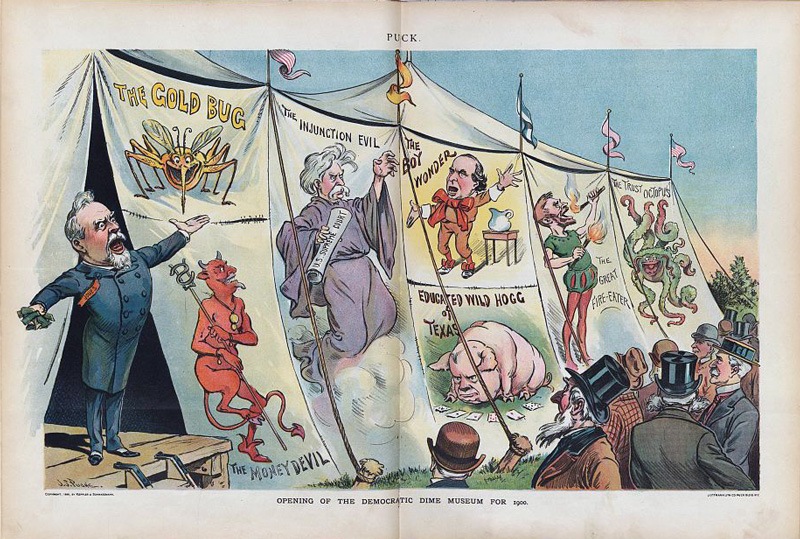
Political cartoon from Puck, showing various political types, including the "fire-eater" (Courtesy Library of Congress)

In politics, as in the circus world, a fire-eater is a performer who will swallow fire to attract a crowd and earn a living.  This aptly describes the tawdry crowd of grand-standing Republicans threatening to shut down the federal government today.

Their behavior resembles nothing so strongly as that of radical pro-slavery men, who, before the Civil War, threatened angrily to secede from the Union whenever the federal government wasn’t going their way.  Antebellum fire-eaters pretended to be great patriots and high-minded constitutionalists while actually serving the retrograde interests of a minority.

So it is with today’s right-wing Republicans, whose aversion to President Obama and health-care reform is so intense as to drive them along a reckless and self-defeating course.  Ted Cruz is, if anything, more self-serving and sophomoric than leading pro-slavery apologists–men such as William Lowndes Yancey of Alabama or Robert Barnwell Rhett of South Carolina–whose parochial defense of slave-holding and states’ rights marred careers as distinguished as any in their day.  In the end, these men could not love the United States more than they loved holding slaves, leading them to sacrifice true patriotism to an ignoble cause.

By now it has dawned on many Americans that those in Congress intent on derailing Obamacare at all costs are more like demagogues than patriots.  In their stubborn attempt to thwart the inclinations of a national majority, stand in the way of progress, and sabotage the federal government, Cruz and his ilk recall the secessionists whose noblest vision was to arouse local populations to follow them.  Intent on justifying their contempt of the federal government with high-toned ideas, the first fire-eaters used every conceivable means they could to oppose the federal government and the will of the majority, ultimately succeeding in persuading their fellow-citizens to withdraw from the Union and take up arms.

So it is with the current Republican spoilers, laboring unceasingly to deprive Americans of access to the new ACA-mandated health-insurance plans.  Don’t they realize that most Americans are tired of extremism, tired of factions intent only on undoing?  Republican fire-eaters would be better off quitting the circus and getting down to the sober, un-sensational business of governing.

Image: A 1900 political cartoon from Puck showing various American political types, including the fire-eater at right, courtesy of the Library of Congress.

Want to tell the fire-eaters what you think of their actions?
FOR A HANDY LIST OF THEIR TELEPHONE NUMBERS, COMPILED BY FELLOW BLOGGER ERIC PRILESON,
CLICK HERE

Once Noble Senate

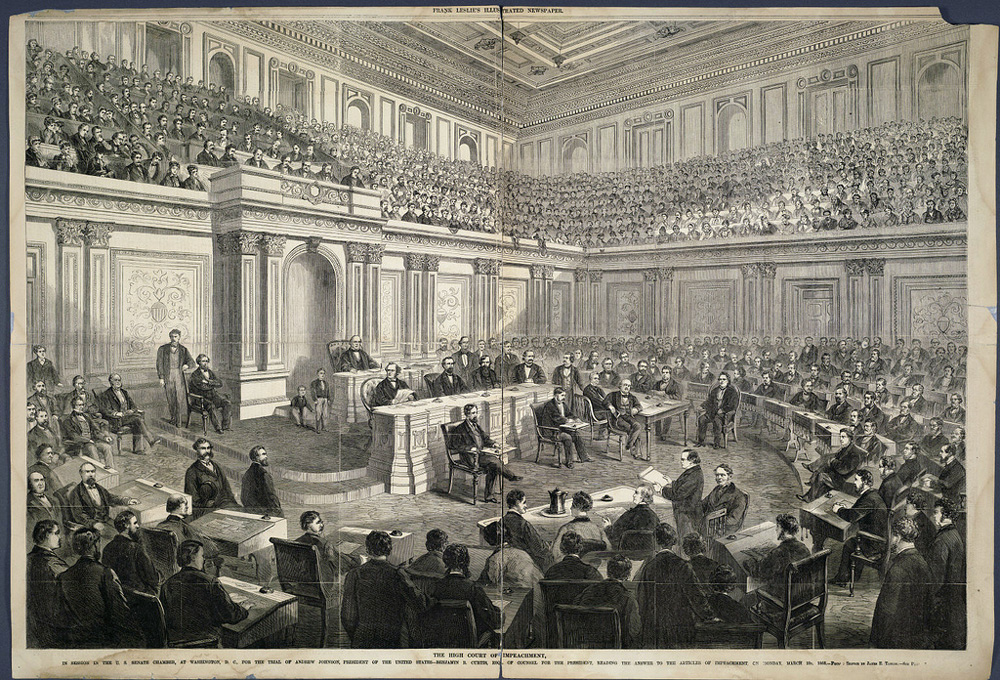
The US senate chamber in 1868 (Courtesy of Cornell University Library via the Commons on Flickr)

I don’t know that what I write here makes me a pundit, but in the wake of the election I have been hit with a strong urge to refrain from punditry—to take a break from it, at least, and let government be.

One of the evils of an excessively long campaign season is that we all develop the habit of opinionating and editorializing.  Our partisan passions, aroused for such a long period, require an effort to quiet, and we forget that there is something larger than the fate of the parties or particular people, namely our collective fate as a nation and economy.  That hangs in the balance now.

The media, even more than our political leaders, bear responsibility for having created a public culture that prizes the work of governing less than politicking.  Competent governing is not praised and celebrated; it is not longed for; it is not revered or nurtured.  No, it is regarded skeptically—poked at and doubted.  Dubious motives are assigned; obstacles exaggerated; worst-case scenarios dreamt up and embroidered.

Would the nation would better or worse off for having a moratorium on loose talk, during which all cable networks, talk shows, and editorial rooms would go dark for a few days?  The talking heads, eager for their fees and salaries, who incessantly press their stale points of view on the rest of us are one of the biggest impediments to redirection and innovation.  They are themselves one of the biggest drags on bipartisanship and governmental resolve.

The hullabaloo surrounding the “fiscal cliff” reminds me that the Senate, in its earliest days, used to meet in private.  That’s right.  From 1789 to 1794, the first senators met privately in chambers in New York and later Philadelphia (Washington DC didn’t exist then) to fulfill their Constitutional duties as they understood them, admitting no spectators, seeking no publicity.  They simply did their work and went away.

This was a perfectly legitimate style of proceeding.  After all, they had been entrusted with large public responsibilities and they knew the nation depended on their behaving in an honorable way.

The senators soon abandoned the custom of meeting in private, however, because they thought that, unless the public could look in on the Senate and begin to understand what it was all about, the body would never develop the authority and prestige that the Founders wanted and expected it to enjoy.   The early Senate was in danger of being eclipsed in importance by the House, which then, as now, was a more unruly and irresponsible body.

The Senate, intended to be the ultimate forum for resolving the nation’s most complex problems, evolved into a highly prestigious and effective body during the long period from the early 1800s until 1986, when the Senate approved live televised coverage of its proceedings.  The reservations that had made senior senators reluctant to embrace such a change were fully vindicated, for the reorientation of the Senate toward this vicarious presence has destroyed the close-knit mutuality that characterized the body, and which rewarded the difficult work of its members with commensurate prestige.

The nation’s chief executive, once the factotum of his party in Congress, has become inflated in importance proportionately.  Today, we look to the president for all things—even for the wisdom that our Founders knew could only be found collectively, in the best minds of the Senate, in its palmiest days.

Image from this source.

A Prisoner of the Bully Pulpit Breaks Free

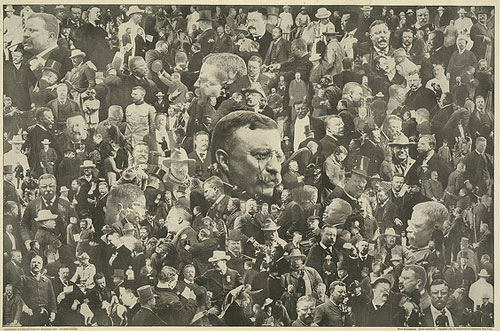
Photomontage of Theodore Roosevelt (Courtesy of Cornell University Library via Flickr Commons)

♦ A HISTORICAL ANALYSIS OF PRESIDENT OBAMA’S ACCEPTANCE SPEECH ♦

Theodore Roosevelt, though a fine president in many ways, left behind one baleful legacy: the idea of the presidency as a ‘bully pulpit,’ by which he meant a superb vantage from which to preach to others about how the nation should be.  When you hear presidential candidates speaking confidently of the miraculous feats that will follow from their being elected, it’s the misleading cadences of a bully-pulpit preacher you’re hearing.

THEODORE ROOSEVELT RESHAPES THE PRESIDENCY

To an extent difficult for us to appreciate today, Roosevelt’s conception of the president as an active visionary was revolutionary, departing in significant ways from the executive role the Constitution laid out.  Our scheme of government assigns the president a few plain duties, which, given the size and scope of the government and its role in the world, constitute a staggering burden.  In addition to serving as the symbolic and ceremonial head of the nation, the president executes the laws, conducts foreign policy, commands the armed forces.  Presidents often function as party leaders, but their constitutional function is essentially one of interdependence, for a president cannot make a law, placing every president in that regard very much at the mercy of Congress.

THE CHANCE TO BECOME A SCINTILLATING STAR

During the first century of the nation’s life, presidents grappled with this limitation in various ways, but Teddy was the first to dare to act as though it didn’t exist.  He was determined to make the president the determining force in all things.  Like Satan—the most powerful angel in Milton’s celestial firmament—, he chafed at playing second fiddle; he longed to be God.  Suiting actions to words, Roosevelt broke the mold, becoming a media-oriented president intent on using his considerable intellect and celebrity to reshape the nation and govern Congress.  Initiative pulsated from the White House.  It was all very thrilling.  Moreover, it kept Roosevelt constantly in the spotlight, which was something he liked.

WHICH BULLY PULPIT PREACHERS PLEASE US MORE

Since then, Roosevelt’s conception of the presidency has become our conception, too.  In what is a sad distortion of the Founders’ vision, we expect the president—a single person—to do the work that Congress should be doing.  This, in turn, leads to a confusion about where responsibility lies.  The American people spend more and more time agonizing over presidential choice, more and more time trying to decide which campaign promises and bold visions please them more.

A PRESIDENT IN THE ROOSEVELTIAN VEIN

It was clear from the start that Barack Obama sought to be an activist president in the Rooseveltian vein.  His entire campaign the first time around was based on the premise that he could “change Washington,” reorganize the business of politics, and define a new political epoch singlehandedly.  For much of his first term, he seemed at odds with the presidential role, chafing at its limitations and behaving as though his ability to extract specific laws from Congress was the sole yardstick later generations would measure him by.

Influencing Congress became his preoccupation.  Whether the issue was health care or the debt ceiling, President Obama spent much of his first term lecturing Congress and the public—chiding and exhorting the nation to embrace his vision for us.  His love of showing his mettle prompted him to become over-involved in fruitless wrangles whose results were properly the responsibility of a weak and recalcitrant Congress.  The “victories” so gained were costly indeed: witness a health-care bill ahead of its time that, regardless of its merits, heightened partisan rancor and left much of the nation resentful and unpersuaded.

THE BULLY PULPIT’S NOT ALL IT’S CRACKED UP TO BE

As recently as January, the president’s bully-pulpit predilections were on full display, when he chose to use the State of the Union address to tell Congress its business rather than report candidly on governmental progress.  Yet, between then and now, Obama has seen the light about an activist presidency, about what a dead-end it is, how it takes a certain set of conditions to achieve.  In the meantime, he has racked up a steady tally of gains, showing himself to be very able in directing foreign affairs and the military.  And he retains the support of a large part of the electorate, who value his honesty and intelligence and see him as persistent, prudent, and humane.

FOUR YEARS OUT

Which brings us to the president’s recent acceptance speech.  Some listeners were disappointed; others found the speech a bit desperate or weak.  We all noticed a difference.  The bully-pulpit fervor we’ve grown so accustomed to was missing.

Instead, the President re-articulated his fundamental role as ‘the people’s sovereign’—the keeper of the people’s interest, uniquely entrusted to embody and articulate their general sentiments and needs.  This emphasis on the president’s traditional role as the national symbol of the people’s rule enabled the President to remind his listeners of their primary role as citizens, in a system in which his power is ‘from the people.’

A JUSTER RECOGNITION OF PRESIDENTIAL DUTY

Lacking the glitz and razzmatazz of his earlier speeches, the president’s speech that night was pitched in a lower key.  Its high points were not remarkable for policy specifics, but for their embrace of a more constitutionally sound notion of the presidency, one focused on executing the will of the people and the astute exercise of presidential duty.  The speech’s most important moment came when Obama said, “I’m not a just candidate for the presidency.  I am the president,” a simple declaration that eloquently accounted for his changed tone.

For a sitting president who a year ago styled himself an underdog, this embrace of experience and authority marked a great leap toward political maturity.  Scaling back the high-flown rhetoric and grand visions of which he has been so fond, the president has raised his ambitions in another way: making a bid for greatness by renouncing a view of office that offers self-gratification now.

Regardless of the continuing deep divisions in Congress, the nation can repose confidence in the seasoned president we have now.  All in all, it was a moment I rejoiced to see: a prisoner of the bully pulpit breaking free.

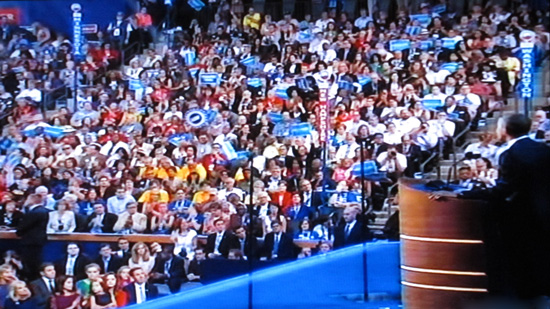
President Obama delivering his acceptance speech before the Democratic National Convention, Sept 6, 2012 (Screen shot courtesy of WTTW Channel 11 Chicago)

Top image: “Five hundred different views of Theodore Roosevelt,” from this source.
Bottom image: Screen capture of PBS Newshour coverage of the Democratic National Convention.