Excitement Is General

Crowds gathered for the presidential inauguration, 1921 (Courtesy of the Library of Congress)

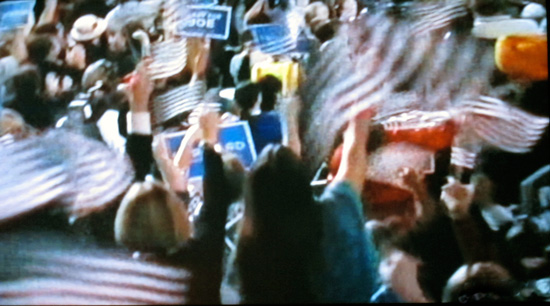
Excitement is general as we head into the final weeks of the long campaign.  With the presidential race in a dead heat, it’s anyone’s guess who the victor will be.  The candidates receive ever closer scrutiny, waves of analysis rolling in over airwaves and Internet incessantly.  Stalwarts gear up for the final push.

The uncertainty of the race is drawing huge audiences to the presidential debates.  Last night’s debate between President Obama and challenger Mitt Romney is estimated to have drawn some 65 million viewers.  According to Bloomberg, the viewership for the debates has been roughly double what it was for the nominating conventions this summer.

The spontaneity of the response to the debates is unprecedented, too.  Last night during the debate, Twitter recorded over 7 million new tweets, with more than 109,000 recorded during a single minute when the candidates were discussing immigration.  Romney’s peculiar remark about ‘binders full of women’ prompted an immediate outpouring and a new hashtag.  Within minutes, satirical takes on his remarks were available for view on this Tumblr page.

Every age has its own political customs.  The ones we’re using today are making history, too.

Image: Crowds gathered for the presidential inauguration in 1921, from this source.
Click image to enlarge.

Biden’s Arrow Hits Home


Joe Biden has mastered the political stump speech.  Watch the whole of his controversial campaign speech in Danville, Virginia, and you’ll see a great piece of Americana: a politician who knows how to work a crowd, seeking votes in a way that’s entertaining and folksy.  Biden’s allusion to slavery was hardly a gaffe; it was a logical and powerful way to get across a larger point about class and how Republicans have treated it for several decades.

We know Biden’s speech was a big success, because he was immediately excoriated as a dunce and a racist.  Blowback dominated the media for several days.  Romney huffily declared that Democrats had hit a new low and tried to get us to believe that Biden was a dangerous man whose message of division somehow “disgraced” the presidency.

Both sides questioned old Joe’s fitness and utility: Could he fill the presidential shoes if necessary?  Shouldn’t Obama drop him in favor of the sure-fire Hillary?  Democrats behaved predictably, too: instead of championing Biden and endorsing his underlying point, they grew sheepish.  If only they learned unity, the race wouldn’t even be close.

Puncturing the politics of avoidance
Yes, Biden hit a nerve, and he did it by puncturing the politics of avoidance that has been gripping the country.  Ever since the Reagan era, when Republicans managed to yoke together with one seamless ideology the economic interests of the elite with the social and moral concerns of people far more ordinary, class has been diminished as a potent source of political energy.  Republicans wish their supporters to believe that the interests of the wealthy and the less-so are the same.  To the extent that Democrats can pry this apart and present an alternative vision of class in American society, they will gain an important advantage over a Republican party that’s badly weakened already.

After all, this election is not “about jobs” or “the economy,” as Republicans say so blandly: it is about economic inequality and the role of the super-wealthy in our economic life.  It is about whether people like Mitt Romney, who has the whole world as his oyster, care about this nation’s economy and its ordinary people.

Romney would like voters to believe that his interests and theirs are just the same: that, if you feed the interests of his class, all will benefit; the interests of all classes will be served.  If that were the case, the recession would be ending, because American elites can write the script of the unfolding story.  They can decisively aid in restoring the nation’s economic health.  Leaders of America’s corporate class already have far more power than the president to see to it that Americans are more fully employed.

A party that’s drifted from its noble beginnings
Biden’s bald reference to slavery may well have pricked the conscience of Republicans who know how far their party has drifted from its noble beginnings.  In Lincoln’s time, Republicans were not only the champions of abolition: they were devoted to egalitarianism and to securing better economic prospects for lower-class whites.  The most radical Republicans advocated for full racial equality, a bracing proposition given the time.  Republicans were the ones who wanted to discuss such forbidden topics as slavery; it was Democrats who were proponents of silence, who wanted all discussion of “the peculiar institution” gagged.

Yet even then there were Republicans, such as Horace Greeley, who would not join the anti-slavery fight because they doubted whether the nation’s growing free-market system held out a sufficient promise of prosperity to American workers—even when those workers were white.  In the meantime, the persistence of slavery in America proved beyond a doubt that powerful elites, if left to their own devices, could not always be counted on to do the right thing.

Perhaps it was all that history that gave Biden’s arrow such a powerful zing.

The Closed-Door Campaign

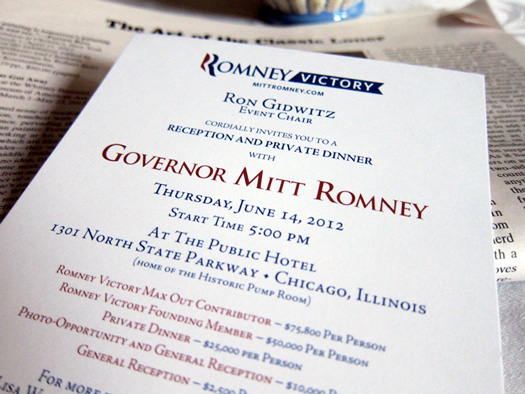
Photograph of an invitation to a Romney fund-raising event (Credit: Susan Barsy)

A piece of high-end junk mail appeared in my P.O. box the other day.  An invitation to an upcoming Romney fundraiser, it is a perfect souvenir of this campaign season.  For just $75,800, I can become a “Romney Victory Max Out Contributor,” and perhaps sit next to someone powerful in the old Pump Room.

Now that the suspense has gone out of the primaries, a superficial calm has fallen over the presidential campaign.  Tune out the perfunctory stump speeches and ramped-up media campaigns, and you will hear the ching-ching! of aggressive fund-raising, as both Romney and the president crisscross the country desperately scrounging up cash, now taken as a proxy for popular support.

Have you been reading about the changing style of presidential fundraising?  Whereas in 2008 Obama made securing small contributions a priority, his style of fund-raising is now virtually indistinguishable from that of Mitt Romney.  Both rely mainly on high-end fundraisers, hosted by celebrities or other ultra-wealthy Americans and typically kept at a distance from the public eye.  “Few Witnesses to Obama, Romney, As They Raise $1.5 Billion,” read a recent Bloomberg headline.

In many ways, this cozy relationship between leading politicians and the wealthy merely mirrors the relationship the two groups have enjoyed historically.  Go back to the Revolutionary Era or the early republic, and you will find that wealthy Americans led the colonies and states, wrote the Constitution, and dominated high office.  All throughout the nineteenth century, the line between public interest and private remained  suspiciously murky.  In fact, that a politician represented his own financial interest and that of his friends was taken more or less for granted; it was rarely viewed as criminal, certainly.

At present, however, the candidates’ attentiveness to wealth smacks of a politics of avoidance that is gripping the country.  For the people, indeed.  The candidates offer platitudes to a populace who are suffering, disillusioned, and angry, but it’s probably more fun to dine with the wealthy and promise to supply the things that they need.  Yet as long as the nation’s leading classes remain locked in this romantic tango, behind closed doors, a true economic recovery is unlikely to occur.

RELATED:
Susan Barsy, Mitt Romney as Exhibit A, Our Polity.
Julie Pace, What $40,000 Gets You in Presidential Fundraising, Yahoo/AP.