American Inquiry

It's High Noon in America

Skip to content
  • Most Recent
  • On Critical Elections
  • Origins
  • Contact
  • Index

Tag Archives: political engagement

That Was Some Speechifying

10 Sep 2012 By Susan Barsy in Candidates and Campaigns Tags: 2012 election, Democrats, nominating conventions, oratory, political customs, political engagement, political parties, TV stills 2 Comments

DNC audience (screen grab from PBS coverage)

The conventions are over, leaving me satisfied that our democratic traditions are alive and kicking.  The parties have some liabilities—the Republicans’ more evident than the Democrats’—but I found it hard not to get excited about the strenuous, face-to-face character of the political action and oratory.
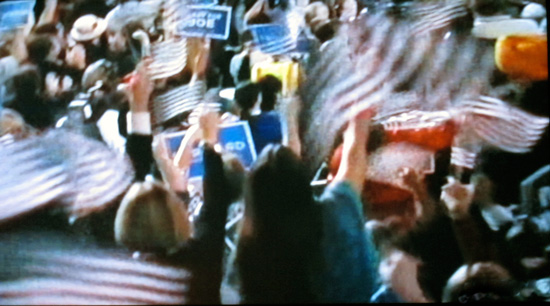
Blur of flags at the Democratic National Convention (screen shot from PBS coverage)

Blatant lies marred Paul Ryan’s otherwise impressive speech, leaving Ann Romney to claim the palm as the Republicans’ best speaker.  She was not just interesting and animated; she did a masterful job of recasting her husband’s character, inadvertently proving that she’s a much better stump-speaker than he.
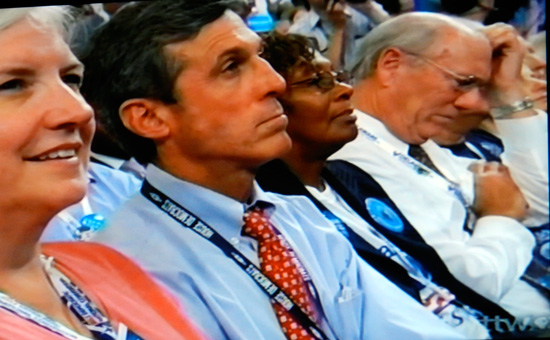
DNC listeners (screen shot from PBS coverage)

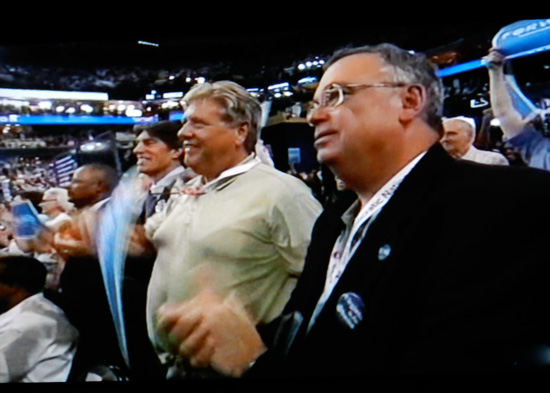
The Democrats not only had better hats and sexier women (let’s admit it: we all notice); their speakers were more thrilling, and their delegates more engaged and visually interesting.  Democratic delegates were a real force in the proceedings, unlike their Republican counterparts, who, when they bothered to fill their seats, spent their time texting or listening warily with folded arms.  I loved the Democratic delegates’ orchestrated use of placards.
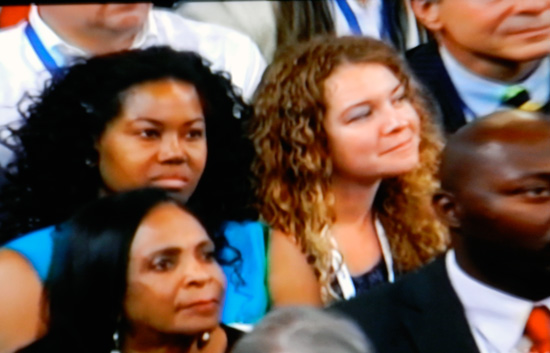
DNC listeners (Screen shot from PBS coverage)

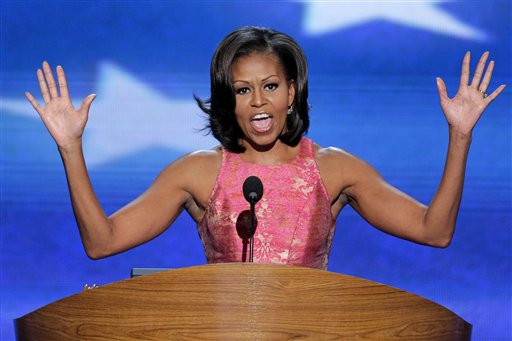
As for the Democratic speakers, they offered resounding proof of the health of their party.  San Antonio mayor Julian Castro, Massachusetts senatorial candidate Elizabeth Warren, First Lady Michelle Obama, and former presidential nominee John Kerry were all standouts, topped only by Bill Clinton, whose ability at once to enlighten and entertain is far superior to anybody’s.
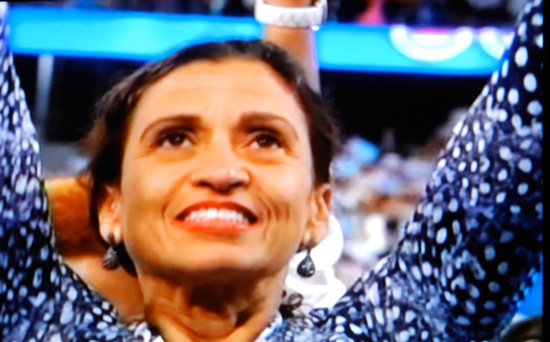
DNC delegate (screen shot from PBS coverage)

Besides the political import of the convention, it was a treat to hear so many fine modern speeches that were by turns colloquial, fiery, affecting, and funny.  Though Democrats still have much work to do ideologically, it was good to see them working successfully as a body to reassert the basic values of fairness and equal opportunity.

Jill Biden at the DNC (screen shot from PBS coverage)

Blur of action at the DNC (screen shot from PBS coverage)

DNC audience (screen shot from PBS coverage)

All images are screenshots from PBS coverage of the Democratic National Convention.

RELATED:
‘How Does Everyone Know When To Hoist Those Signs?’, Bloomberg Businessweek.
  • Share on Facebook (Opens in new window) Facebook
  • Share on X (Opens in new window) X
  • Email a link to a friend (Opens in new window) Email
  • Print (Opens in new window) Print

Worshippers

20 Jul 2012 By Susan Barsy in Political ephemera Tags: 1828 election, Americana, Andrew Jackson, artifacts, campaigning, heroes, homemade, political engagement, US presidents, voting, women 11 Comments

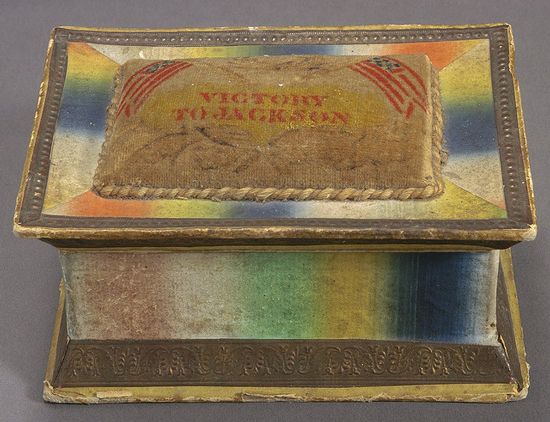
1832 sewing box adorned with the motto "Victory to Jackson" (Courtesy Cornell University Library via Flickr Commons)

Some objects retain their charm long after their usefulness is gone.  This 180-year-old sewing box, bearing the words “Victory to Jackson,” is one of them.  Notwithstanding its worn corners and faded velvet, it is still expressive of a quiet, feminine hope, cherished at a time long before any American woman had the right to vote.

This exclusion did nothing to keep women from following politics and having political opinions anyway.  I would have loved to see this box and its owner back in the day.  Who was the owner of this rainbow-colored trinket, and where had she gotten it?  How had she become a Jackson supporter?  Was she a rural or a city dweller?  And was the box homemade?

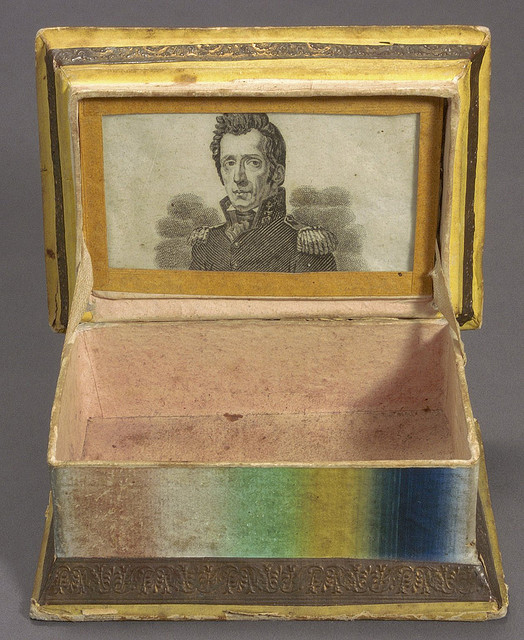
1832 sewing box decorated on the outside with the motto "Victory to Jackson" and with a picture of General Andrew Jackson inside (Courtesy Cornell University Library via Flickr Commons)

The elaborate materials of the box are impressive for 1828 or 32, when it would have been made.  The stamped metal trim, the multi-colored dyed velvet, and the special, machine-stamped, fabric inset on top, with its crisp flags and still brightly emblazoned lettering, suggest that its maker had easy access to goods made in factories.  The way the fancy velvet coordinates so perfectly with the colors of the inset top makes me wonder whether this might have been a mass-produced item.  The box’s interior, though, with its pasted-in picture of Jackson—probably taken from a newspaper or quarterly—, is so shrine-like that it’s tough to avoid concluding that the item was homemade.

Certainly, the creation of this political trinket was painstaking.  Even the cardboard box that supplied its core was heavily worked over.  The result is a powerful item, that, whether placed in a sitting room or used quietly by a hearth, was not just a proud declaration of sentiment but a daring conversation piece.  Who could see such a thing in a woman’s home and not begin talking?

The object of all the fuss was General Andrew Jackson, who in 1828 made a no-holds-barred bid for the presidency.  His campaign was famous for its unprecedented reach, for tapping into popular loyalties to vanquish a retrograde elite.  Once in office, he was a tireless champion of democracy, and, though his years in office were remarkable for their controversy, he easily won election to a second term.

Jackson had true star power.  He was widely celebrated as a military hero.  In an age when Americans relied on newspapers, letters, and word of mouth to get their news, he is said to have been the most widely known figure in the country.  Everyone knew who he was.  If nothing else, they knew he was the hero of the Battle of New Orleans—the man who, in vanquishing British troops in 1815, had given Americans a new reason to be proud of their nationality.

His broad fame engendered curiosity about what he actually looked like, making likenesses of him prized.  Such likenesses could then become objects of adoration, as had clearly been the case with our sewing-box lady.  To obtain the likeness of a leading man wasn’t an easy thing.  It’s not surprising that, when photography came along in the 1840s and 50s, politicians were among the first to have their pictures taken.

We are far removed from the world that once worshipped its heroes.  Politics was no less nasty then than now, but the emphasis on excellency was more thorough-going.  The political realm was the only one promising true celebrity, leading the best men to compete there for popular affection and renown.

At the same time, statesmen’s practical remoteness made it easier for citizens to cherish their own homemade visions of their leaders, endowing them with fantastical virtues and showering them with the love that was once regarded as one of the chief compensations of public service.

The sewing box is part of the Susan H. Douglas Collection of Political Americana
at Cornell University Library, which has made digital images of it publicly available via Flickr Commons.
To see other items in the collection, click here.

RELATED
Parties Made New: Our Critical Elections
Political Affections

  • Share on Facebook (Opens in new window) Facebook
  • Share on X (Opens in new window) X
  • Email a link to a friend (Opens in new window) Email
  • Print (Opens in new window) Print

Like this:

Like Loading…

The Untouched and the Untouchables: Connecting to the Body Politic Today

4 Jul 2012 By Susan Barsy in Candidates and Campaigns Tags: 2012 election, apathy, campaigning, citizenship, efficiency ideal, George Caleb Bingham, networks, political customs, political engagement, political parties, social media, voting 6 Comments

George Caleb Bingham, "The Verdict of the People," St Louis Art Museum, courtesy of Wikimedia Commons.

I FIGURED JUNE was a good time to go on a trip because, honestly, my practical role in politics is over until November.  Like many millions of Americans who are political, I grapple daily with the fact that as a citizen I am increasingly unnecessary.  No matter what my wishes, I must admit that, with the primary election in my state long over, there’s little left for me to do.

This is partly because I live in “a captive state” (and in a heavily Democratic city) that, come November, can be counted on to go a certain way.  If I want to see a negative campaign ad or some old-time campaign-trail mud-slinging, I’ve got to visit Unedited Politics (a fine online repository of contemporary political video, by the way).  It’s sad when watching second-hand commercials is what political involvement comes down to.

Don’t get me wrong: I always volunteer for candidates and give money, too.  My husband and I purchase gobs of campaign buttons to give away, because this basic currency of political attachment no longer circulates as freely as it used to.

Voters still want to be involved as much as ever, but campaigning—which once depended on face-to-face social relationships—has become much more impersonal and scientific.  Yes, we still rely on social networks to some extent, but this reliance is increasingly mediated by the commercial and technological tools campaigns love to use.  Campaigns no longer build social relationships—they just want to use mine.

This, and the fact that only a human can “pull the lever” in a voting booth, are the only things saving me from political extinction.

Otherwise, ordinary citizens are problematic in a political system where cash procures and arranges everything else.  Money comes into political coffers from the checkbooks of large entities and individuals; it goes out to consultants, mass-mailing experts, ad agencies, staffers, and media companies.  It all gets spent trying to connect the untouched and the untouchables: apathetic voters and their potential leaders.

This heavily capitalized and bureaucratic system overlays original democratic rituals that are still practiced, but with greater care, today: stumping, pressing the flesh, baby-kissing, even treating.  The messy, ribald rituals immortalized in works like George Caleb Bingham’s 1852 painting The County Election (below) would horrify us today, but the personal and social pleasures once part of politics were exactly what used to keep voters engaged.

George Caleb Bingham, "The County Election," St Louis Art Museum (courtesy of Wikimedia Commons).

Besides the déclassé (and male-dominated) nature of this scene, it is striking for its openness and  communality.  Candidates today are too worried about inefficiency and terrorism to contemplate taking part in anything so ordinary.  Ironically, the very success of our political model is killing off participatory democracy.  The last time I volunteered to work on a presidential campaign, I was encouraged to use the Internet and work remotely from home—an efficient arrangement that connected everyone but me.

Voters clamor for greater “say,” but power moves farther up the ladder, anyway.  As entire freeways close for the safe passage of official motorcades, and staffers orchestrate campaigns from within closed compounds, the disconnect in our body politic is likely to continue.

Images: George Caleb Bingham’s The Verdict of the People (1854-55, top)
and
The County Election (1852, bottom),
both owned by the St. Louis Art Museum, from this source and this.

RELATED:
Susan Barsy, The Closed-Door Campaign, Our Polity.
Susan Barsy, Political Affections, Our Polity.
Sasha Issenberg, Abolish the Secret Ballot, The Atlantic Monthly.
Walter Kirn, Knowledge of the Future is Messing with the Present, The Altantic Monthly.

  • Share on Facebook (Opens in new window) Facebook
  • Share on X (Opens in new window) X
  • Email a link to a friend (Opens in new window) Email
  • Print (Opens in new window) Print

Lay It on The Fire

2 Apr 2012 By Susan Barsy in Reading & Writing Tags: appreciation, beauty, citizenship, collaboration, decline, political engagement, republicanism, spring 4 Comments

Lincoln Park in spring

Spring is coming to my corner of the city, but I’ve hardly noticed it.  Normally I would go out walking a lot at this time of year, to enjoy all the beautiful plants, the freshness of life, its fragility.  This year I’ve been too preoccupied with my writing, with politics, to savor the season.  I look out the window of the car while my husband is driving me to work, and this is spring: the picture that I take out the window at 50 miles an hour.  At least this I can savor: this picture, showing the exact stages of the new leaf, the exact position of the gulls in the grass, the quality of the light, the fog just lifting off the craggy trees.  Grant looking over it all.  This is my spring.  I’ve taken many photographs from the car this spring.  I cheat sometimes and use the “posterize” setting on my camera to key up the city.  Maybe it’s not such a cheat in a way, because the resulting images correspond to my state of mind, and to my subjective sense of the city, the moment.

Flowering trees appreciated while waiting for the light to change

I love writing this blog, not least because it forces you to consider why you’re bothering.  If you’re going to write a blog, you can’t burn out, you can only burn.  You have to lay your ideas on the fire, even the digressive ones, and after you’ve done that you can see what’s missing.  You can see all kinds of gaps and divisions.  For instance: what’s the connection between the beauty of my life and the political mega-crisis we are living?  What’s the connection between my knowledge of political history and what I as a citizen should be doing?  What’s the connection between all the smart moderates out there and the dismal do-nothingness of many of our “leaders” and the lowest-common-denominator politics they keep offering?  The connections are weak, and they need to be stronger.  Somehow, we need to marshal what is great and precious in ourselves and use it as a lever to create a better politics for our times.

I am conservative in the sense of honoring the great things that have been created in this country.  On my drive to work, I see a great massing of buildings and capital.  I see amazing parks and beautiful architecture, order and great vitality.  The commercial streets are choked with the latest thing, with old mom & pop stores, the thundering arterial El, and every sort of pedestrian and vehicle.  Generations of effort have made this amazingly complex and abundant society that’s ours.  It could be better, but then look at the world news.  We have basics, and a framework for becoming, that other peoples have never had and still dare not dream of.  Who wants to think of it slipping away because we’ve been careless, arrogant, stupid, or lazy?

The Revolutionary generation wanted to establish a republic, but it was, at the same time, a form of government that made them anxious.  They regarded it as a strenuous form of government, one highly dependent on the virtue and judgments of citizens, and they believed that, if the citizens weren’t up to it, the republic would fail.  This was their worry.

Some among us are fond of touting individual enterprise, but everything that I value in our culture is the fruit of civic collaboration.  Almost everything I see on my way to work owes something to an intelligent framework of laws, principles, and customs that we can’t even see.  The many social goods we enjoy—whether it’s freedom of religion, the security of property, or the opportunity to gain an education or borrow money—exist only because generations of citizens willed them into being.  The truth of our system is: we labor politically as a group so that the individual may thrive.  To keep it going, each of us has to find something to give and lay it on the fire.

  • Share on Facebook (Opens in new window) Facebook
  • Share on X (Opens in new window) X
  • Email a link to a friend (Opens in new window) Email
  • Print (Opens in new window) Print

A Decision We’ll All Feel

28 Mar 2012 By Susan Barsy in Affordable Care Act Tags: Affordable Care Act, citizenship, health care, political engagement, protest, US Supreme Court, Washington DC 2 Comments

Today, for a third day, the Supreme Court will continue to hear arguments regarding the constitutionality of the Affordable Care Act.  Crowds pack the courtroom; protesters swirl around outside; and those of us farther away are hearing same-day audio broadcasts of the proceedings, a rarity.  If nothing else, this event shows how knit together we’ve become as a nation.  As a capital, Washington DC used to be mocked as a place out of sight and far from the minds of the people; today it’s at the center of things, a nucleus of discourse and controversy.

The case is a landmark in another way.  There’s a lot of hype about it, and passions are keen on all sides.  Everyone understands something momentous is happening.  Unlike many Supreme Court decisions, which concern distinct subsets of people—union workers, say, or pregnant women, or juveniles in prison—, this one will affect all Americans directly.  Perhaps that’s what gives the proceedings a different feel.  Will we end up with a single integrated health-care system that acknowledges and includes us all, or will we continue with the old balkanized system that denies the fact that we are connected through it already?  Because, one way or another, we do already pay for the care that the uninsured need, and bear the indirect costs of their being ill, if you are inclined to monetize issues that way.

To strike down this complex and undoubtedly imperfect legislation would be undoing change that is happening already; more to the point, it would re-affirm Americans’ separatist tendencies: our determination to go it alone no matter what the costs or consequences.  On the other hand, should the constitutionality of the Affordable Care Act be affirmed, we will find ourselves on a new road together, engaged in a massive and complex experiment whose likely outcomes are truly unknown.

  • Share on Facebook (Opens in new window) Facebook
  • Share on X (Opens in new window) X
  • Email a link to a friend (Opens in new window) Email
  • Print (Opens in new window) Print

Post navigation

« Older posts
Newer posts »

American Inquiry publishes work on history, politics, photography, emotion, and threats to the human species.  It celebrates the promise of the American political tradition while presenting constructive ideas about the dangers facing the United States today.

Read our latest on SubStack: "Every Person In The US Should Have A Legal Status"

American Inquiry will move to a new platform on Squarespace in the coming months. Please watch here for updates on the transition. Thank you.

SUBSCRIBE

It's free and private, and the only way to be sure of receiving every post.

Owned by American Inquiry

SEE YOU NEXT TIME

SUSAN BARSY

the origins page has moved

Click here to view the pages on Slovakian Genealogy.

American Inquiry

Footer menu

  • Most Recent
  • On Critical Elections
  • Origins
  • Contact
  • Index
↑
Loading Comments...
%d